In my last post I mentioned the Iris that I’ve been working on for the Lincolnshire Textile Group exhibition Bountiful Botanicals which will be held in August 2026 in Lincoln Cathedral. Having made numerous leaves, seed pods and flowers in the past using Tyvek I knew this fabric from DuPont would be perfect for the flower project. I think most readers will know of Tyvek fabric but if you don’t it’s made of 100% high density polyethylene (HDPE) fibres. These are randomly laid and compressed through a unique flash-spinning process to form a strong, non woven material that has the properties of paper, film, and fabric. It can be painted, stitched and heat distressed to create wonderful textures and exciting structures.
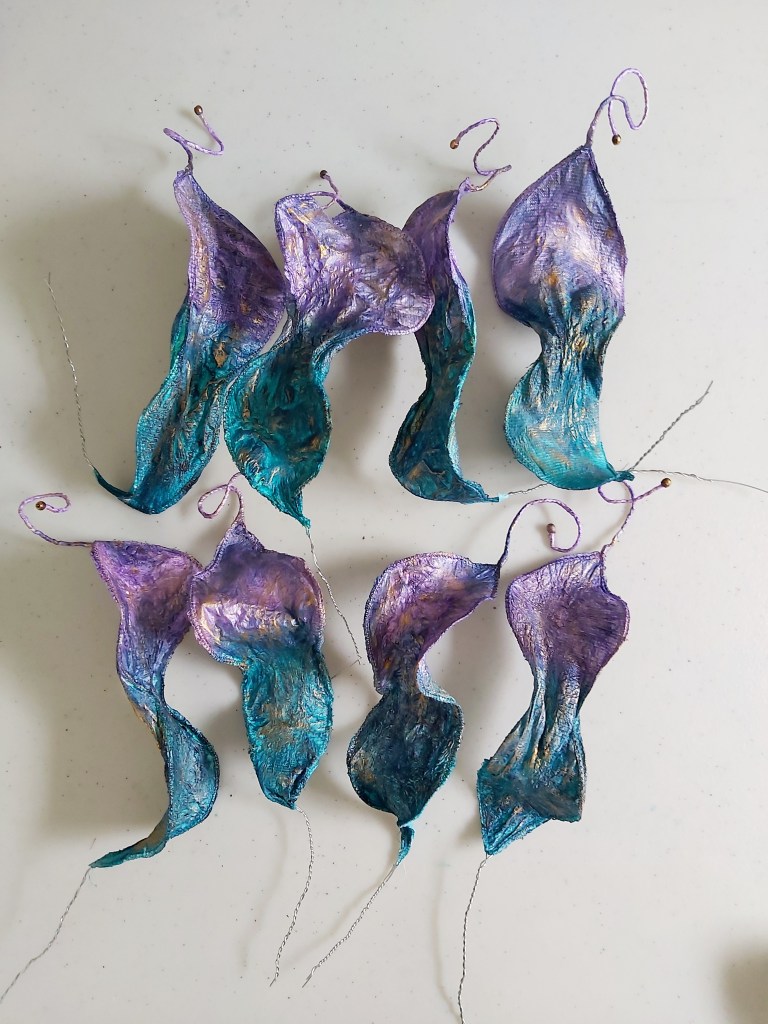
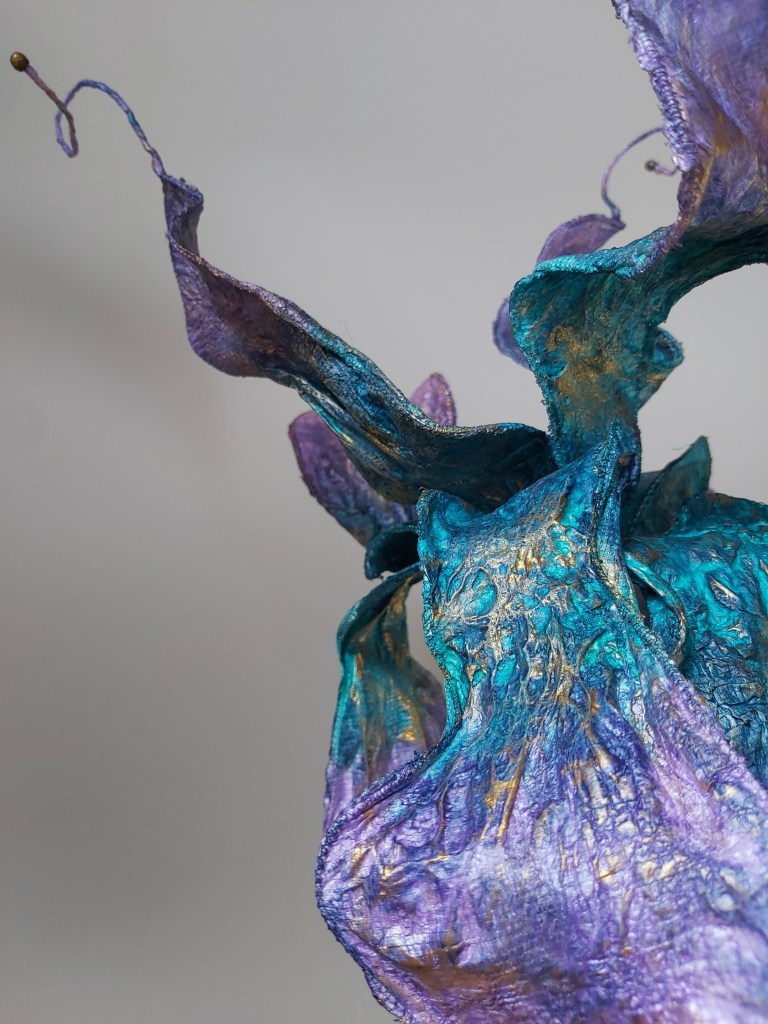
The idea was to create a single, tall slim flower with four leaves. I began by creating the individual petals, four larger ones to hand down and four slightly smaller ones to stand upright. I decided to make this a stylised Iris and added a twirly flourish at the end of each petal, finished off with a gold painted wooden bead.
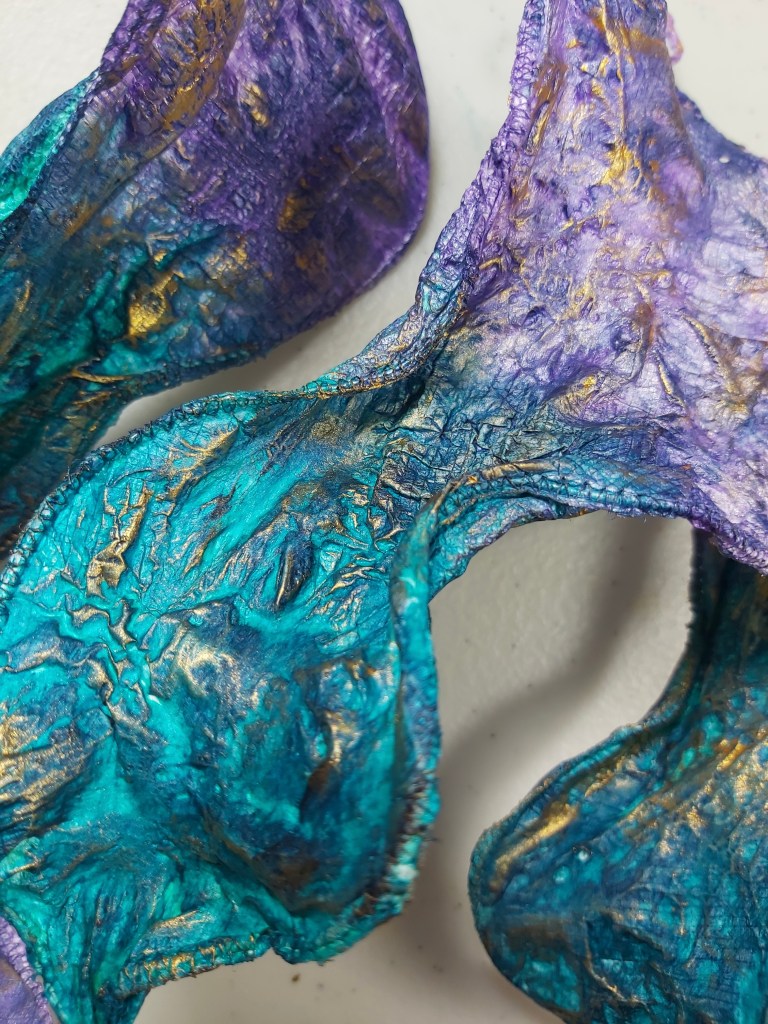
Apart from the B&Q wire for the armatures all the other materials used in this project have been recycled or repurposed including the recycled Tyvek which I now buy in preference to the new, non recycled version. It isn’t as substantial as the original but perfectly good enough for creating petals, leaves, etc. and I love the effects I can get when it’s distressed and painted with metallic acrylics. Although it isn’t yet widely recycled there are specialist centres that are doing this which is good to know.
The stem of the flower is a repurposed garden cane and for the base I found the perfect shaped glass vase in my local charity shop. Originally I was going to felt a “bulb” as a base but I’m glad I went with the vase as it not only provides the stability needed for the display but it also gave me the ideal form around which I could wrap the string, plus it emphasise the verticality of the flower making it appear even taller. I was intending to dye the string but after offering up a few different coloured papers to audition the colours I came to the conclusion that it works better left natural as it gives more focus to the flower itself.
The photo of my flower in situ shows where the choice of colour came from. It stands 112cm tall and the flower head is approx 26cm wide.
If you use Tyvek fabric in your projects and want to try the recycled version it’s available on eBay UK from Spenic-recycling.
As I sit down to begin this post the sky has darkened and the rain (fingers crossed) is about to fall, heaven knows we need it, but what a fabulous summer it’s been so far here in sunny Lincolnshire! I tend to not do too much in the way of creative stuff through July and August as there are too many distractions and this year the intense heat has made me feel very lazy so lots of time spent relaxing, reading and watching creative videos. Consequently I’ve now got a table full of projects I need to finish and a head full of others I want to start.
A couple of projects I did do this summer are two wet felted vessels. The first one, inspired by a shrivelled seed pod, was made at the İFA Region 8’s Summer School in Arnesby near Leicester. Our region encompasses several counties and is so spread out we struggle to get our İFA members to attend. On the other hand we have a regular group of creative ‘non members’ in the locality who are more than welcome to come along to our events, and thankfully they do! It was a busy and fun two days…..
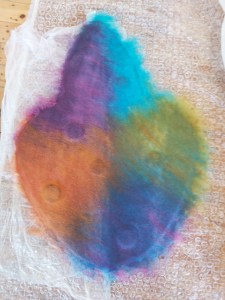
My seed pod began life as five leaf book resist measuring 27cm x 36cm and various colours of Merino and Corriedale fibres. After removing the resist and fulling the felt I pushed and pulled the pod and attached strong clips to create the shape I wanted. I didn’t want a visible hole so the one I cut was so tiny so meant the resist ended up being pulled to pieces in order to get it out! Now it’s finished I feel like it needs a bit of something adding so I’m wondering about embroidering circles in a dull gold thread?
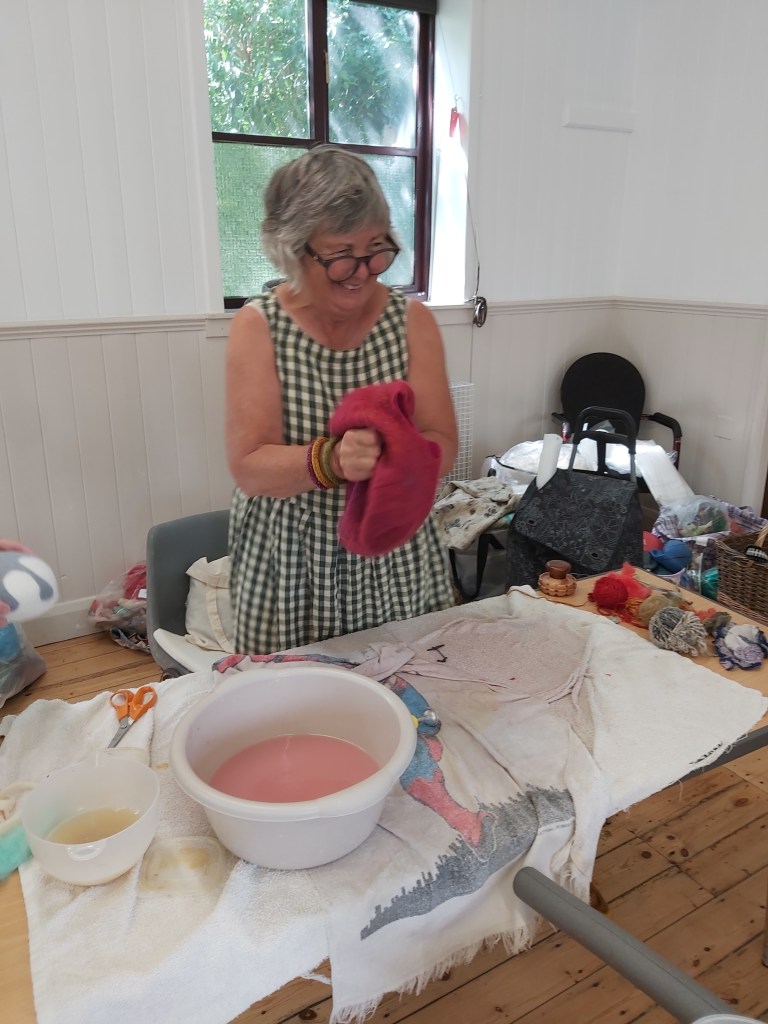
The second vessel was started last Friday when I was working at the Usher Gallery in Lincoln. I’d seen a post somewhere mentioning they were having their second Artist Studio Day and inviting local artists to apply. If successful it meant I would get the use of a table in their ground floor workspace and get to spend the day with four other artists. It sounded like a great opportunity and I’m so glad I applied! Only four artists turned up on the day and unfortunately one of those had to leave early. My other two companions were both painters and it was nice to get to know a bit about them and watch them work. We had a few members of the public come in to see what we were doing but for most of the time it was very quiet which allowed us to focus on our projects.
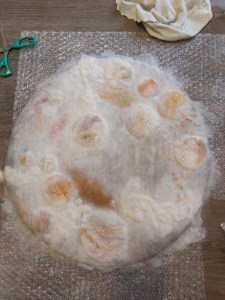
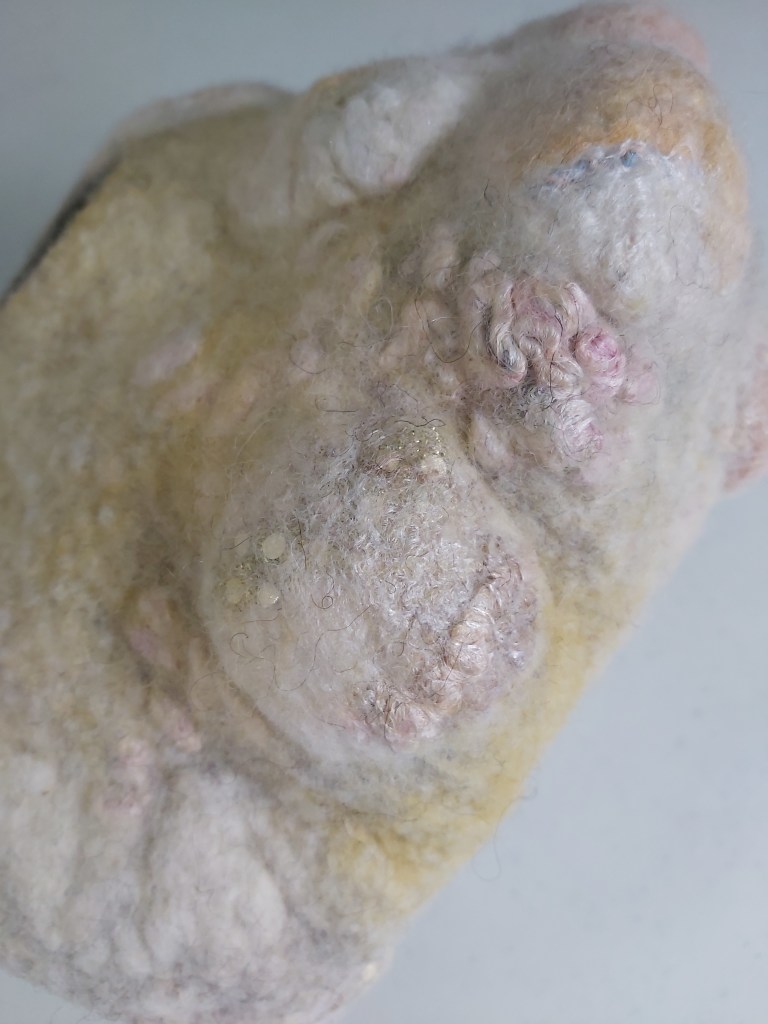
The day before I went I made a textured prefelt using threads, silks, fabrics, etc which I could cut up to create the undulating surface decoration. It was necessary to do this beforehand as I knew my vessel was unlikely to be finished on the day but would need to be at a stable stage in order to be able to fold it to carry back to the car. I got the obvious comments from one or two folk of how my work “looked like a pizza”. The following day after removing the resist and fulling it my 41cm dia pizza had become an 18cm x 24cm 3D vessel weighing 120gms. I’m loving the textures and colours it has!
One of the Summer pieces on my table which I’ve yet to finish is an Iris which I started at the end of July. This is going to be for the Lincolnshire Textile Groups Bountiful Botanicals competition taking place in October. I’m creating it from hand painted Tyvek fabric and wire and the flower will be approximately 30cm dia by 115cm tall. I’ve just got the leaves to do now and then I’ve got the perfect spot for it in my lounge when it’s finished. I don’t want to reveal too much before the competition so this is a sneak preview for now…..
Another work in progress on my table right now is this insect brooch, at approx 14cm long I’ve definitely developed a thing for hand made oversized textile brooches! I’ve just got the legs and antennae to finish, more colour to add and the pin to attach.
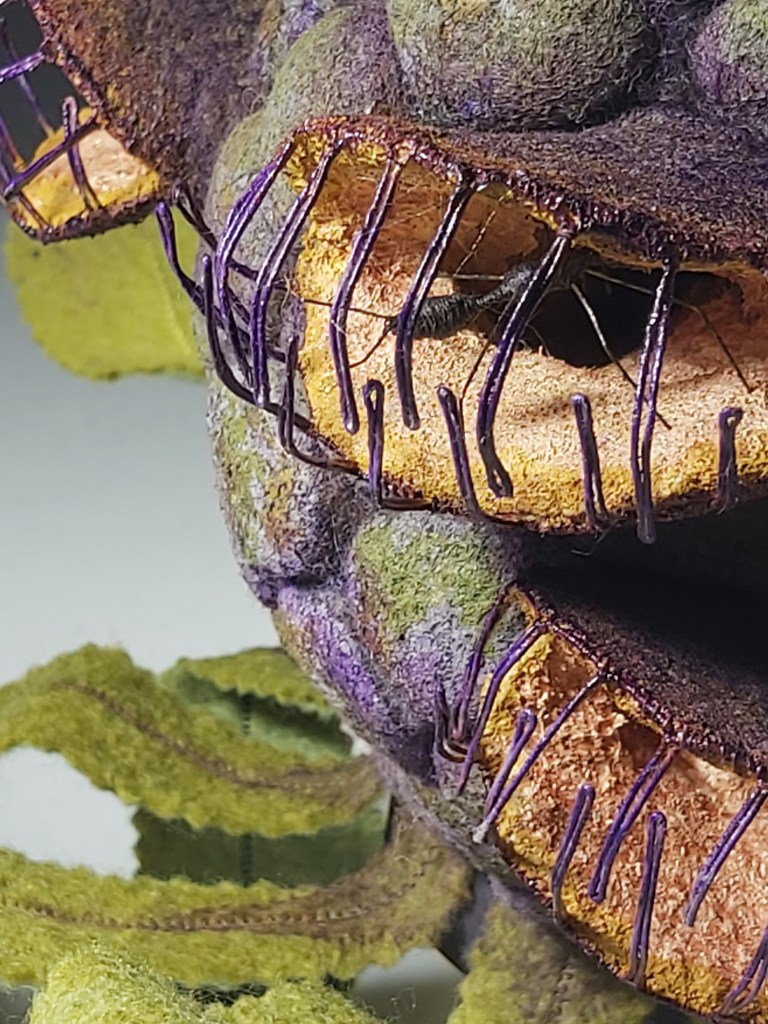
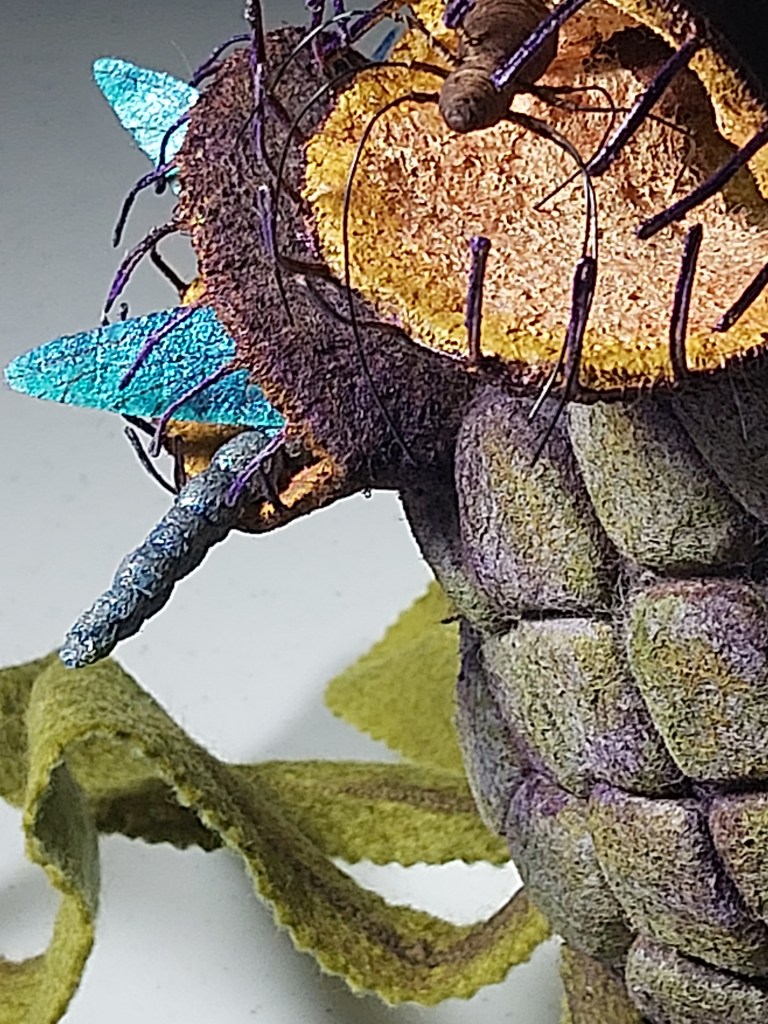
My final work in progress is a mixed media project and something else I’m keeping under wraps until October as it’s also for the Lincolnshire Textile Group. Depending on how it turns out, it might replace the Iris as my competition piece. This started life as an oversized wet felted Banksia Nut which I made last year. I’ve never been happy with it but a few months ago I had the idea of giving it a new lease of life with a new identity. I’ve still got lots to do to it yet. It’s by far the strangest thing I’ve ever made and it won’t be for everyone, let’s just say it’s a hybrid of Banksia meets Venus Fly Trap and yes numerous insects will appear to be harmed in the making of this piece! I can’t wait to reveal it!
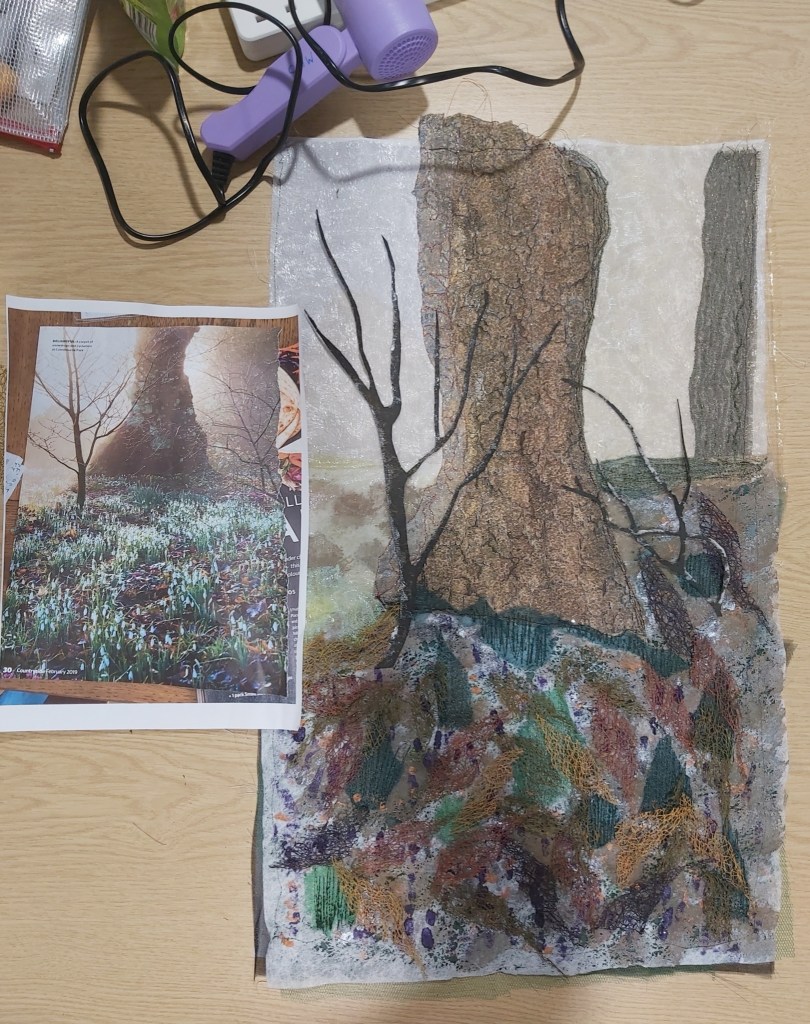
Two weeks ago I was at the Old Barn Hotel, Grantham as guest tutor for the Lincolnshire Textiles Autumn School. The group had invited me to teach my Tall Trees mixed media workshop for fifteen students.
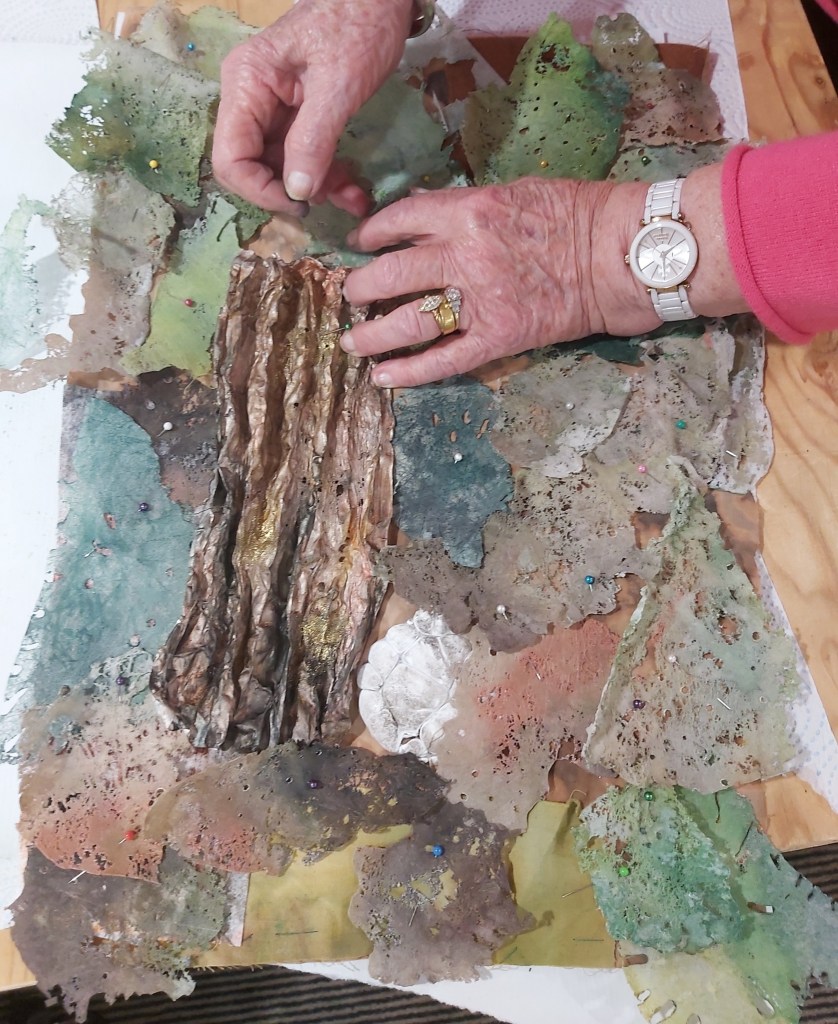
Our class began on the Friday evening after checking in and enjoying a delicious three course meal. The ladies had been asked to bring a photo, sketch or idea for the piece of work they would be making based on a tree/forest theme. I talked through the various materials I like to work with including Lutradur, Tyvek, wallpaper, organza and interfacing. The group were shown examples of how I’ve used these materials in my work and also how previous students have interpreted this workshop.
During the course of the evening ideas were explored, designs drawn up and our base fabrics painted.
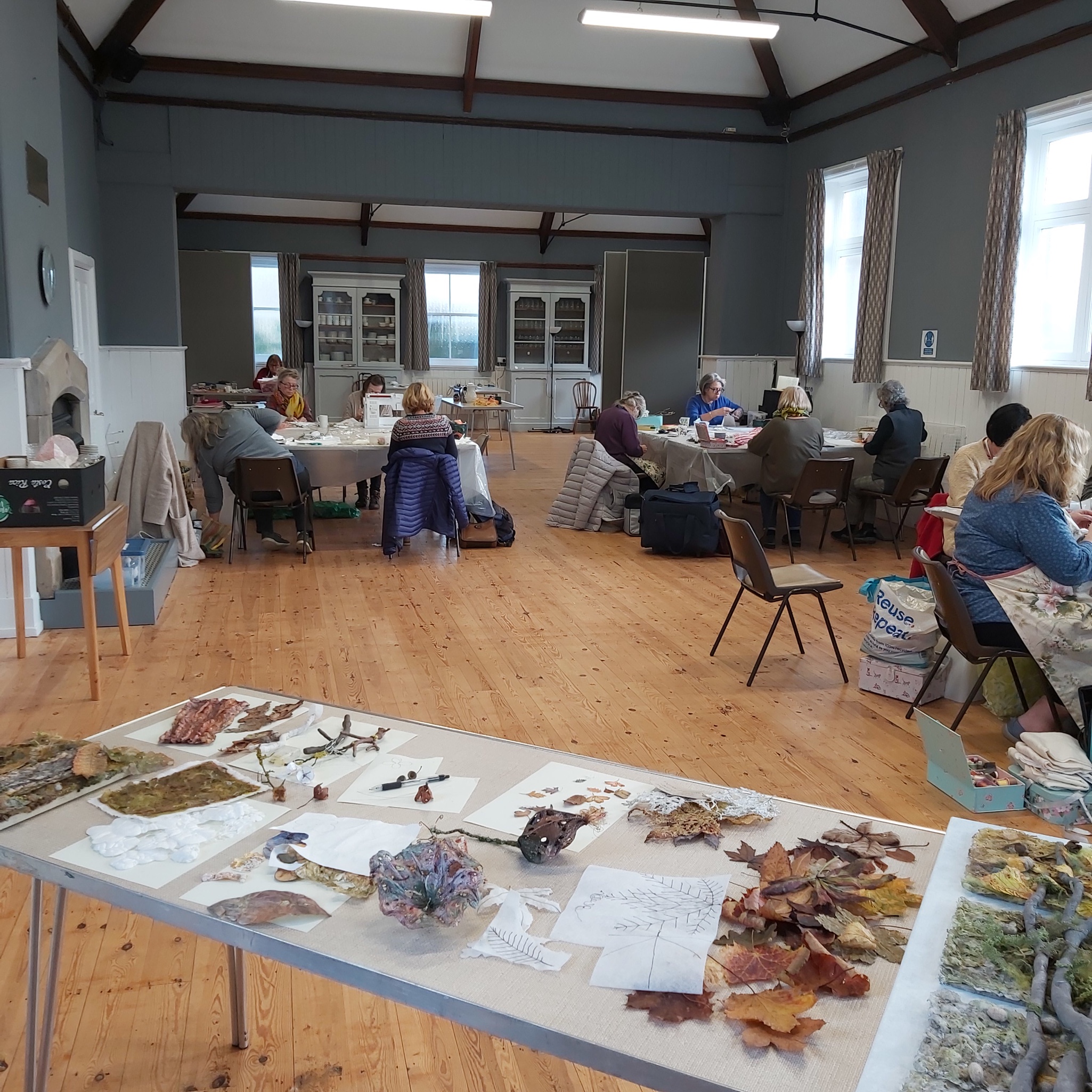
The next morning, as soon as breakfast was over, the group were back to work— painting, auditioning different fabrics and papers, machine and hand stitching and burning. I had a terrific group of highly motivated ladies to work with and it was wonderful how they embraced using materials and methods they wouldn’t normally have used. Some of the more traditional members of the group admitted to feeling a little out of their comfort zone at the start but a bit of gentle coaxing and encouragement “to play” seemed to do the job and very soon all appeared to be having fun!
The group coordinator, Janet Taylor, did a great job of organising the weekend and was very kind when she said “Karen did a wonderful job of motivating everyone and worked hard all weekend. We learned so much, and the group was supportive and helpful throughout. It was such a treat to focus entirely on stitching and creativity, without the usual distractions. The weekend was intense but immensely rewarding, made even better by the company of friendly, like- minded people.”
The weekend flew by and although there was still work to done when these photos were taken you can see how good the pieces are looking! The group has its next meeting on Saturday and I’m looking forward to seeing many of these finished.
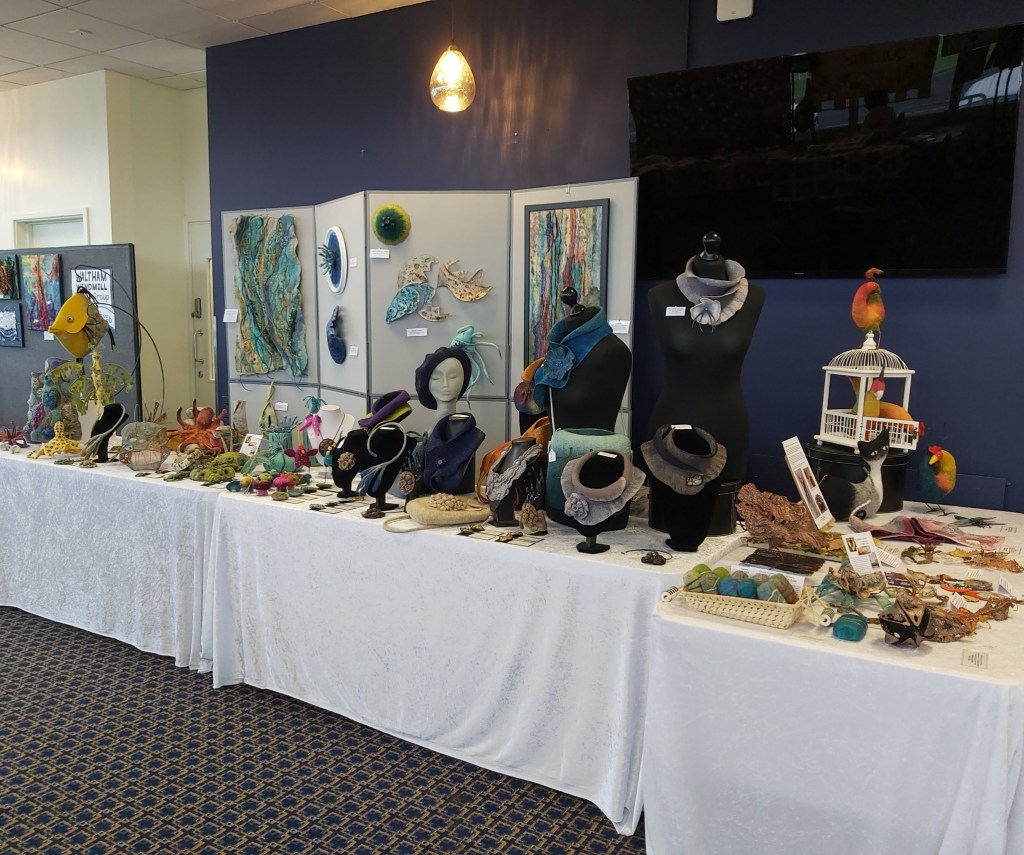
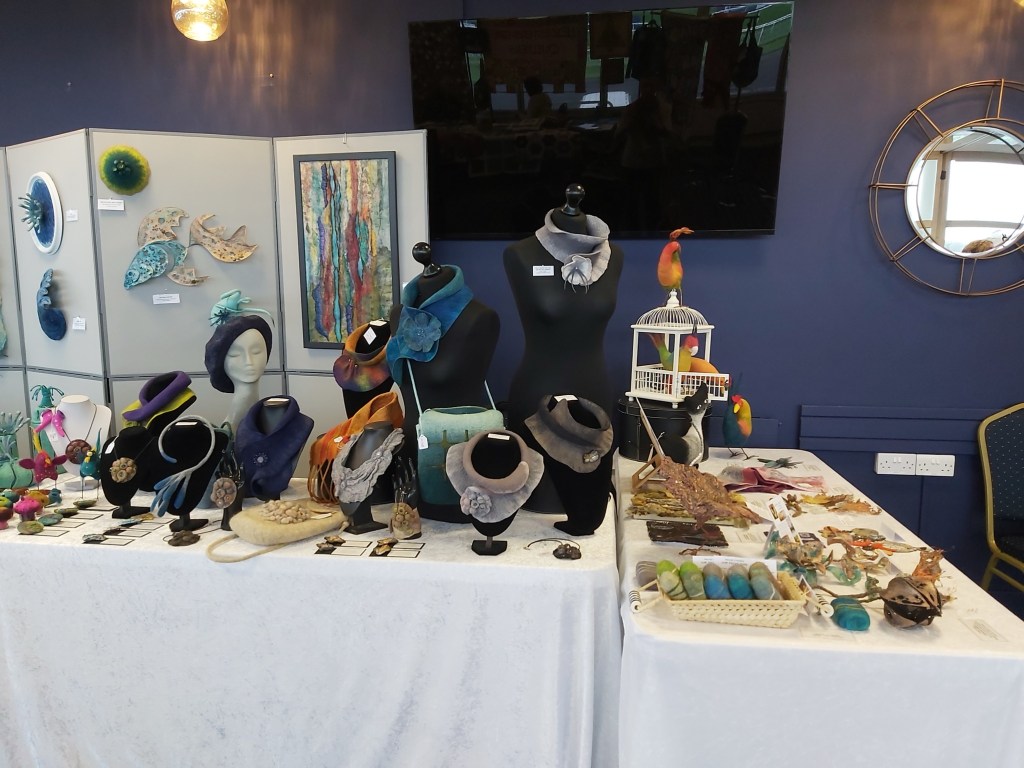
Another recent event was the 2024 Big Textile Show at Leicester Racecourse last weekend. The BTS is always a great show and this year was no exception.
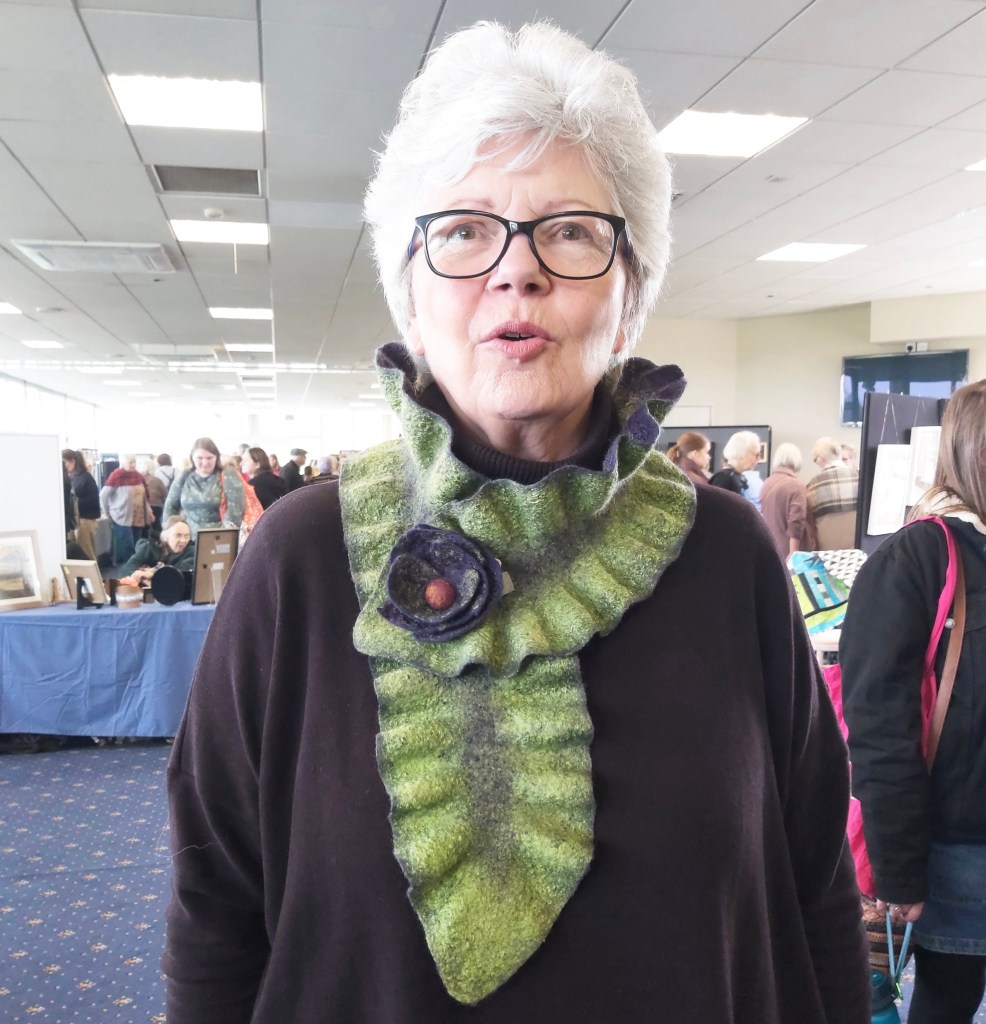
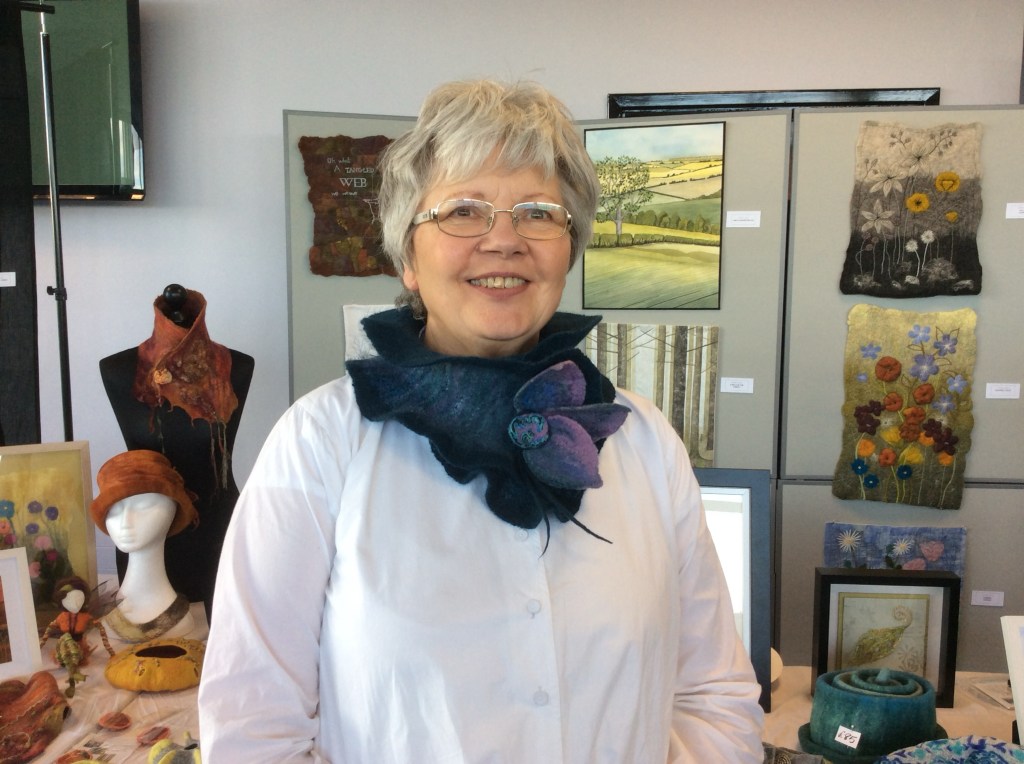
My first customer was the lovely Kate from the Lutterworth Stitchers who purchased my multicoloured Collar. Kates a regular visitor to my stall and looks terrific in whatever she chooses to wear as you can see by these images from previous years!
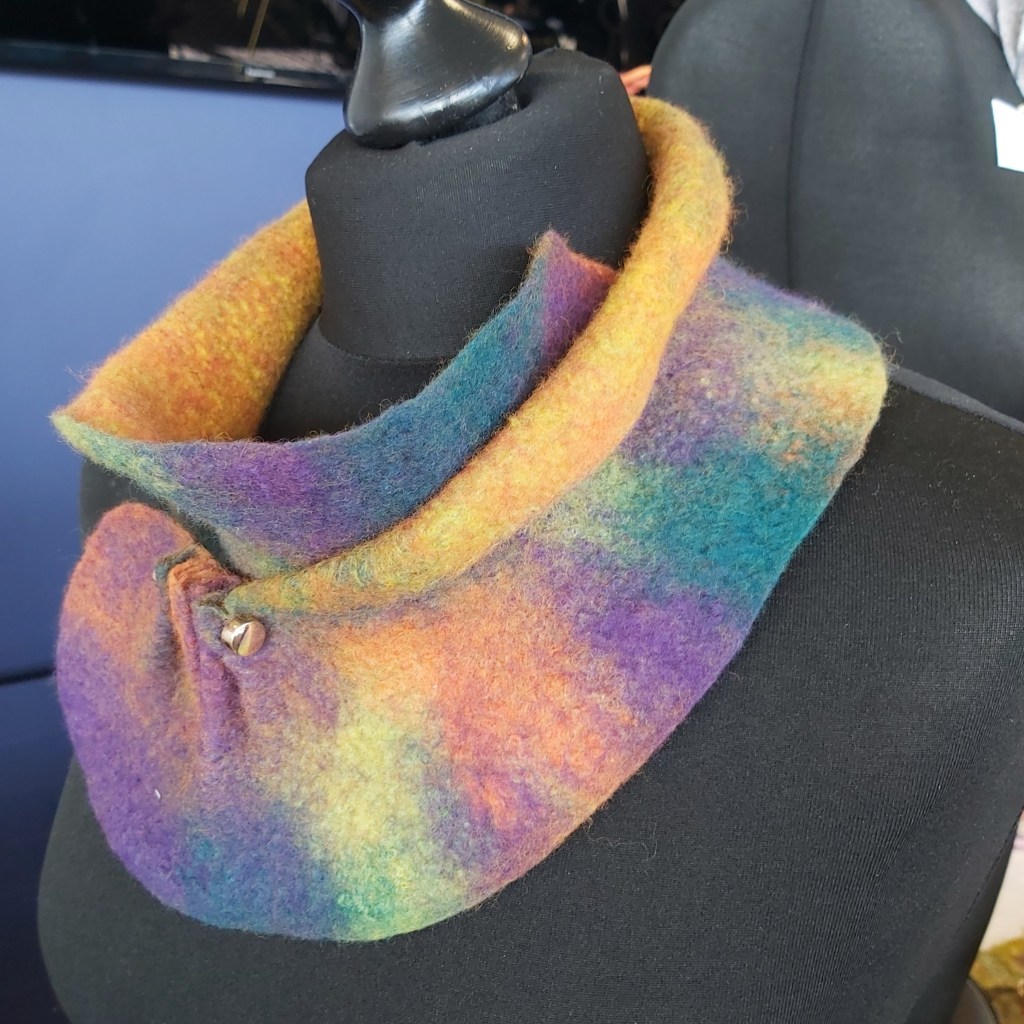
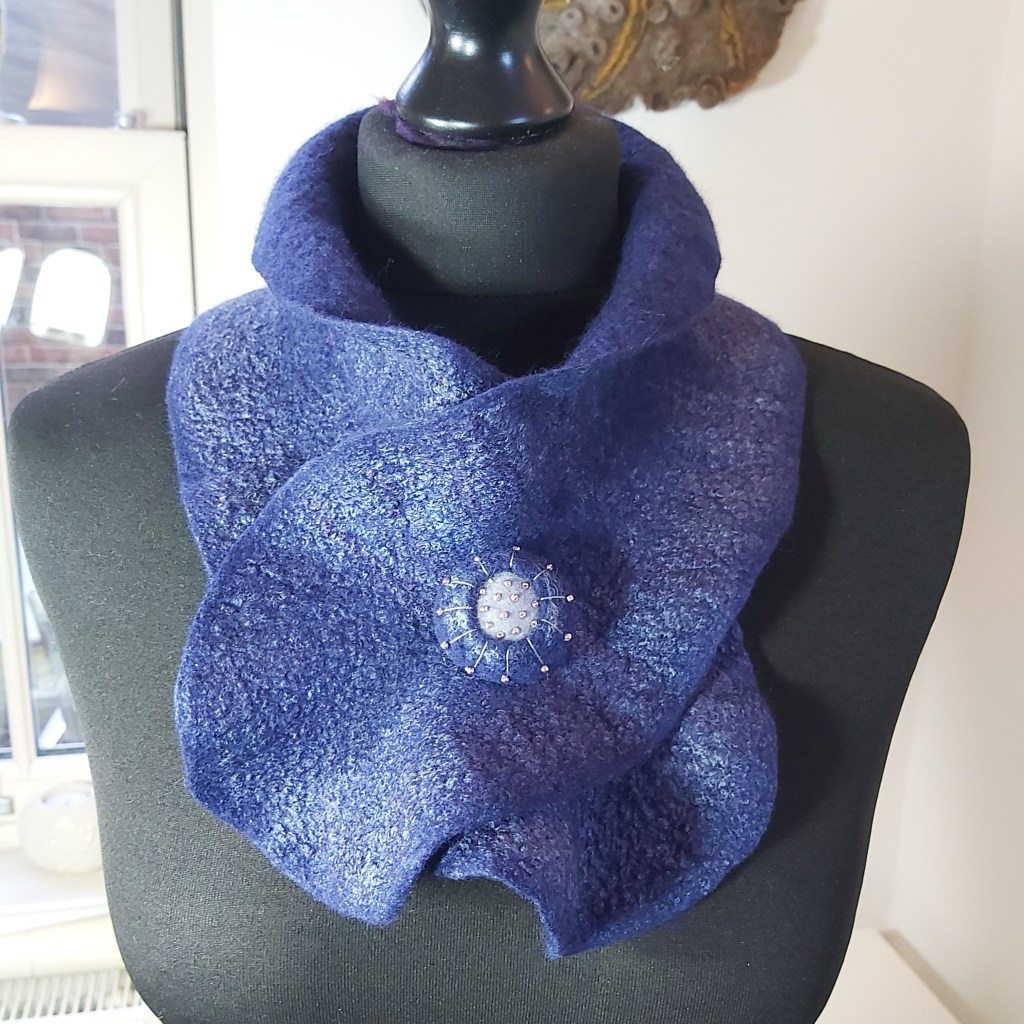
I took a few other new Collars with me including these two in blue and one in dark grey/neutral tones.
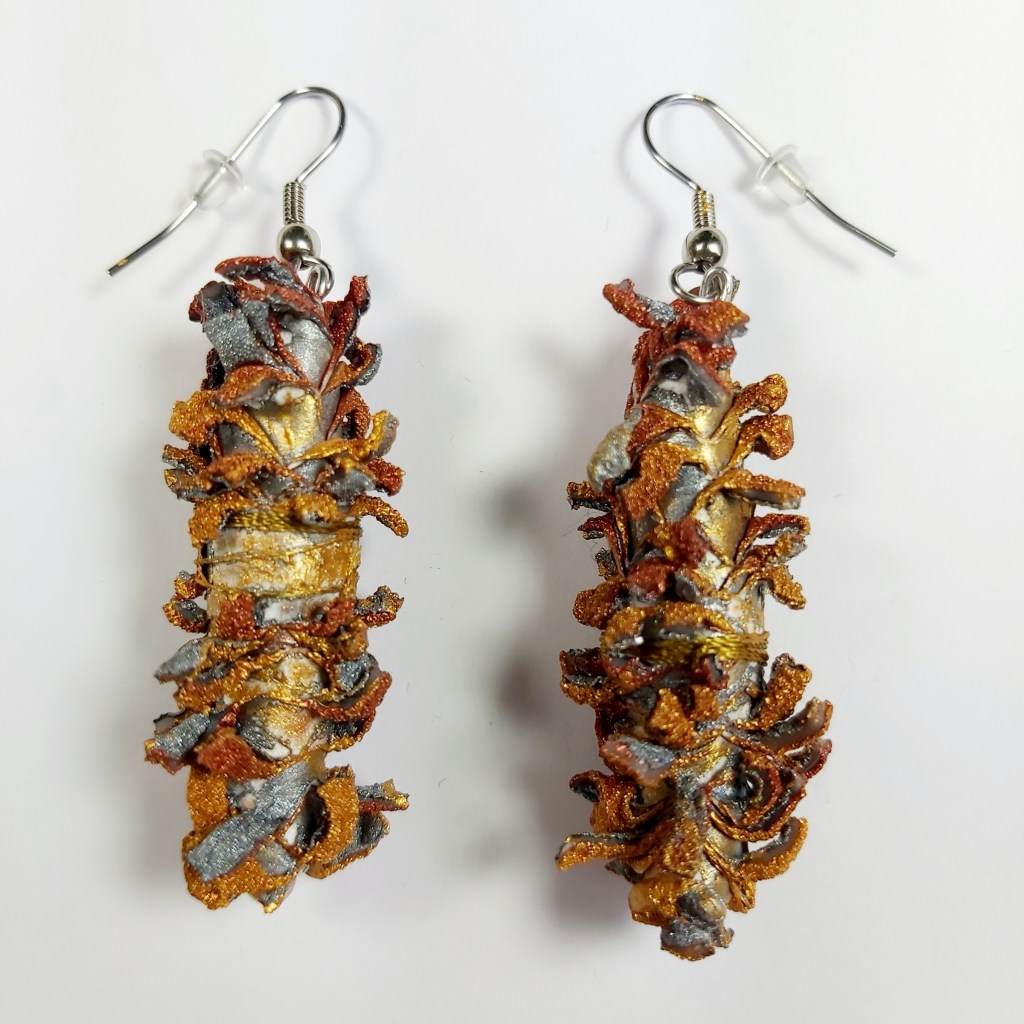
My latest distraction is Tyvek Earrings! A few weeks ago I ran a Tyvek workshop for the Louth Textile group and created a pair of earrings as one of my workshop samples. They proved popular with the group so I made several more pairs for the show. Unfortunately I forgot to photograph them all before the opening but these are what came home with me and are now in my SHOP. I’ve never been a fan of smooth Tyvek beads but I love them with the added textures. It’s quite a challenge making these and absolutely impossible to get an exact match but I quite like that as it adds to their uniqueness!
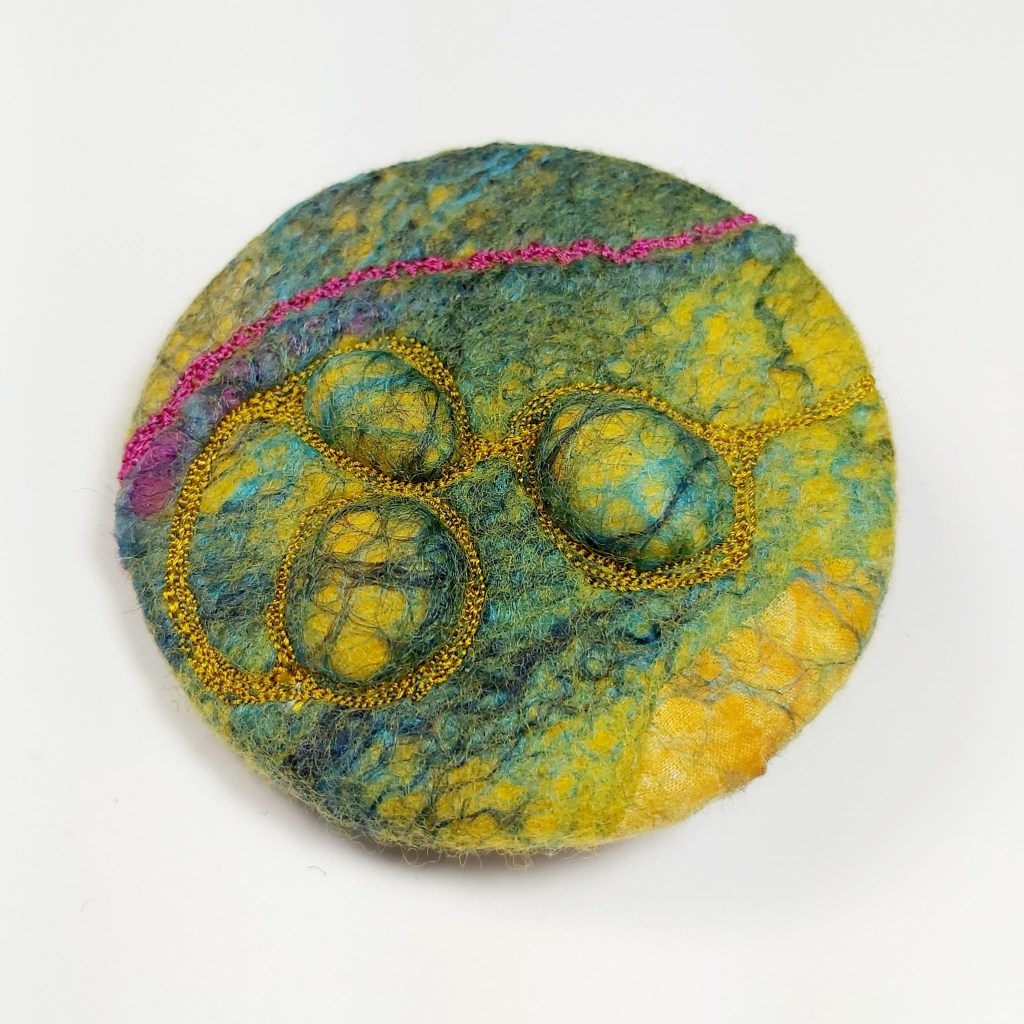
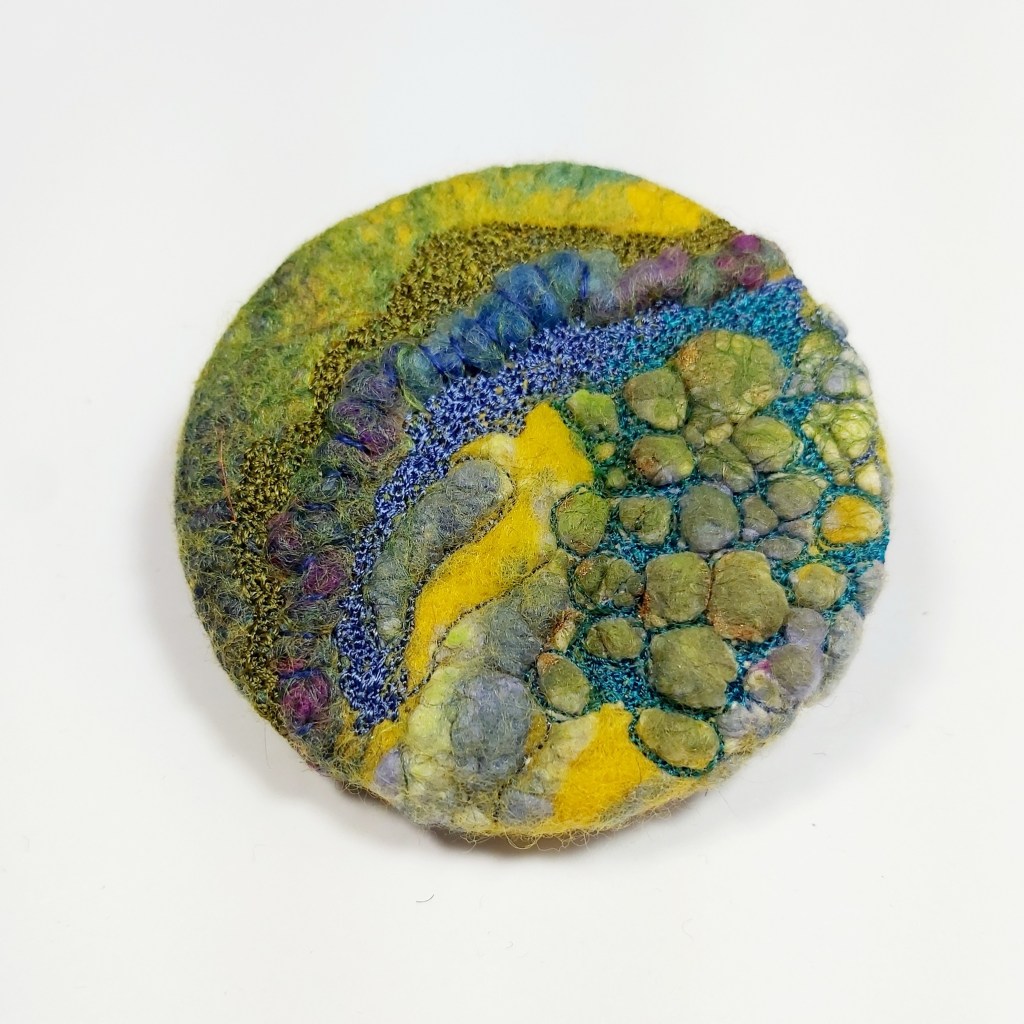
I also made a new batch of gold and silver Tyvek Brooches. I like to mix textures and so these often feature on my felted scarves and collars. These three came home with me so are also in my SHOP along with some new wet felted Brooches.
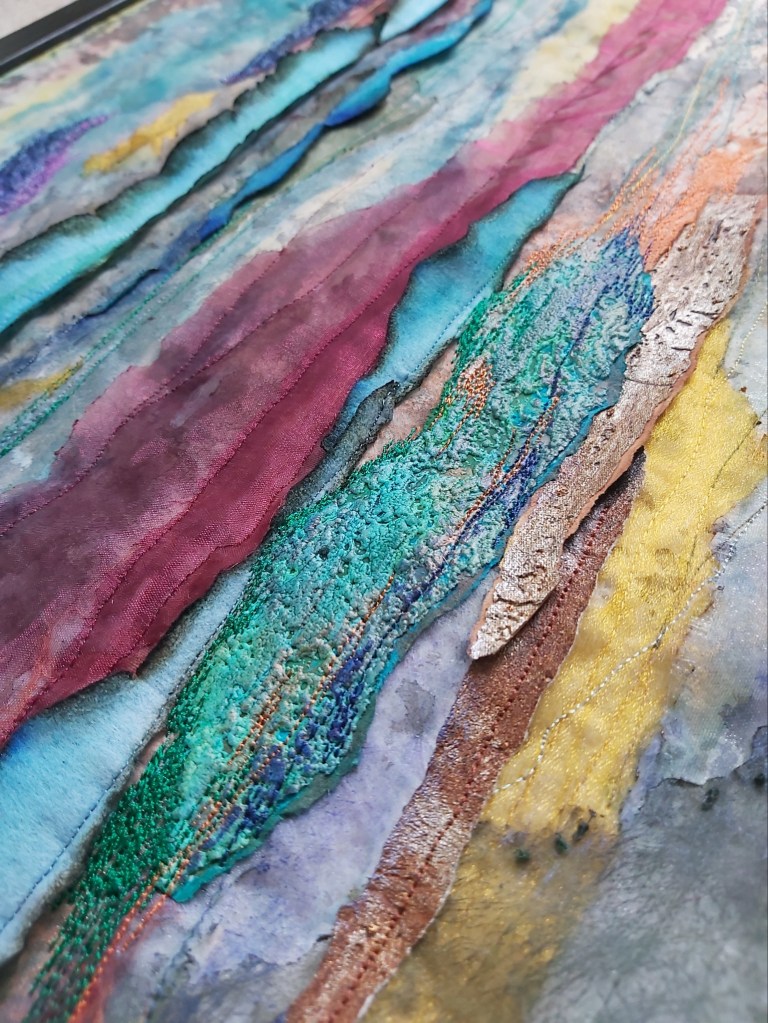
A few days before the show I started to rework a piece I’ve had hanging in my hallway for several years. It’s been hanging on display behind glass, I don’t know why I originally did that as I’ve always preferred to see textile pieces unglazed. Anyway I recently removed the glass which instantly improved the look but then decided to give it a revamp with added textures, more FM stitch and stronger colours. I’m thinking peeling paint on rusty metal and I’m liking where it’s going but it’s not finished yet so I had it displayed on my stand as “work in progress”!
I’ve detailed a few more events that have happened over the past few months over on the Felting and Fibre Studio which can be found here.
With only three more workshops before Christmas things are starting to quieten down so time to think about new projects and ideas for 2025.
In a previous post I showed a wire work Angler Fish made using galvanised wire, aluminium wire, beading wire and sinamay, for Waltham Textiles forthcoming exhibition. My original plan had been to cover the wire frame with painted Tyvek fabric before distressing with a heat tool….somehow I got carried away with making the framework and didn’t get to add the Tyvek fabric at the point I’d intended and the fish was put to one side looking like this…..
Feeling this project wasn’t really finished, last week I decided to bite the bullet and go back to my original idea of adding the Tyvek fabric, although at this stage it was going to be particularly fiddly! Now I can call it done and I’m really glad I took the time to do it, the result is far closer to how I originally envisaged my fish looking.
Wire work, Tyvek fabric and Sinnemay
Painted with Dylon fabric paint and acrylic ink she stands approx 31cm tall x 62cm long x 36cm wide.
There are over 300 species of anglerfish living at various ocean depths. All anglerfish are carnivorous and therefore adapted for the capture of prey. Deep-sea species have large heads that bear enormous, crescent-shaped mouths full of long, fang-like teeth angled inward for efficient prey-grabbing. Most adult females of the suborder Ceratioidei have a luminescent organ called the esca at the tip of a modified dorsal ray (the illicium or fishing rod). This organ serves the purpose of luring prey in dark, deep-sea environments, but also serves to call males’ attention to the females to facilitate mating. Who knows what this girls gone fishing for!
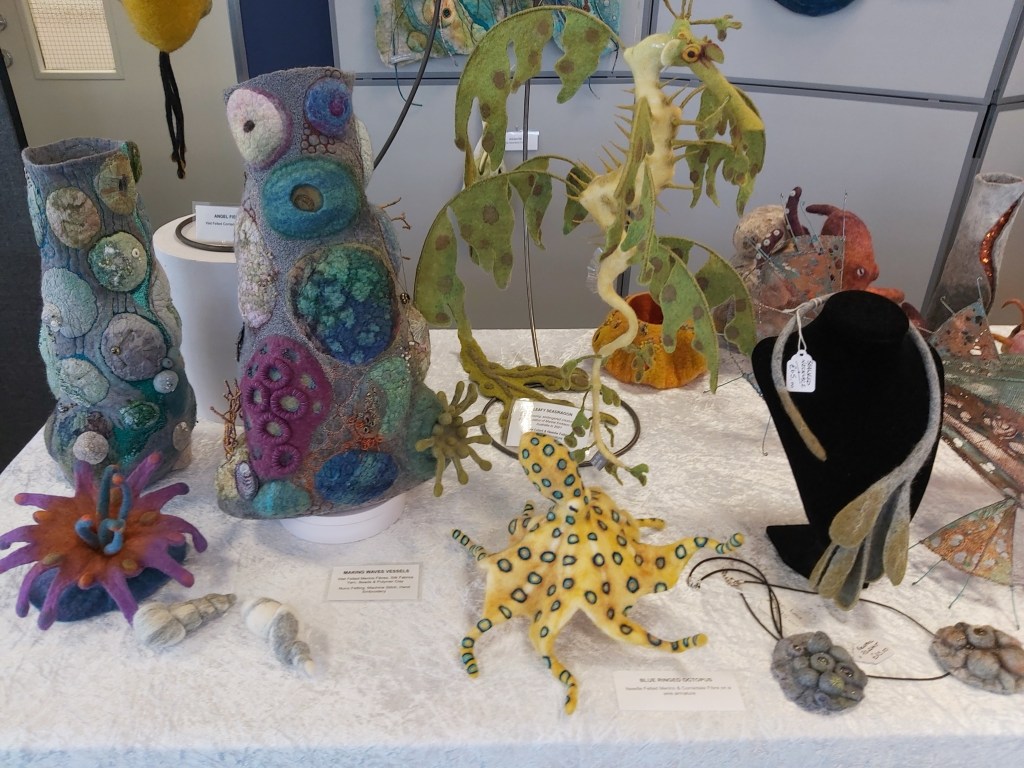
The Waltham Windmill textile group, of which I’m a member, have a theme which runs for two years culminating in an exhibition of work. The current theme is Making Waves and the exhibition for this one will be held sometime in the first half of 2024.
Within the groups theme we have free rein to make whatever we want plus we’ve agreed a number of specific items we will each make. One of the items is a jelly fish. Having done a bit of research into the many and varied species of jelly fish I came across the spotted Blue Jellyfish which is native to UK waters. My first thought was to create a “wet look” using Merino fibre covered with lots of viscose which would create a sheen and then I would free motion stitch the spots. That was quickly replaced with the idea of making my jellyfish from sheer fabrics…..I seem to have accumulated lots of sheers and only ever use tiny amounts so this would be a perfect opportunity to use up some of my stash. After rummaging through a huge sack of fabrics, almost losing hope of ever finding the colour I needed, I came across a small piece of blue and another of turquoise, just enough to do the job…..so much for stash busting!!
Blue Jellyfish (Cyanea lamarkii), feeding on small plankton, England – source www.wildlifetrusts.org
The remnants of fabric, and the size of my embroidery hoop, determined the size of my jelly fish. I’d got some of the wash away stabiliser left over from a project I did a few years ago so that would be useful for stiffening and shaping the jelly fish.
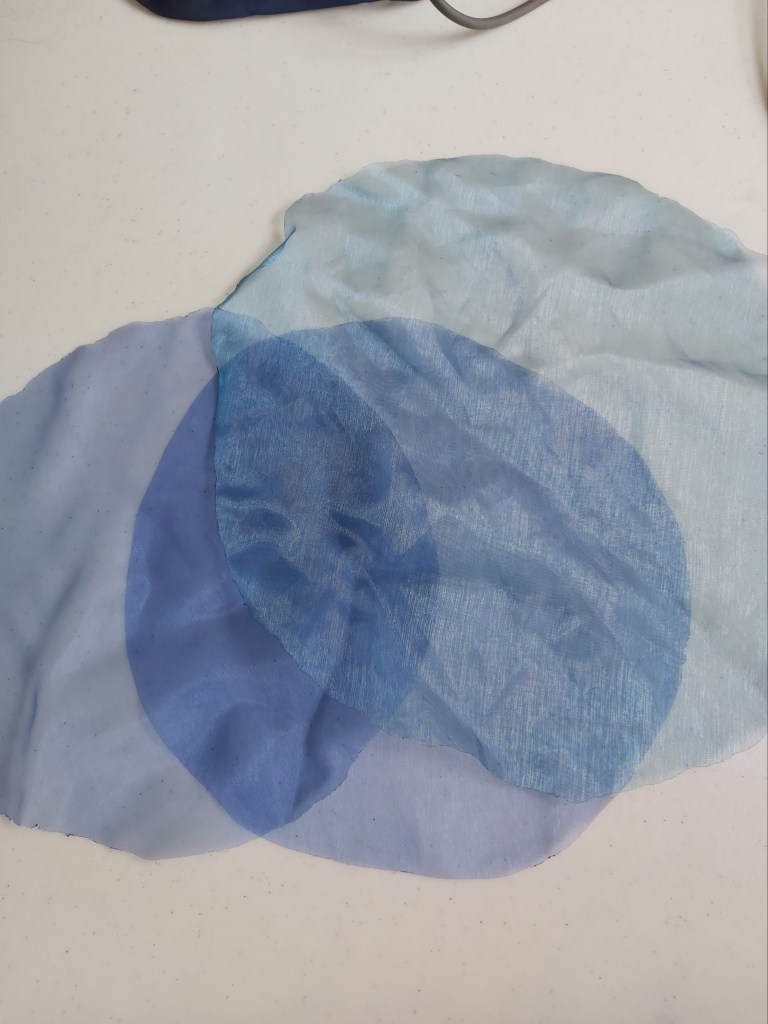
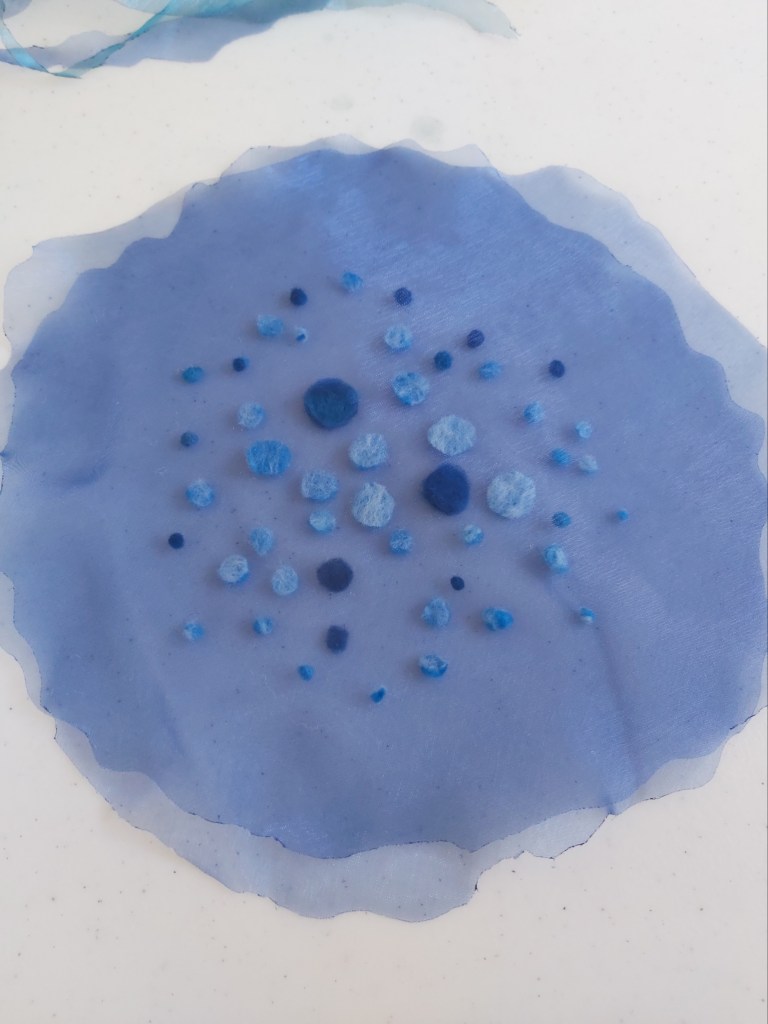
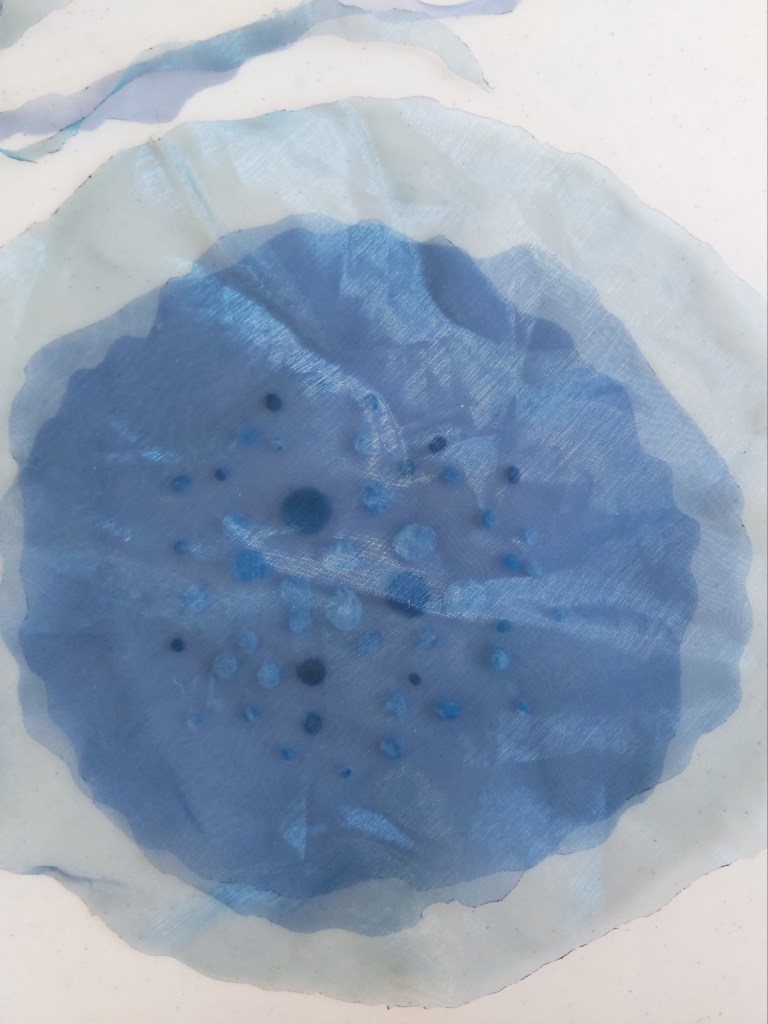
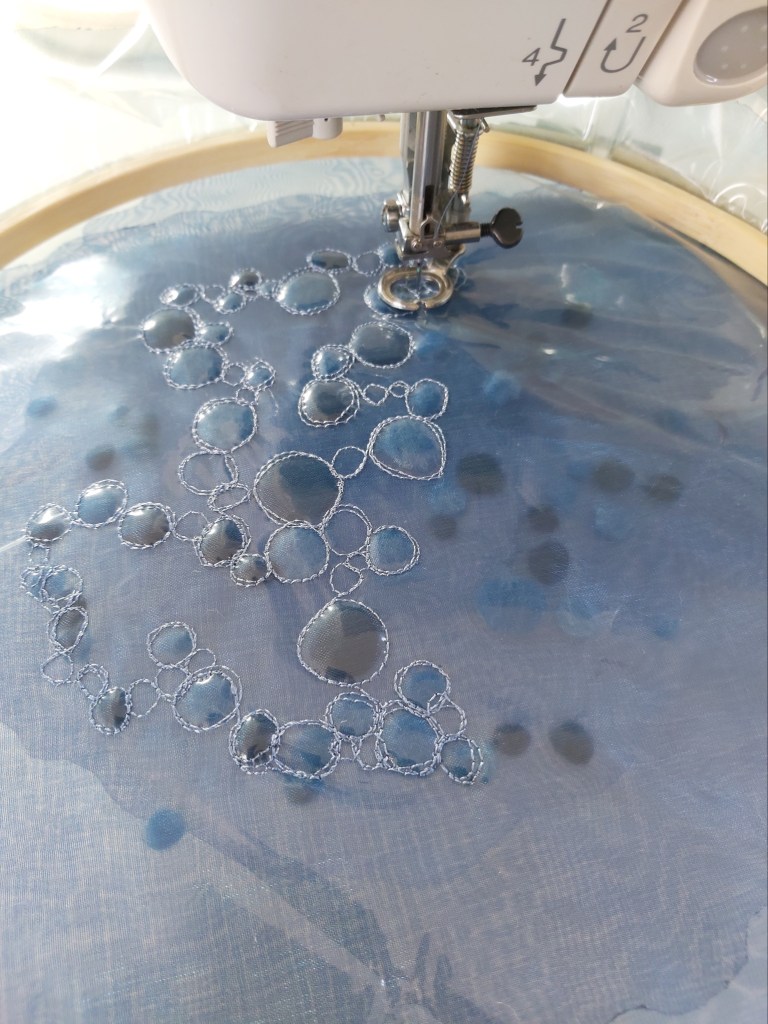
I had enough blue fabric to cut out two circles plus one slightly larger from the turquoise. I also added a small white circle of fabric underneath thinking it would highlight the spotty area. Next I cut up some scraps of felt for the spots and arranged them on the blue discs before covering with the turquoise sheer. This sandwich was then put in the hoop and I machine stitched around the spots…..or at least that was my intention! Unfortunately I struggled to see where some of the felt was so it’s a bit hit and miss but it was near enough!
After removing it from the hoop I washed out some of the stabiliser retaining a good bit of the glue on the fabric to enable me to shape it over a plastic bowl. I didn’t think to photograph the drying stage so the next image shows it dry with the unattached tentacles cut from tulle and sheers.
The final step was to wet felt a blue “inner”, with additional thin felt tentacles, sew the fabric tentacles inside it and insert into its casing.
The finished spotted blue jelly fish.
I’m quite pleased with the finished result and this particular area of the exhibition should be interesting as we’ve used lots of different styles and techniques between us.
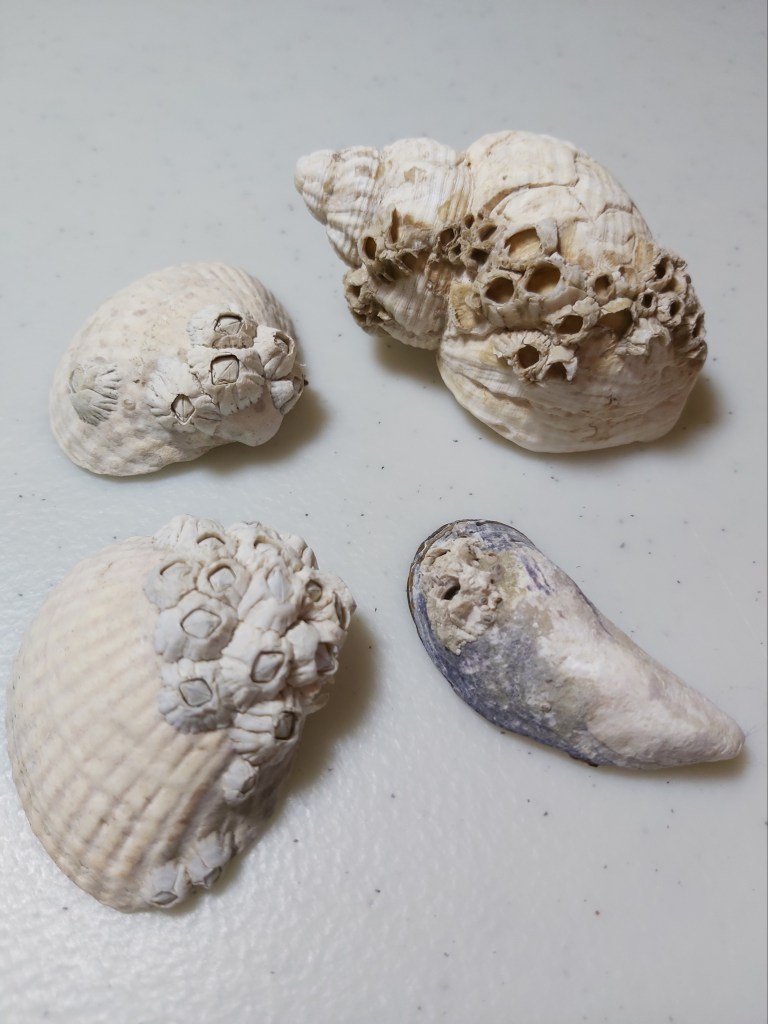
Another idea I’ve been playing with is barnacles. I’ve always had a fascination for barnacles and can’t resist collecting them when I find them on stones and shells. These marine crustaceans are related to the crab and lobster and tend to live in shallow and tidal waters, typically in erosive settings.
There are around 1,000 different species and, as adults, typical barnacles are covered with calcareous plates and are cemented, head down, to rocks, shells, pilings, ships’ hulls, driftwood, or seaweed, or to the bodies of larger sea creatures, from clams to whales.
They feed by reaching into the water column with eight pairs of thoracic limbs called cirri which are long and feathery. The cirri extend to filter food, such as plankton, from the water and move it towards the mouth as you can see in this video. (Follow the link and scroll down to Ecology)
Barnacles on rusty metal
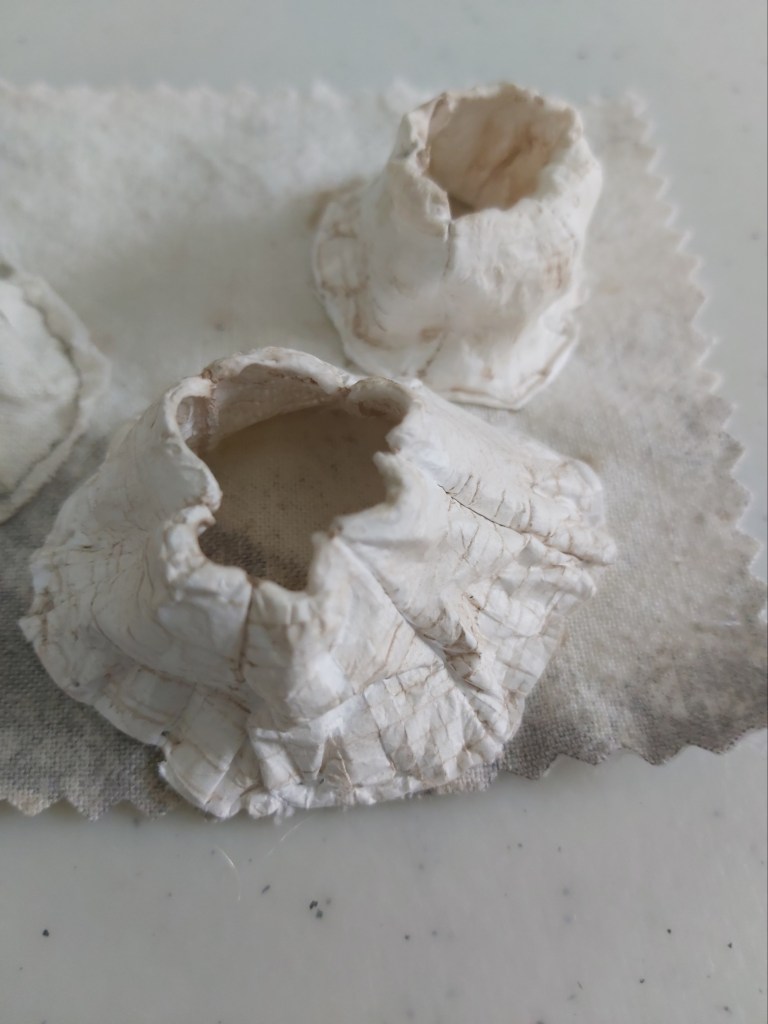
I’ve always liked this photo of barnacles on a rusty piece of metal which was taken on a visit to Ullapool harbour so I’m experimenting with different fabrics, including cotton and Tyvek, to make a barnacle inspired wall hanging. So far I’m leaning towards the Tyvek fabric.
Cotton fabric barnaclesTyvek fabric barnacles
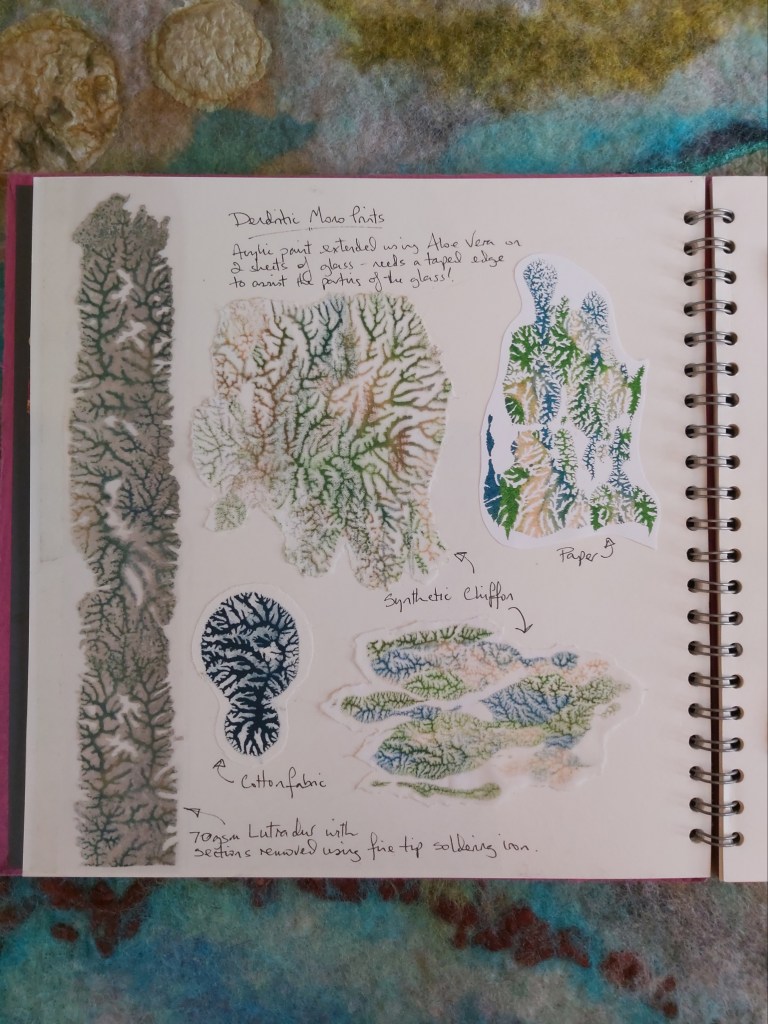
Something else I think will lend itself to the theme is dendritic printing. I love the vein like patterns, very reminiscent of coral, which can be created by pressing acrylic paint between two sheets of glass or plastic and then printing with it. I’ve been trying this out on different surfaces including paper, Lutradur, chiffon and cotton.
The most surprising result was a the print on felt, I was amazed at the clarity of it and I can see this being developed further with added stitching.
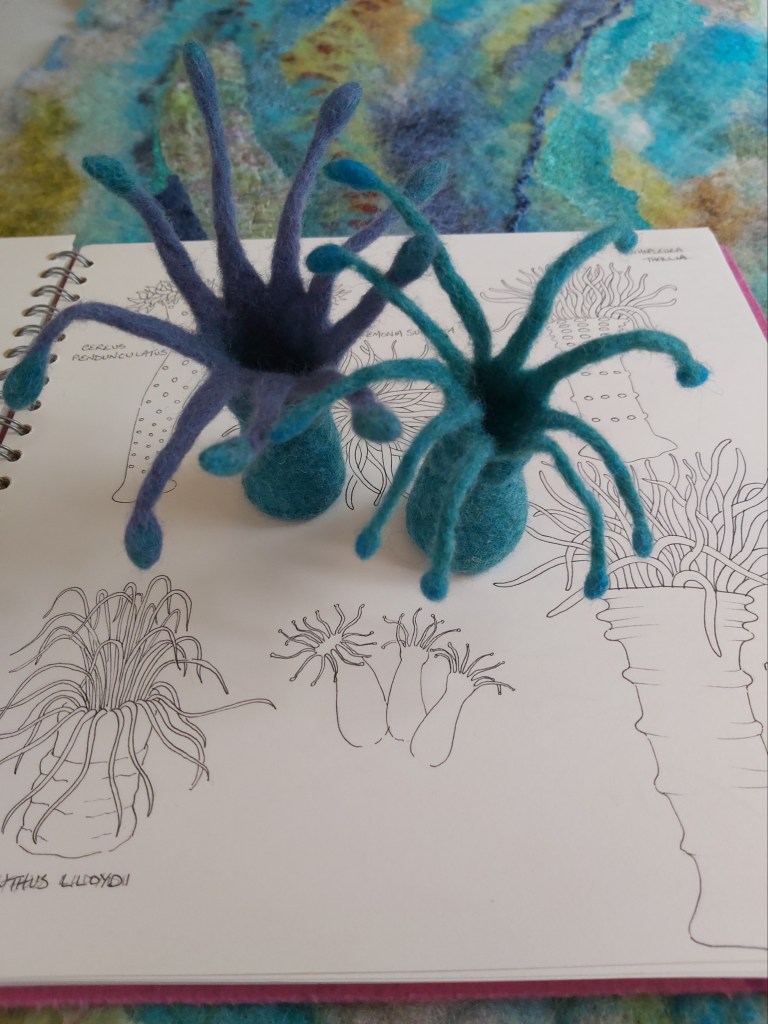
Working on ideas for felted sea anemones
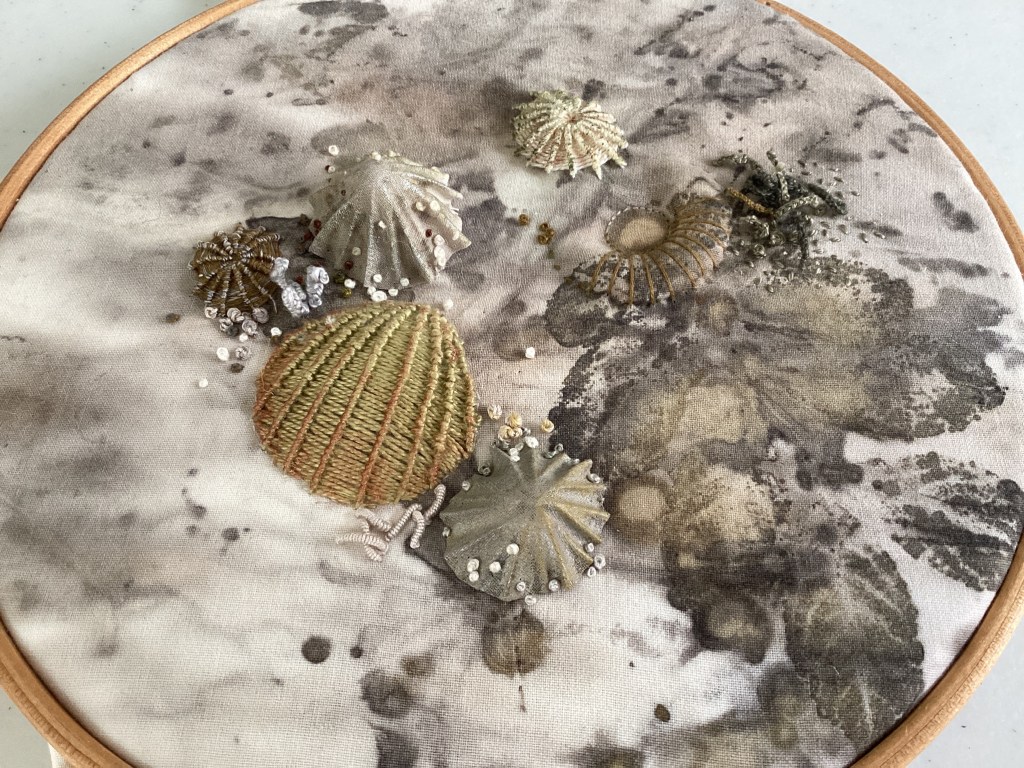
There are so many possibilities within this theme that my mind is working overtime and I’ve a few other projects on the go right now. One of them is this small 20cm dia embroidery being worked on an eco print cotton fabric.
Another is a wallhanging approximately 95cm x 45cm. It started out as a wet felted background made from various remnants of fibre which I ran through the drum carder. It’s had a lot of embellishment since this picture was taken, incorporating machine stitch, hand stitch, cord making, recycled coffee capsules, burnt sheer fabrics and hand painted silk fabrics. It’s almost finished now so I will feature that in my next post.
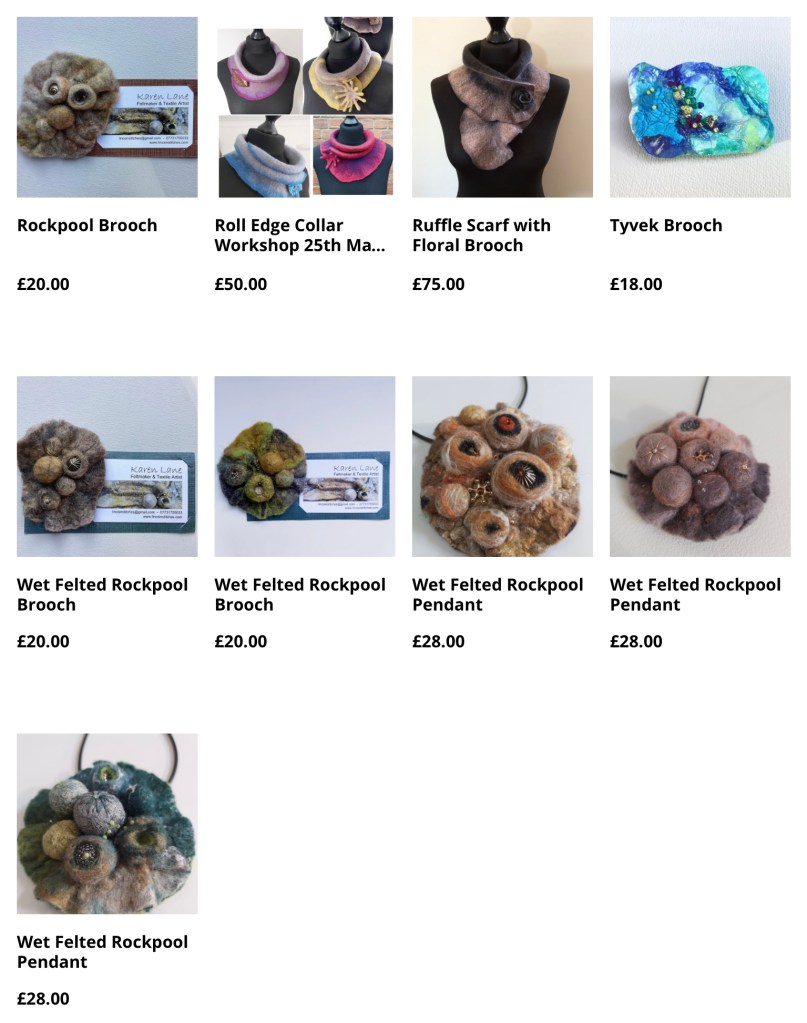
I’m not the most techie of folk but I’m doing a happy dance this week as I’ve managed to set up an Online Shop linked to my Sumup Account. I’ve added a “Shop” tab to my websites navigation bar and put a few items in there to start things off including a forthcoming workshop, brooches, pendants, and scarves/collars. I’m often being asked if I will teach online so I’m also hoping to add online tutorials to the shop at some point later this year….I needed to put that last sentence in print to encourage me to get on with it!!
Visit the Shop using this link or the “Shop” tab on the navigation bar.
After kicking myself, yet again, for not keeping my posts up to date here goes with a round up of what I’ve been doing in the first quarter of 2023.
I’ll start with the fact that I’ve pulled out of the Alford Craft Market Shop where I’ve been selling some of my felted items for the past two years. I only went in originally because in 2020 The Big Textile Show was cancelled due to Covid and I had lots of product destined for that show sitting in boxes going no where! Also workshops weren’t happening and so I had plenty of time to make more stock so it made sense to find an outlet and Lynne at the Alford shop kindly found me a space.
Workshops have always been, and always will be, my main focus so with life back to normal in 2022 it was time to leave the Alford shop at the year end to concentrate on what I enjoy doing most.
I don’t always get the chance (or sometimes I simply forget!)to take photos during a class butthese are a few of the workshops I’ve run since the beginning of this year of which I have images…..
In February the Ladies at EYE’s (East Yorkshire Embroiderers) invited me back up to spend the weekend with them in Cottingham. I’d been working on a new illustrated talk for them, originally I’d said it would be The History of Feltmaking but very soon in to my research I realised that title was a huge mistake as it was far too broad a topic for a 45 minute talk! I knew I wanted to start with some of the earliest discoveries of felt known to man, discovered in the Tarim Basin and at Pazyryk in Siberia, and end with present day Feltmakers who are pushing the boundaries of what can be achieved with fibre, water, soap and imagination. The difficulty was what to leave out and what to put in from the intervening 4,000ish years which would join those two sections and ensure the presentation was interesting, exciting and had flow. Having delayed starting this project until the beginning of December it was going to keep me very busy over Christmas and in to the New Year!
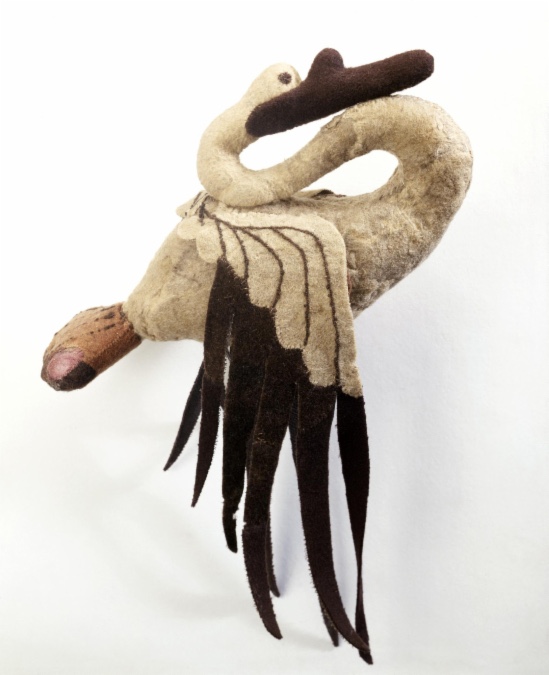
This naturally mummified baby was discovered in the Tarim Basin wearing a blue felted hat and dates to around 600BCEThis wonderful Felt Swan was discovered at the Pazyryk burial site and dates to the 5th to 4th century BCE. Image source Hermitage Museum
Doing the research was fascinating and also very time consuming. I found myself going off on a tangent many times as one interesting fact led to another, and another……. I’ve now got enough content in the bag for another talk when I get around to sorting it out. Needless to say the whole thing took a lot longer than I anticipated and I only got finished a couple of days before I was due to present in Cottingham! My one and only talk until now has been about my journey as a textile artist and that’s the easiest subject to talk about as it’s what I know, no crib sheets required! This wasn’t going to be quite so easy, not the first time around anyway, and there was the added worry that others might not find it as interesting to listen to as I had done to research.
I gave my talk, A Journey in Felt, to an audience of approximately 120 ladies on the Saturday and breathed a huge sigh of relief with the positive response it received! That night I probably had the best nights sleep for several weeks and the following day we were back at the venue for the wet felted Fairy Slipper workshop.
Thirteen ladies took part in the workshop, 11 making the slippers and two of them opting to create a wet felted picture which they had done with me previously and had asked if they could do again.
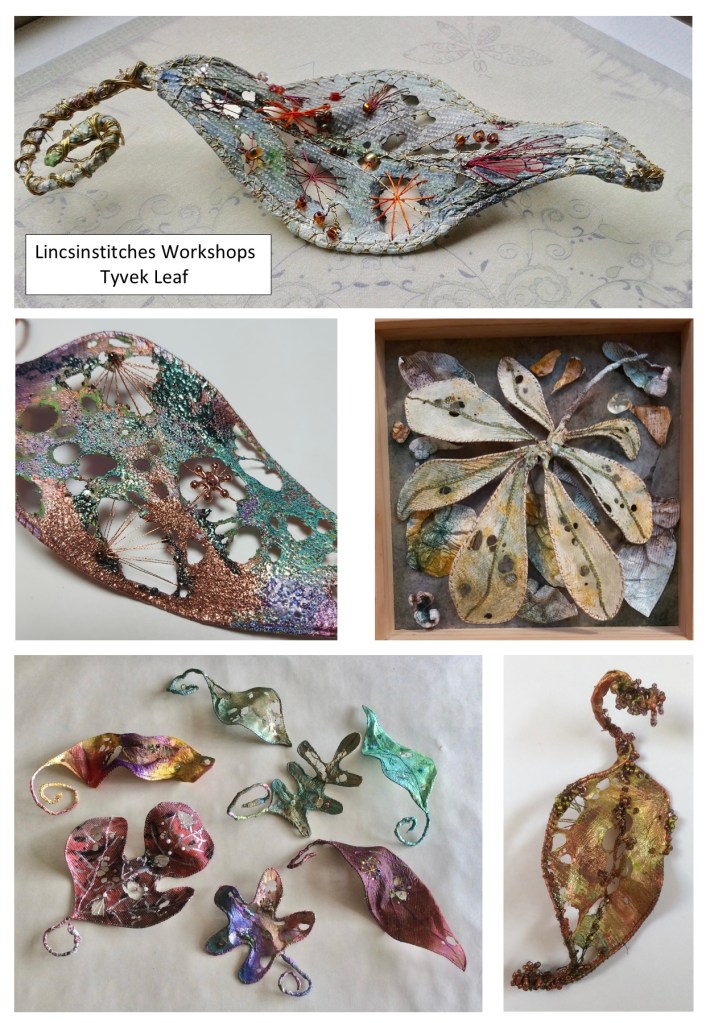
Also in February I visited the Creative Stitchers at Great Coates where we spent the day painting, stitching and heat distressing Tyvek fabric to make our Tyvek leaves and 3D seed pods. I love the fact that, due to the process used, these pieces cannot be repeated so each one will always be totally unique!
Something I’m doing much more of now is small group workshops in my home studio. These tend to be groups of friends who book together either for a specific project or, as in the case of Margie, Di, Clare and Jacky, each one came with a certain idea in mind and I helped guide them towards completion. These ladies have been several times for wet felting and in February decided to ring the changes with some needle felting and Tyvek work.
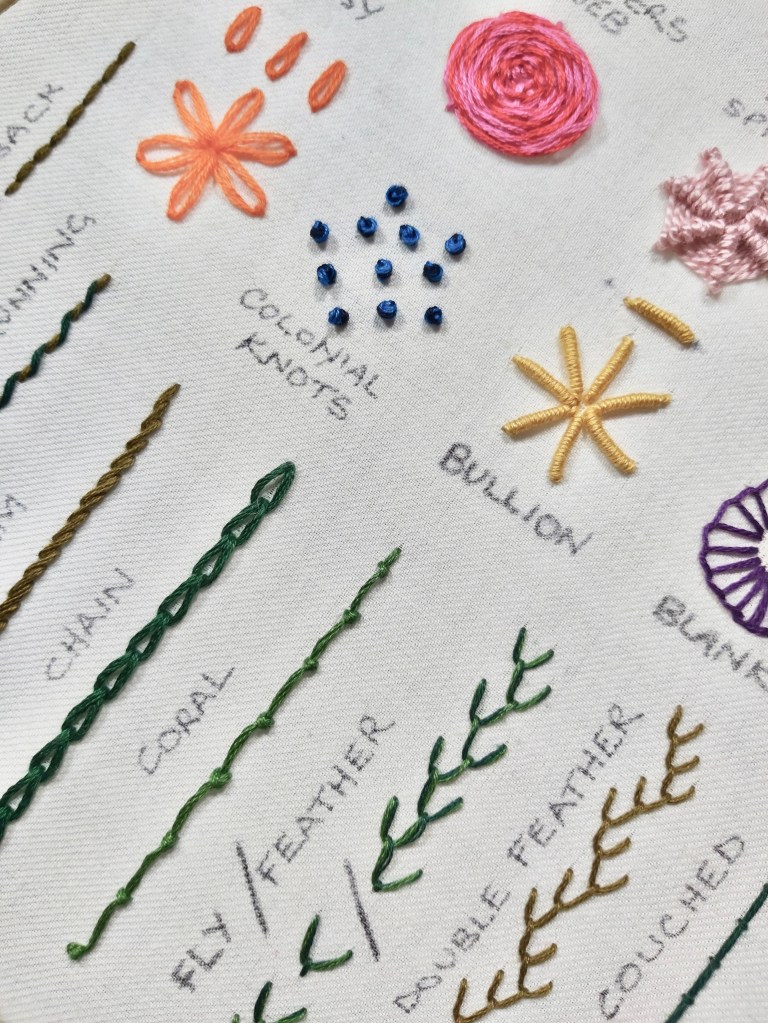
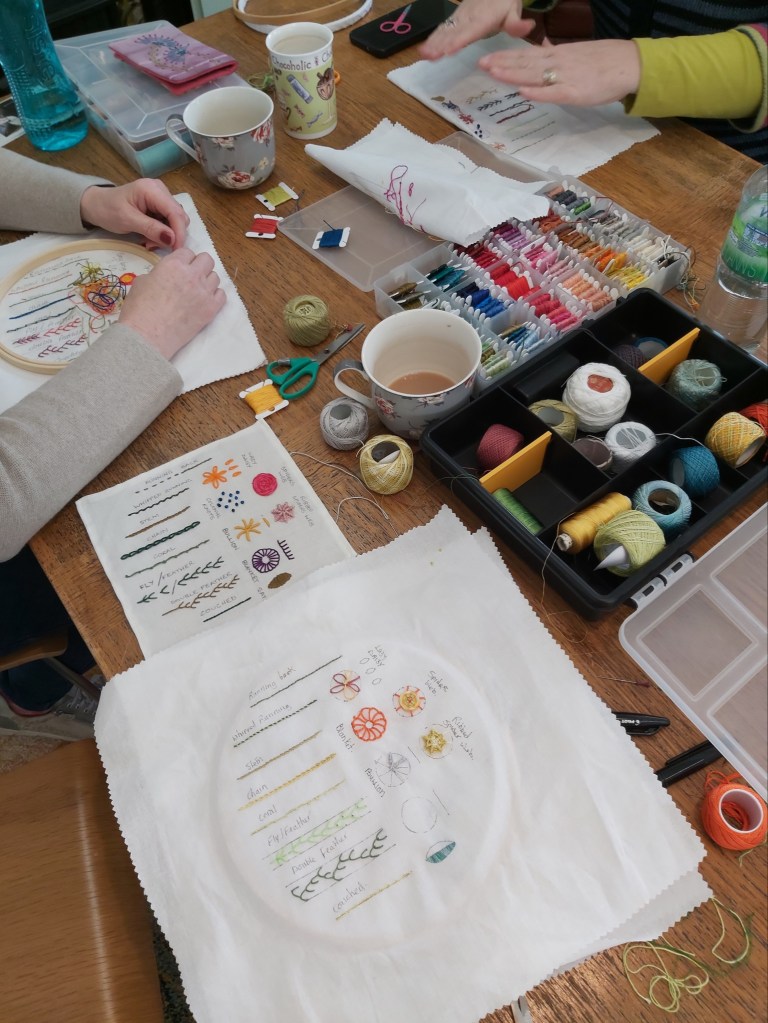
Following a request earlier this year I put together a beginners Hand Embroidery Workshop. I love hand embroidery but tend to stick with using just the same two or three stitches so it was really nice to get back to basics and rediscover the ones I haven’t used for quite some time. Hand stitching isn’t something you can rush so it was also good to sit and relax and generally slow things down for a little while whilst making my samples.
In this class we progress through the different stitches with each student making a sampler which can be used for future reference. The sampler consists of 18 stitches (some basic and some not so basic!) and students also get a template of flower shapes which they can take away and stitch at leisure using their newly acquired skills.
The next images are of the first of these classes which was held at the Alford Craft Market Studio in February.
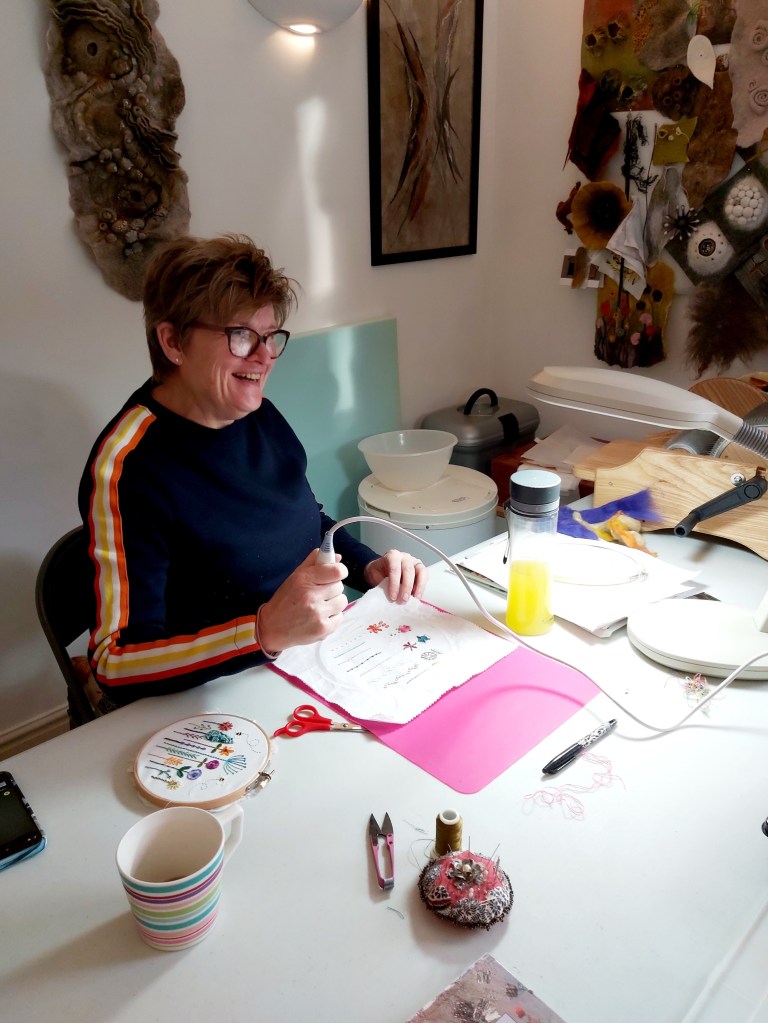
Later that month I had Emma, Kirsty and Sue come along to my studio for the beginners hand embroidery class.
Layer, Stitch & Burn is another fabric and stitch workshop but this time using the sewing machine and with the added excitement of “burning” our fabric! The first time I saw this technique being demonstrated was many years ago in a video by a Canadian textile artist called Susan Lenz. Susan works in many different mediums and styles and uses this technique for her In Box and Window series.
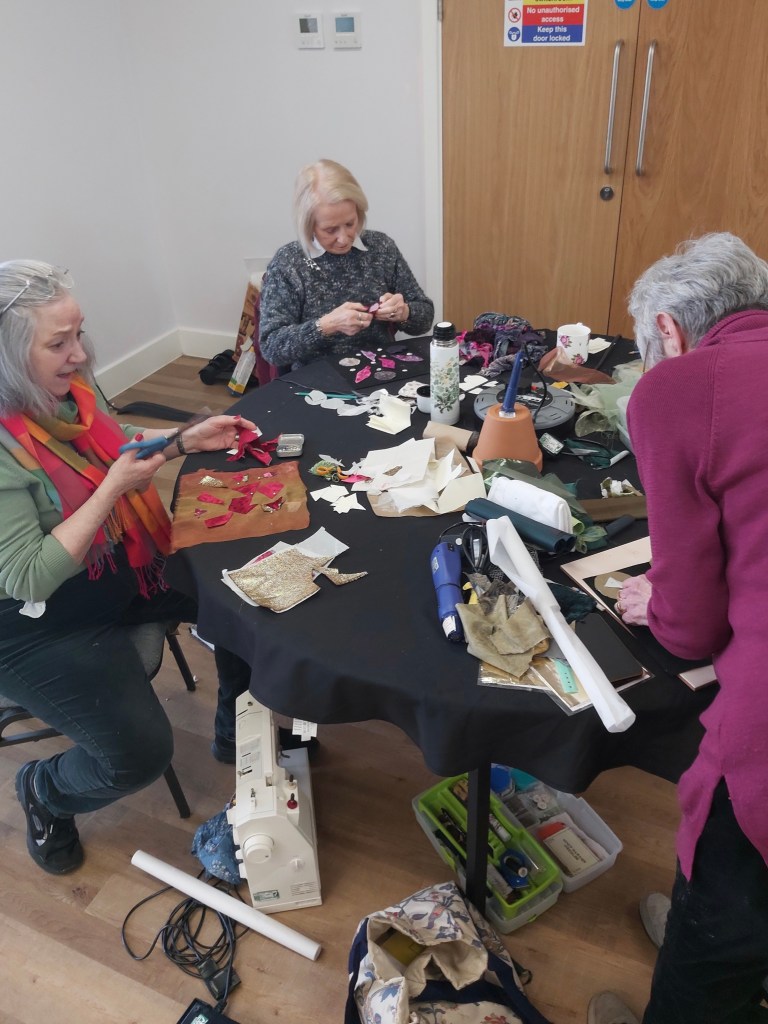
Last month I took Layer, Stitch & Burn to the Sleaford Embroiderers at their monthly gathering at the Hub in Sleaford. This is a fun, experimental workshop using a variety of synthetic fabrics. Techniques include cutting, layering, bonding, foiling and free motion stitching. Finally, once everything is held firmly in place, we burn away our background using a soldering iron & heat tool to leave a lace like effect. Most of the ladies would go on to finish their work at home but here are a few photos of their work in progress.
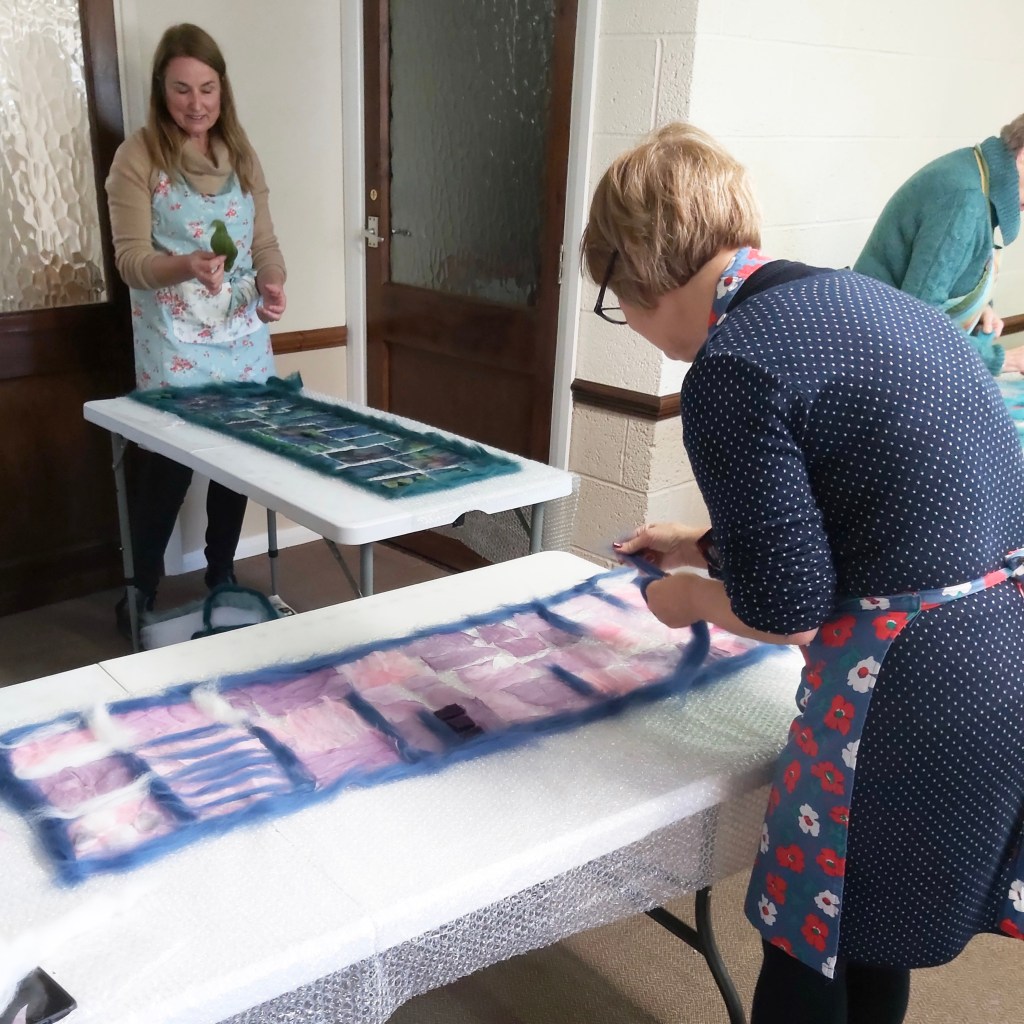
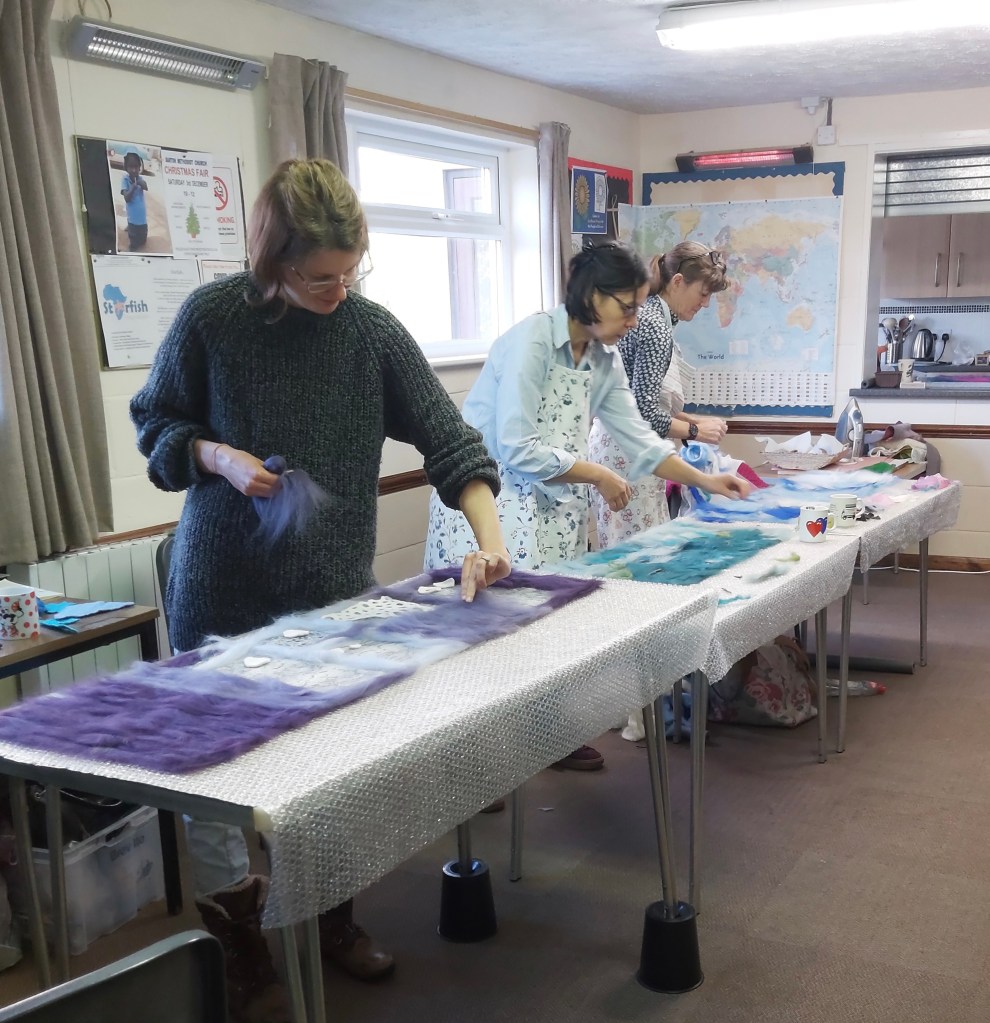
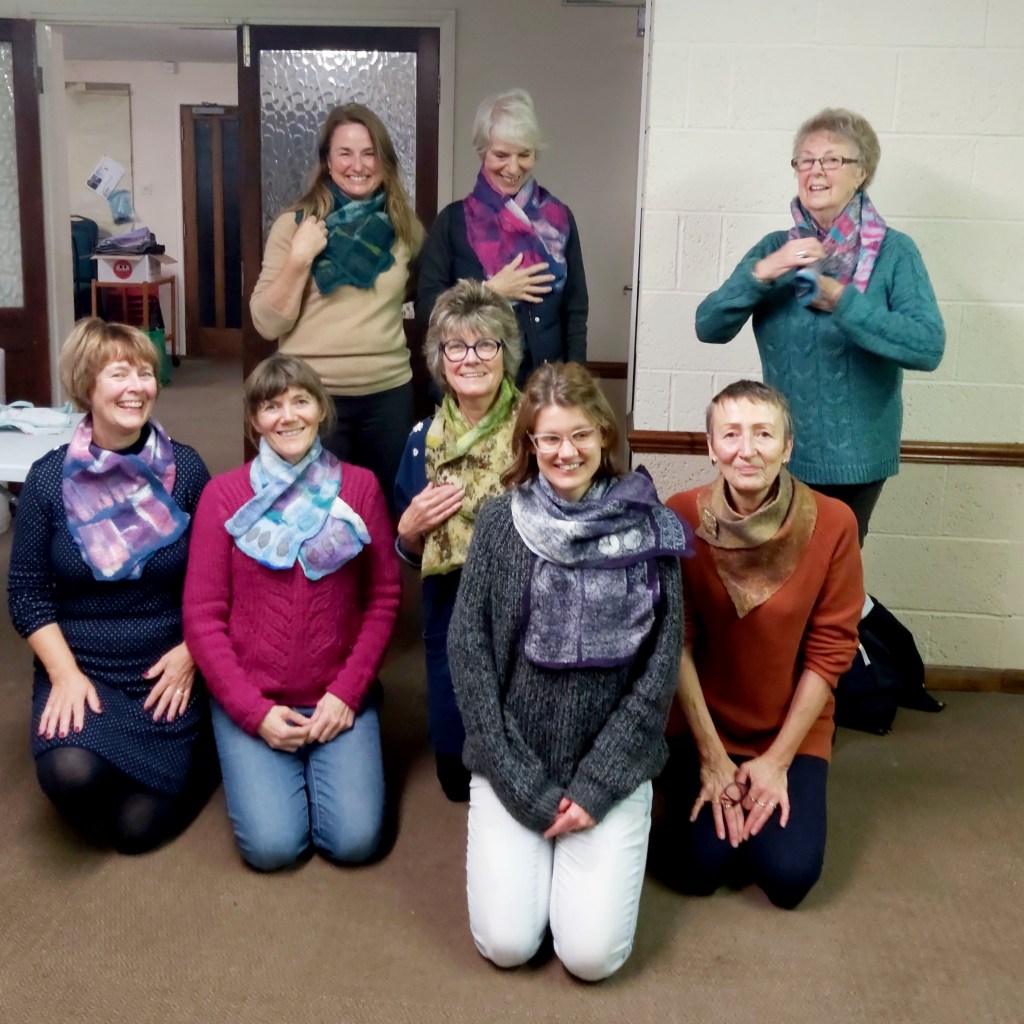
The next set of images show the beautiful Nuno Felted Scarves made by eleven ladies in Barton under Needwood, Staffordshire. These were all created by layering Superfine Merino with fine silk fabrics. Its always interesting to see the different colour combinations students put together and how some really go to town with the added elements such as prefelt, yarn, etc to create additional texture.
Every scarf made in these classes is totally unique and I’m always thrilled to see how happy students are with what they have achieved. It’s even more rewarding knowing, as with this group, that none of the ladies had used this technique before!
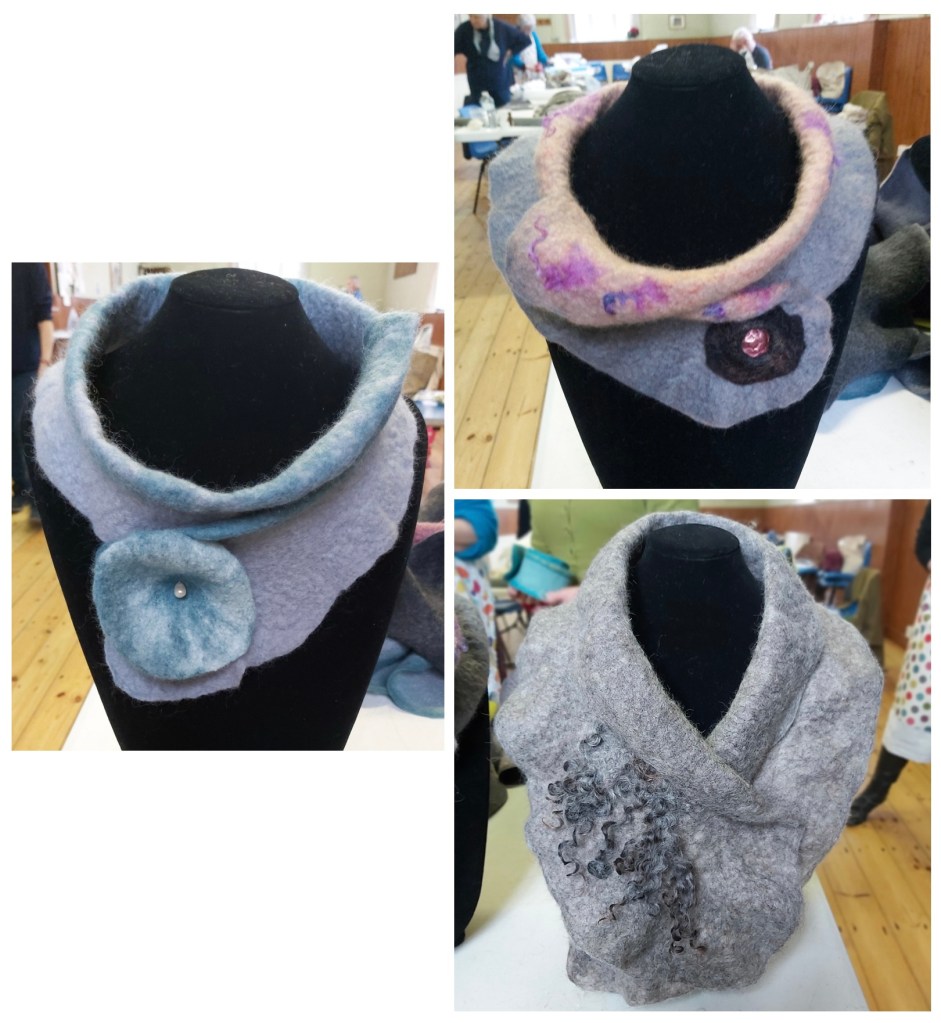
My most popular workshop currently has to be the Superfine Merino Roll Edge Collar with brooch fastener. I’ve done a couple of these in my studio recently and last month I travelled down to run the class in Ashby Magna, Leicestershire for Region 8 of the International Feltmakers Association. Ten ladies attended the class and achieved some really wonderful results.
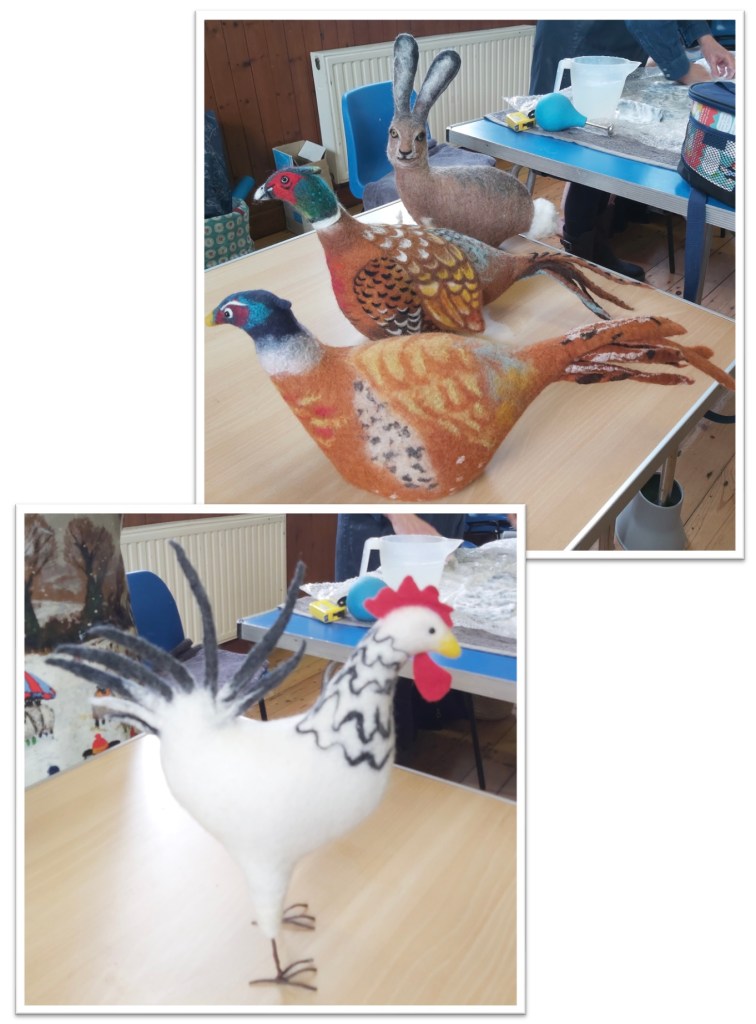
It was a lovely surprise to see that Fiona had also brought along some fabulous wet felted birds and a hare to show me. She made these at home using techniques she had learnt in my Chicken Workshop in Arnesby, Leicestershire last October…..we were all very impressed!
Fiona’s wonderful 3D wet felted birds.
All in all it’s been a great start to 2023 and in between workshops I’ve been working on some creative projects of my own so will include those in future posts……I just need to keep up the momentum now I’m back at it!!
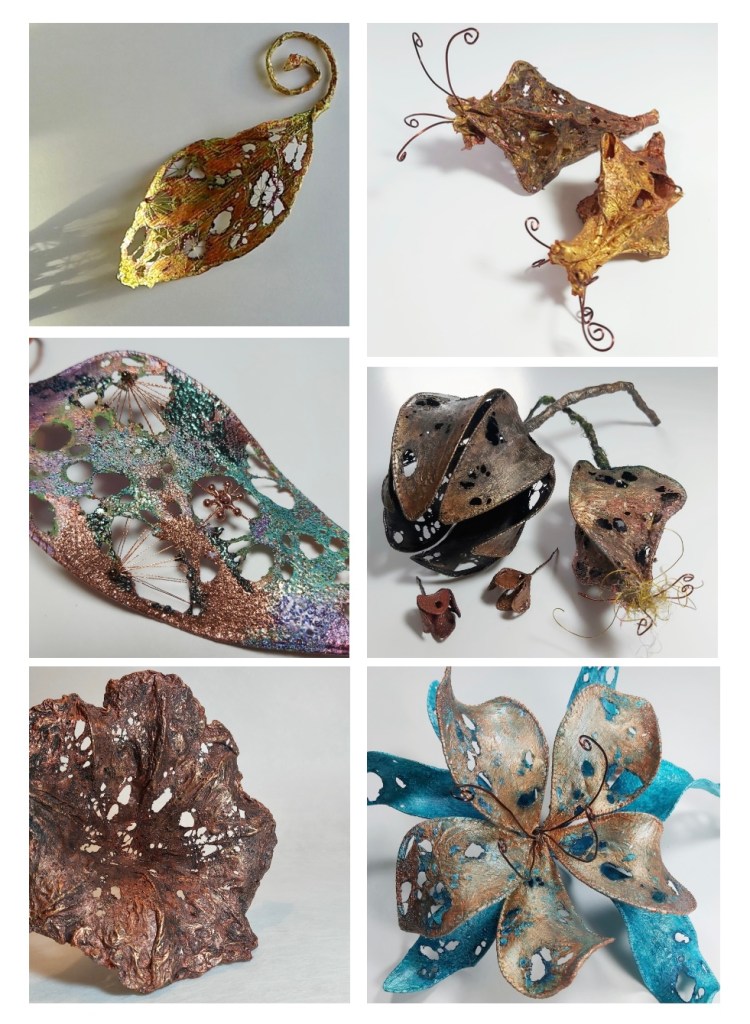
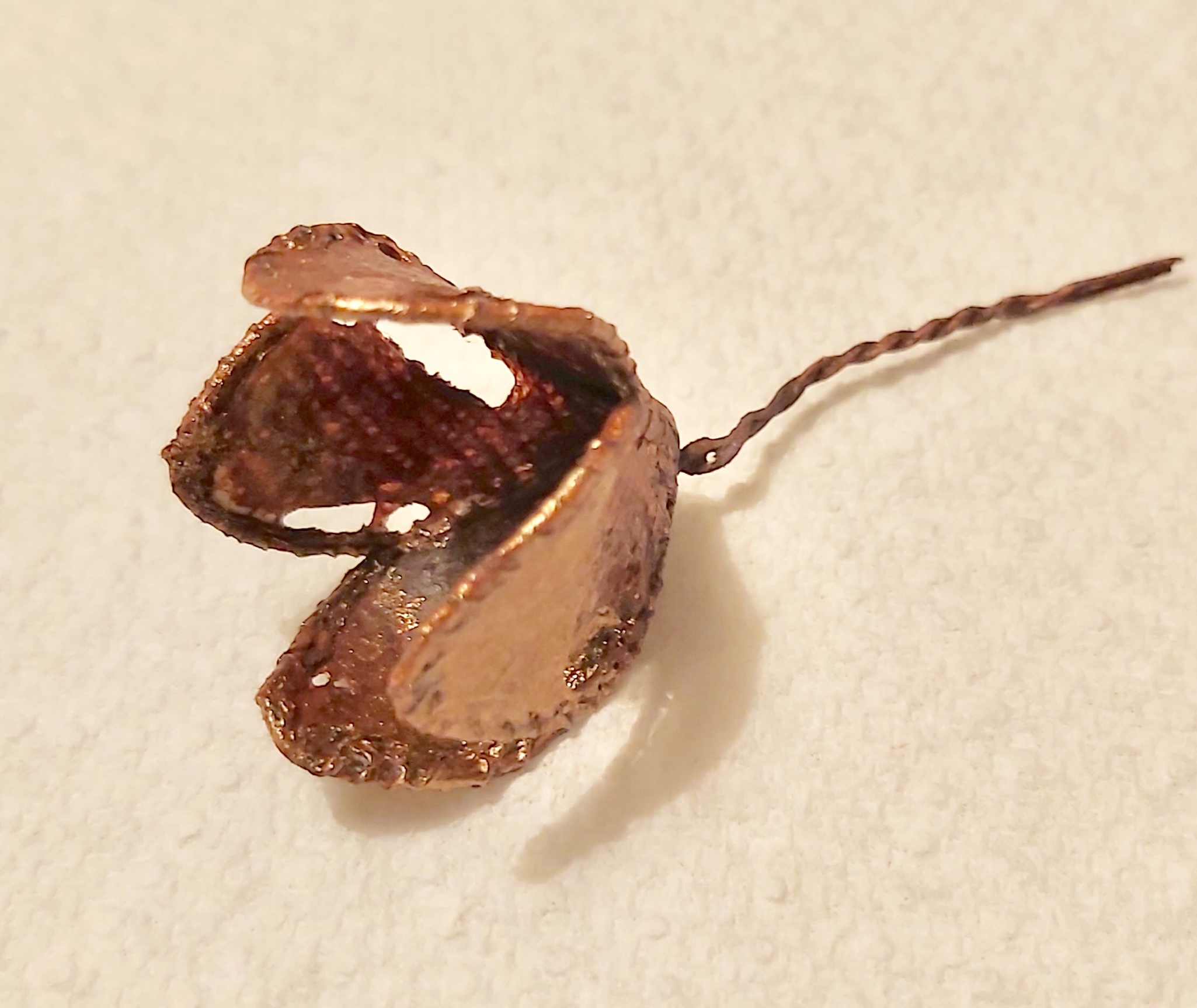
My recent Forest Floor workshop for the ladies of Snape Textiles up in Bedale has reignited my interest in working with Tyvek fabric. It’s a material I hadn’t used for a little while but making a tiny seed pod a few weeks ago, as a sample for their class, has led to more, and larger, pieces and an idea for a new workshop I’m calling Inspired by Nature…..3D Textiles.
The small seed pods are 6cm from end to end, the large one is 30cm
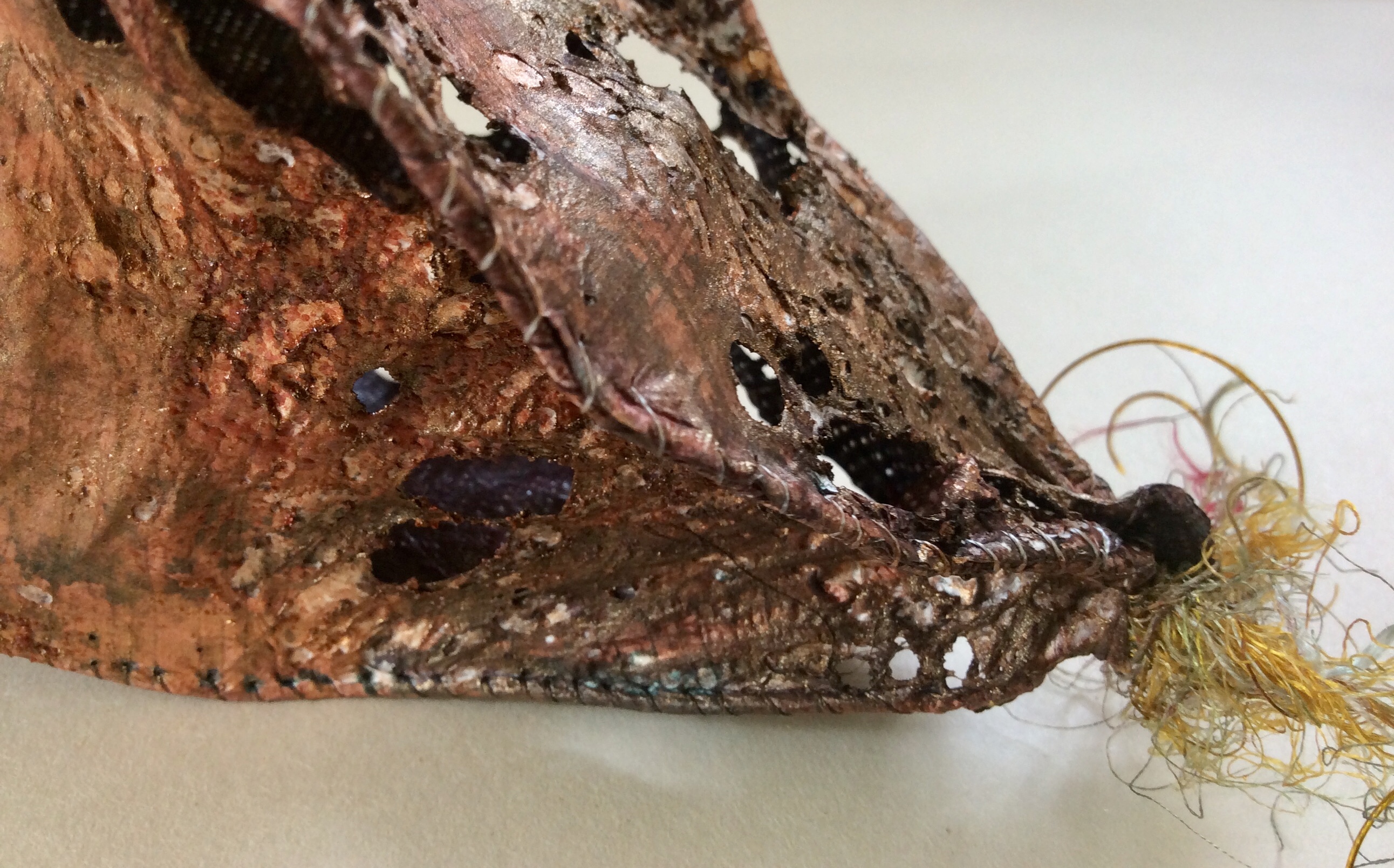
These pieces all start with a wire armature wrapped in hand painted Tyvek fabric which is then distressed with a heat gun.
What I particularly like about this technique is the metallic look that can be achieved…..although they are strong, and look as if they are heavy, these pieces actually have the weight and feel of paper.
The first Inspired by Nature – 3D Textile class will be held at Belchford Village Hall LN96LJ on the 22nd January 2022 so if you are interested in learning this technique, or want to know more about the workshop please get in touch via the contact form.
I recently had the pleasure of running two consecutive one-day workshops for members of the Snape Textile Group up in the beautiful village of Bedale, North Yorkshire.
The group had booked my Forest Floor workshop which covers lots of different techniques for working with heat manipulative materials and creating the kind of stuff you find littering the forest floor such as leaves, twigs, bark and seed pods. With 30 ladies interested it was decided to split this fast paced class into two days to ensure all of them had the best learning experience and no one got left behind!
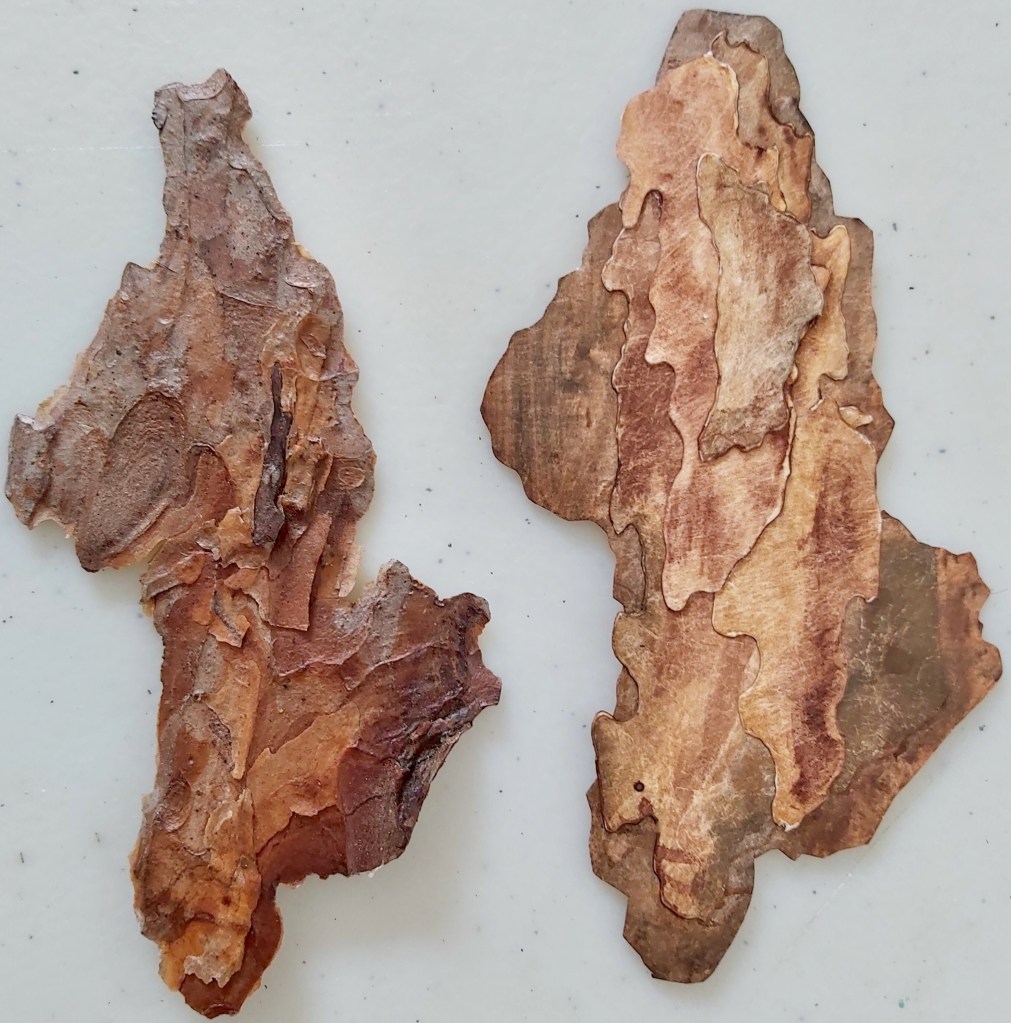
A few of my workshop samplesReal bark v fake bark
After each demonstration the students set to painting, stitching, wrapping and distressing (using heat guns and soldering irons) their Tyvek and Lutradur to create the various elements.
This is a sample based workshop and students are not necessarily expected to produce a finished piece of work by the end of it when it’s booked as a one day class. We do discuss how to pull everything together and create a suitable background but this is something that can be done afterwards at your own pace. If a group particularly want to see it through to the end it can either be booked as a two day class or we simply limit the amount of leaves made on the day to get a finished piece done. Yes, it’s those leaves that tend to hook folk in and then the time just disappears!
Just a few examples of what was made
It was a full on weekend with the ladies producing an array of wonderful work and, hopefully, having a lot of fun in the process. This was the first time some had used a heat gun or a soldering iron but going by the response it won’t be the last!
Thanks to all for your enthusiasm, hard work and good company and a special thanks to Sarah Lowe for hosting me for the weekend. I’m looking forward to working with you all again at some point in the future.
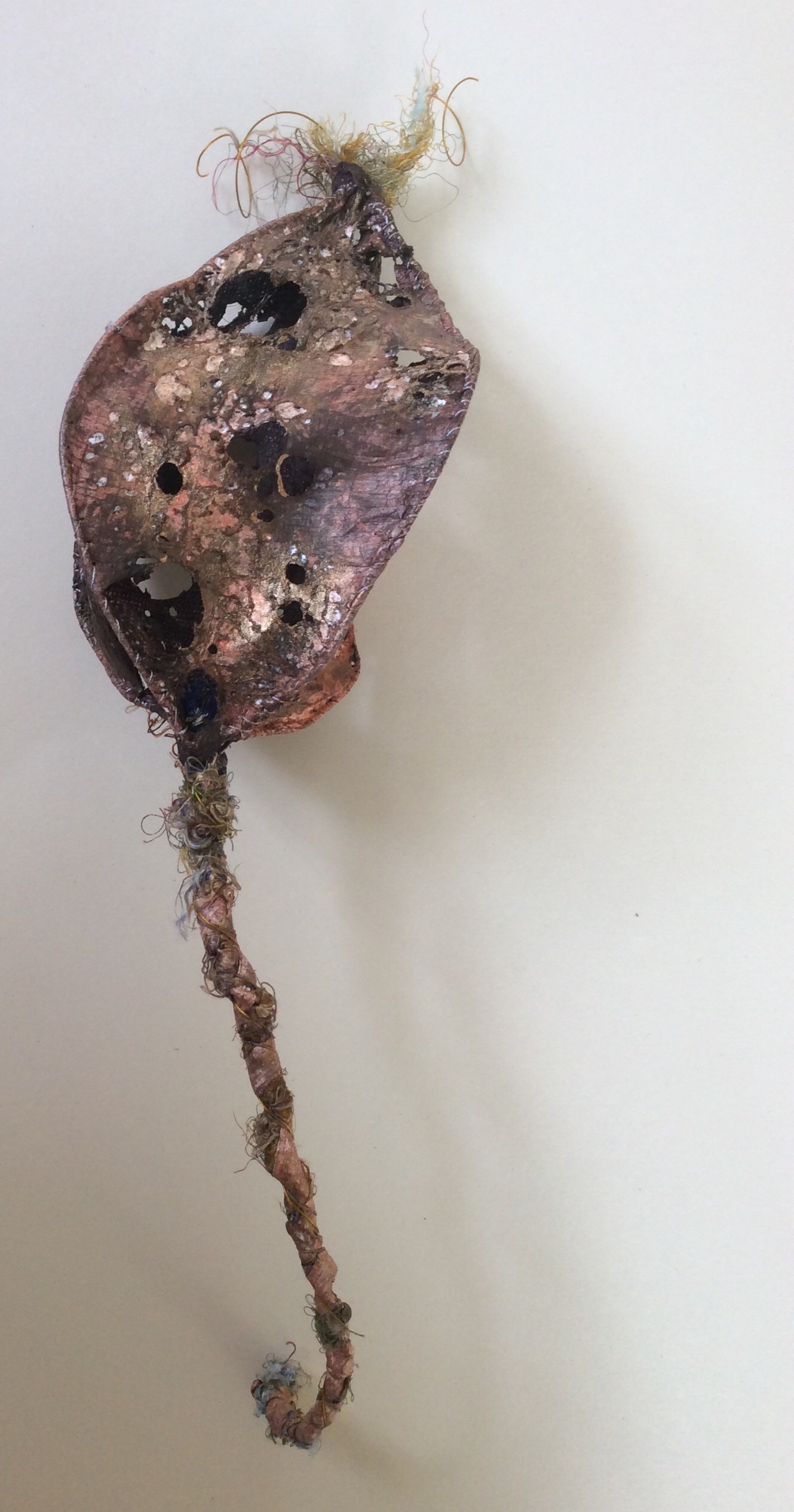
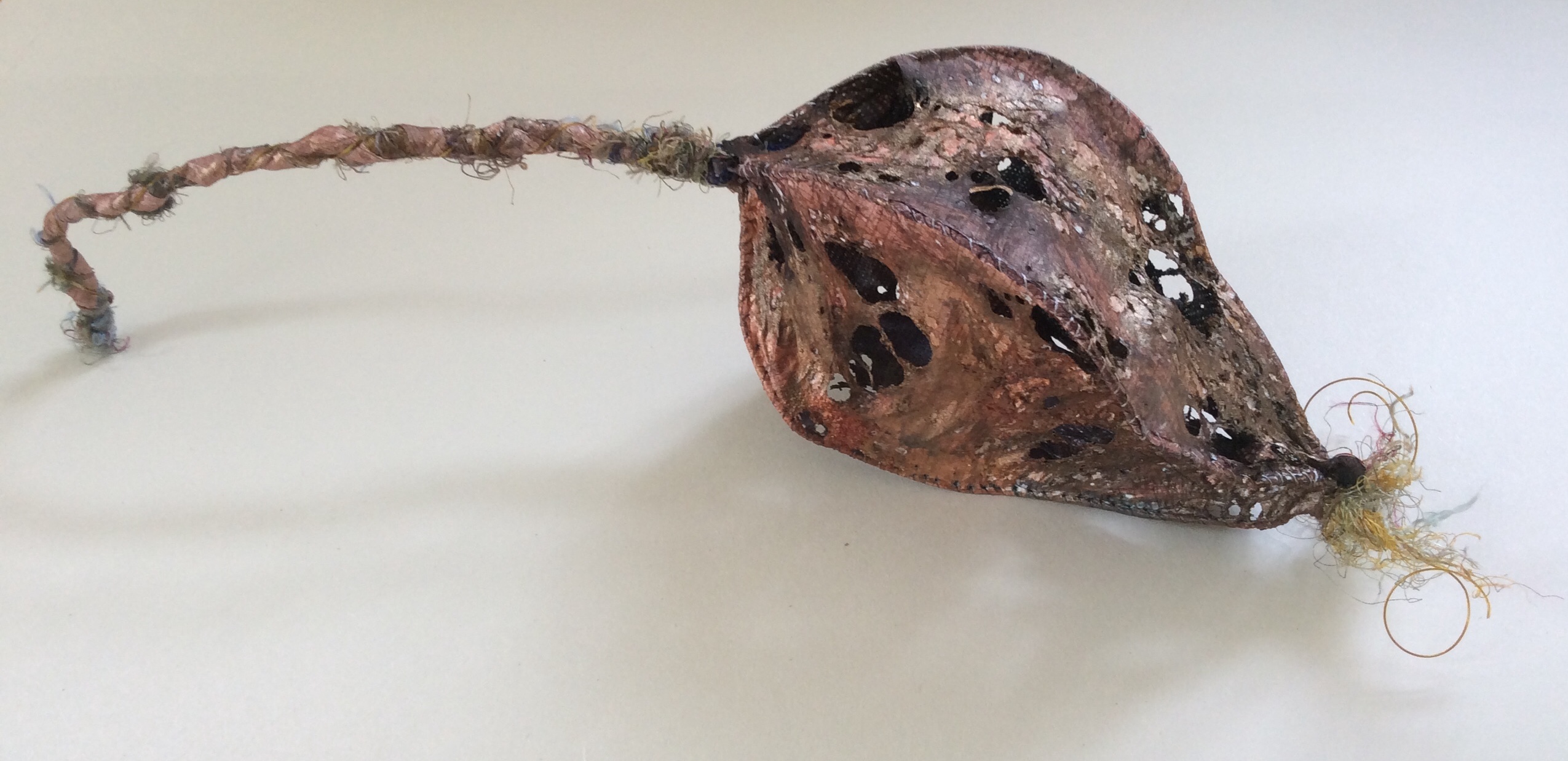
I developed a ganglion on my right hand as a result of making the bird mask last week. It’s giving me some gip so I’m resting the hand for a while and doing a few pieces that don’t require a strong grip. Yesterday it was a Tyvek Seed Pod incorporating sari silks and acrylic paint…..
Today I made a start on a mixed Media piece with the theme “Abstraction” which was set by the textile group Jeudis which I became a member of a couple of months ago. I’m combining free motion stitch with painted Lutradur and wet Felted Merino, for now it’s work in progress…..
































































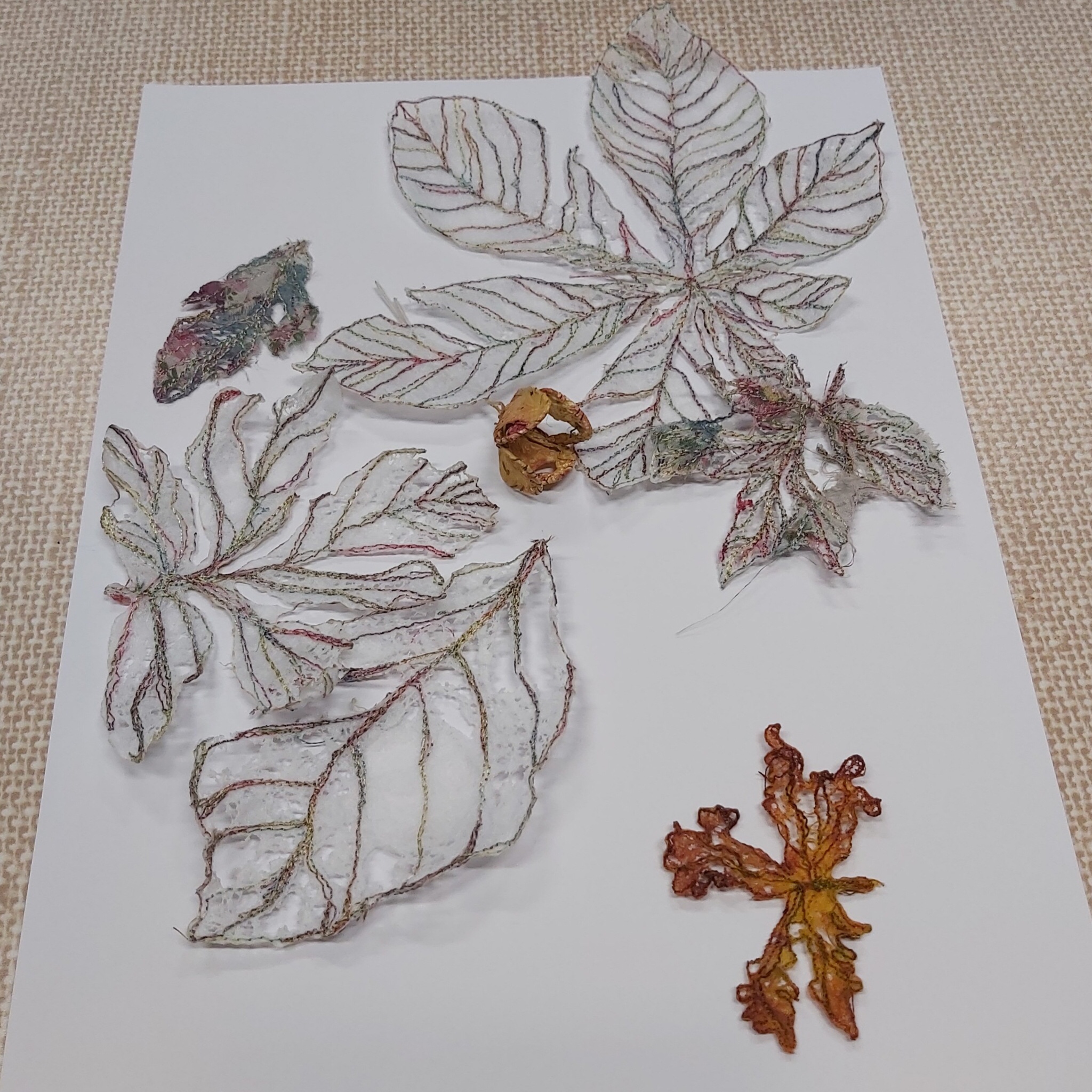


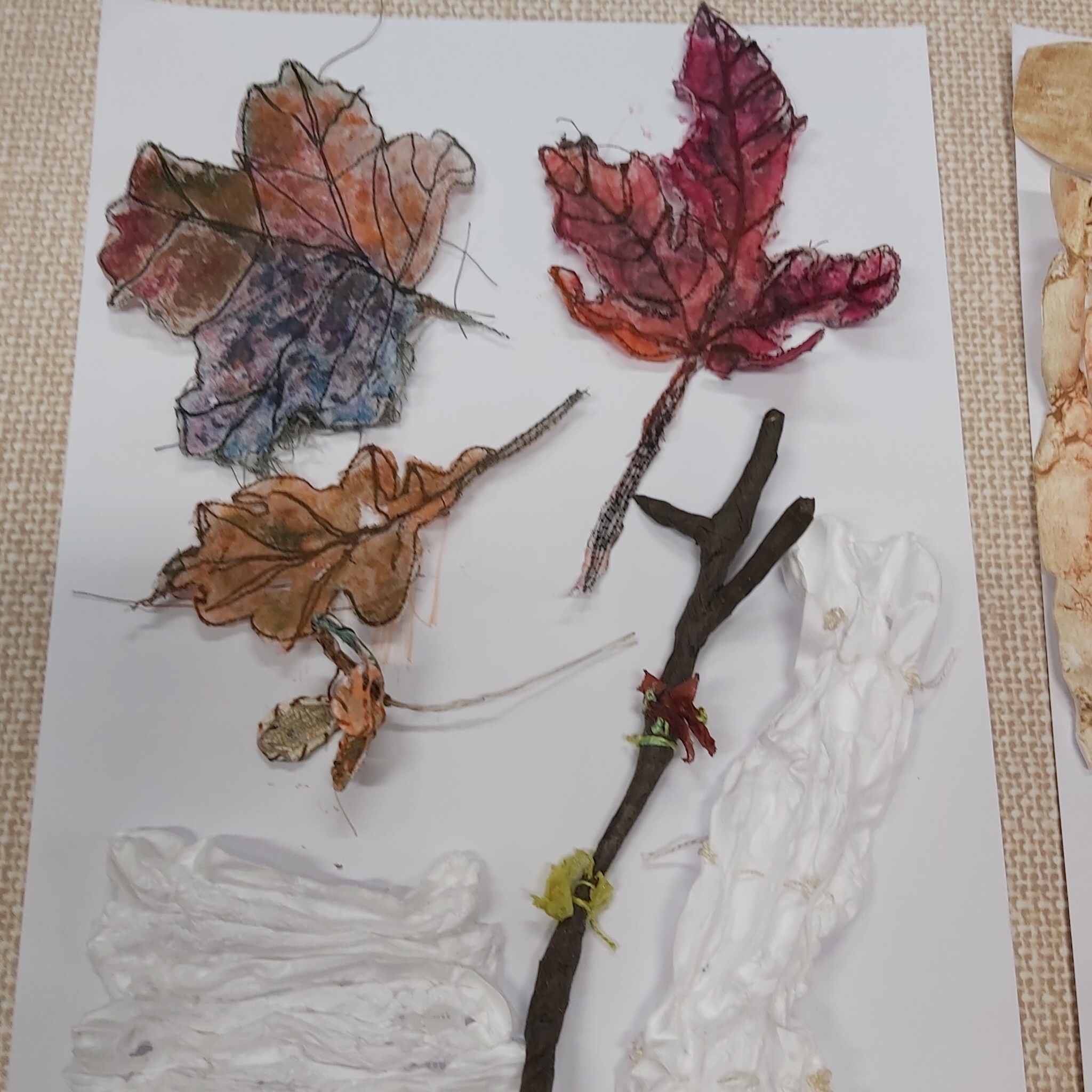



 Lincs In Stitches