This time last year I became a member of Lincolnshire Textiles, an exhibiting, mixed media group who meet monthly at Cherry Willingham near Lincoln. I became aware of the group after being invited as a guest speaker to talk about my work and this was followed by a visit to their last group exhibition, Sapphire & Steel, which was held in Lincoln Cathedral. As well as members exhibiting their individual pieces, central to the displays is always a group piece and this creates a striking focal point as you enter the Chapter House as you can see from this photo taken of their last exhibition.
This year the main theme of our exhibition is “Water” and the group piece will represent a whirlpool with 30(ish) members having contributed a section each. Along with a template we were each given a colour swatch and asked to work in shades of that colour without going too dark or light either way. This was my template for shape which is approx 60cm x 15cm at its widest parts, and the little colour swatch of thread.
My first thought was to fill the shape with swirls or crashing waves……
But then I remembered seeing some of the pieces that had been submitted at previous meetings and two or three other members had already worked on that type of design, so I decided to rethink.
The other thing that came to mind was that my section might lend itself to being the shape of a fish so that’s what I decided on…..
The next step was to gather various threads that looked like they might be suitable and then look for different textured fabrics which I could colour. As we were asked to work in monotone it would be important to use as many textures as possible so I pulled out cotton, velour, interfacing, tulle, Lutradur, Evolon, gauze, elastic and crepe bandage.
I mixed up a shade of green that was as near as possible to the swatch and applied it to the fabrics in varying strengths. This gave me a nice variety of shades and texture to work with.
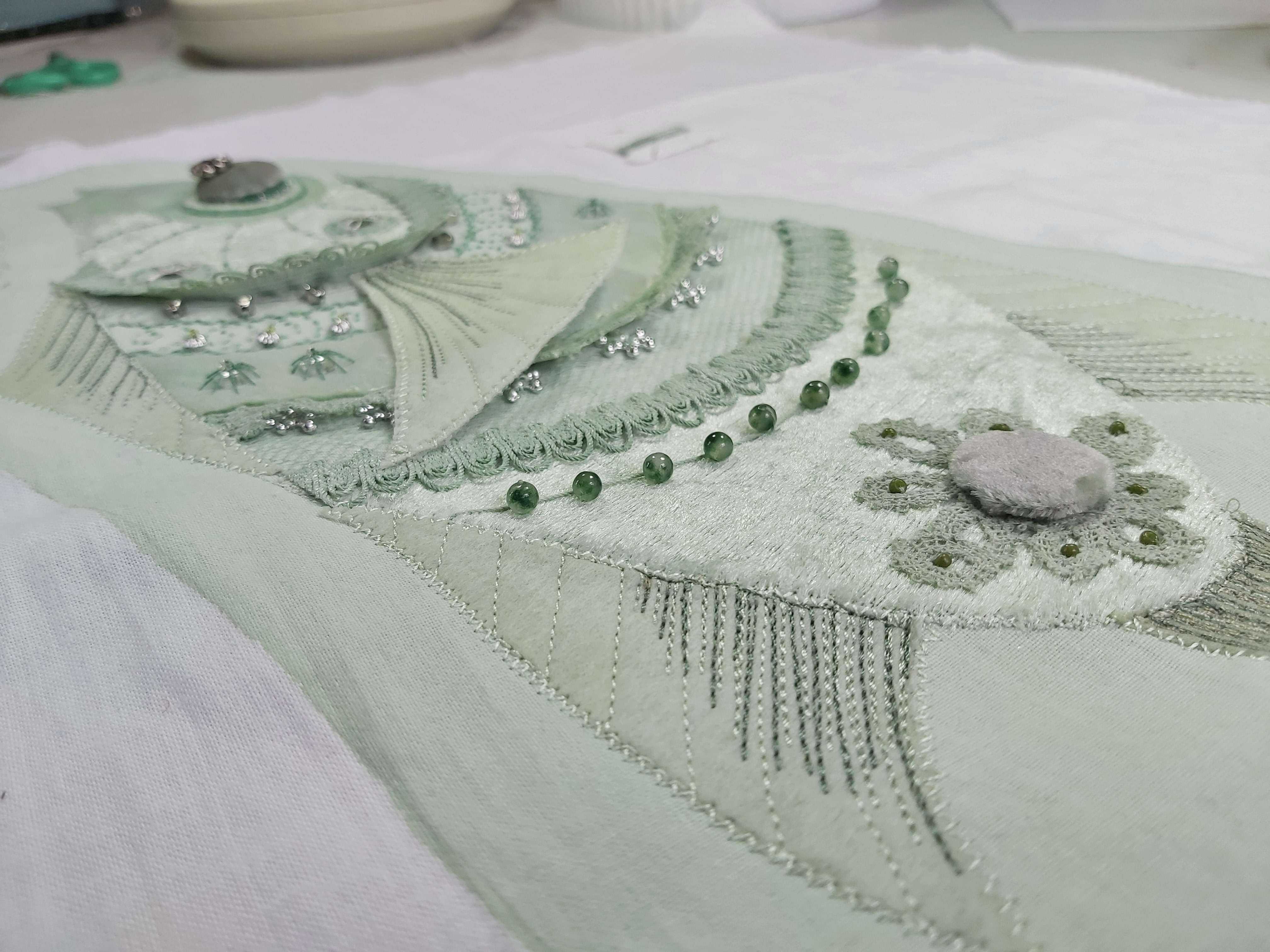
This is my finished fish with the addition of beads which I’m hoping will catch the light and add interest. I’m looking forward to seeing the finished piece but certainly don’t envy Hilary who now has the job of joining all of our segments together and making them fit!!
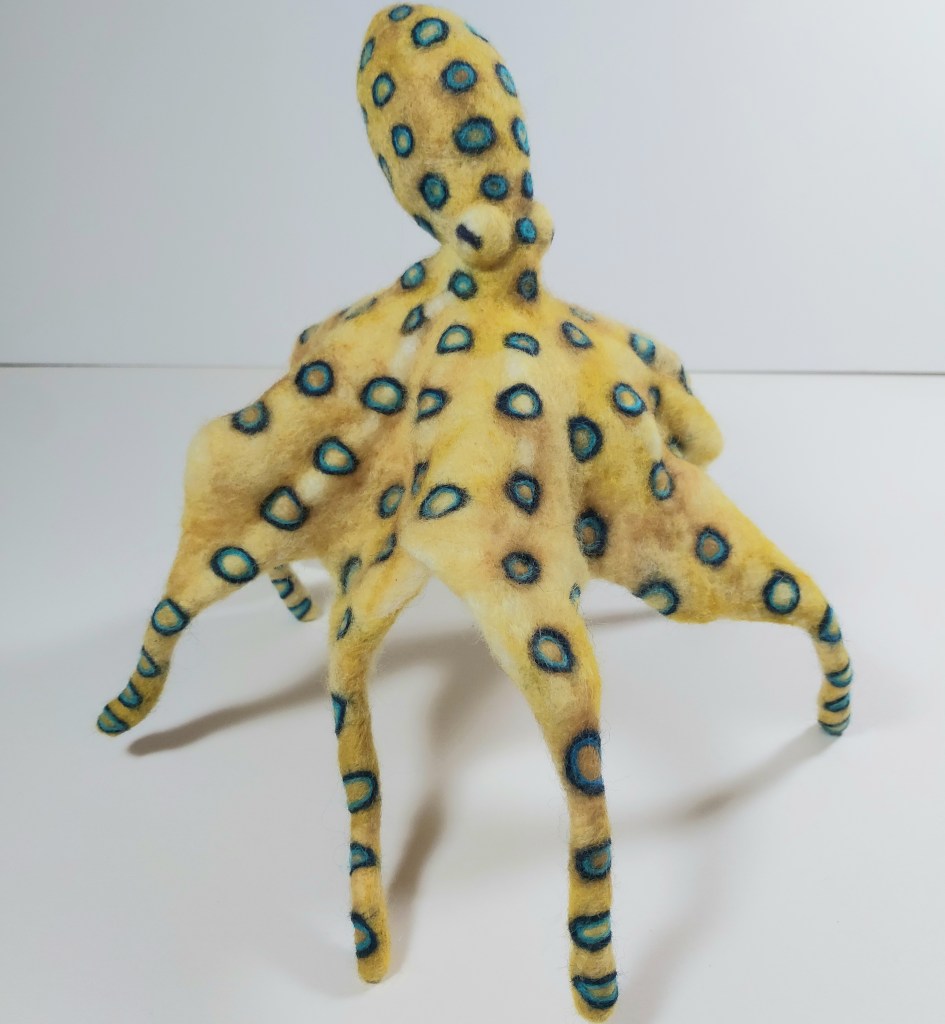
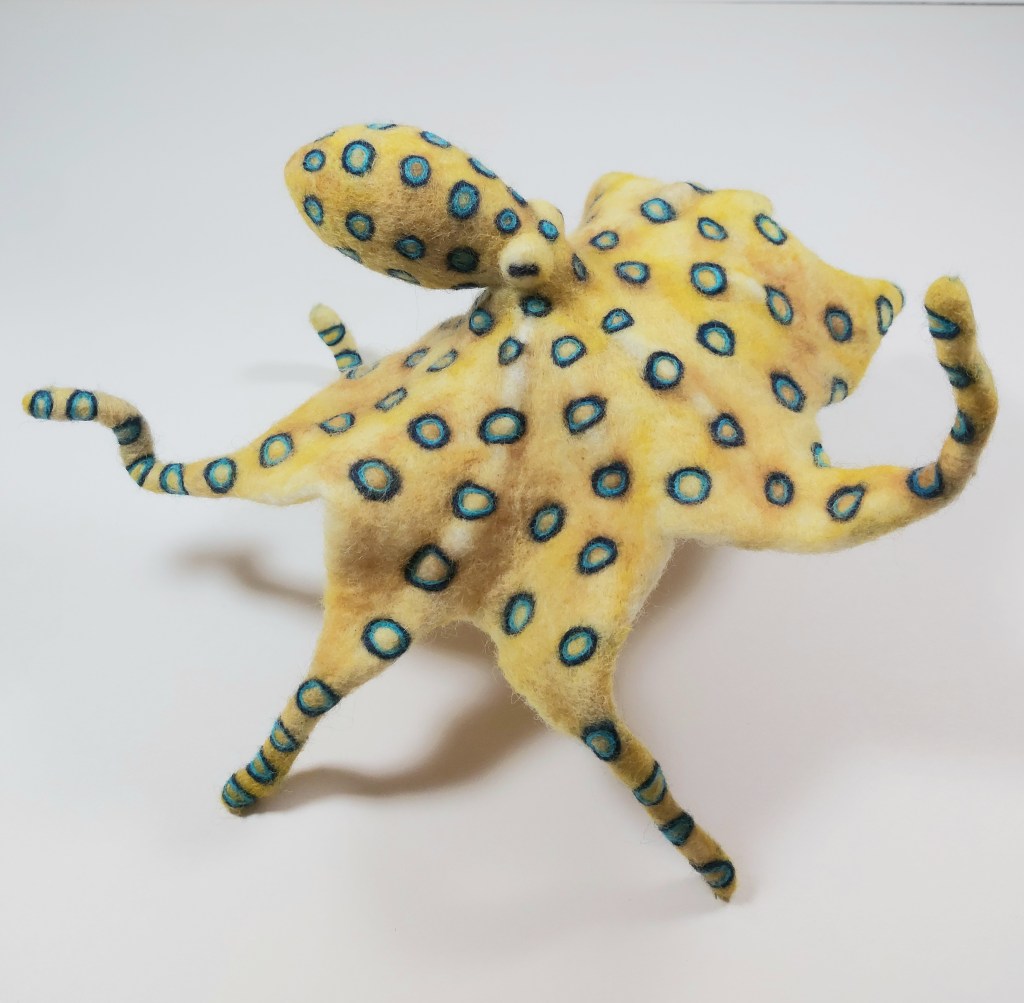
I mentioned in my last post that Waltham Textiles Exhibition will feature an Octopuses Garden. Well, after many hours of needle felting Olivia, or Oli to her friends, was born. At approx 36cm in diameter she’s a blue ringed octopus, fully articulated and created from carded Corriedale with Merino markings. The only thing left to do now is create and attach her suckers but that will be a fiddly time consuming job and one that will be fitted around less repetitive projects!
In real life the blue ringed octopus is much smaller than Oli. Size differs between species, but they range from around two to six centimetres long, with arms reaching lengths of seven to 10 centimetres. They usually appear as pale-brown in colour, and are only identifiable by their iridescent blue markings when they are agitated or hunting. Native to the Pacific Ocean, they can be found in the soft, sandy bottom of shallow tide pools and coral reefs. Although small and pretty they carry an extremely toxic venom which they use to paralyse their prey! Like other octopuses the blue-ringed octopus has a short lifespan of about two years. During the mating season the female will lay anywhere from 50-100 eggs, which she will guard for a long incubation period lasting almost two months. The male blue-ringed octopus dies after mating.
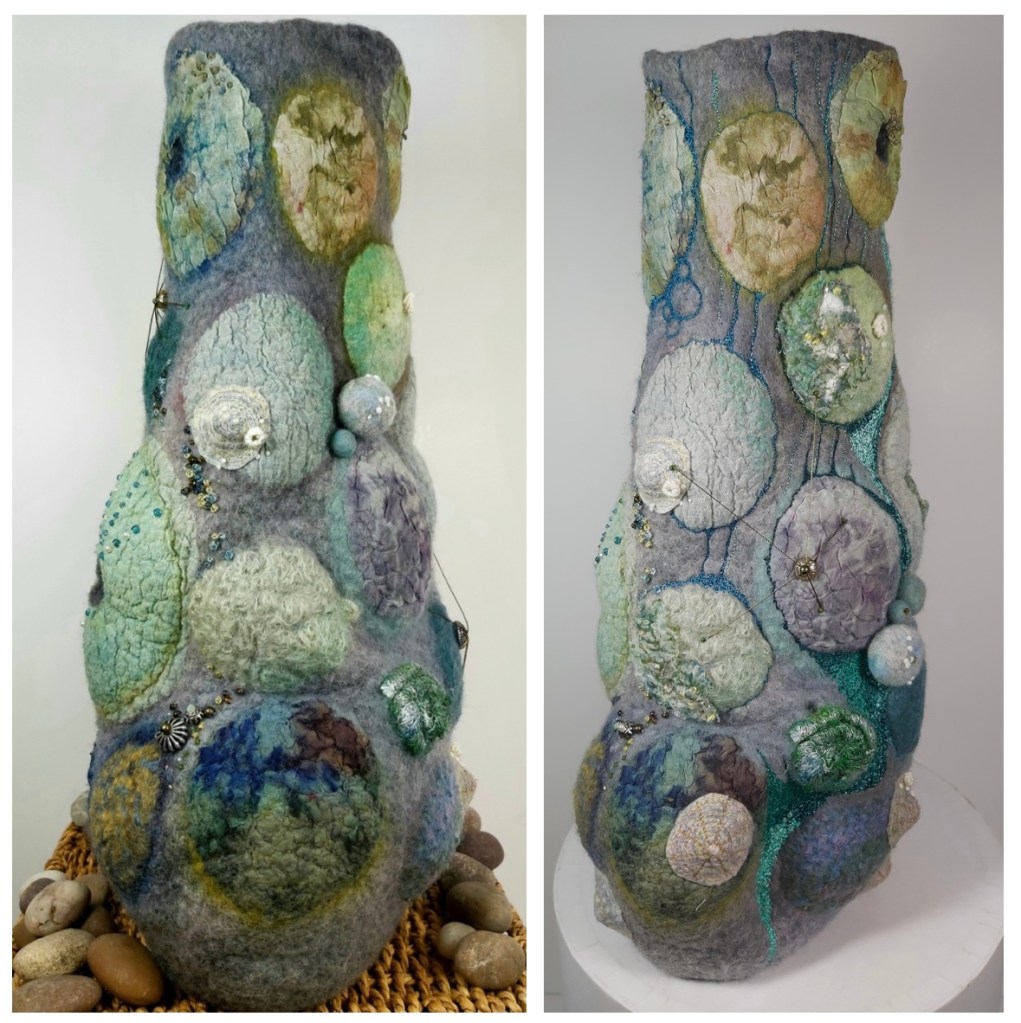
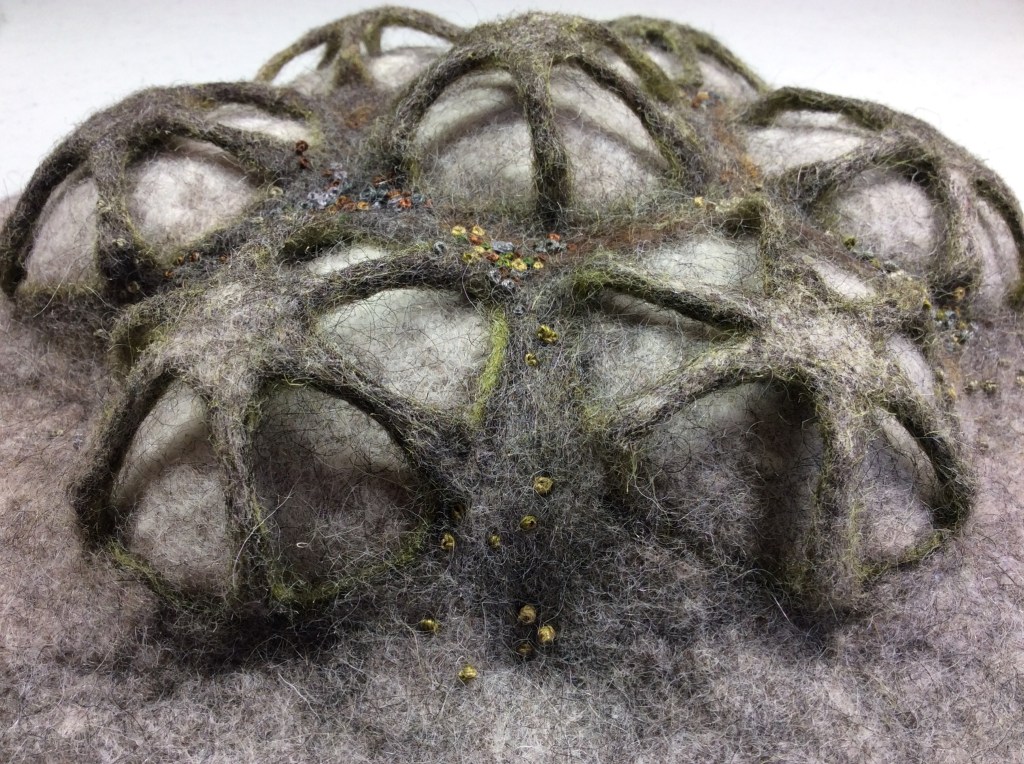
I’ve also recently given a makeover to a 3D wet felted piece, this was the first of two coral inspired vessels I made in 2023. The second one was heavily FM stitched, and far more interesting for it! I’ve been looking at this first vessel for a while and thinking “should I”? Over Christmas I finally bit the bullet and added FM stitch. The images on the left show before and on the right show after.
I absolutely love stitching into felt, whether by hand or machine, and I’m really pleased with the outcome and the added depth the machine stitching has created in this project.
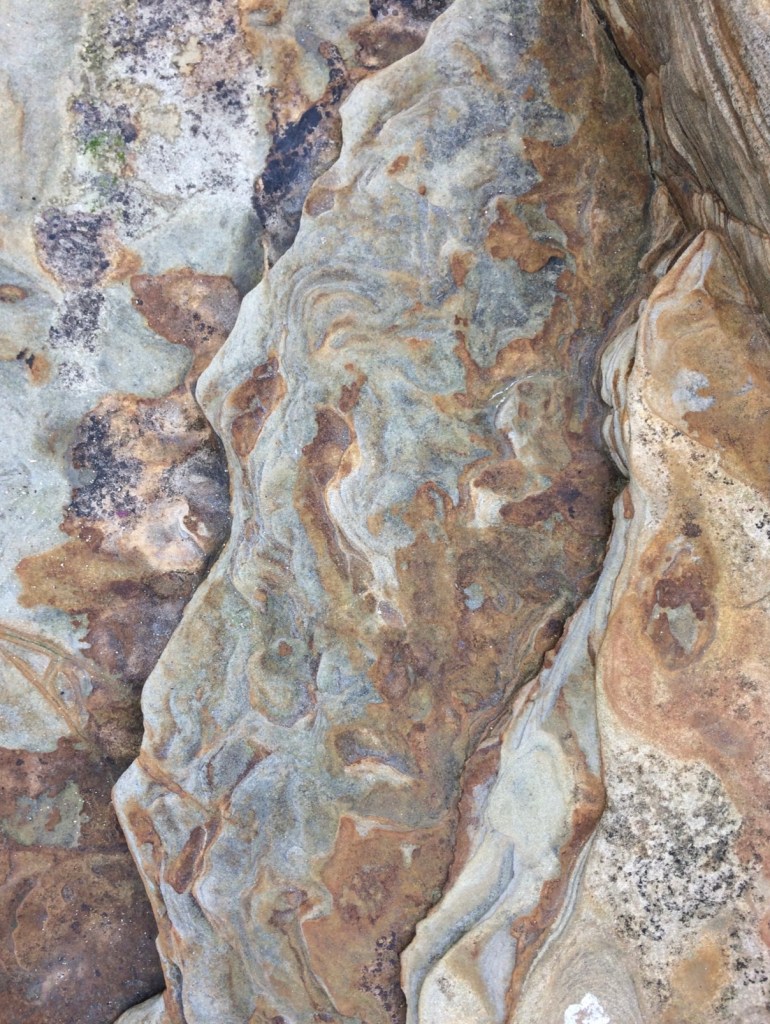
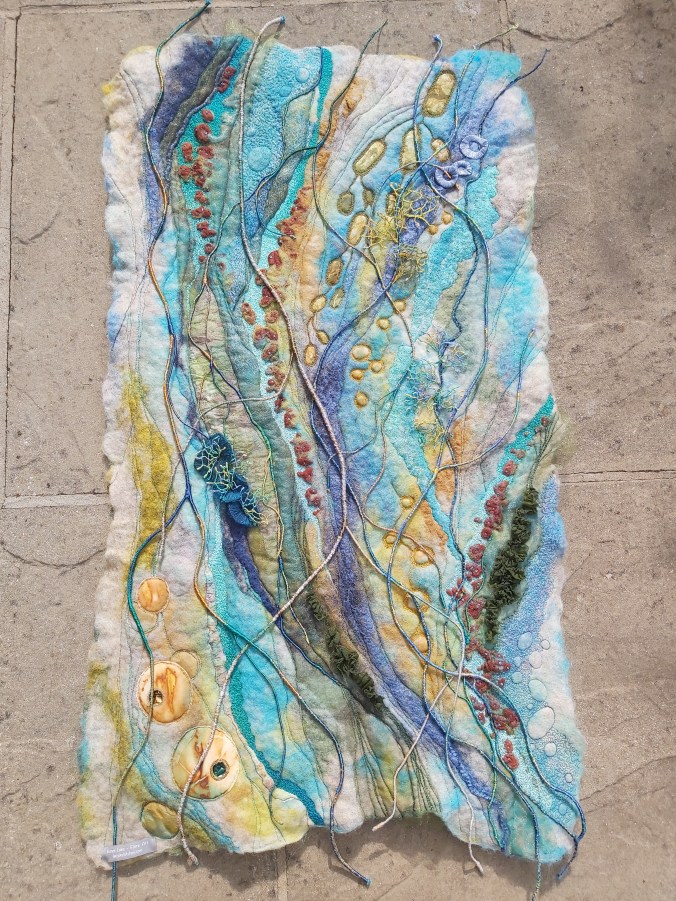
As part of the Waltham Windmill “Making Waves” challenge all members will have a metre wide wall space at next years exhibition to use as they wish. It’s too early to know for sure what I’m going to be putting up in my space (no shortage of ideas though!) but one possible piece could be this wet felted wallhanging I’ve called “Going with the Flow”. The inspiration for this came from the wonderful, wavy markings on the large stone slabs on Seahouses beach in Northumberland. This is one of my favourite spots in the UK and I took these photos a couple of years ago knowing that one day they would inspire a piece of work.
For the background I pulled out my box of oddments, short lengths of fibre left over from various projects, not enough to put back in their pack but too much to throw away…..not that I ever throw any fibre away! I recently bought myself a drum carder from Richard Britton and had fun carding all those oddments before laying them out.
This is how it looked after felting with silk fabrics, silk fibres, knitting yarn and nepps. I liked the silk circles bottom left but wanted them more 3D so they were removed and replaced with hand dyed fabric discs, recycled from another project.
So now I had my base fabric it was time to start embellishing. I made a start with a few lines of free motion stitch, mimicking the curving marks on the stone slabs. I didn’t have a sketch, or a plan, for where I was going but I like to work this way, making a start and then seeing where it takes me. I have to admit it would sometimes be far quicker to have a plan as it would avoid all of the attaching and removing and repositioning until it looks right, but I really do enjoy that part of the process!
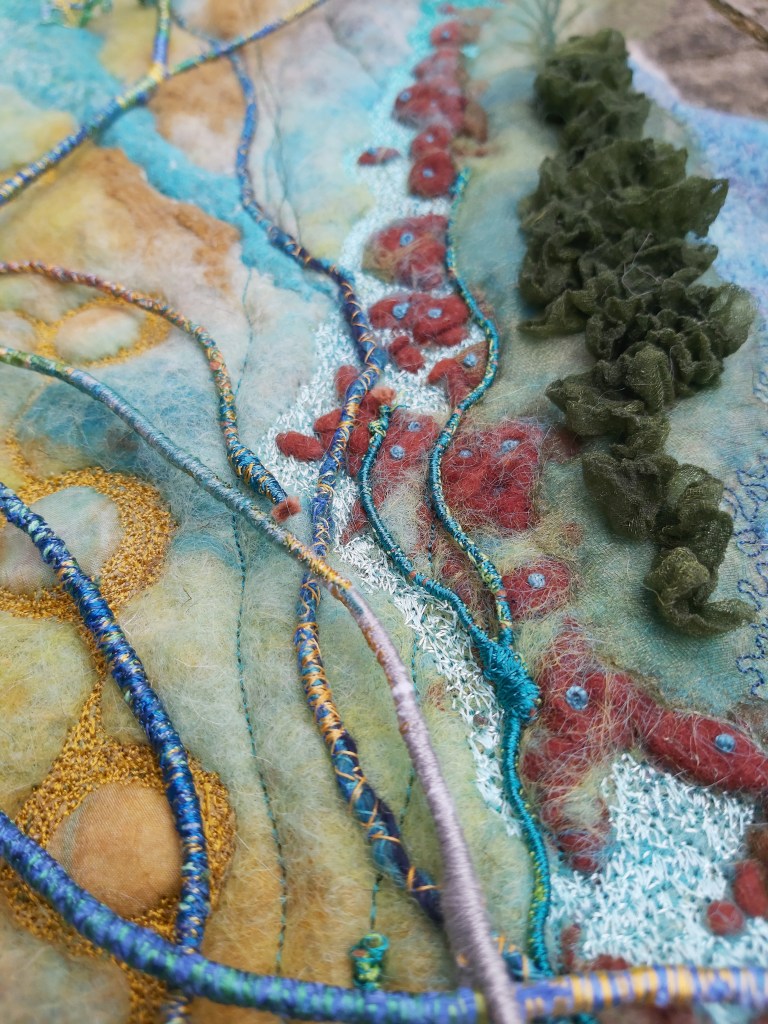
Its been several months in the making but I’ve thoroughly enjoyed working on it using a combination of free motion stitch, hand embroidery, recycled fabrics and coffee capsules, sheer fabrics, hand painted silk fabrics and machine wrapped cords. The more I embellished the further it shifted from being about single slab of rock to becoming more about the ocean in general with its abstract rivulets of water, seaweed, coral and the obligatory rock pools. Approx 90cm x 50cm.
Another of the specific items we’ve been challenged with for the Making Waves exhibition is a fish. I immediately decided I was going to wet felt mine which lead to us having a in-house felted fish workshop and the creation of TroutPout! She’s made from carded Corriedale and is approximately 33cm x 36cm excluding the fins.
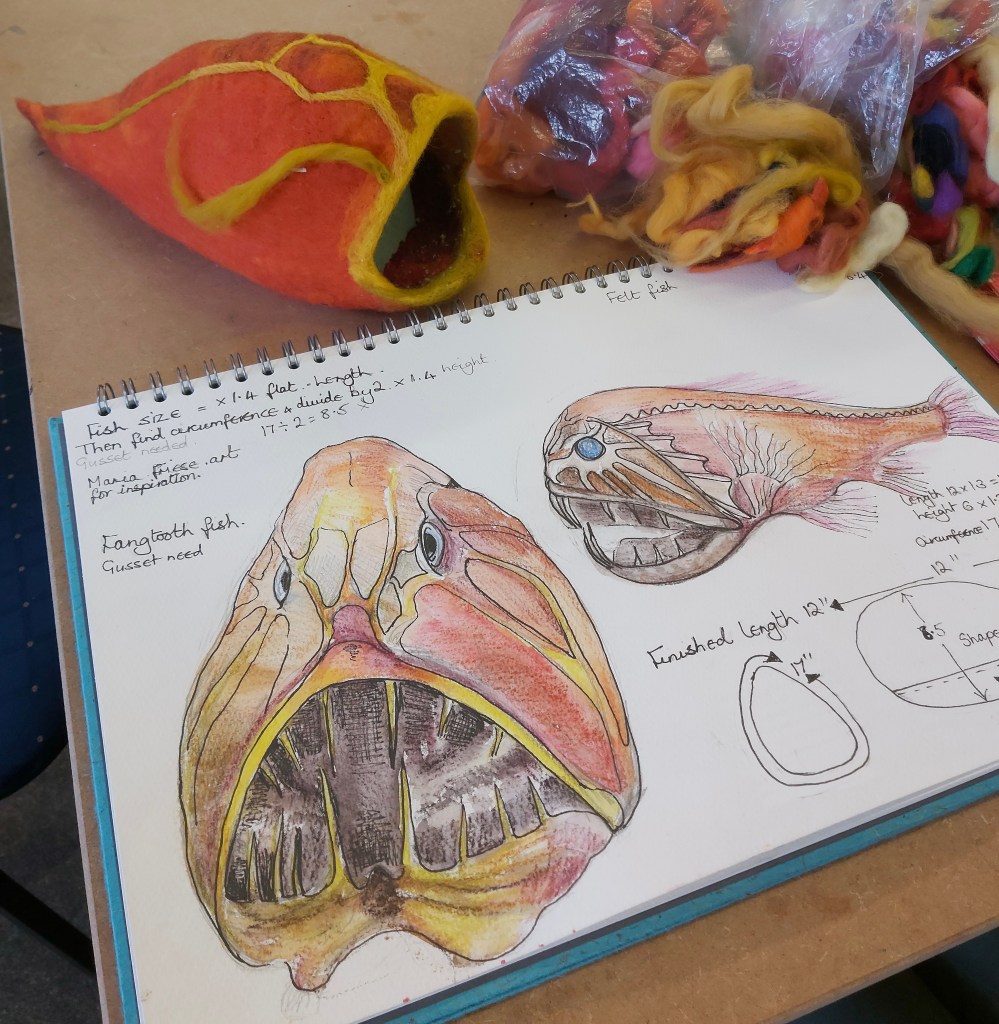
These are some of the other fabulous fish that members have made so far, this one is Barbara’s scary Fangtooth…..
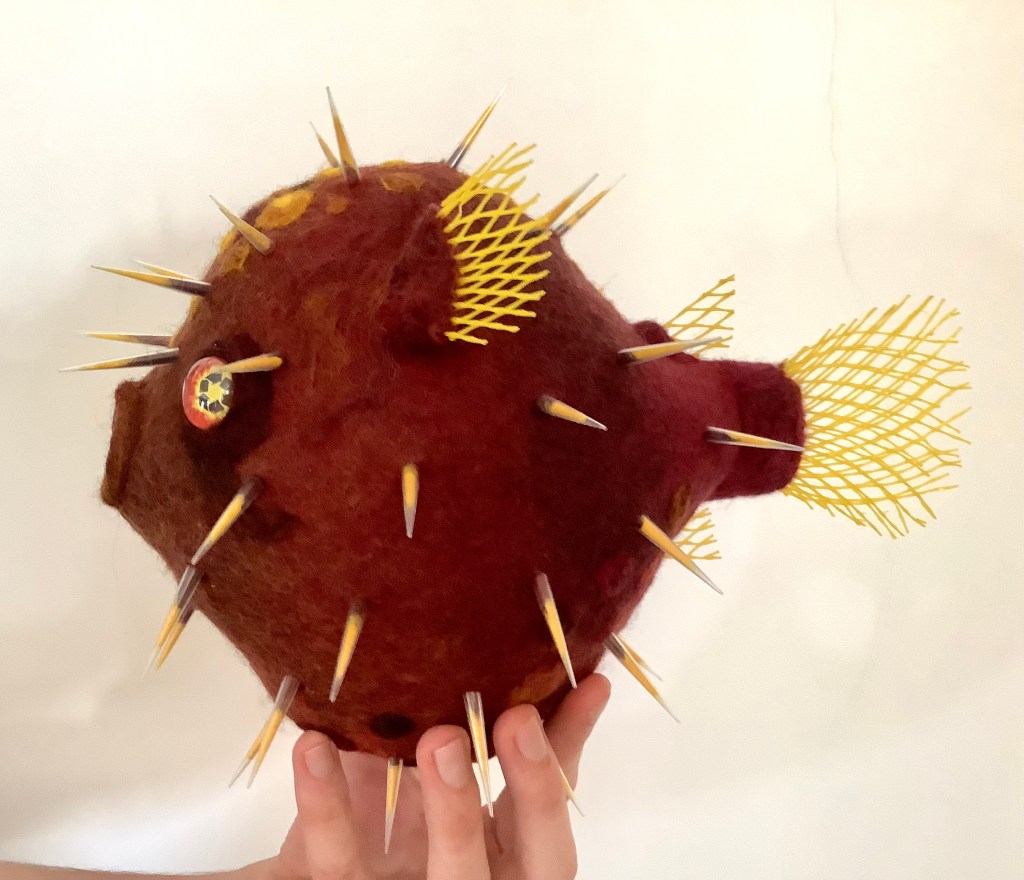
Lucy made a wonderful wet felted Puffer Fish adding recycled plastics, including pipette tips, wine bottle netting and glass beads with recycling symbols underneath, to highlight the plight of our oceans.
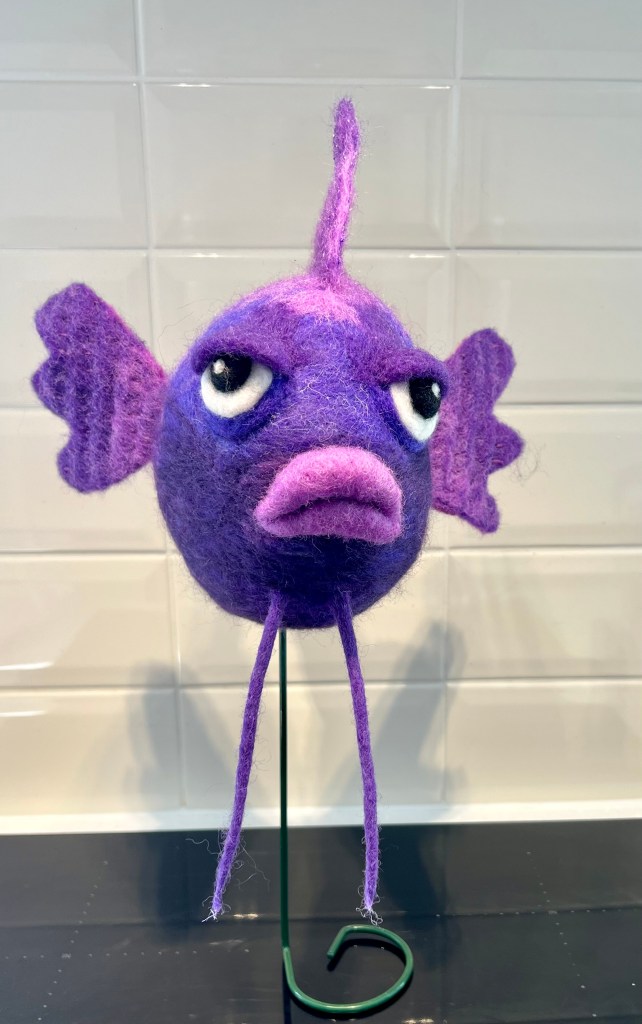
Sue is new to wet felting but she’s taken to it like a fish to water (couldn’t resist!) and has made “Angry Fish”. I think he looks more sulky than angry but he’s terrific!
And there are several others that are work in progress….
I’ve been teaching 3D Seed Pod workshops recently using wire wrapped with Tyvek fabric and decided I’d also like to make an Anglerfish from wire rather than fibre. It was only when I’d got the 60cm x 33cm framework made that I sat back and realised I’d gone past the stage where I had meant to start adding my fabric! Time for plan B…..maybe I could use wire mesh to give it “body”?
I looked for some online but hesitated as I wasn’t sure how flexible or suitable the mesh would be. Having put the fish to one side, a few days later I joined the Lincolnshire Textile group and at my first meeting I was offered a piece of silver coloured Sinamay. Sinamay is one of the most popular hat-making foundations. It’s woven from the processed stalks of the abaca tree, a type of banana native to the Philippines. I couldn’t believe my luck……..being silver coloured this off cut looked like wire mesh but wasn’t and if I sprayed it lightly with water I could shape it to fit and stitch it with aluminium wire to my framework. So this is Wanda, also known as “Gone Fishing!” made with a combination of galvanised, aluminium and beading wire and Sinamay. She wasn’t easy to photograph as I didn’t have large enough sheets of black card but hopefully enough detail is showing.
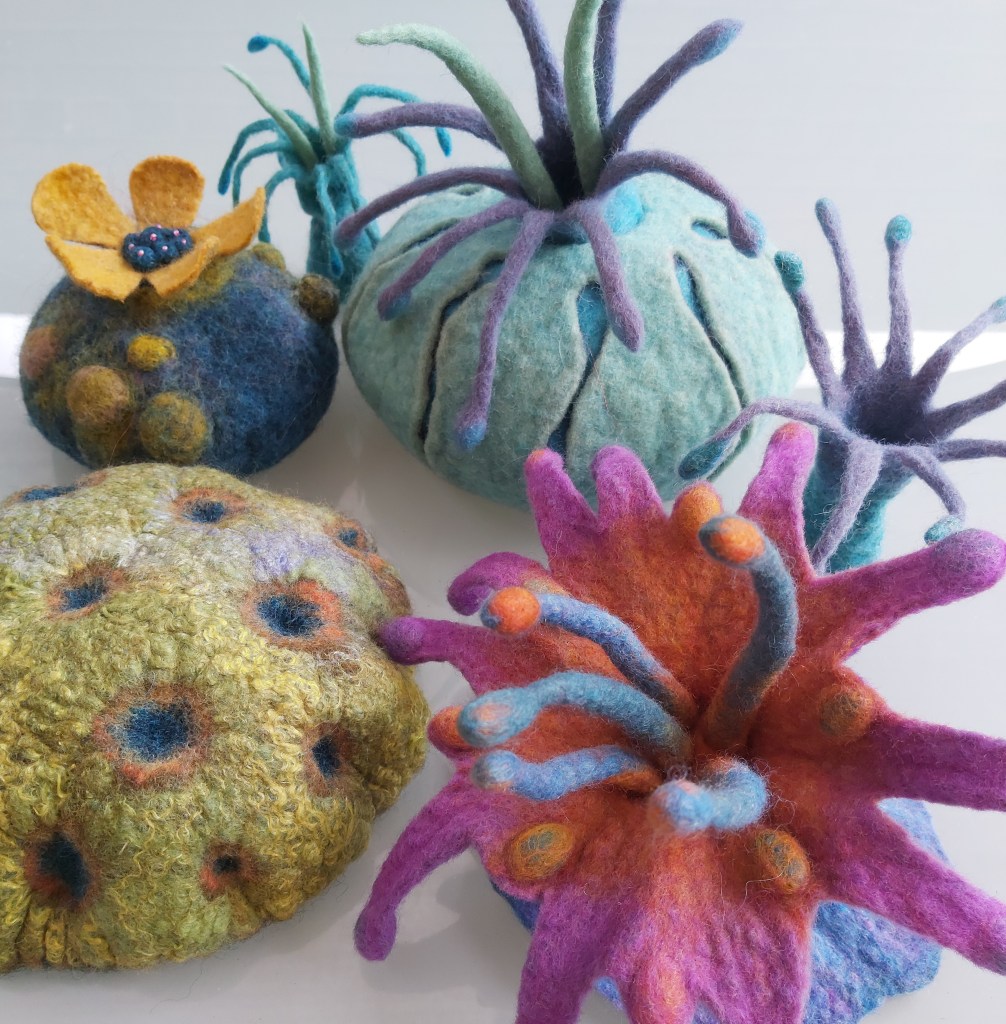
Another feature of our exhibition will be the Octopus’s Garden so we will be needing a few Octopus and a variety of coral decorate it…..my collection is steadily growing!
I mentioned having joined the Lincolnshire Textile Group and, as luck would have it, their current theme, and next years exhibition, is “Water” so sits nicely with the Waltham theme. It’s good to know I can carry on creating ocean inspired work for at least the next 12 months!
The Waltham Windmill textile group, of which I’m a member, have a theme which runs for two years culminating in an exhibition of work. The current theme is Making Waves and the exhibition for this one will be held sometime in the first half of 2024.
Within the groups theme we have free rein to make whatever we want plus we’ve agreed a number of specific items we will each make. One of the items is a jelly fish. Having done a bit of research into the many and varied species of jelly fish I came across the spotted Blue Jellyfish which is native to UK waters. My first thought was to create a “wet look” using Merino fibre covered with lots of viscose which would create a sheen and then I would free motion stitch the spots. That was quickly replaced with the idea of making my jellyfish from sheer fabrics…..I seem to have accumulated lots of sheers and only ever use tiny amounts so this would be a perfect opportunity to use up some of my stash. After rummaging through a huge sack of fabrics, almost losing hope of ever finding the colour I needed, I came across a small piece of blue and another of turquoise, just enough to do the job…..so much for stash busting!!
Blue Jellyfish (Cyanea lamarkii), feeding on small plankton, England – source www.wildlifetrusts.org
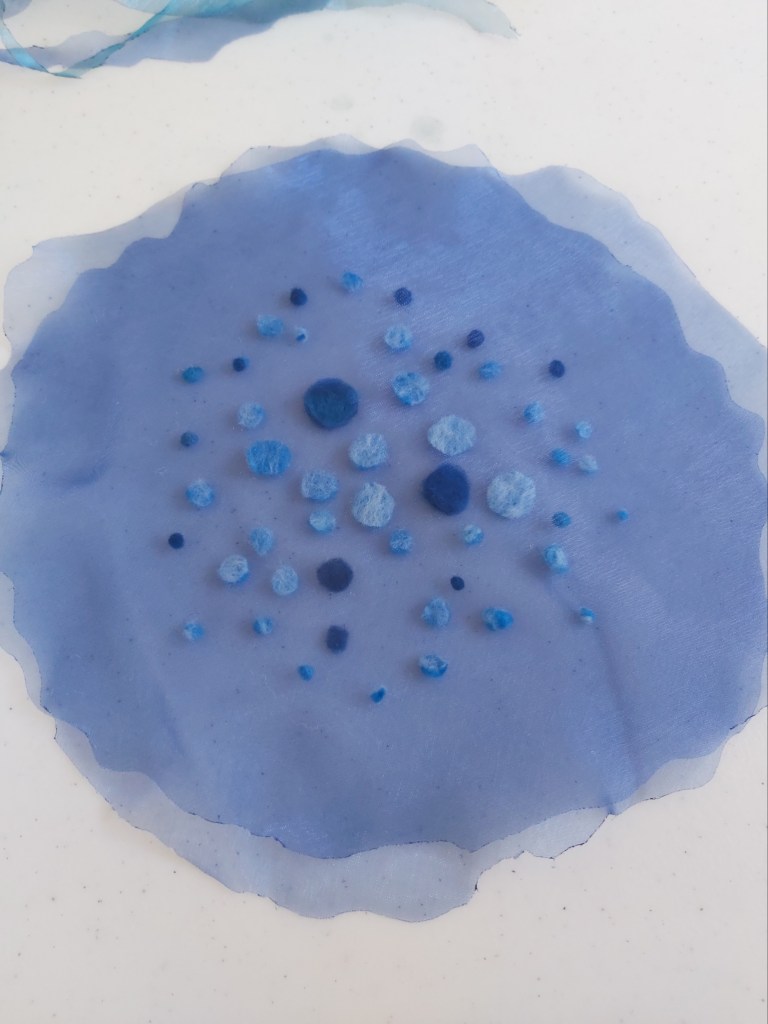
The remnants of fabric, and the size of my embroidery hoop, determined the size of my jelly fish. I’d got some of the wash away stabiliser left over from a project I did a few years ago so that would be useful for stiffening and shaping the jelly fish.
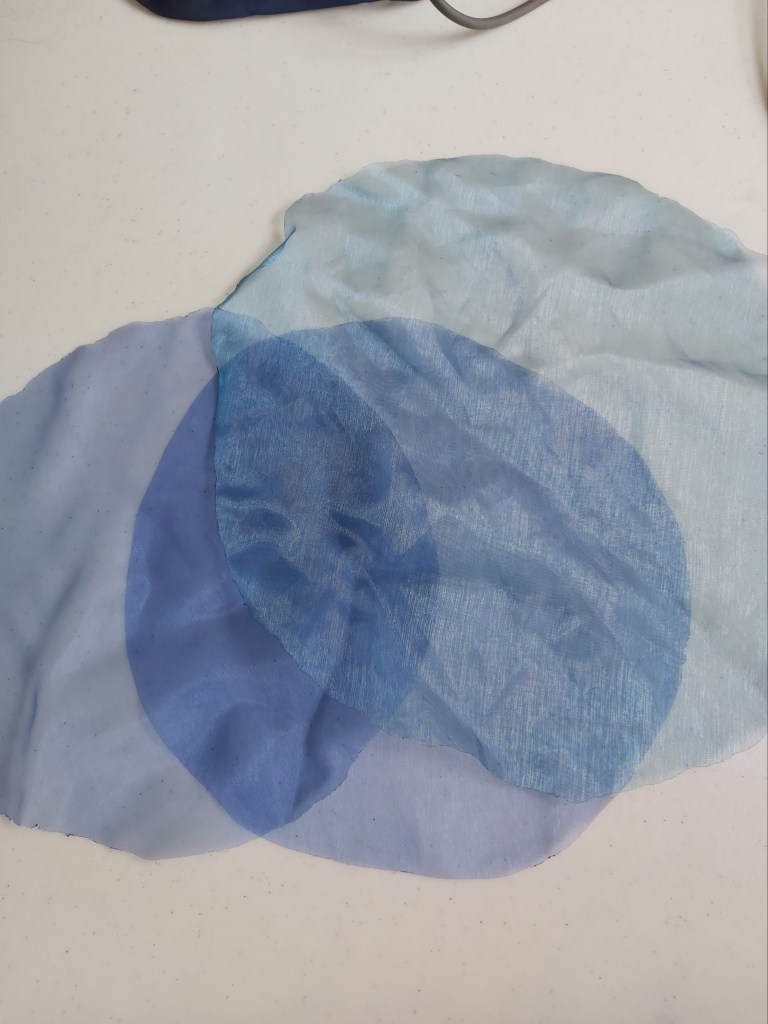
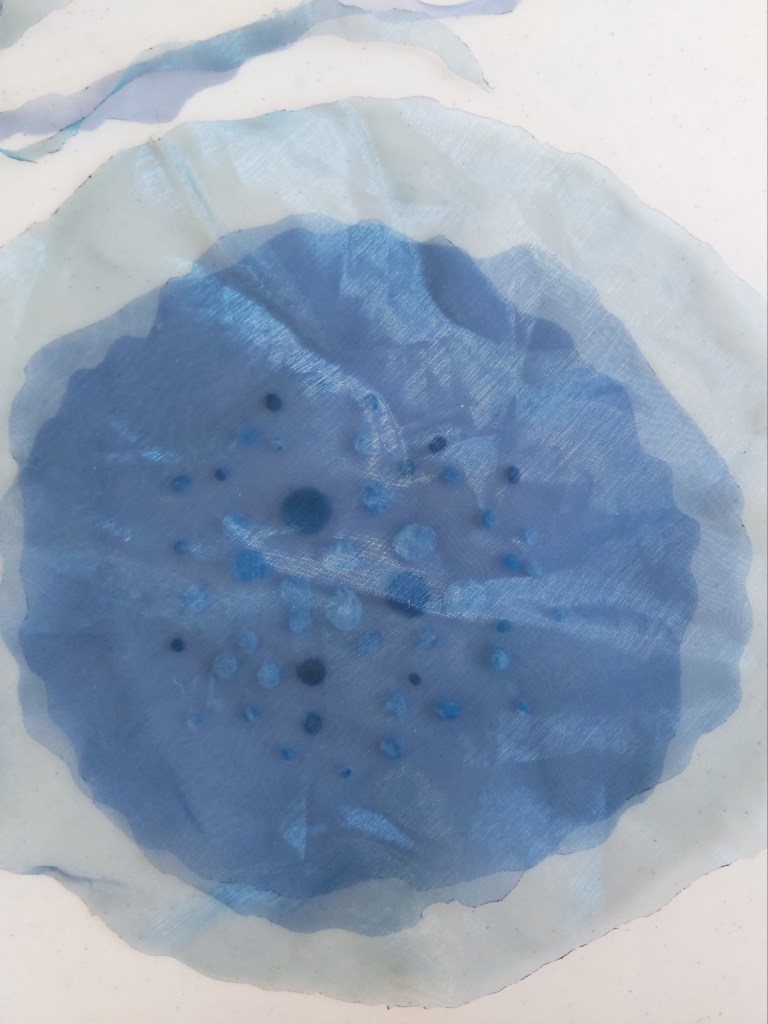
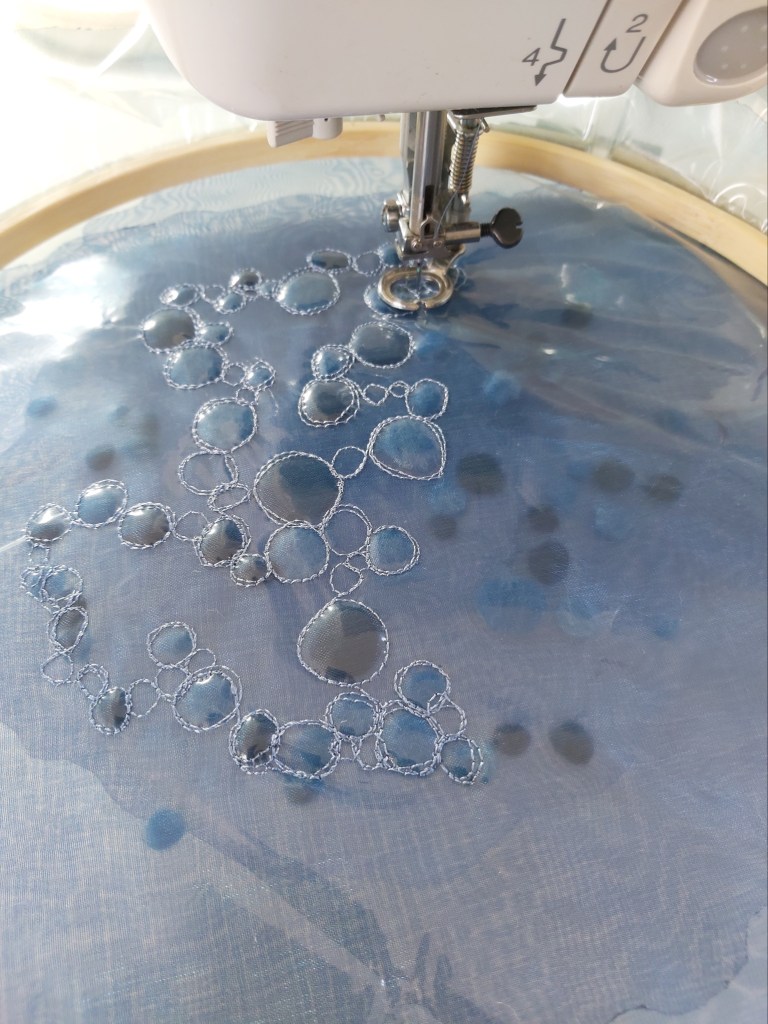
I had enough blue fabric to cut out two circles plus one slightly larger from the turquoise. I also added a small white circle of fabric underneath thinking it would highlight the spotty area. Next I cut up some scraps of felt for the spots and arranged them on the blue discs before covering with the turquoise sheer. This sandwich was then put in the hoop and I machine stitched around the spots…..or at least that was my intention! Unfortunately I struggled to see where some of the felt was so it’s a bit hit and miss but it was near enough!
After removing it from the hoop I washed out some of the stabiliser retaining a good bit of the glue on the fabric to enable me to shape it over a plastic bowl. I didn’t think to photograph the drying stage so the next image shows it dry with the unattached tentacles cut from tulle and sheers.
The final step was to wet felt a blue “inner”, with additional thin felt tentacles, sew the fabric tentacles inside it and insert into its casing.
The finished spotted blue jelly fish.
I’m quite pleased with the finished result and this particular area of the exhibition should be interesting as we’ve used lots of different styles and techniques between us.
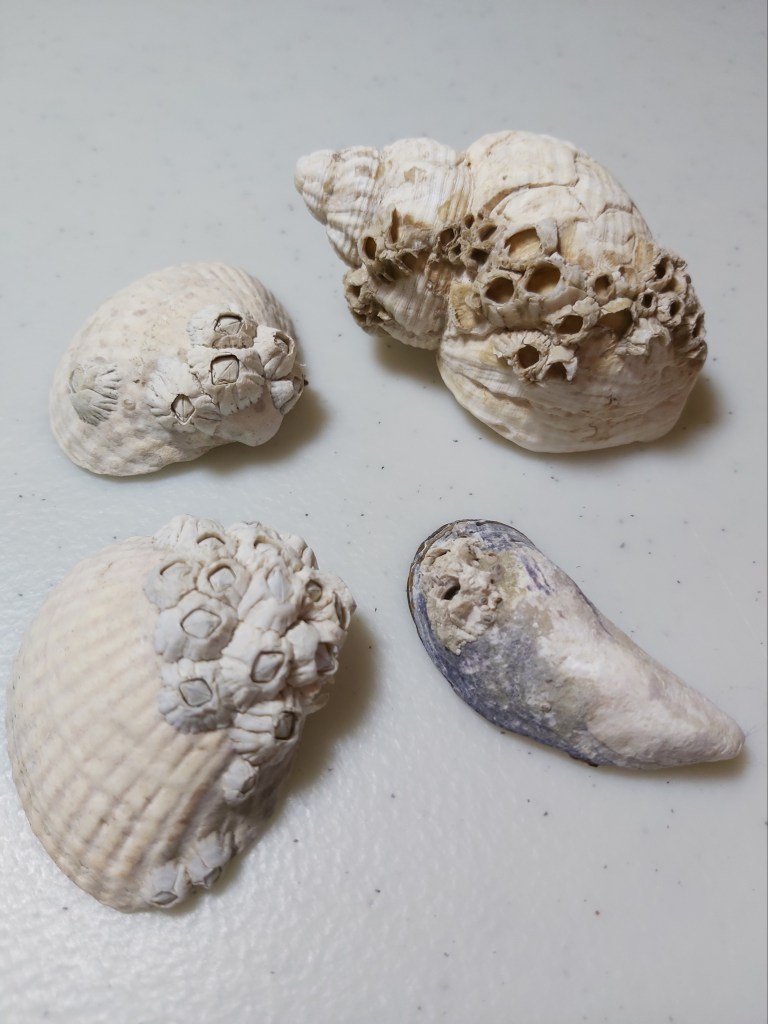
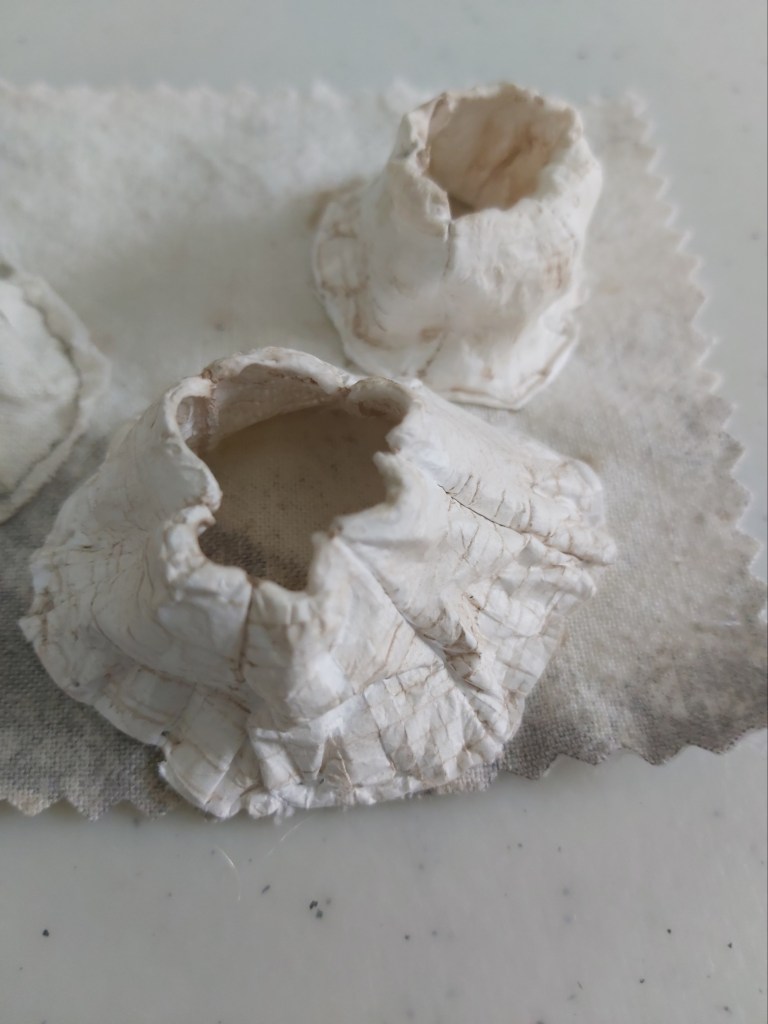
Another idea I’ve been playing with is barnacles. I’ve always had a fascination for barnacles and can’t resist collecting them when I find them on stones and shells. These marine crustaceans are related to the crab and lobster and tend to live in shallow and tidal waters, typically in erosive settings.
There are around 1,000 different species and, as adults, typical barnacles are covered with calcareous plates and are cemented, head down, to rocks, shells, pilings, ships’ hulls, driftwood, or seaweed, or to the bodies of larger sea creatures, from clams to whales.
They feed by reaching into the water column with eight pairs of thoracic limbs called cirri which are long and feathery. The cirri extend to filter food, such as plankton, from the water and move it towards the mouth as you can see in this video. (Follow the link and scroll down to Ecology)
Barnacles on rusty metal
I’ve always liked this photo of barnacles on a rusty piece of metal which was taken on a visit to Ullapool harbour so I’m experimenting with different fabrics, including cotton and Tyvek, to make a barnacle inspired wall hanging. So far I’m leaning towards the Tyvek fabric.
Cotton fabric barnaclesTyvek fabric barnacles
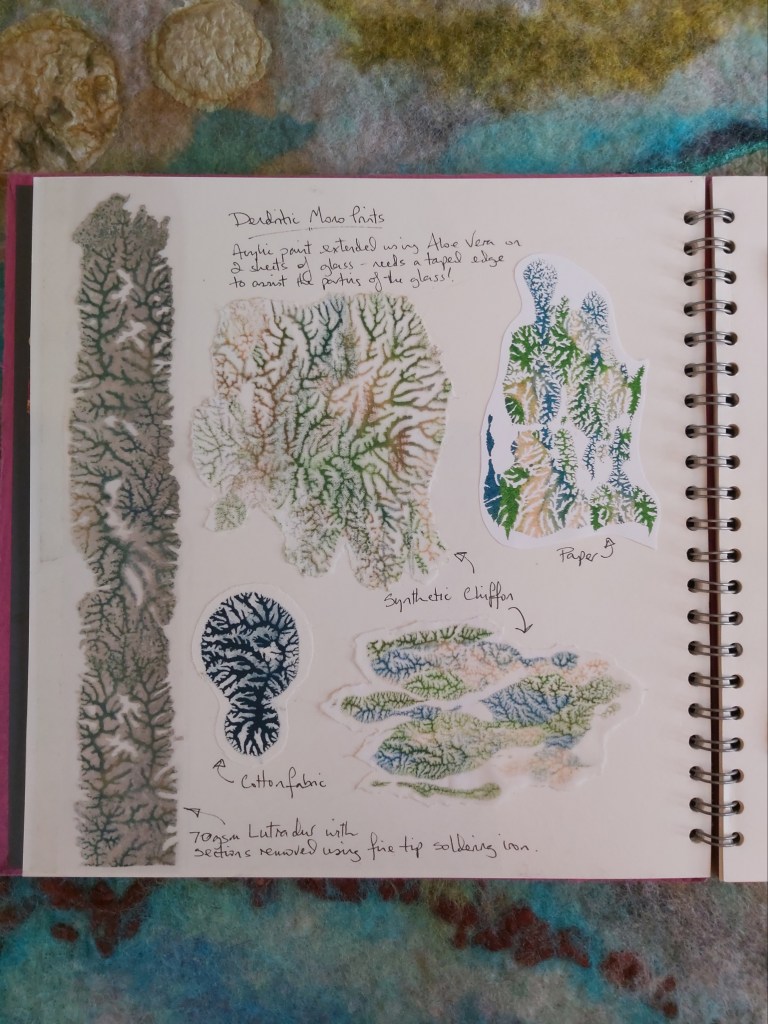
Something else I think will lend itself to the theme is dendritic printing. I love the vein like patterns, very reminiscent of coral, which can be created by pressing acrylic paint between two sheets of glass or plastic and then printing with it. I’ve been trying this out on different surfaces including paper, Lutradur, chiffon and cotton.
The most surprising result was a the print on felt, I was amazed at the clarity of it and I can see this being developed further with added stitching.
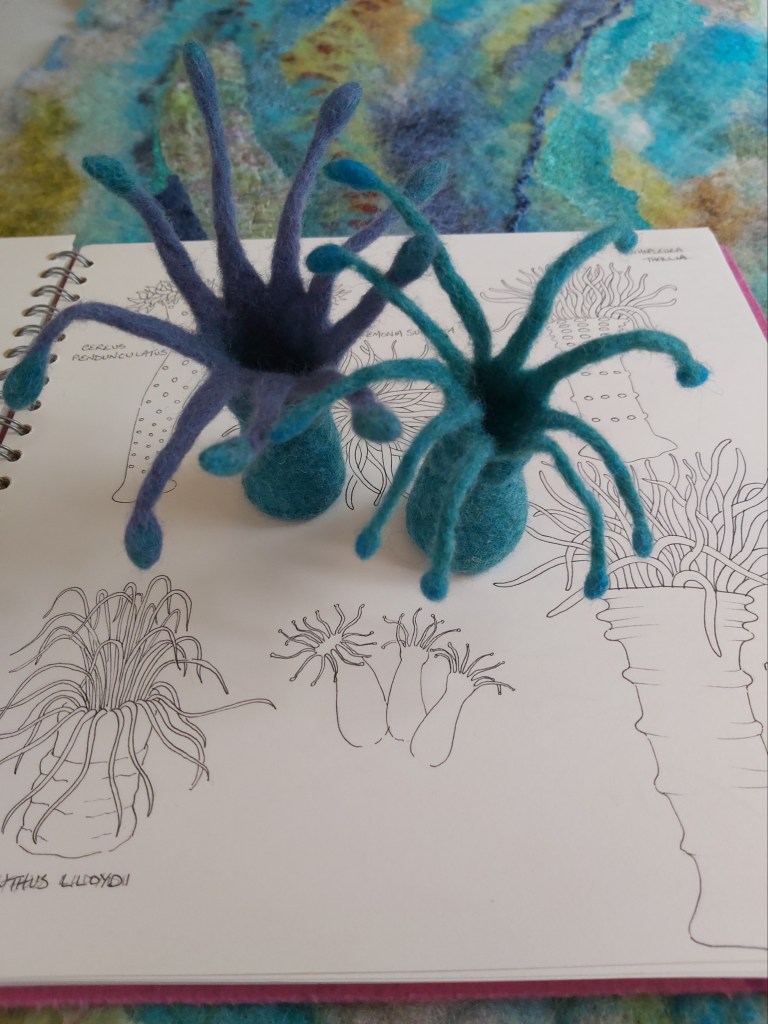
Working on ideas for felted sea anemones
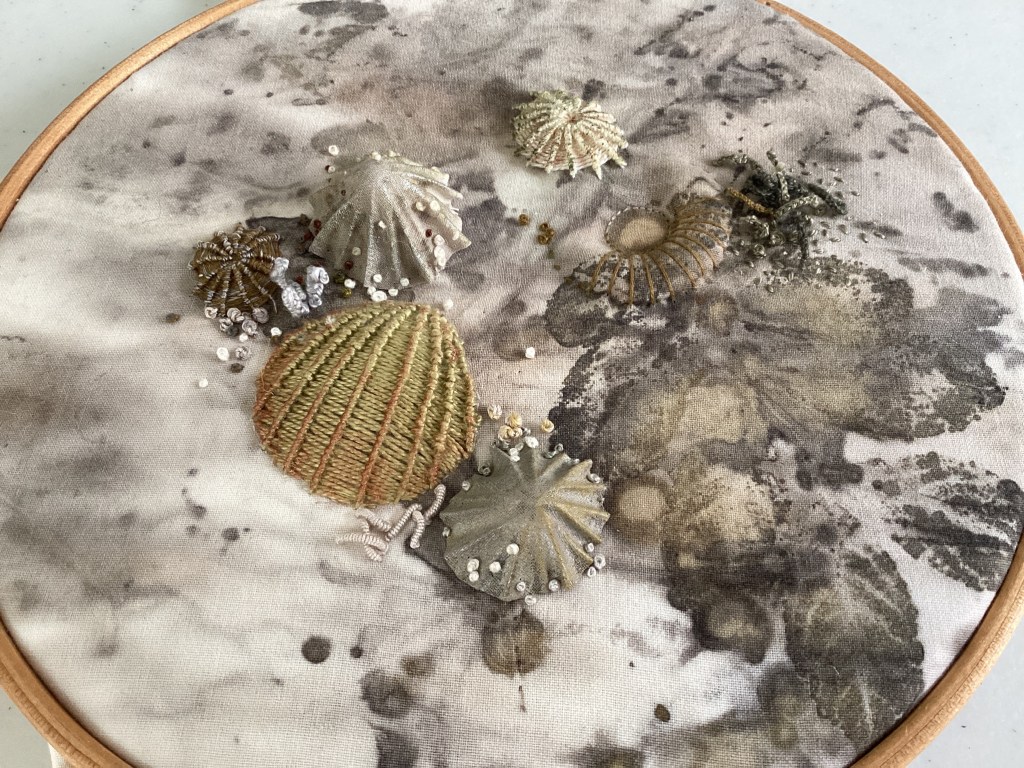
There are so many possibilities within this theme that my mind is working overtime and I’ve a few other projects on the go right now. One of them is this small 20cm dia embroidery being worked on an eco print cotton fabric.
Another is a wallhanging approximately 95cm x 45cm. It started out as a wet felted background made from various remnants of fibre which I ran through the drum carder. It’s had a lot of embellishment since this picture was taken, incorporating machine stitch, hand stitch, cord making, recycled coffee capsules, burnt sheer fabrics and hand painted silk fabrics. It’s almost finished now so I will feature that in my next post.
Back in 2019 I signed up to take part, for the first time, in the 2020 British Quilt & Stitch Village Show which is held annually at Uttoxeter Racecourse in Staffordshire. Needless to say it got postponed due to Covid and was rescheduled for 2021. With Covid delaying it yet again it was rescheduled for 2022 and will finally be launching in three weeks time on the 22nd of April.
It’s been such a long time coming I am so excited at the thought of getting back to exhibiting again after all this time! It’s also going to be great to see the other exhibits…..online exhibitions are better than none but you can’t beat being up close and personal to really appreciate other people’s work.
The show will be on from 10am each day on the 22nd , 23rd & 24th of April with lots of fantastic exhibitors and traders eager to help us replenish our stash! There is lots of free parking and the site is wheelchair accessible. The show offers a warm, friendly atmosphere, displaying plenty of embroidery/quilt exhibits (group & competition), and work from textile artists and Feltmakers plus a variety of traders and fabulous workshops.
If you are planning to visit please stop by my stall and say hello. Unless there is a last minute shuffle you will find me in the Premier Bar, these are just a few of the pieces I will have on show.
Where did January go? With the lifting of Covid restrictions and things starting to get back to normal the time is passing in a blur. It’s terrific to be takings bookings for classes once again and I’m looking forward to working with new groups this year. It’s also going to be great, after two years of cancelled exhibitions, to be showing my work at the Quilt & Stitch Village at Uttoxeter in April and the Big Textile Show at Leicester in October.
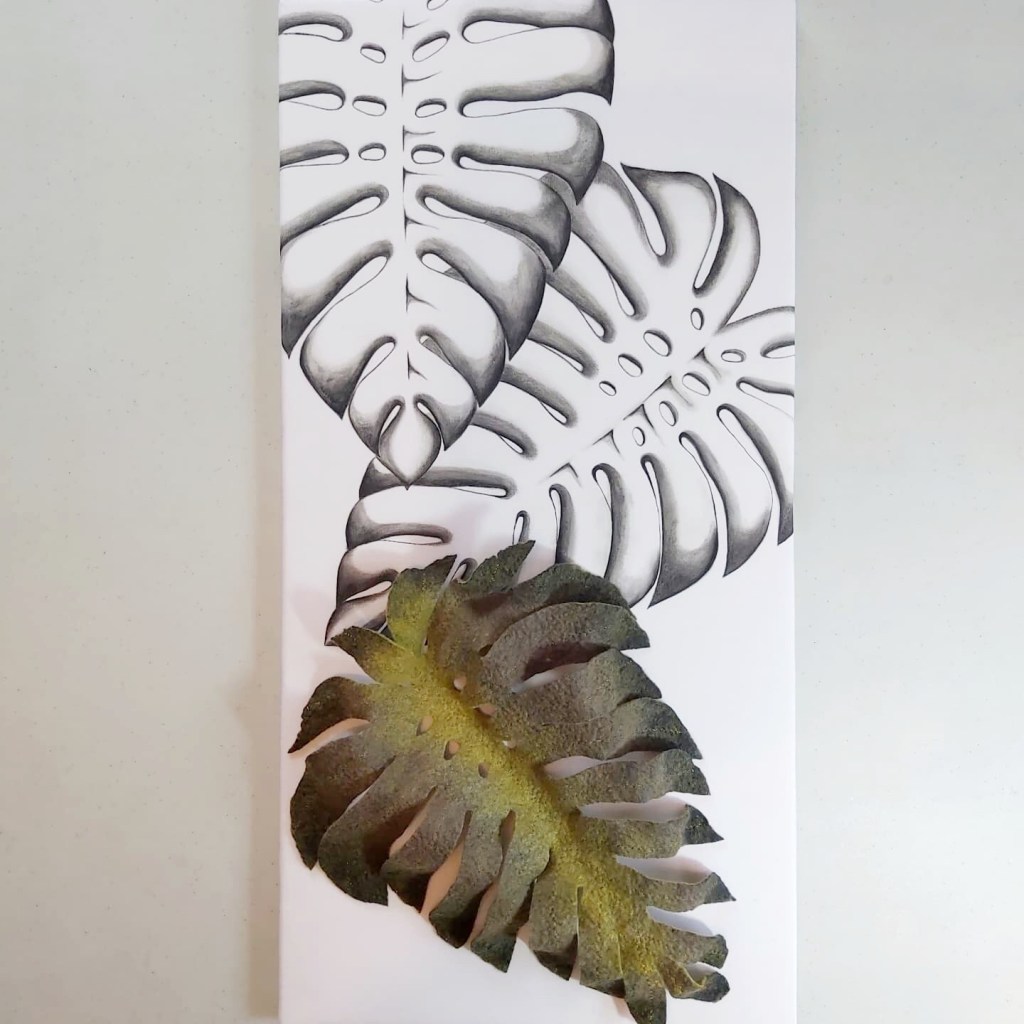
At the Waltham Textile group we normally have a biannual exhibition of our work but, due to Covid, it was cancelled in 2020 rescheduled for 2021 and then had to be cancelled again. It’s now been confirmed for August but in the meantime I’ve sold my main “Leaf” themed piece made for that show so recently made this mixed media “Monstera” to replace it.
I bought a 40cm x 80cm canvas with the intention of painting Monstera leaves on it and then adding a 3D Felted leaf. After drawing a template onto paper and offering it up to plan the layout I changed my mind about painting onto the canvas. It’s not something I’ve done before and the surface appeared to be a bit too textured for the look I wanted to create. Instead I sketched the leaves onto a piece of white cotton fabric, outlined them with an Inktense pencil and added a little shading. The aim was for very simple, very smooth, perfectly formed leaves looking more like curved metal than the foliage on my cheese plant. I think this was influenced by the very smooth metallic looking Tyvek seed pods I’ve been making lately.
The Monstera in our lounge looks a bit neglected, to the point that I couldn’t bring myself to photograph it for this post! Its been with me for more years than I can remember, moving from house to house, and I thought it would be nice to make a piece of work inspired by this plant….or should I say the plant it used to be!!
I don’t consider myself a painter but I do like painting on to fabric. If you need to paint precise lines a good tip is to use aloe vera (by far the cheapest) or acrylic medium instead of water when applying acrylics on fabric. This keeps the paint where you want it to be and avoids it bleeding into other areas. I managed to get a tiny bit of black paint on the lower section of the fabric but stopped short of starting all over again when I realised the felted leaf would cover it up!
My paper template for the painted leaves was 13” x 18” so to make the felted leaf I multiplied by 1.4 enlarging it to 18.5” x 24” to allow for shrinkage. Layer one was a very yellowish green Merino (might have been lichen but not certain). Layer two was a combination of various shades of grey with the yellowish green running down the centre. This was topped with a layer of dark green Merino and Ireland Viscose all around the edge and snippets of gold Viscose down the centre. These images don’t give a true representation of colours but you get the gist.
After wetting out I measured the fibres and found they had spread to approx 20” x 27”. At the fulling stage, every now and then, I put the original template on top to check for size and ensure I was keeping to the right shape.
Once it had shrunk to the correct size it was left to dry. The next stage was to add wires to the back of the leaf so it could be shaped. This could possibly have been done with directional laying of the fibres and lots of fulling but I wanted the option of posing the leaf once it was attached to the canvas and wires are a good way of doing this.
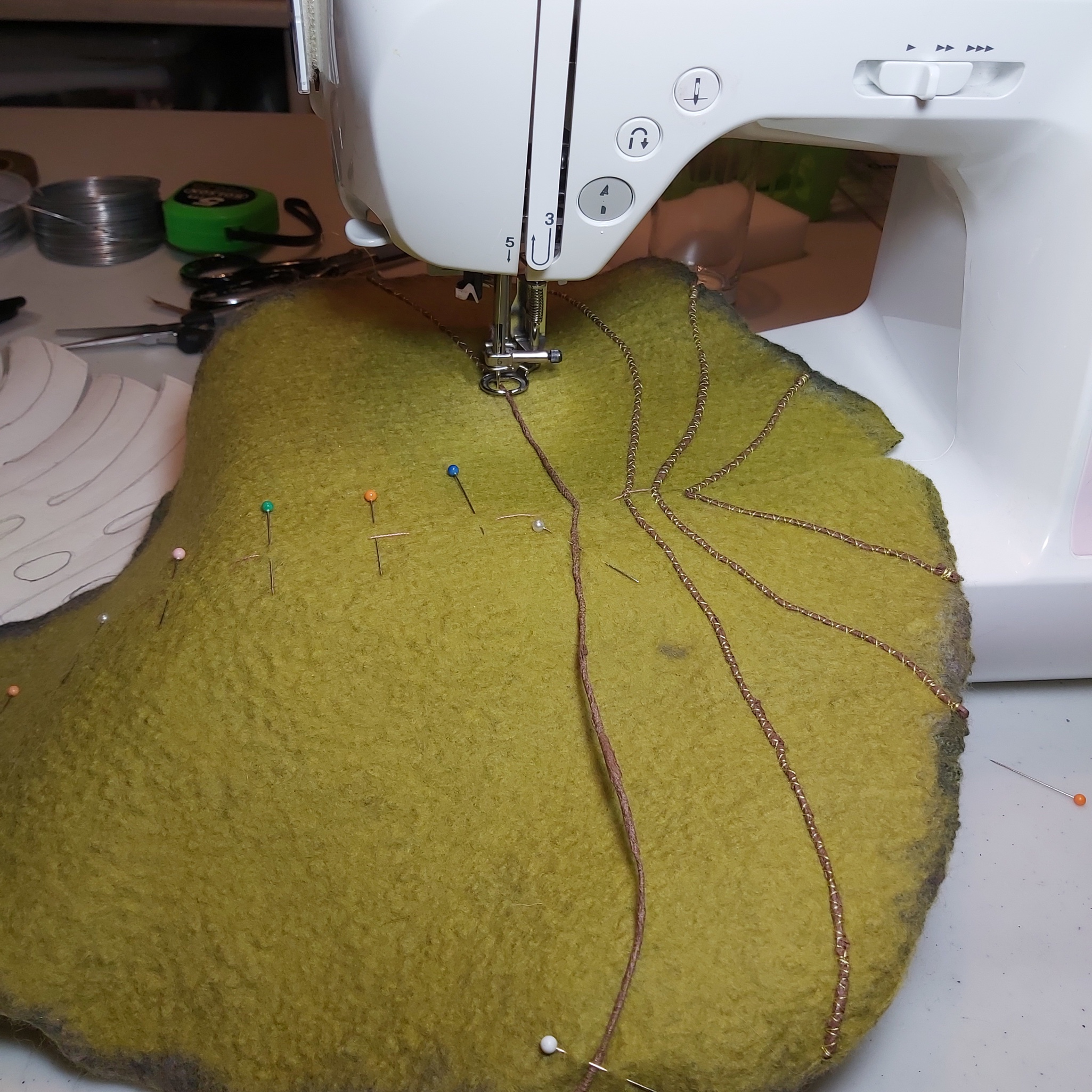
The wires were spaced out and attached on the reverse using a zigzag stitch which also formed the veins on the front side. You can see that bright yellowish green colour on the reverse of the leaf. Once that was done it was just a matter of cutting into the felt to form the individual leaves and the characteristic little holes of the cheese plant before attaching to the canvas.
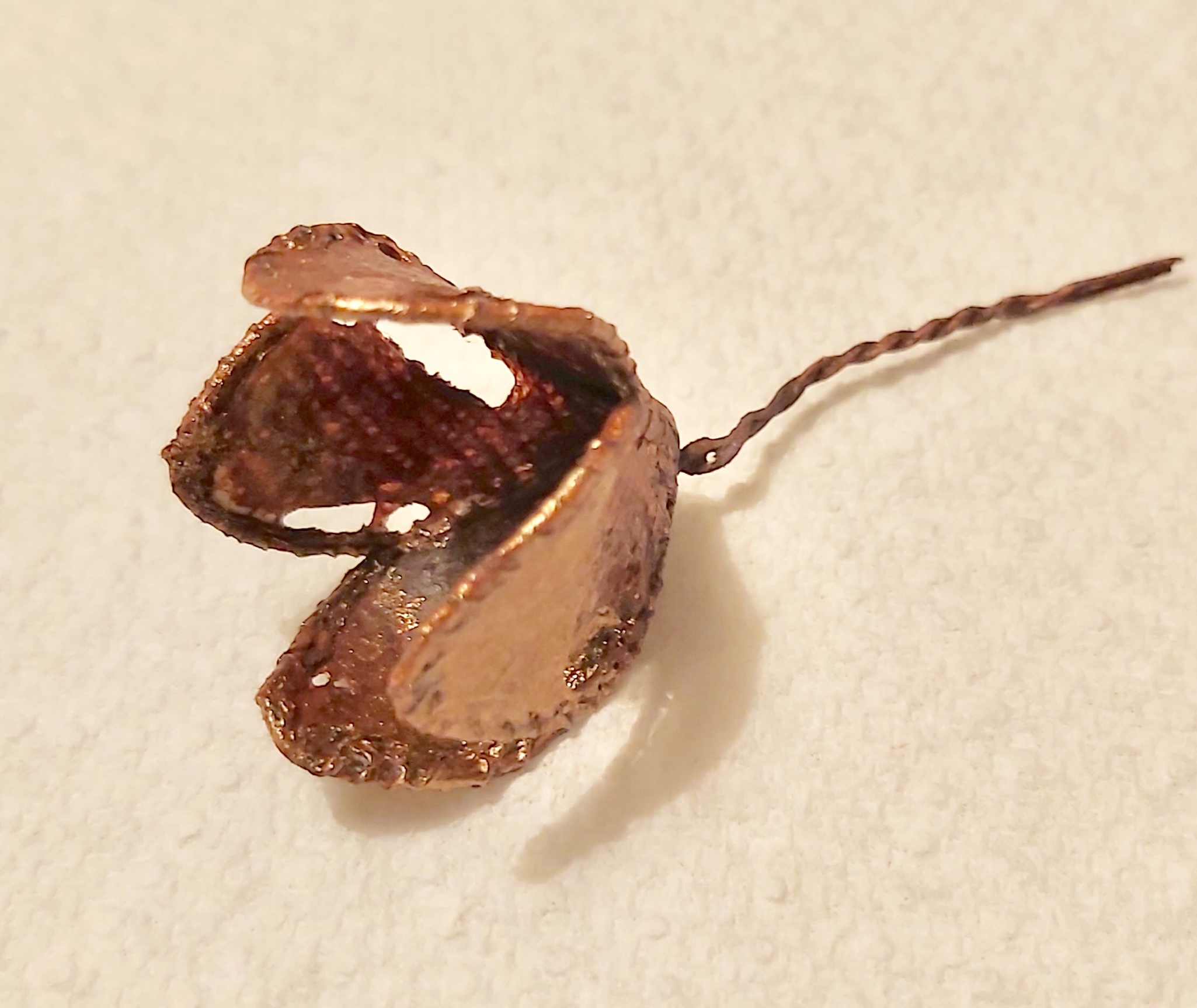
My recent Forest Floor workshop for the ladies of Snape Textiles up in Bedale has reignited my interest in working with Tyvek fabric. It’s a material I hadn’t used for a little while but making a tiny seed pod a few weeks ago, as a sample for their class, has led to more, and larger, pieces and an idea for a new workshop I’m calling Inspired by Nature…..3D Textiles.
The small seed pods are 6cm from end to end, the large one is 30cm
These pieces all start with a wire armature wrapped in hand painted Tyvek fabric which is then distressed with a heat gun.
What I particularly like about this technique is the metallic look that can be achieved…..although they are strong, and look as if they are heavy, these pieces actually have the weight and feel of paper.
The first Inspired by Nature – 3D Textile class will be held at Belchford Village Hall LN96LJ on the 22nd January 2022 so if you are interested in learning this technique, or want to know more about the workshop please get in touch via the contact form.
I recently had the pleasure of running two consecutive one-day workshops for members of the Snape Textile Group up in the beautiful village of Bedale, North Yorkshire.
The group had booked my Forest Floor workshop which covers lots of different techniques for working with heat manipulative materials and creating the kind of stuff you find littering the forest floor such as leaves, twigs, bark and seed pods. With 30 ladies interested it was decided to split this fast paced class into two days to ensure all of them had the best learning experience and no one got left behind!
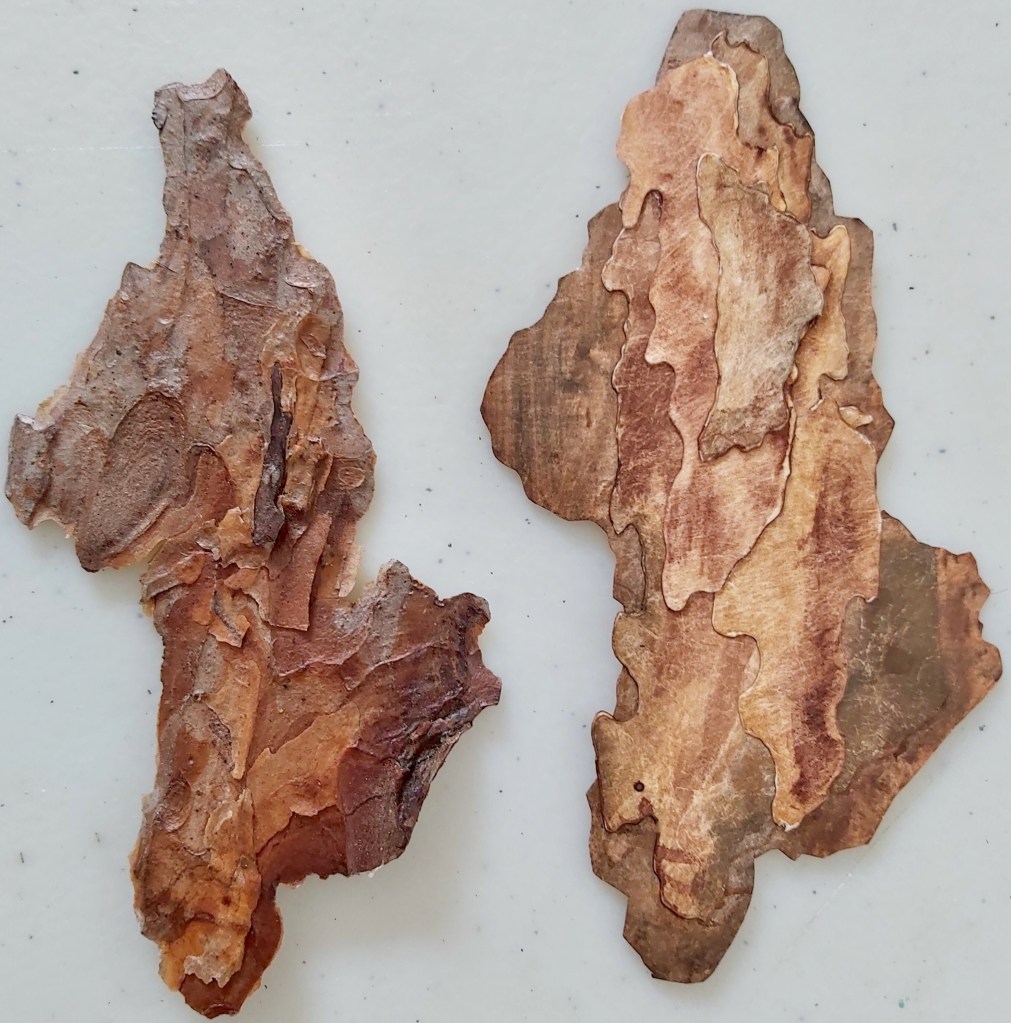
A few of my workshop samplesReal bark v fake bark
After each demonstration the students set to painting, stitching, wrapping and distressing (using heat guns and soldering irons) their Tyvek and Lutradur to create the various elements.
This is a sample based workshop and students are not necessarily expected to produce a finished piece of work by the end of it when it’s booked as a one day class. We do discuss how to pull everything together and create a suitable background but this is something that can be done afterwards at your own pace. If a group particularly want to see it through to the end it can either be booked as a two day class or we simply limit the amount of leaves made on the day to get a finished piece done. Yes, it’s those leaves that tend to hook folk in and then the time just disappears!
Just a few examples of what was made
It was a full on weekend with the ladies producing an array of wonderful work and, hopefully, having a lot of fun in the process. This was the first time some had used a heat gun or a soldering iron but going by the response it won’t be the last!
Thanks to all for your enthusiasm, hard work and good company and a special thanks to Sarah Lowe for hosting me for the weekend. I’m looking forward to working with you all again at some point in the future.
Do you recycle your coffee capsules? I’ve recently started doing this, on a very small scale I admit, by getting creative and adding them as inclusions to my felt. It got me wondering what other folk might be creating with theirs. This is a guest blog I’ve just written for the Felting and Fibre Studio on that subject…..
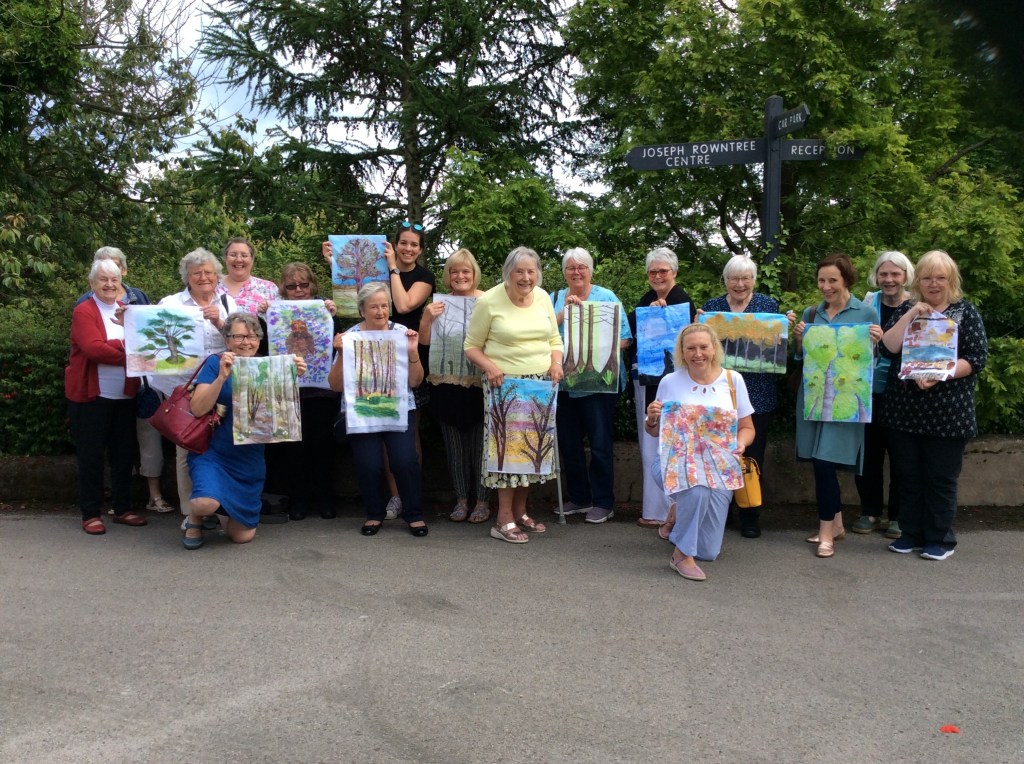
It’s been a long time coming but last weekend I taught my first face to face workshop of 2021 at Cober Hill near Scarborough. Originally booked for summer 2020, this residential workshop for the East Yorkshire Embroiderers had to be carried over to this year due to the Covid lockdown restrictions.
I did wonder if it was too soon for some and if numbers would be depleted but it turned out the ladies were very keen to get back to normal! Nineteen of the twenty ladies booked for the weekend retreat turned up, sixteen came to do the workshop and three came simply to chill.
Cober Hill was built in 1890 and was purchased by Arnold Rowntree, former Liberal Member of Parliament for York, and nephew of the chocolate manufacturer Joseph Rowntree, in March 1920. Rowntree had a vision for it “to be a place of joy and beauty, …a centre of refreshment and inspiration for many of those engaged in difficult public services… I hope experiments in Weekend Schools, Winter and Summer Schools of various kinds and of longer or shorter duration may also be tried there…” The venue, with its gardens, tennis court, croquet lawn, theatre and numerous other communal spaces, offers an annual programme of craft workshops as well as hosting private groups, businesses and schools.
The theme for our weekend was “trees” and the aim was for the students to combine layers of fabric and paint with machine and hand stitching. The finished work could then either be backed as a quilt or mounted in a frame.
After dinner on the Friday evening the group were shown examples of my “tree themed” work and I talked through the techniques I had used to create them. The ladies then started to plan their designs based on images they had brought for inspiration. Not everyone wanted to do trees, one lady chose to use the techniques discussed to do a moon gazing hare while another went completely “off piste” with her abstract take on an owl!
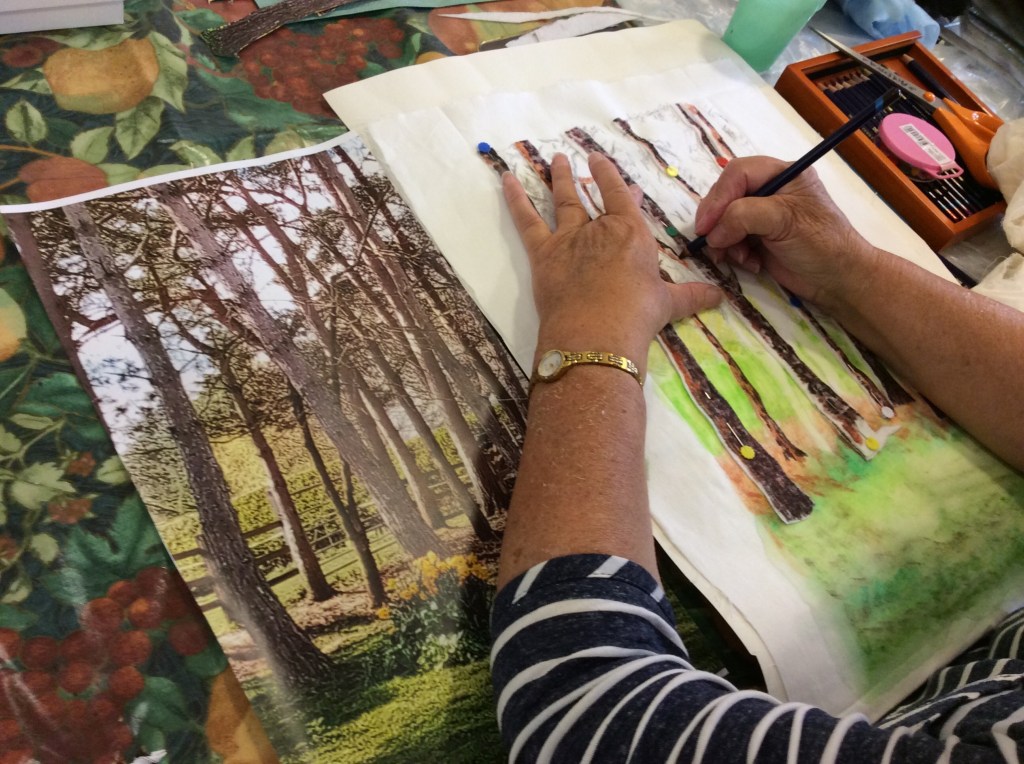
Maggie went her own way with an OwlMelanie painting her background layer.Dorothy and Debra painting their backgrounds.Ann laying down the background for her trees.Rachel’s background is painted and now she’s working on her foreground layers.Sandra adding detail to her foreground trees.
With the bulk of the painting completed and dried on Friday evening the ladies could concentrate on layering and stitching their fabrics on the Saturday.
Hilary’s background has been painted and now she is layering up her sheer fabrics to create depth to her forest.The moon gazing Hare is starting to take shape.Dorothy’s forest is pinned and ready for stitching.Evelyn’s work in progress.
I think the surprise of the weekend was Melanie who only came to Cober Hill to keep Ann, her grandma, company. This young lady doesn’t have the use of a sewing machine and had never done any free motion stitching before…..she borrowed Ann’s machine and took to it like a duck to water!
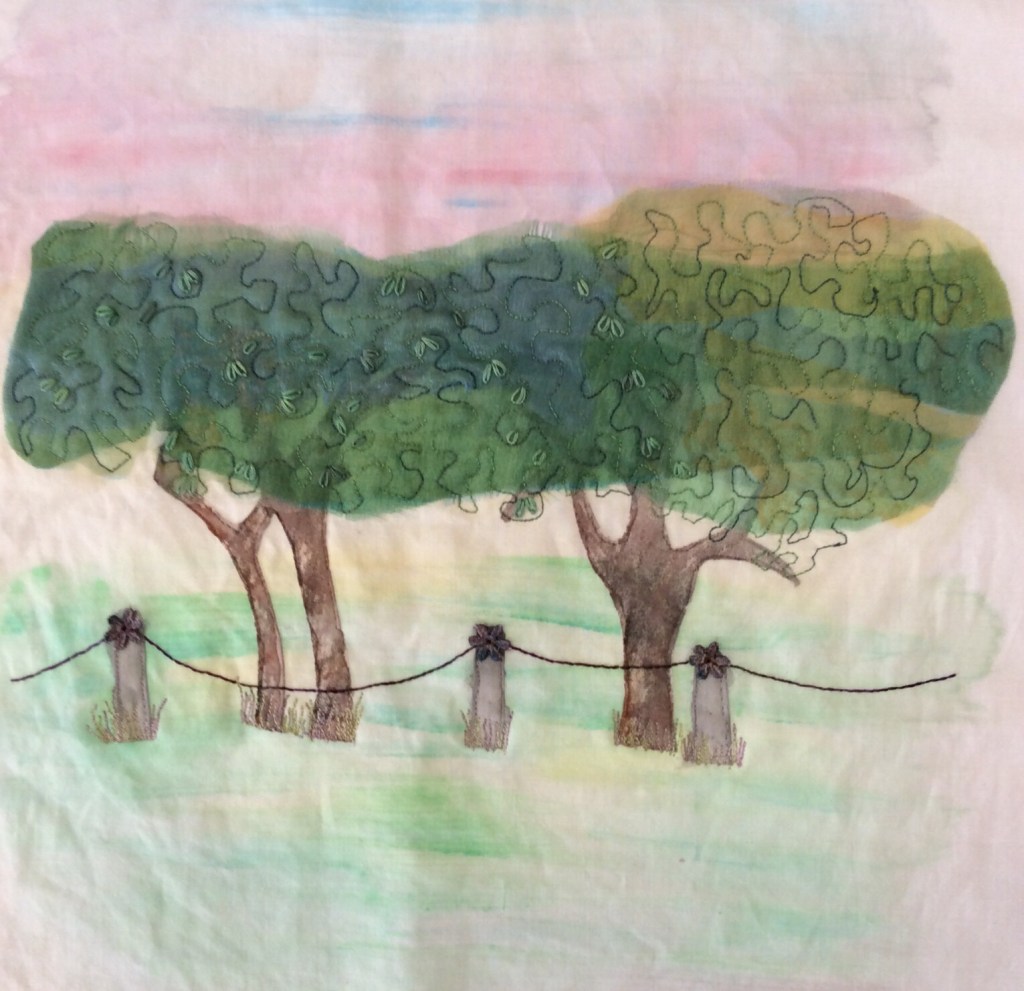
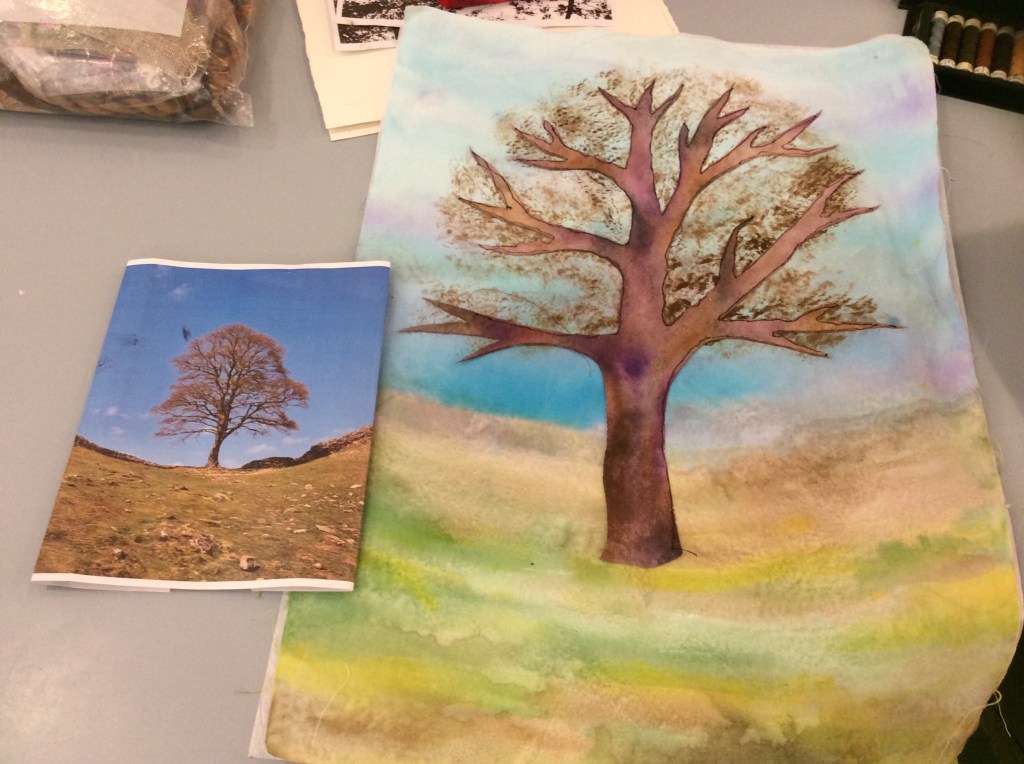
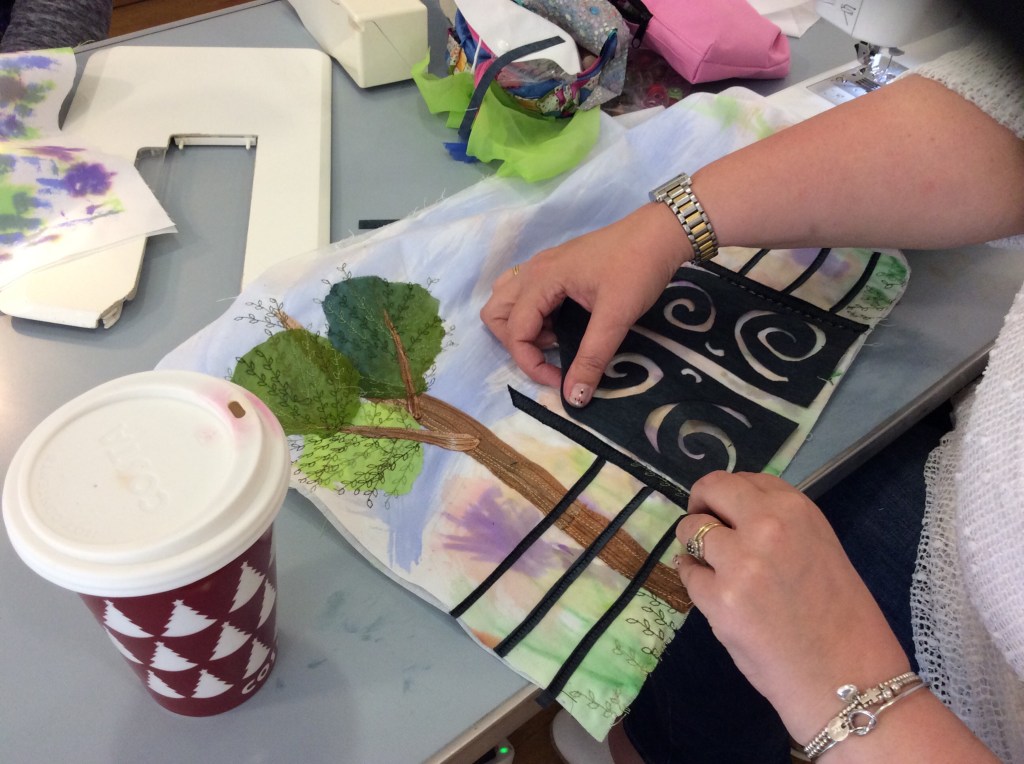
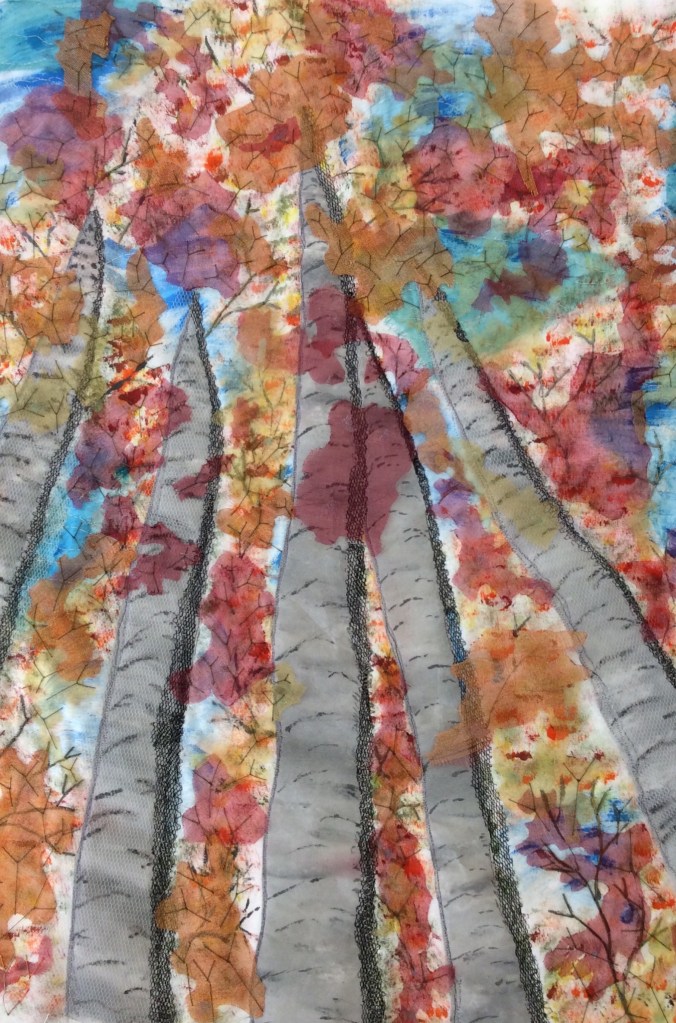
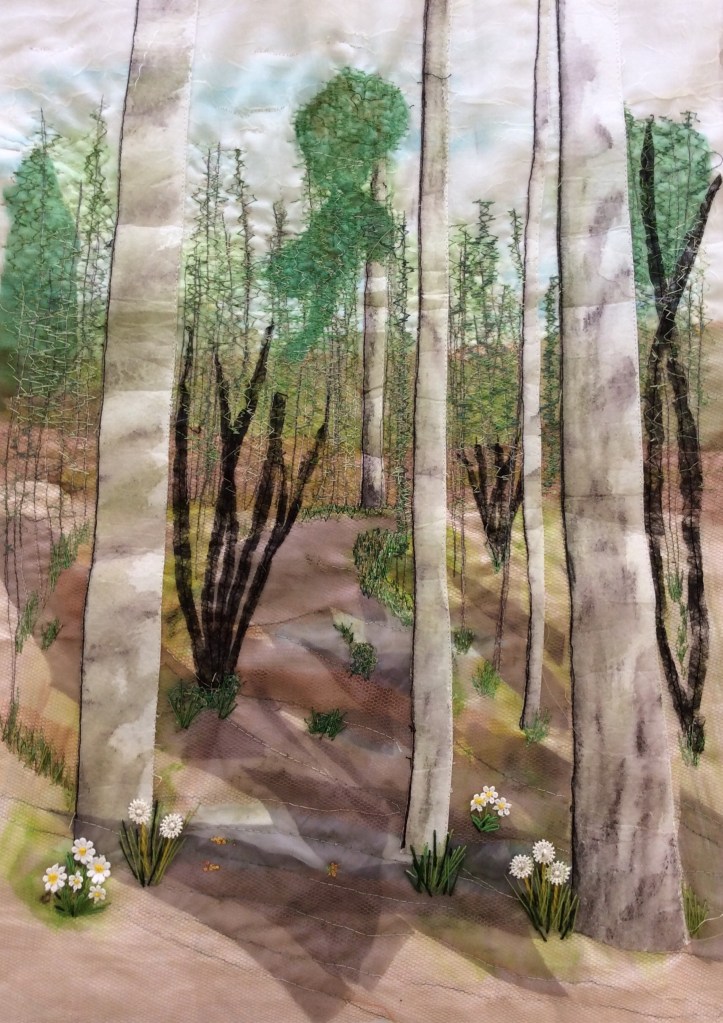
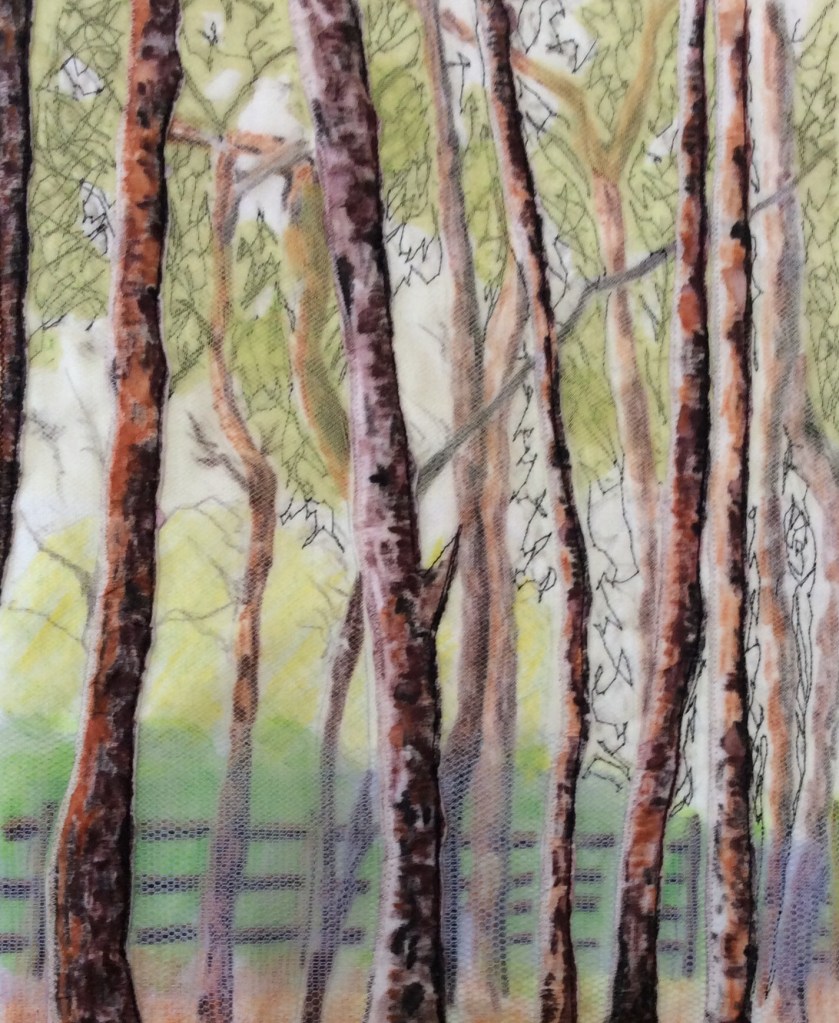
Melanie’s lone tree is starting to take form.Rachel adding her gate and railings.Ruth is beginning to add hand stitched detail to her tree.Debra used lots of free motion stitch on her version of a tree canopy.Using the same image as Debra for inspiration, Carol created a tree canopy in autumn colours.Judy took her inspiration from my Walk in the Forest.Hilary made good use of zig zig free motion stitch for her background trees.Margaret did her take on my Three Tall Trees.Dorothy added hand embroidery for her foreground grasses and flowers.Melanie’s finished work…..fantastic to think this was her first attempt at machine sewing and hand embroidery!Rhona’s moon gazing Hare….what this image doesn’t show clearly is the addition of black beads which adds texture and sparkle when you see it close up.Close up of Sandra’s finished trees.
What I hadn’t realised at the outset was that none of these lady’s had done anything like this before, so for some it had been a steep learning curve! It was great to see everyone throwing themselves into the task of painting, layering and stitching and the results speak for themselves! By the time we left Cober Hill on the Sunday there had been some terrific work created. I hope some of my students will continue to develop these techniques alongside their more traditional skills. At least one of them has since bought herself a soldering iron for doing more of this kind of work which was music to my ears!
I just want to say a huge thank you to the EYE’s group for inviting me back to teach their 2021 residential and for being such willing students and wonderful company. I shall look forward to working with you again at some point in the future.












































 Lincs In Stitches