Stylized Iris: Floral Fabric Art with Recycled Materials

In my last post I mentioned the Iris that I’ve been working on for the Lincolnshire Textile Group exhibition Bountiful Botanicals which will be held in August 2026 in Lincoln Cathedral. Having made numerous leaves, seed pods and flowers in the past using Tyvek I knew this fabric from DuPont would be perfect for the flower project. I think most readers will know of Tyvek fabric but if you don’t it’s made of 100% high density polyethylene (HDPE) fibres. These are randomly laid and compressed through a unique flash-spinning process to form a strong, non woven material that has the properties of paper, film, and fabric. It can be painted, stitched and heat distressed to create wonderful textures and exciting structures.
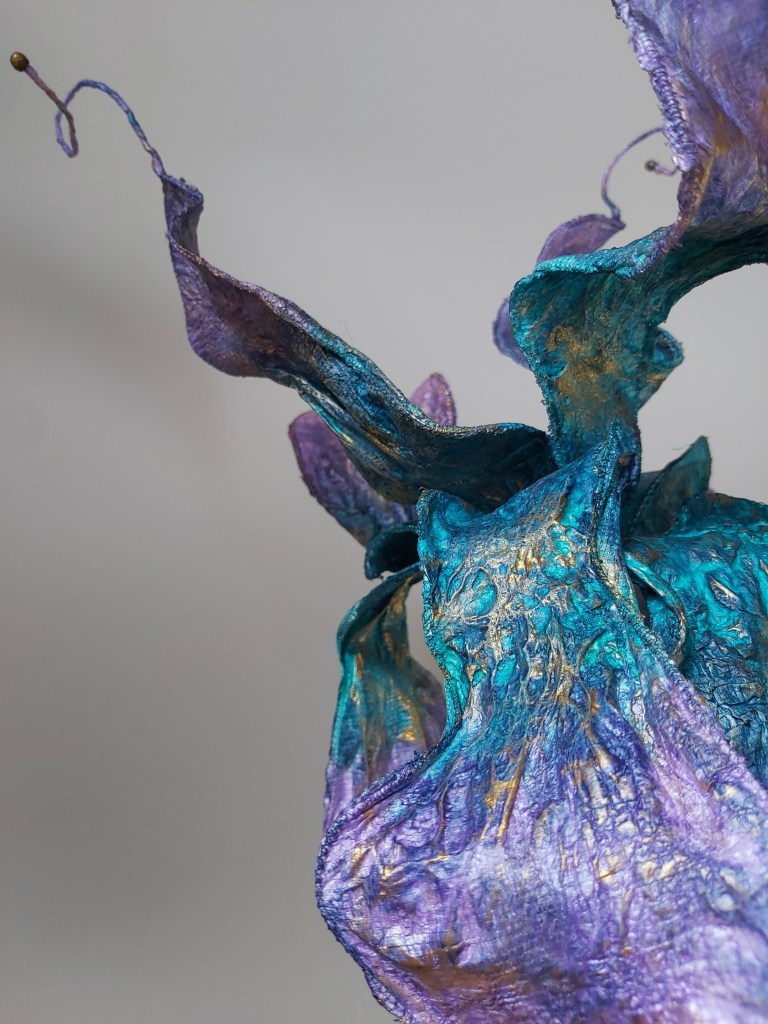
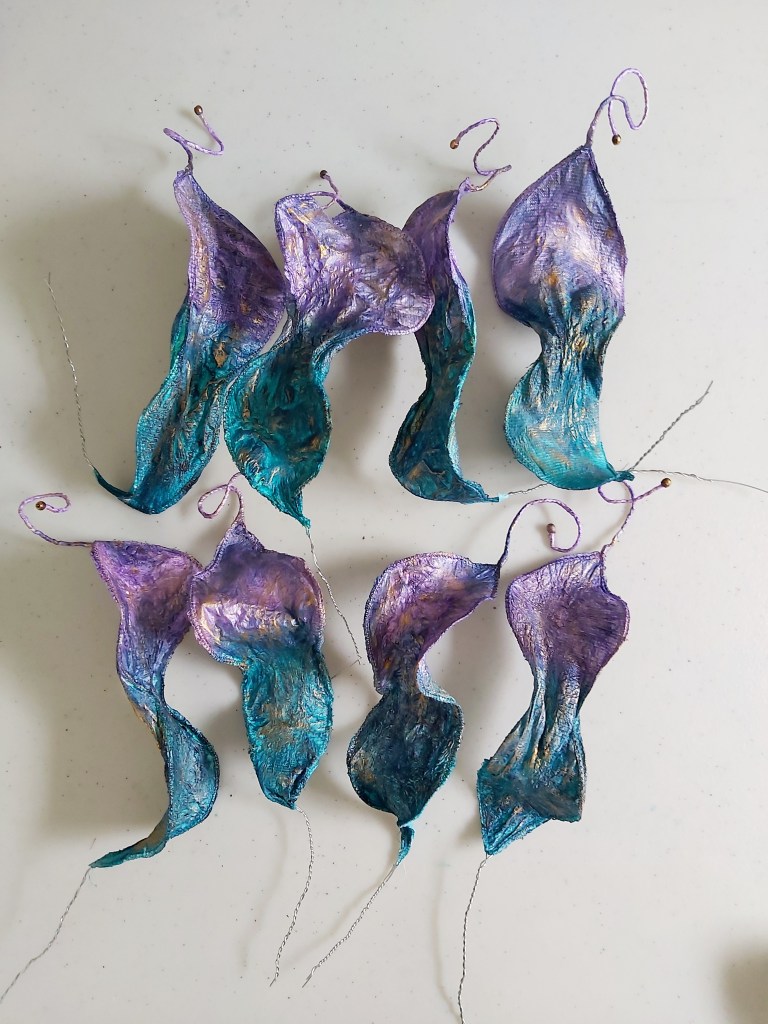
The idea was to create a single, tall slim flower with four leaves. I began by creating the individual petals, four larger ones to hand down and four slightly smaller ones to stand upright. I decided to make this a stylised Iris and added a twirly flourish at the end of each petal, finished off with a gold painted wooden bead.
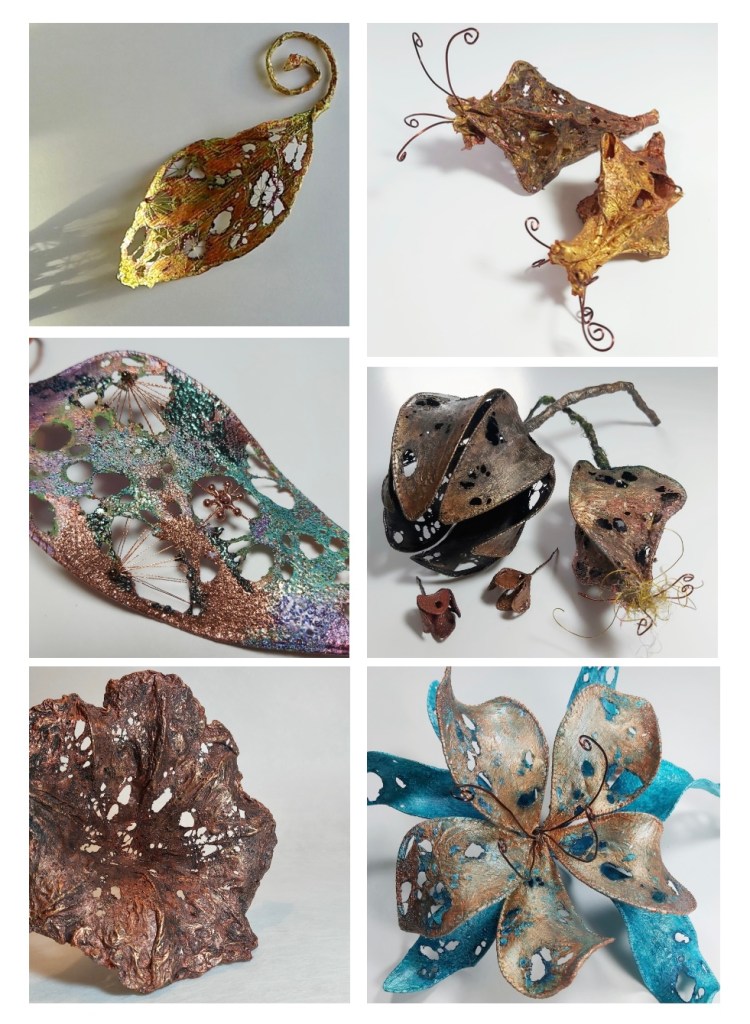
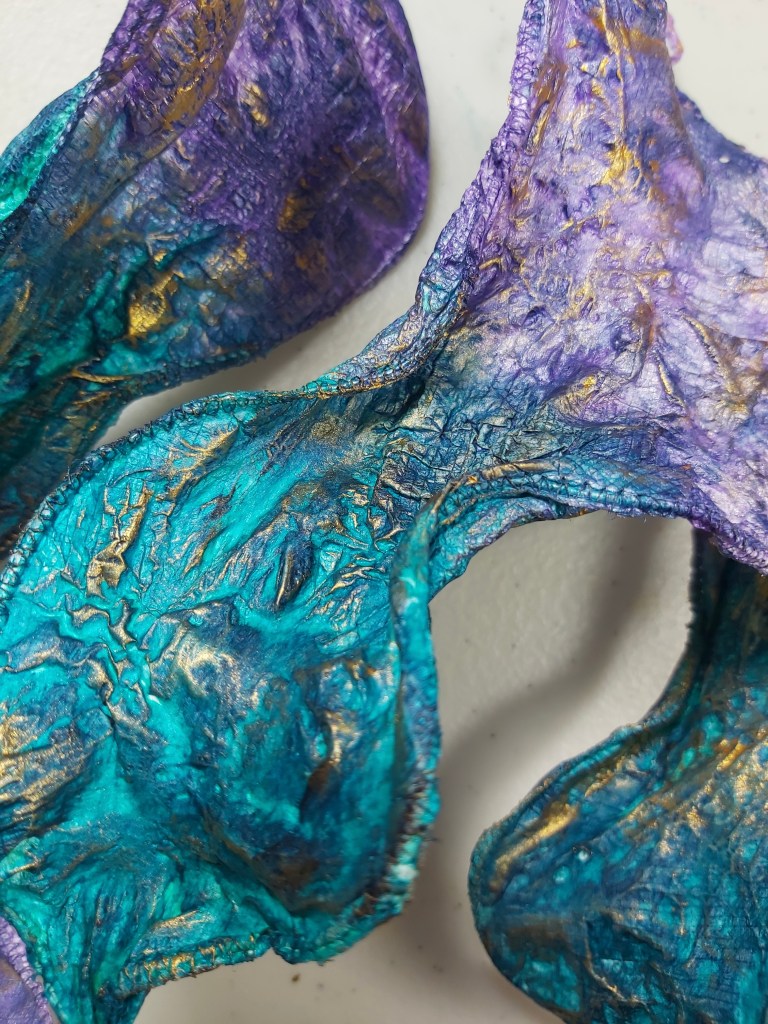
Apart from the B&Q wire for the armatures all the other materials used in this project have been recycled or repurposed including the recycled Tyvek which I now buy in preference to the new, non recycled version. It isn’t as substantial as the original but perfectly good enough for creating petals, leaves, etc. and I love the effects I can get when it’s distressed and painted with metallic acrylics. Although it isn’t yet widely recycled there are specialist centres that are doing this which is good to know.
The stem of the flower is a repurposed garden cane and for the base I found the perfect shaped glass vase in my local charity shop. Originally I was going to felt a “bulb” as a base but I’m glad I went with the vase as it not only provides the stability needed for the display but it also gave me the ideal form around which I could wrap the string, plus it emphasise the verticality of the flower making it appear even taller. I was intending to dye the string but after offering up a few different coloured papers to audition the colours I came to the conclusion that it works better left natural as it gives more focus to the flower itself.

The photo of my flower in situ shows where the choice of colour came from. It stands 112cm tall and the flower head is approx 26cm wide.

Photo shows a hand made, single stem Iris created from Tyvek fabric and wire. The flower is painted in turquoise, purple and gold metallic acrylic with four turquoise leaves. It stands in a vase on a coffee table next to a large Monstera plant.


If you use Tyvek fabric in your projects and want to try the recycled version it’s available on eBay UK from Spenic-recycling.
Bountiful Botanicals: A Textile Art Transformation

At the Lincolnshire Textile Group this month members were invited to submit a piece of work inspired by our current theme of Bountiful Botanicals. I’ve been working on two pieces for the group exhibition and on Saturday morning I had to finally make up my mind which to submit. Would I show my tall, slender Iris, or would it be the wacky, over the top, carnivorous Banksia nut? Being a bit of a rebel, and knowing not everyone is a fan of six and eight legged creatures, I decided to chose the piece that I thought may not win but would get the strongest reaction……regardless of whether that reaction be good or bad! And so it was that I put the Iris back in the lounge and took the insects for an outing!

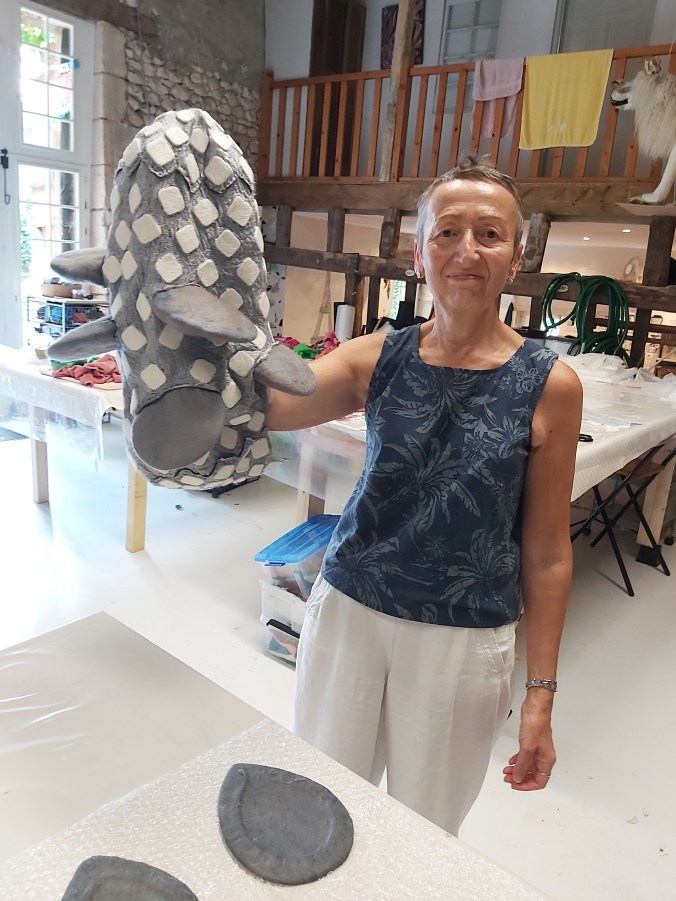
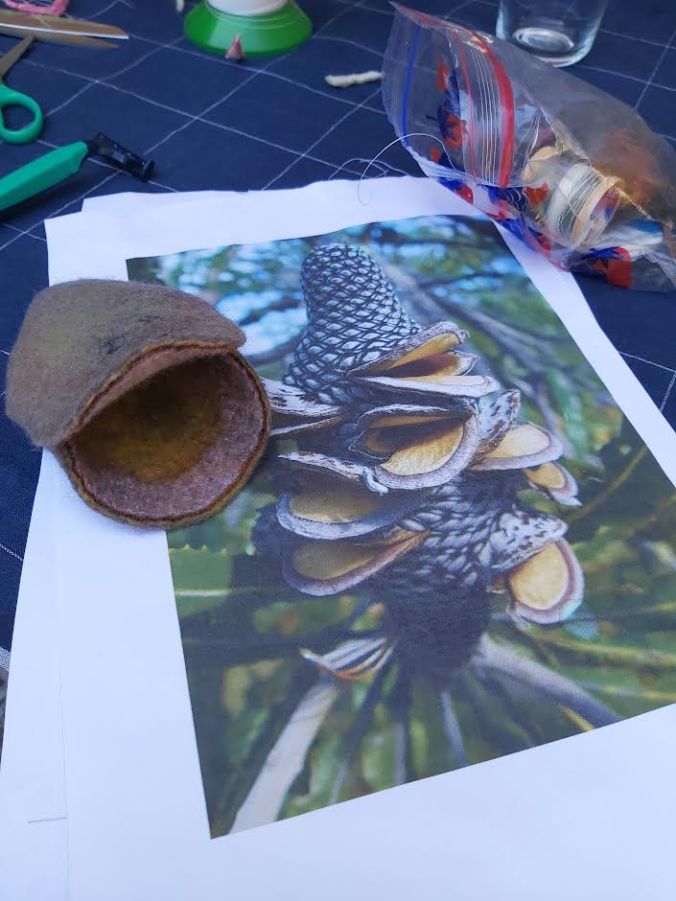
This piece has been a long time in the making as it began life in France last year when I attended a week long workshop with the very talented feltmaker/tutor Saar Snoek. We were asked to take along images of a 3D object, inspired by the natural world, that we would like to create during our week in the Dordogne. Mine was a photo of a Banksia nut, named after the explorer and botanist Joseph Banks who discovered and gave his name to the plant when he sailed to Australia with Captain Cook in 1768 aboard the Endeavour.

Saar taught me a fantastic technique which allowed me to achieve the bumpy texture I needed on the surface of the nut. Once the main body was laid out I set about making the follicles, the mouth shaped parts that are woody seed pods which split open to release the seeds. I don’t know what got in to me but I thought these needed to be substantial so I laid layer, upon layer, upon layer and as any feltmaker knows, the thicker the felt the harder it is to it shrink. Consequently I couldn’t shrink the lips as far as I’d intended, hence the finished nut became known as Mick (Jagger) or “Ducky”!

Not all projects go to plan and this one certainly didn’t work out as I’d hoped. After all that work, I’d got my proportions sooo wrong it ended up looking more like a child’s toy!

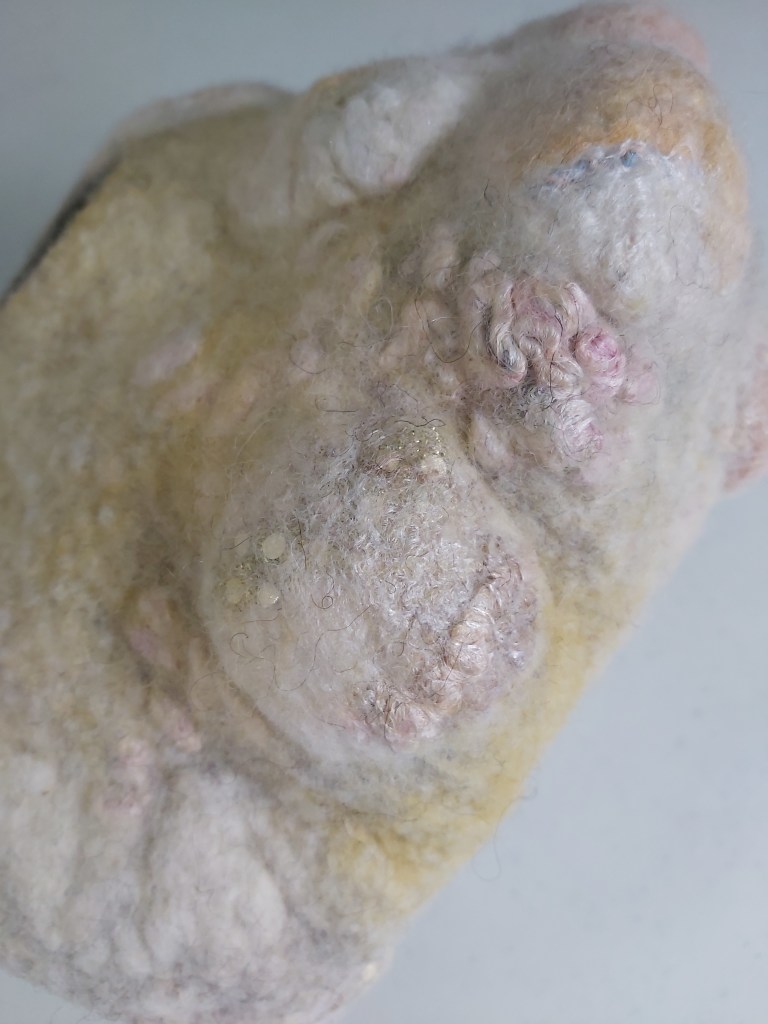
My “toy” Banksia Nut

The upside was that I’d had a fabulous time with our hosts Esther & Jan at Studio Felt & Fibre, tutor Saar Snoek and my fellow students. It was a crazy week from start to finish with lots of laughs, lovely food and beautiful evening walks. I’d learnt a lot and came home with my head buzzing with ideas, however, that nut would lay in my studio for approximately a year before an idea was formed as to how I could reinvent it.

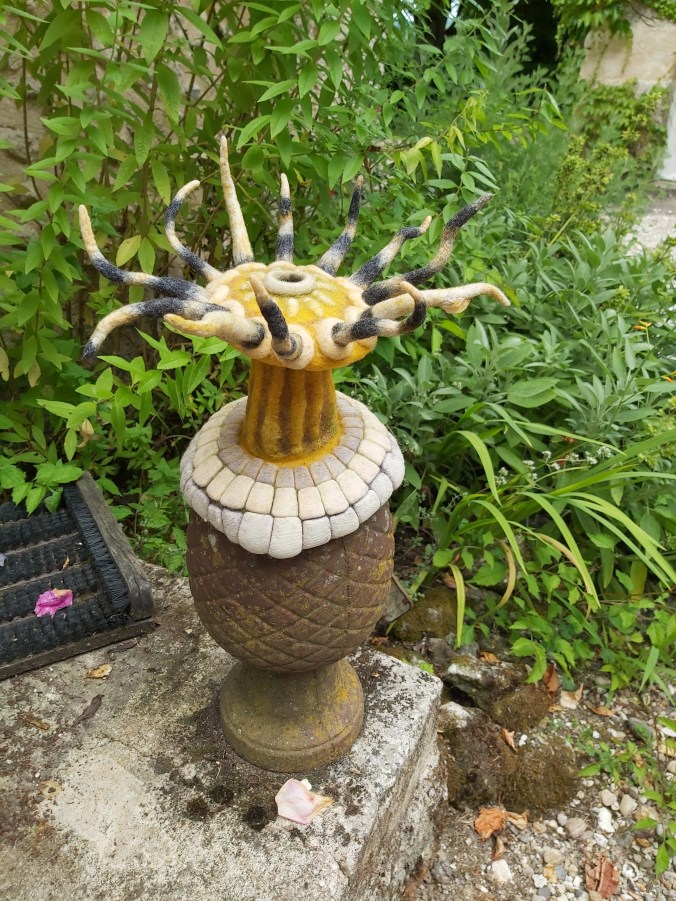
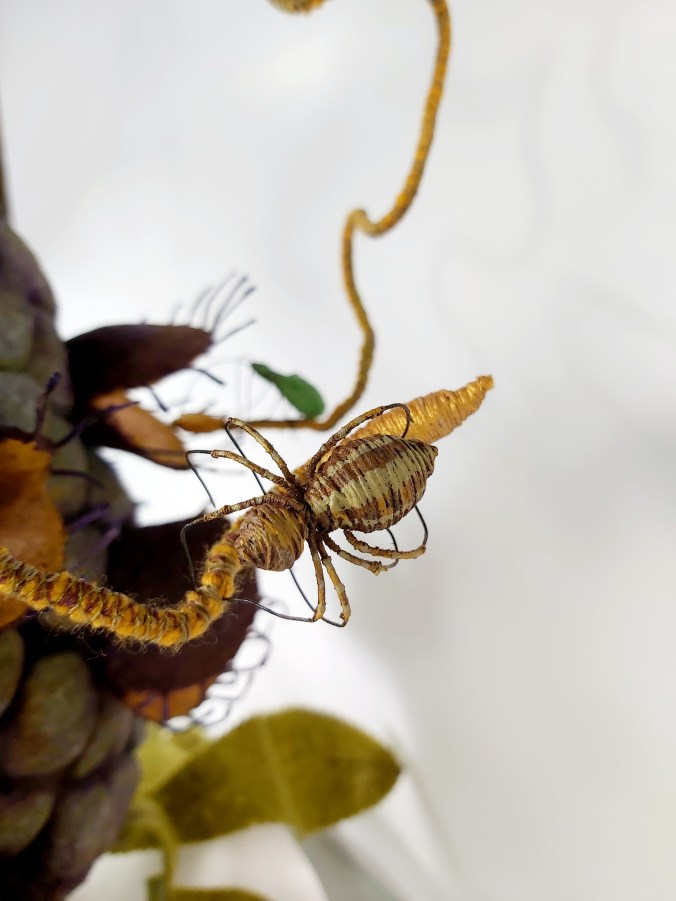
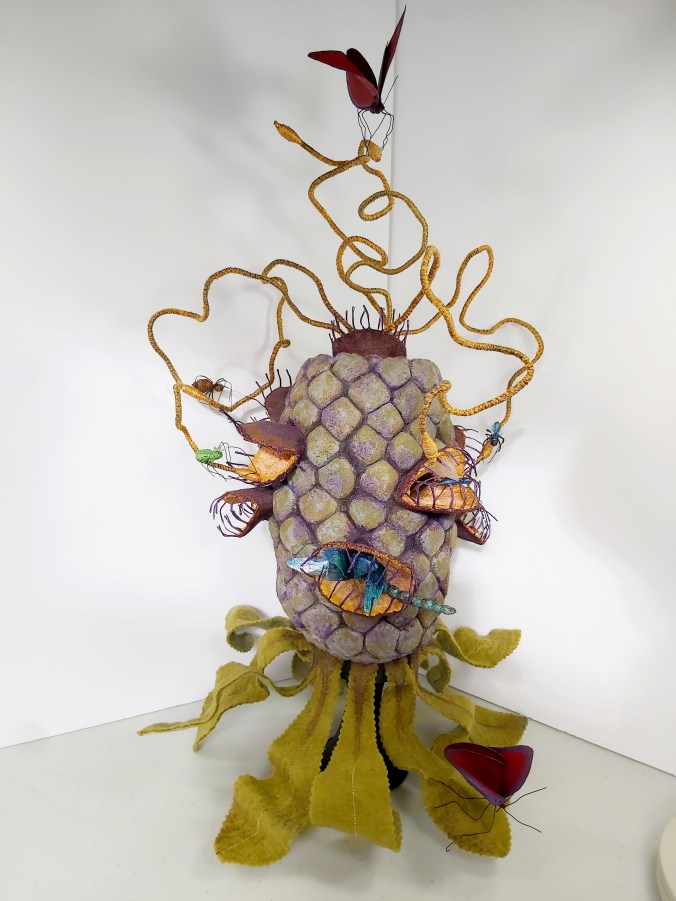
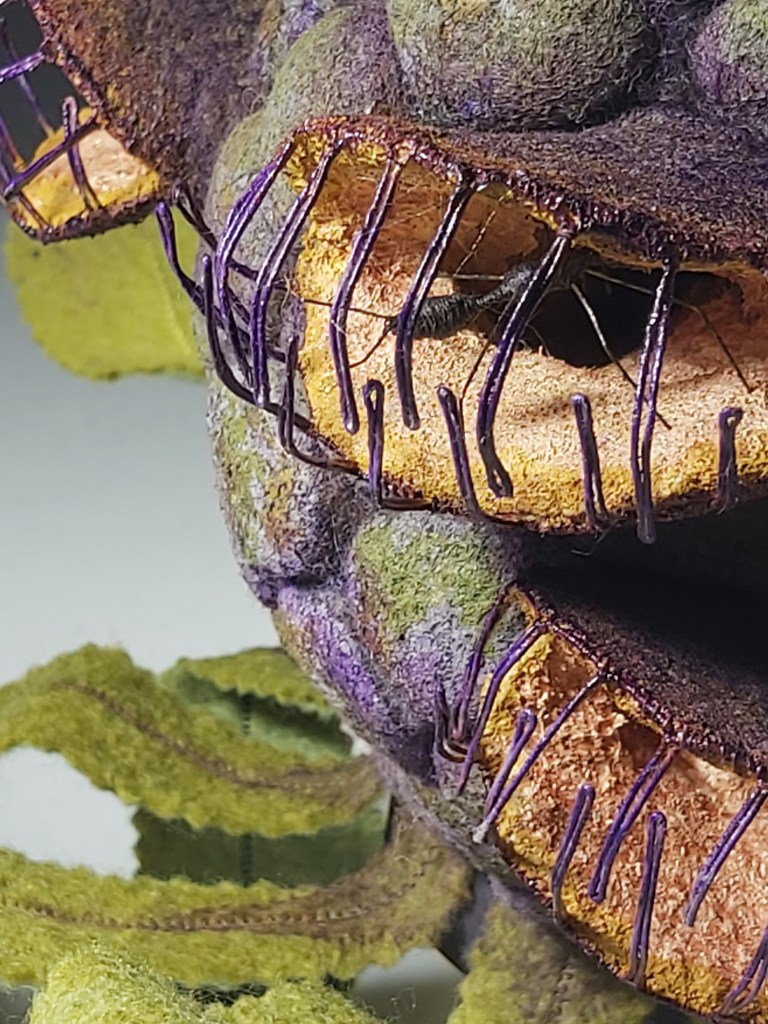
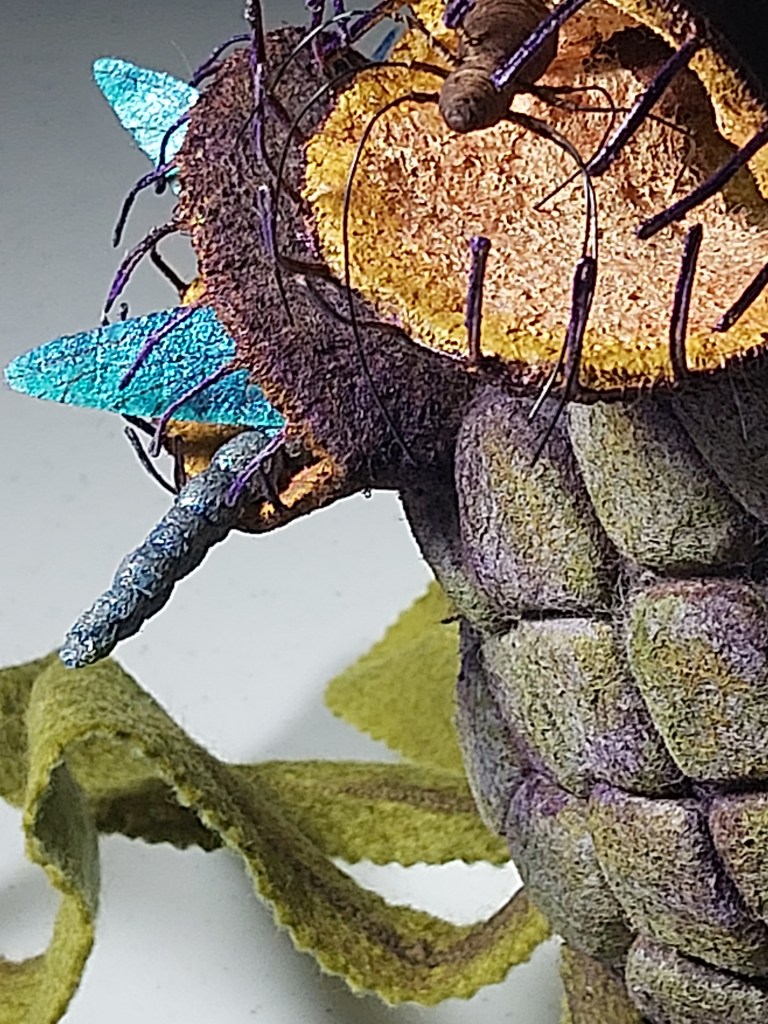
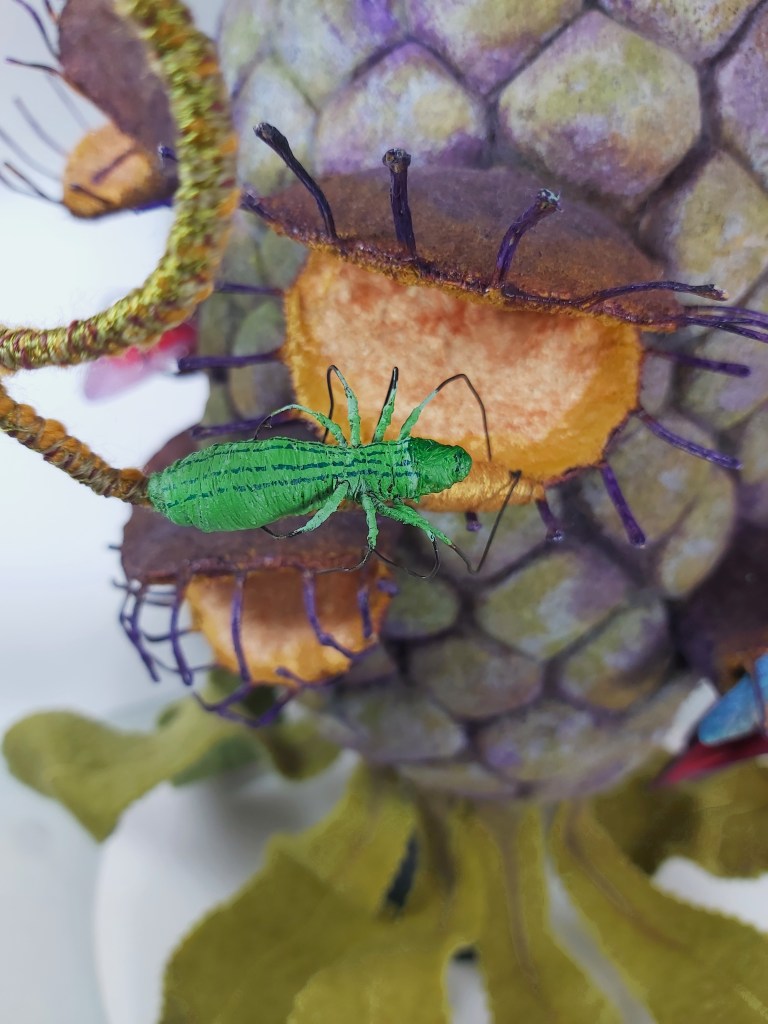
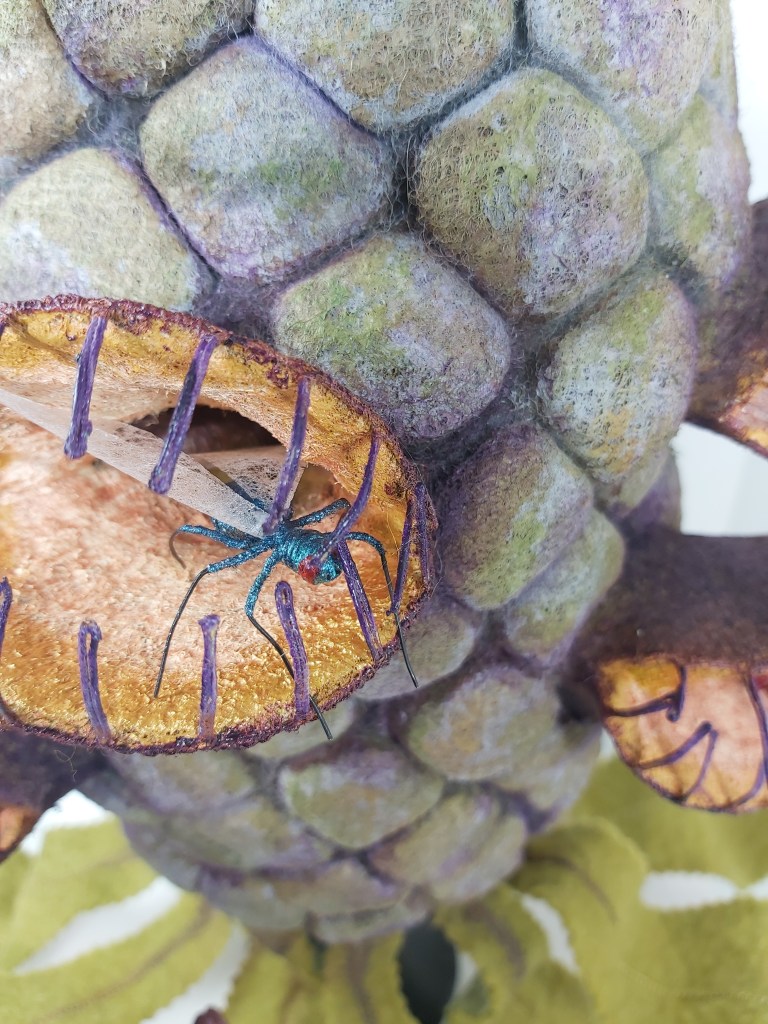
It was a few months back, while I was working through ideas for a wet felted carnivorous plant for the Lincolnshire Textile Groups “Bountiful Botanical” exhibition, that I had a light bulb moment. Why not restyle my Banksia, imagining a world where the plants gone rogue and has evolved in to an insect eater…..think Banksia nut meets Little Shop of Horrors! So I set to, adding some spikes to trap the insects in the mouths (took forever but was so worth it!) and some insect seeking tongue (ish) appendages snaking out of the mouth on top of the nut to catch even more unsuspecting prey and deposit them straight in to its jaws!

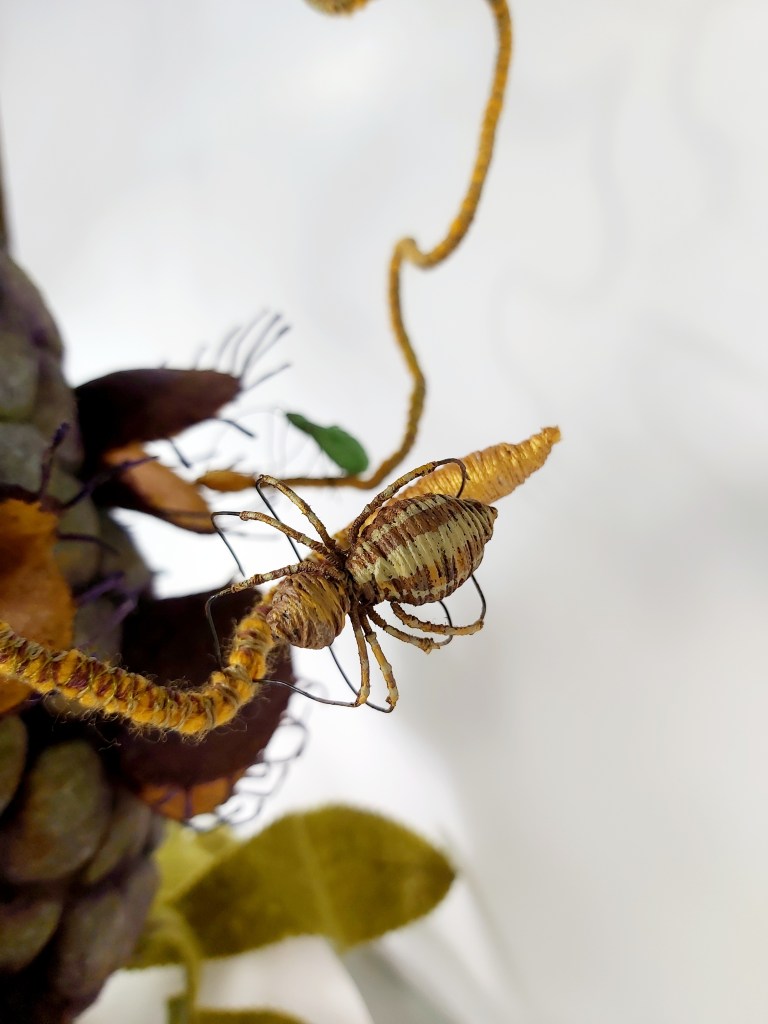
It was very fiddly and time consuming to retro fit the “teeth”, not to mention the three extra follicles, and there were several occasions when I wondered if I was completely wasting my time! Then it came to the point where I needed to make the insects and this was far more fun! Most of them were made with wire armatures wrapped with thread and then painted. Creating the insects made me smile and really brought the piece to life and so it was that the rather wacky Banksia Bites Back was born!

So back to the competition and there were two prizes up for grabs, the members vote and the Judges vote, the latter being chosen by that months visiting Textile Artist. There were lots of inspiring pieces on display and when the winners were announced the Members vote went to this beautiful mixed media piece by Pip Hind. It’s full of wonderful texture and colour and was a worthy winner, sadly this photo really doesn’t do it justice!

Next it was the turn of our speaker, visiting textile artist Anne Brooke, to make her choice. It seems Anne isn’t averse to insects and so I was pleasantly surprised when she announced my piece as her Judges choice! I’m glad I stuck at it and I’m hoping it will bring a smile to visitors faces when its exhibited next year. Like I said, it was a long time in the making but the great thing about a felt project, as with many textile projects, is that if your not happy with the result it simply means it isn’t finished!

Summer Textile Projects…..

As I sit down to begin this post the sky has darkened and the rain (fingers crossed) is about to fall, heaven knows we need it, but what a fabulous summer it’s been so far here in sunny Lincolnshire! I tend to not do too much in the way of creative stuff through July and August as there are too many distractions and this year the intense heat has made me feel very lazy so lots of time spent relaxing, reading and watching creative videos. Consequently I’ve now got a table full of projects I need to finish and a head full of others I want to start. 

A couple of projects I did do this summer are two wet felted vessels. The first one, inspired by a shrivelled seed pod, was made at the İFA Region 8’s Summer School in Arnesby near Leicester. Our region encompasses several counties and is so spread out we struggle to get our İFA members to attend. On the other hand we have a regular group of creative ‘non members’ in the locality who are more than welcome to come along to our events, and thankfully they do! It was a busy and fun two days…..

My seed pod began life as five leaf book resist measuring 27cm x 36cm and various colours of Merino and Corriedale fibres. After removing the resist and fulling the felt I pushed and pulled the pod and attached strong clips to create the shape I wanted. I didn’t want a visible hole so the one I cut was so tiny so meant the resist ended up being pulled to pieces in order to get it out! Now it’s finished I feel like it needs a bit of something adding so I’m wondering about embroidering circles in a dull gold thread?


The second vessel was started last Friday when I was working at the Usher Gallery in Lincoln. I’d seen a post somewhere mentioning they were having their second Artist Studio Day and inviting local artists to apply. If successful it meant I would get the use of a table in their ground floor workspace and get to spend the day with four other artists. It sounded like a great opportunity and I’m so glad I applied! Only four artists turned up on the day and unfortunately one of those had to leave early. My other two companions were both painters and it was nice to get to know a bit about them and watch them work. We had a few members of the public come in to see what we were doing but for most of the time it was very quiet which allowed us to focus on our projects.

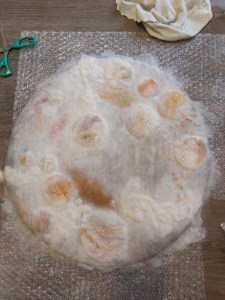
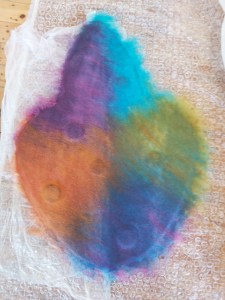
The day before I went I made a textured prefelt using threads, silks, fabrics, etc which I could cut up to create the undulating surface decoration. It was necessary to do this beforehand as I knew my vessel was unlikely to be finished on the day but would need to be at a stable stage in order to be able to fold it to carry back to the car. I got the obvious comments from one or two folk of how my work “looked like a pizza”. The following day after removing the resist and fulling it my 41cm dia pizza had become an 18cm x 24cm 3D vessel weighing 120gms. I’m loving the textures and colours it has!

One of the Summer pieces on my table which I’ve yet to finish is an Iris which I started at the end of July. This is going to be for the Lincolnshire Textile Groups Bountiful Botanicals competition taking place in October. I’m creating it from hand painted Tyvek fabric and wire and the flower will be approximately 30cm dia by 115cm tall. I’ve just got the leaves to do now and then I’ve got the perfect spot for it in my lounge when it’s finished. I don’t want to reveal too much before the competition so this is a sneak preview for now…..

Another work in progress on my table right now is this insect brooch, at approx 14cm long I’ve definitely developed a thing for hand made oversized textile brooches! I’ve just got the legs and antennae to finish, more colour to add and the pin to attach.

My final work in progress is a mixed media project and something else I’m keeping under wraps until October as it’s also for the Lincolnshire Textile Group. Depending on how it turns out, it might replace the Iris as my competition piece. This started life as an oversized wet felted Banksia Nut which I made last year. I’ve never been happy with it but a few months ago I had the idea of giving it a new lease of life with a new identity. I’ve still got lots to do to it yet. It’s by far the strangest thing I’ve ever made and it won’t be for everyone, let’s just say it’s a hybrid of Banksia meets Venus Fly Trap and yes numerous insects will appear to be harmed in the making of this piece! I can’t wait to reveal it!

Art of the Now…..

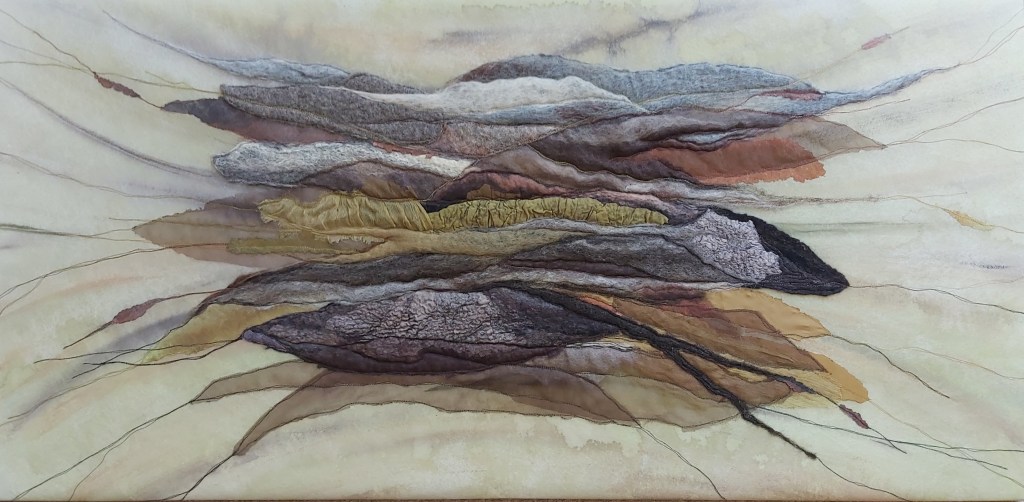
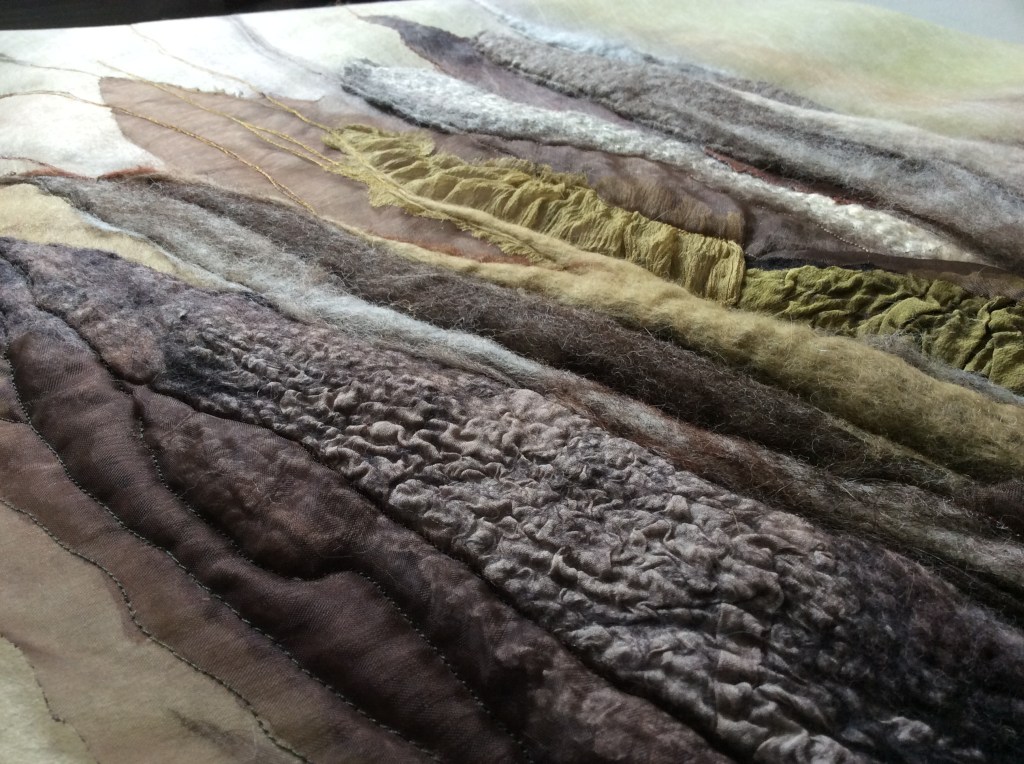
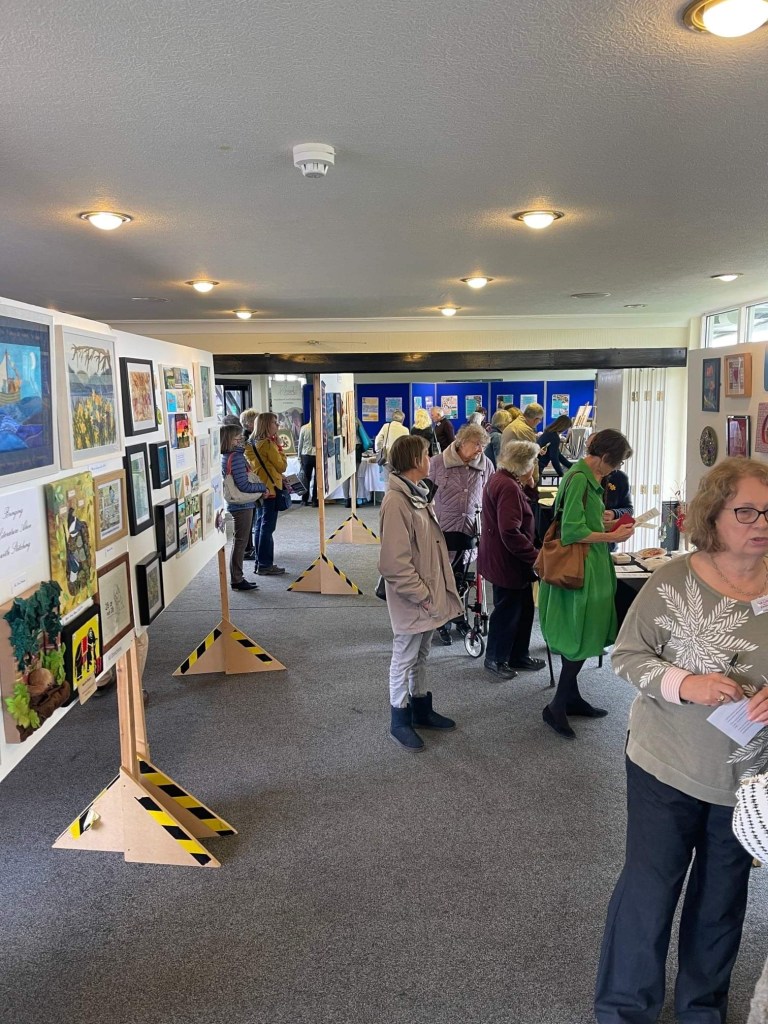
A few months ago I responded to an ad for local artists to apply for the chance to exhibit their art in an Open Call exhibition being held at the Usher Art Gallery in Lincoln. We could submit up to three pieces in any medium. There were around 900 works submitted in total which were then whittled down to just over 100. I was thrilled when I found out that my Nuno felted/mixed media abstract landscape “Northern Soul” had been successful!

Time spent walking in the beautiful Northumberland landscape, particularly around the Coquet Valley and Simonside Hills, provided the inspiration for Northern Soul. It was created using a variety of fibres and fabrics, wet felted and free motion stitched on to a painted background of Lutradur fabric.

The Art of the Now exhibition runs from now until October 19th, it’s open from Thursday through to Monday from 10am – 4pm. It’s free entry and there is a wide variety of techniques, mediums, subject matter and styles on display, although given the rising interest in textile art it would have been nice to see the gallery representing more of this.
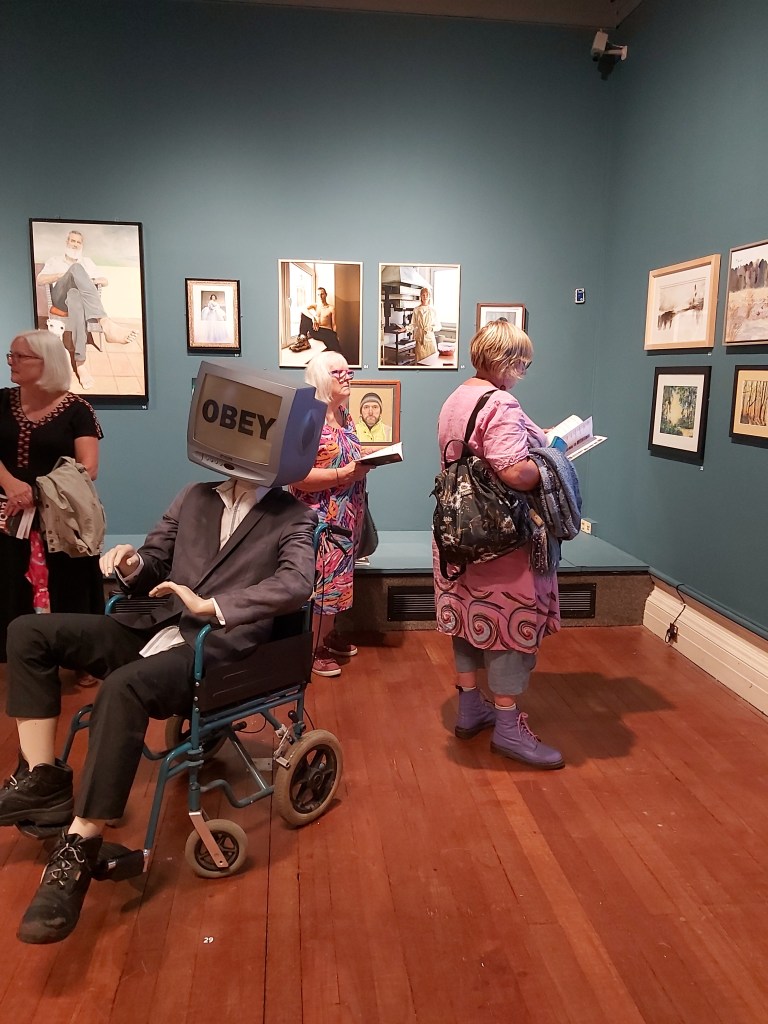
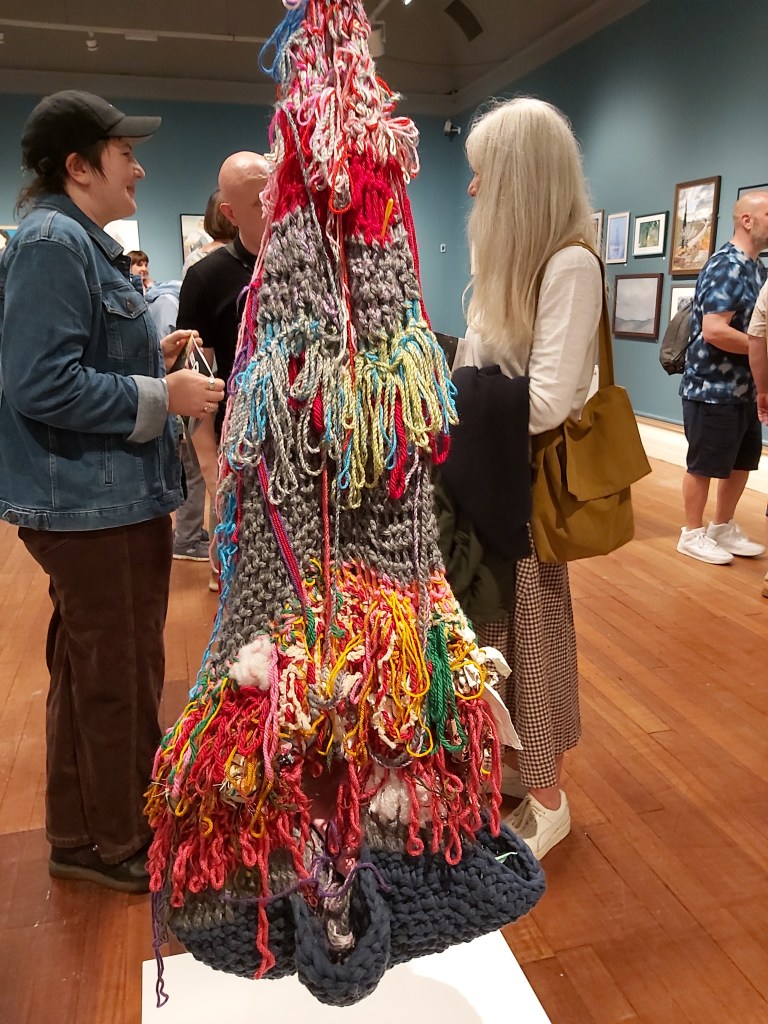
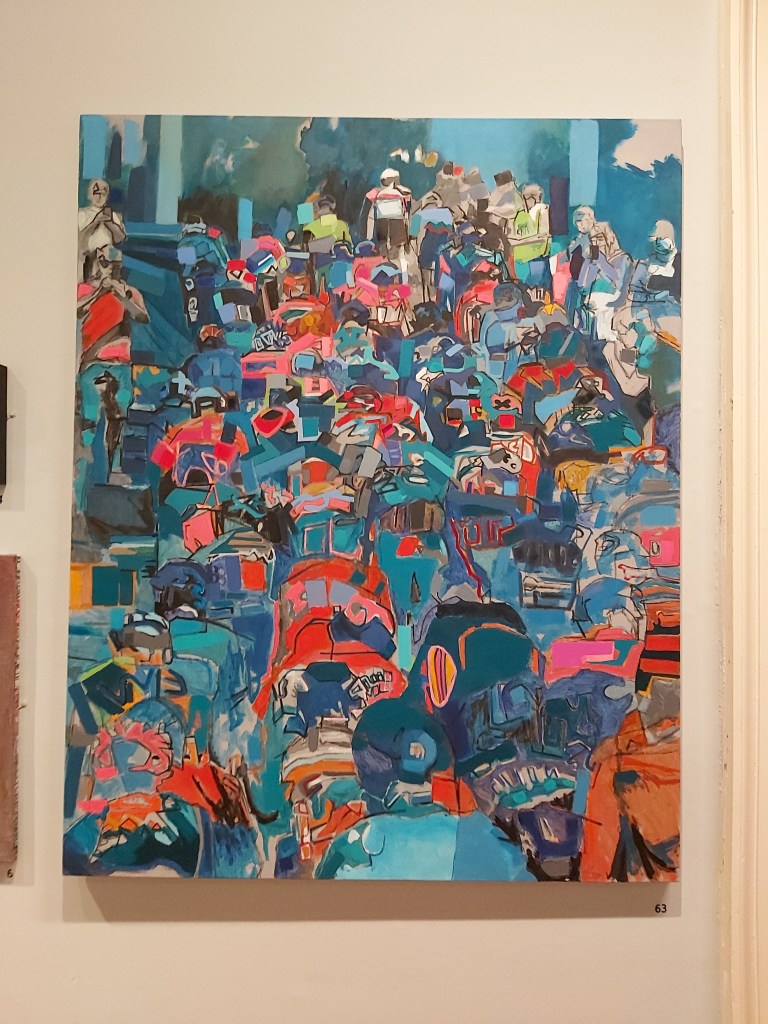
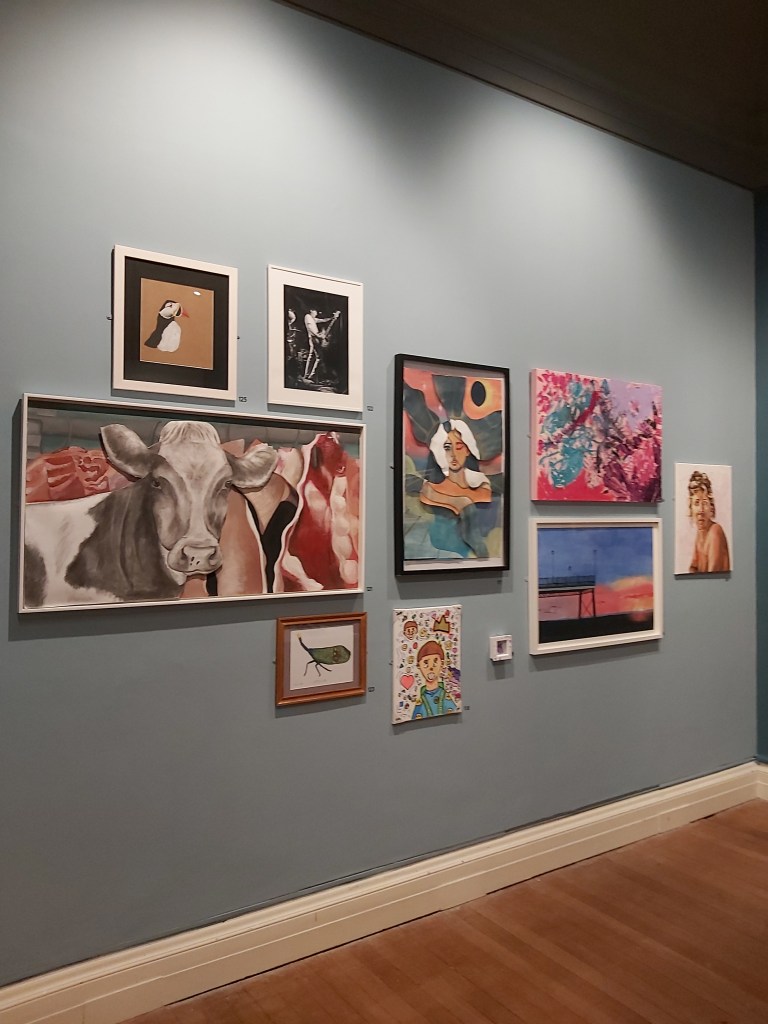
These are a view images from the opening event.

A catch up…..

One thing I can never be accused of is bombarding readers with too many blog posts! Every once in a while, today being an example, I realise I’ve been posting on the Felting & Fibre Studio, on Facebook and on Instagram and completely forgetting to add the same content to my website. I didn’t used to have this problem as originally it was possible to link WordPress with Facebook, but then that option was removed and I got sloppy. I’ve only just discovered that it’s an option again and probably has been for years!
So, backside kicked, rant over, and time to catch up on what’s been happening this Spring with a post I wrote recently for the Felting & Fibre Studio…..

Autumn School & the BTS…..

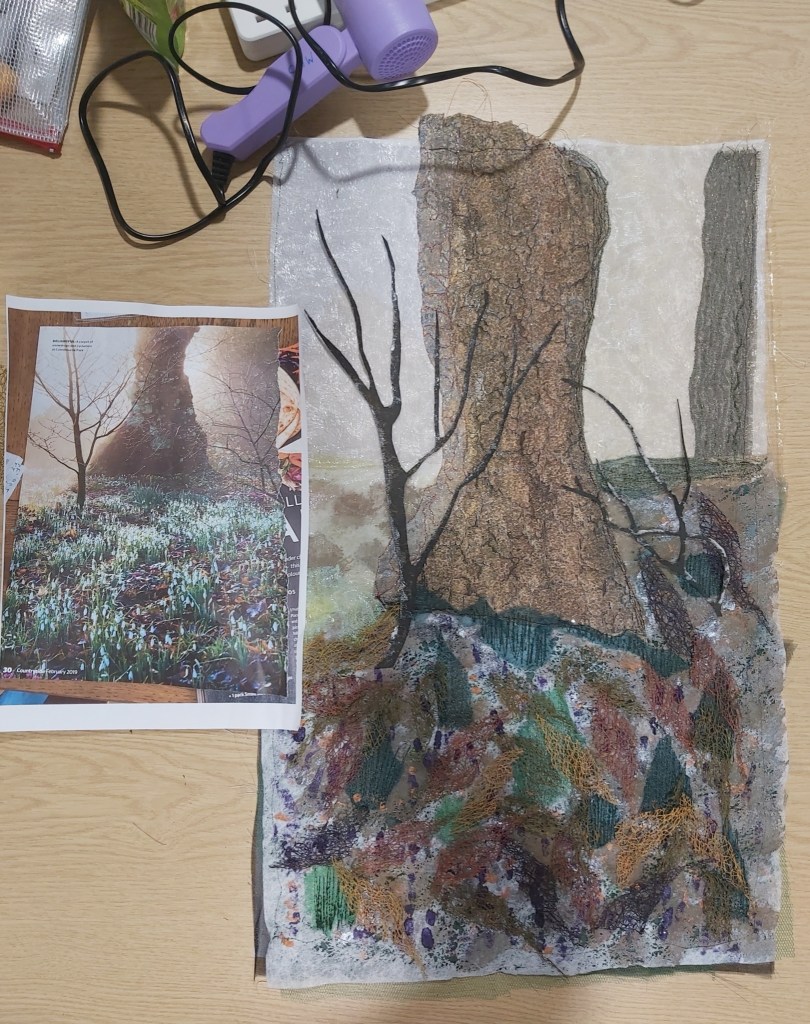
Two weeks ago I was at the Old Barn Hotel, Grantham as guest tutor for the Lincolnshire Textiles Autumn School. The group had invited me to teach my Tall Trees mixed media workshop for fifteen students.

Our class began on the Friday evening after checking in and enjoying a delicious three course meal. The ladies had been asked to bring a photo, sketch or idea for the piece of work they would be making based on a tree/forest theme. I talked through the various materials I like to work with including Lutradur, Tyvek, wallpaper, organza and interfacing. The group were shown examples of how I’ve used these materials in my work and also how previous students have interpreted this workshop.
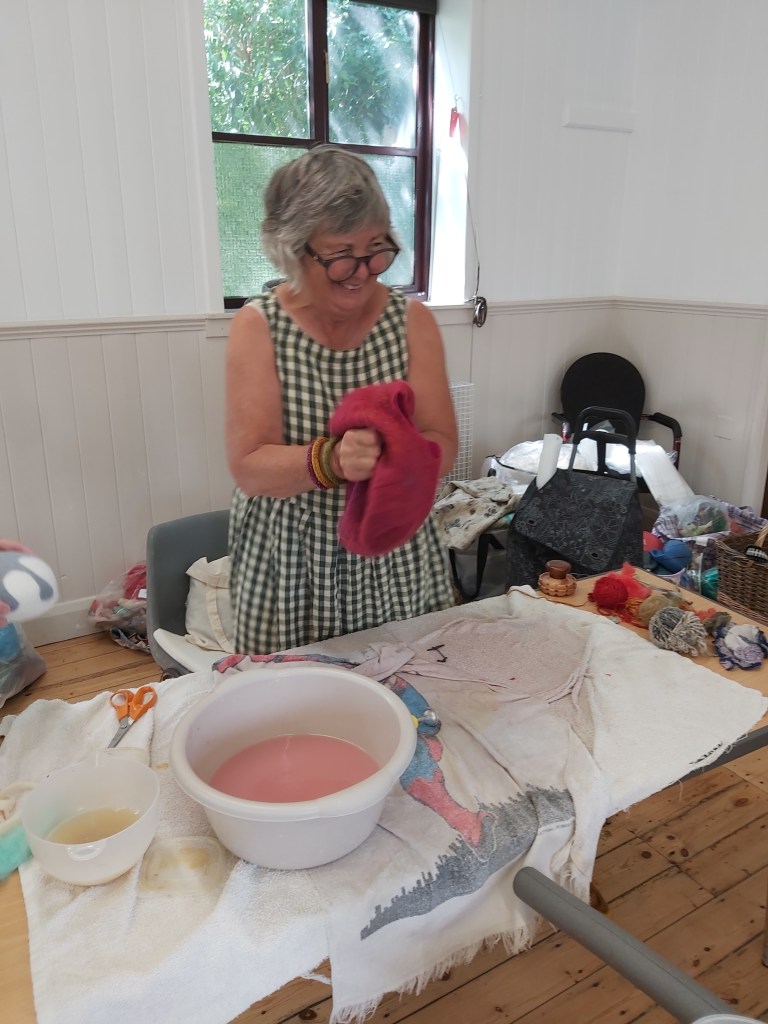
During the course of the evening ideas were explored, designs drawn up and our base fabrics painted.

The next morning, as soon as breakfast was over, the group were back to work— painting, auditioning different fabrics and papers, machine and hand stitching and burning. I had a terrific group of highly motivated ladies to work with and it was wonderful how they embraced using materials and methods they wouldn’t normally have used. Some of the more traditional members of the group admitted to feeling a little out of their comfort zone at the start but a bit of gentle coaxing and encouragement “to play” seemed to do the job and very soon all appeared to be having fun!

The group coordinator, Janet Taylor, did a great job of organising the weekend and was very kind when she said “Karen did a wonderful job of motivating everyone and worked hard all weekend. We learned so much, and the group was supportive and helpful throughout. It was such a treat to focus entirely on stitching and creativity, without the usual distractions. The weekend was intense but immensely rewarding, made even better by the company of friendly, like- minded people.”

The weekend flew by and although there was still work to done when these photos were taken you can see how good the pieces are looking! The group has its next meeting on Saturday and I’m looking forward to seeing many of these finished.

Another recent event was the 2024 Big Textile Show at Leicester Racecourse last weekend. The BTS is always a great show and this year was no exception.

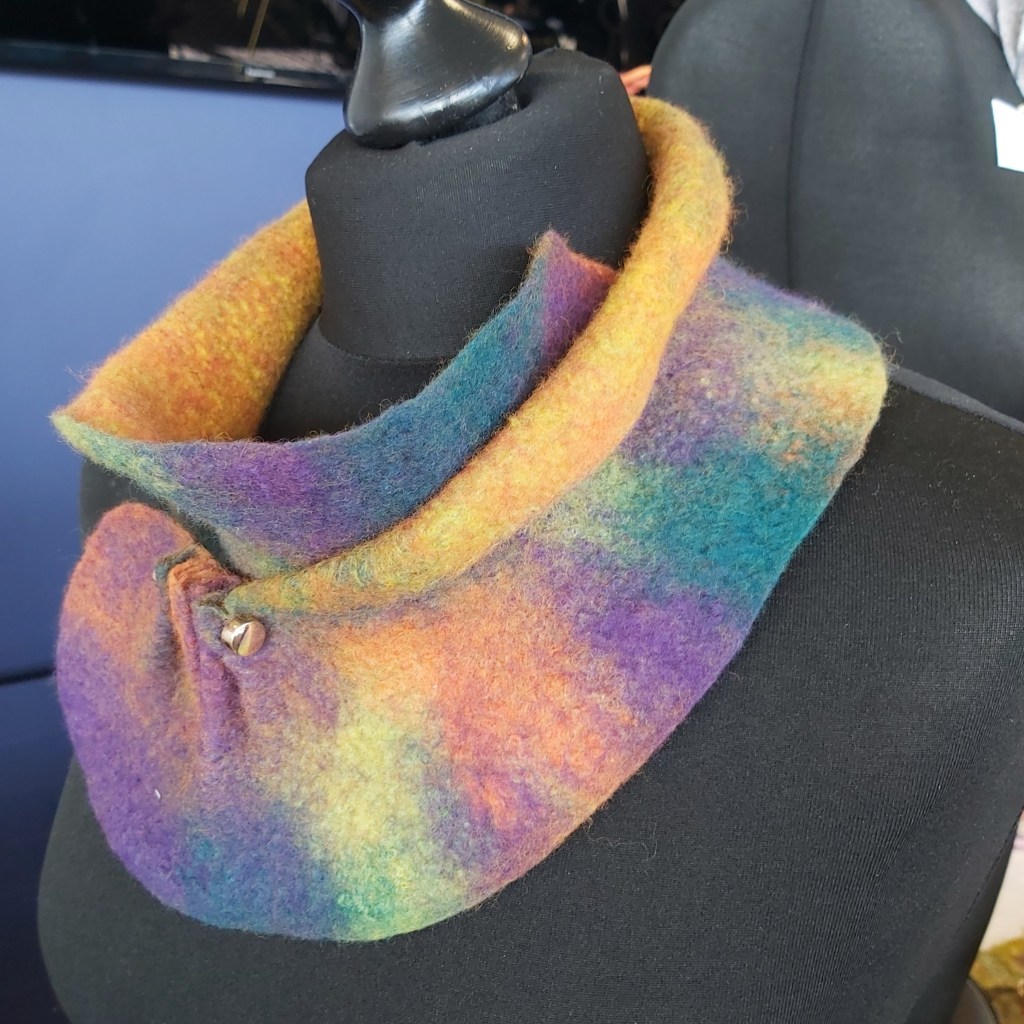
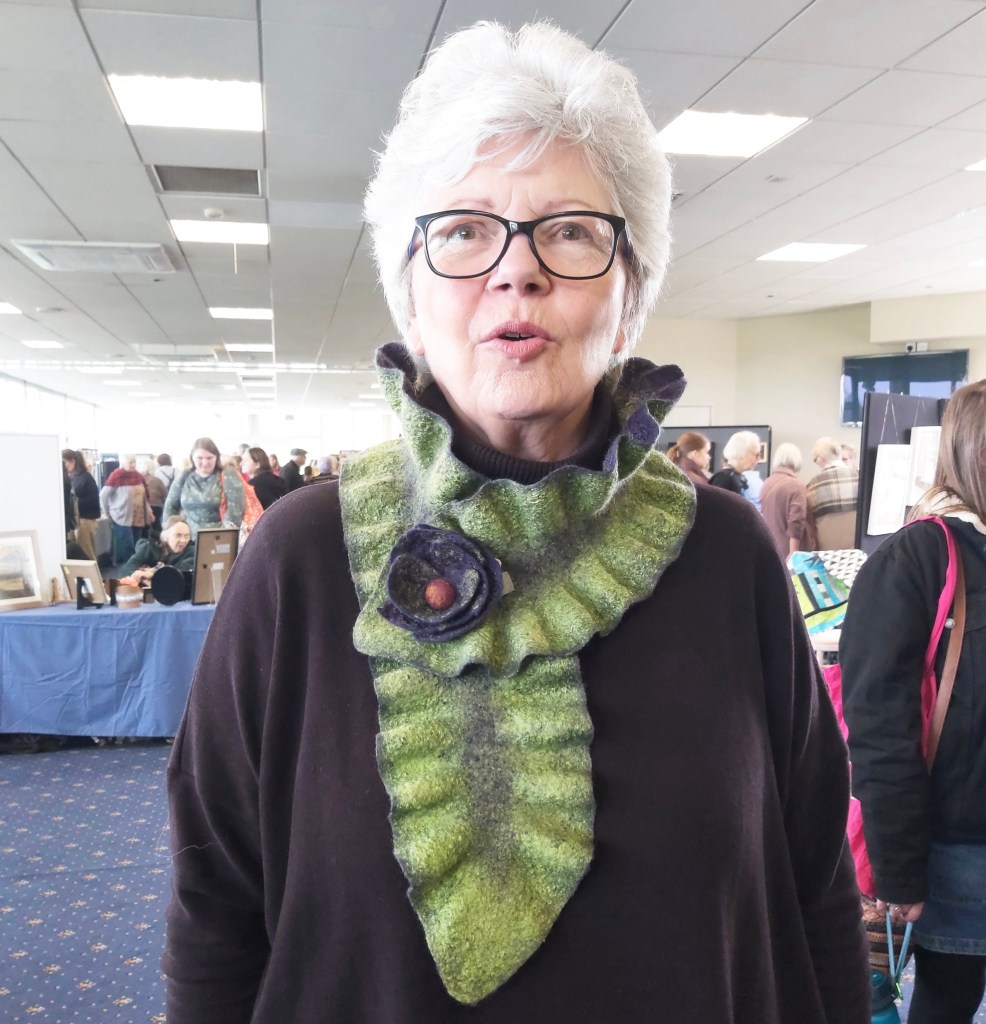
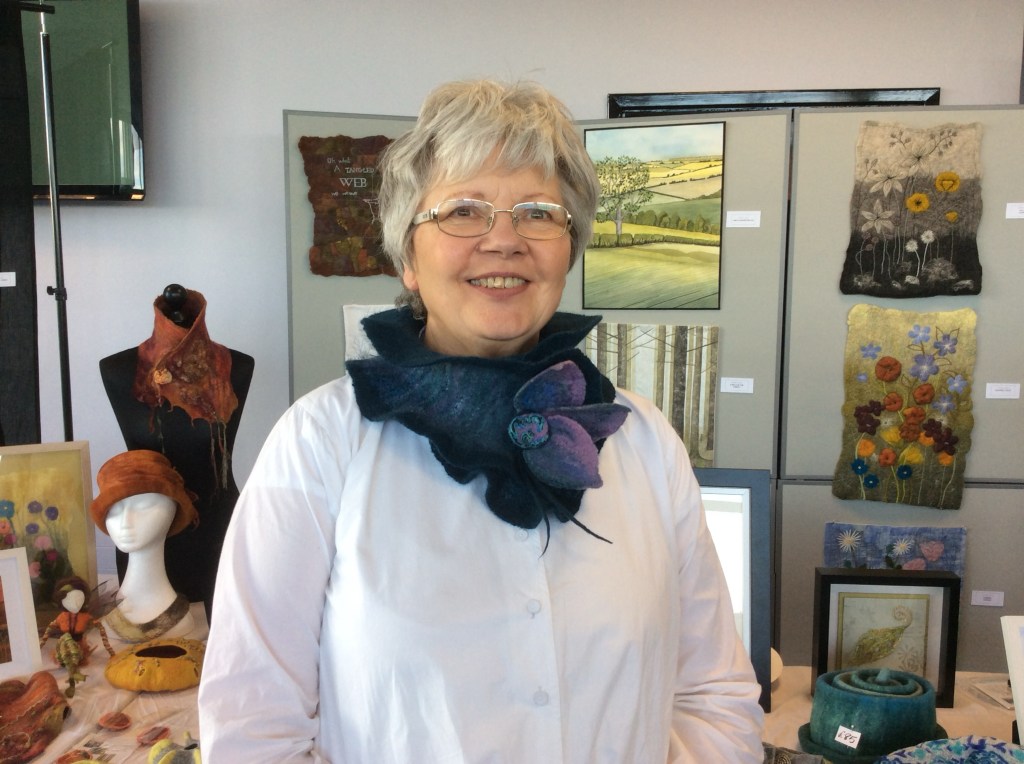
My first customer was the lovely Kate from the Lutterworth Stitchers who purchased my multicoloured Collar. Kates a regular visitor to my stall and looks terrific in whatever she chooses to wear as you can see by these images from previous years!

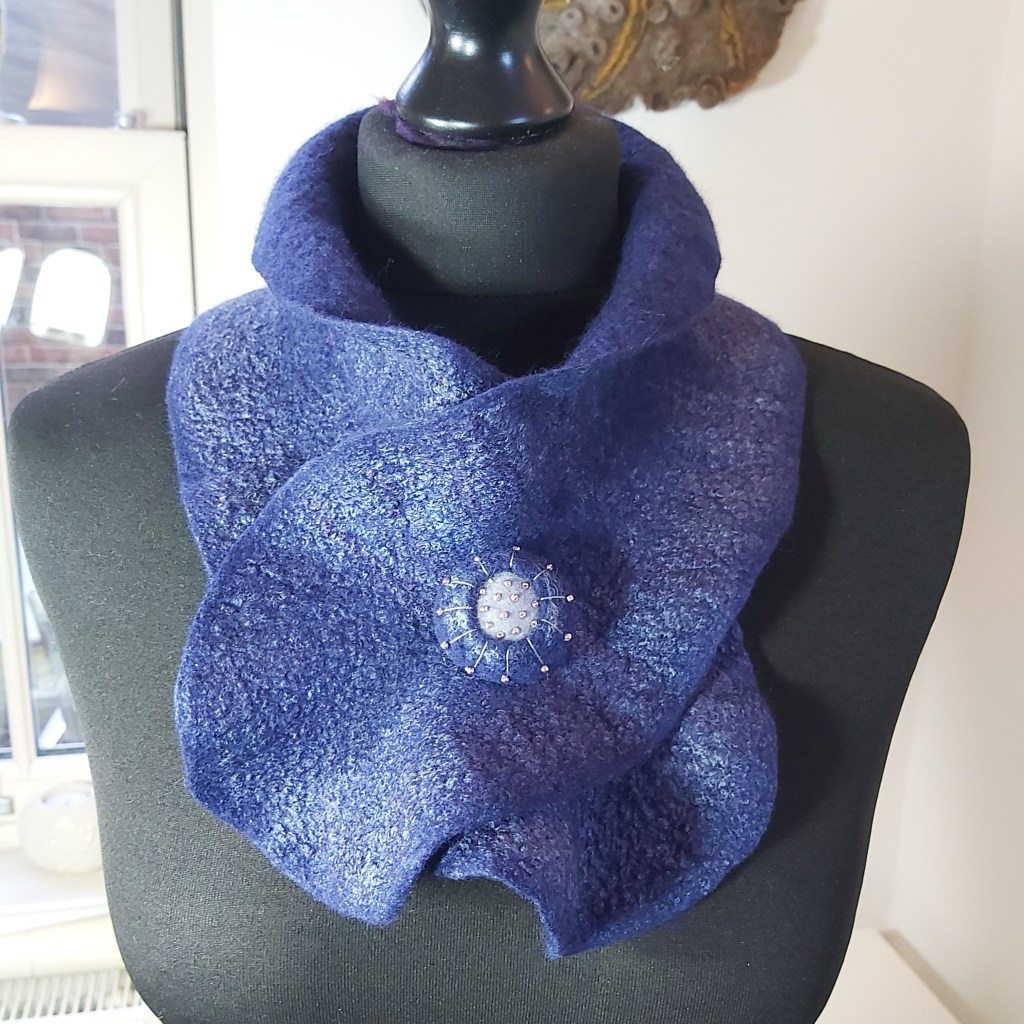
I took a few other new Collars with me including these two in blue and one in dark grey/neutral tones.

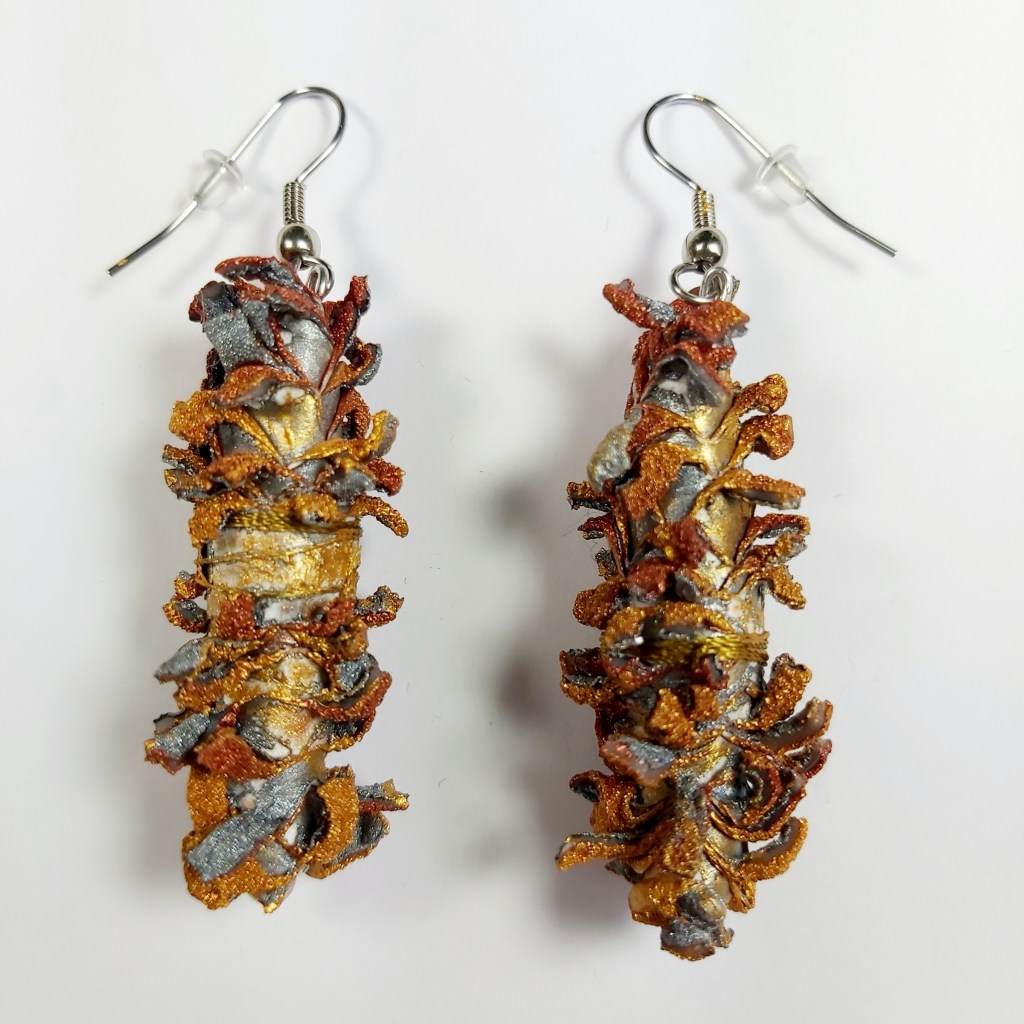
My latest distraction is Tyvek Earrings! A few weeks ago I ran a Tyvek workshop for the Louth Textile group and created a pair of earrings as one of my workshop samples. They proved popular with the group so I made several more pairs for the show. Unfortunately I forgot to photograph them all before the opening but these are what came home with me and are now in my SHOP. I’ve never been a fan of smooth Tyvek beads but I love them with the added textures. It’s quite a challenge making these and absolutely impossible to get an exact match but I quite like that as it adds to their uniqueness!

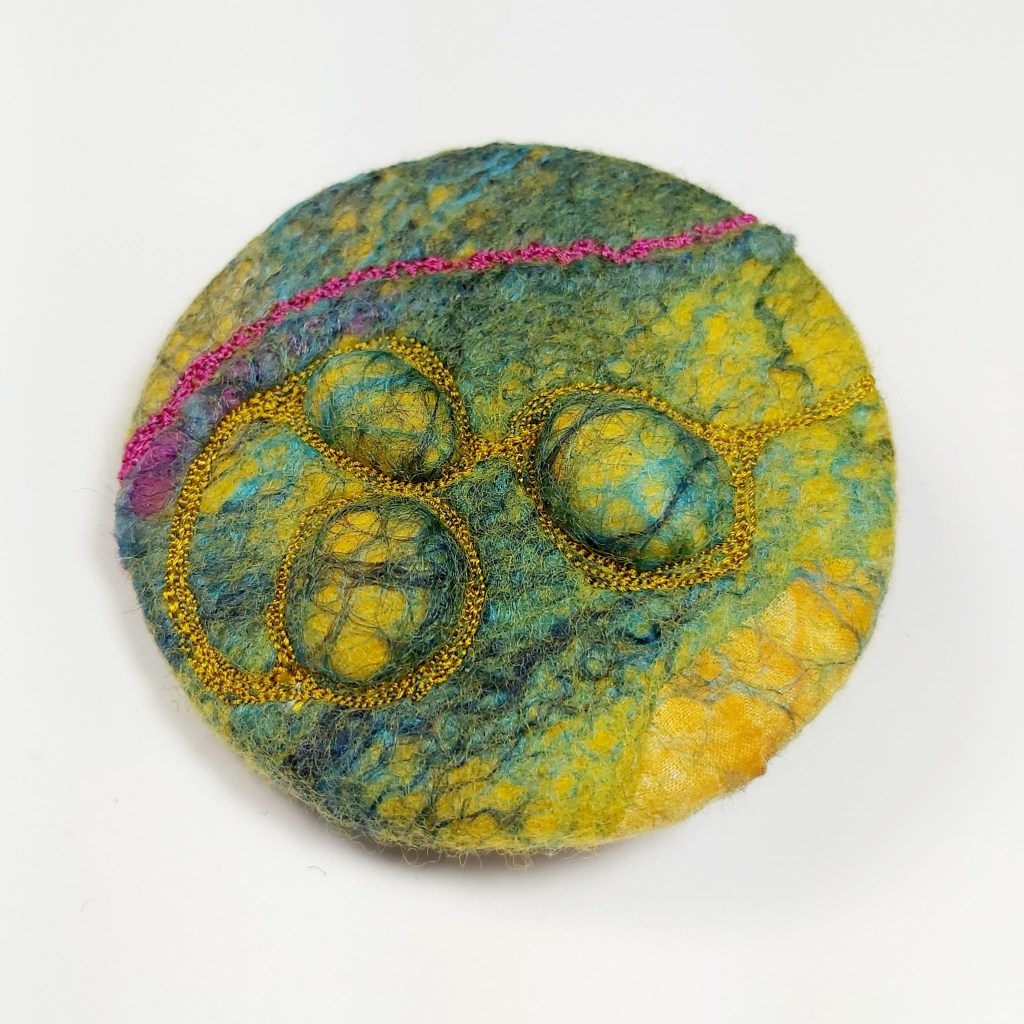
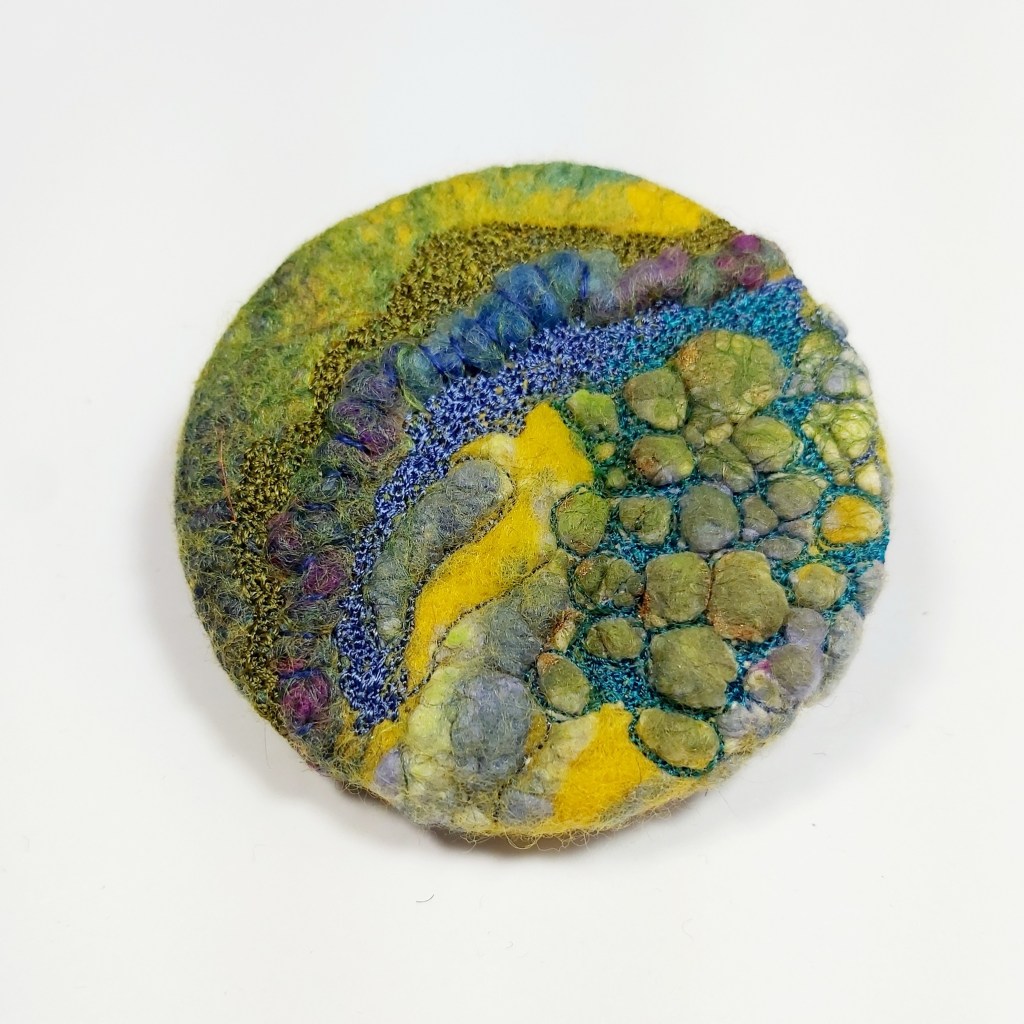
I also made a new batch of gold and silver Tyvek Brooches. I like to mix textures and so these often feature on my felted scarves and collars. These three came home with me so are also in my SHOP along with some new wet felted Brooches.

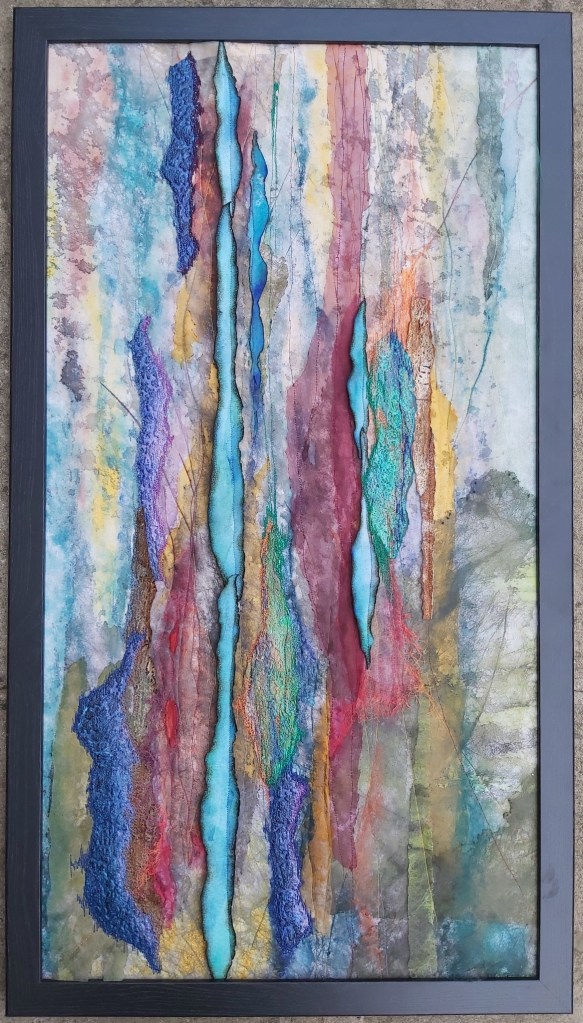
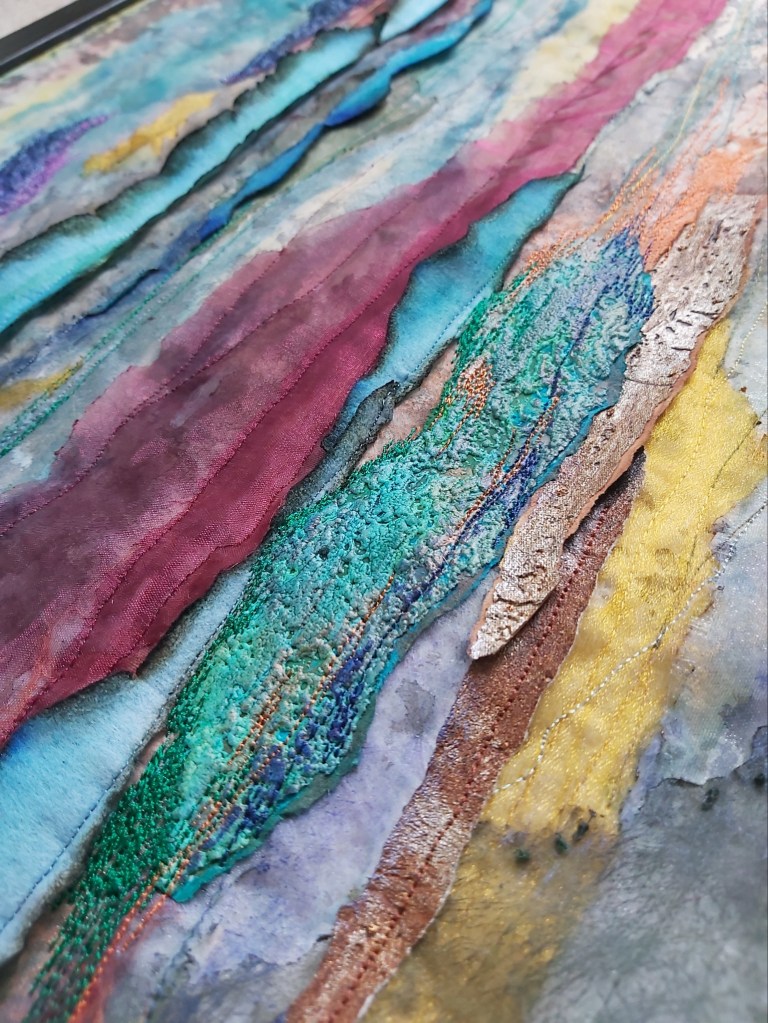
A few days before the show I started to rework a piece I’ve had hanging in my hallway for several years. It’s been hanging on display behind glass, I don’t know why I originally did that as I’ve always preferred to see textile pieces unglazed. Anyway I recently removed the glass which instantly improved the look but then decided to give it a revamp with added textures, more FM stitch and stronger colours. I’m thinking peeling paint on rusty metal and I’m liking where it’s going but it’s not finished yet so I had it displayed on my stand as “work in progress”!

I’ve detailed a few more events that have happened over the past few months over on the Felting and Fibre Studio which can be found here.

With only three more workshops before Christmas things are starting to quieten down so time to think about new projects and ideas for 2025.

Gone Fishing…..

In a previous post I showed a wire work Angler Fish made using galvanised wire, aluminium wire, beading wire and sinamay, for Waltham Textiles forthcoming exhibition. My original plan had been to cover the wire frame with painted Tyvek fabric before distressing with a heat tool….somehow I got carried away with making the framework and didn’t get to add the Tyvek fabric at the point I’d intended and the fish was put to one side looking like this…..

Feeling this project wasn’t really finished, last week I decided to bite the bullet and go back to my original idea of adding the Tyvek fabric, although at this stage it was going to be particularly fiddly! Now I can call it done and I’m really glad I took the time to do it, the result is far closer to how I originally envisaged my fish looking.
Painted with Dylon fabric paint and acrylic ink she stands approx 31cm tall x 62cm long x 36cm wide.

There are over 300 species of anglerfish living at various ocean depths. All anglerfish are carnivorous and therefore adapted for the capture of prey. Deep-sea species have large heads that bear enormous, crescent-shaped mouths full of long, fang-like teeth angled inward for efficient prey-grabbing. Most adult females of the suborder Ceratioidei have a luminescent organ called the esca at the tip of a modified dorsal ray (the illicium or fishing rod). This organ serves the purpose of luring prey in dark, deep-sea environments, but also serves to call males’ attention to the females to facilitate mating. Who knows what this girls gone fishing for!
Something Fishy

This time last year I became a member of Lincolnshire Textiles, an exhibiting, mixed media group who meet monthly at Cherry Willingham near Lincoln. I became aware of the group after being invited as a guest speaker to talk about my work and this was followed by a visit to their last group exhibition, Sapphire & Steel, which was held in Lincoln Cathedral. As well as members exhibiting their individual pieces, central to the displays is always a group piece and this creates a striking focal point as you enter the Chapter House as you can see from this photo taken of their last exhibition.

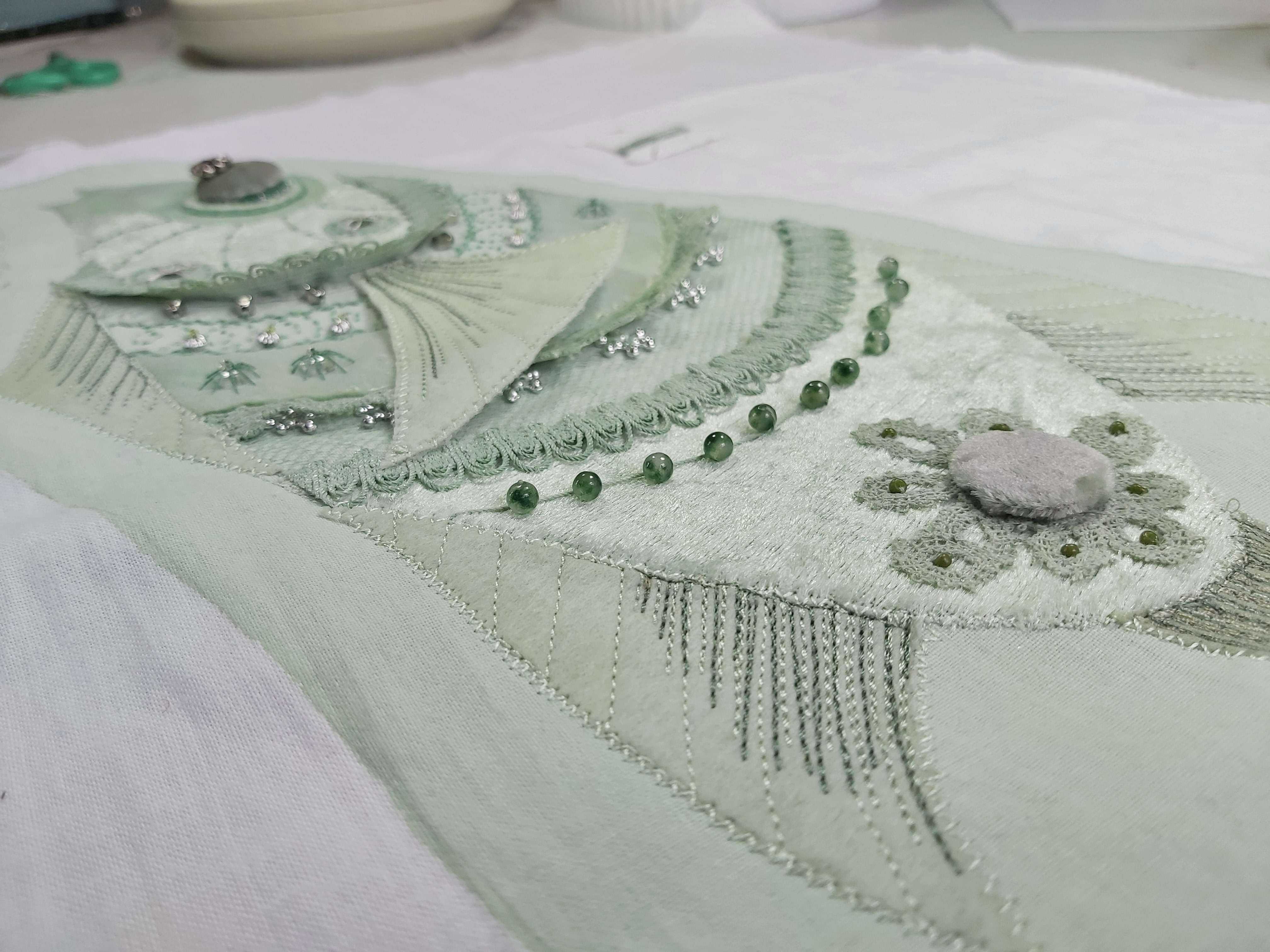
This year the main theme of our exhibition is “Water” and the group piece will represent a whirlpool with 30(ish) members having contributed a section each. Along with a template we were each given a colour swatch and asked to work in shades of that colour without going too dark or light either way. This was my template for shape which is approx 60cm x 15cm at its widest parts, and the little colour swatch of thread.

My first thought was to fill the shape with swirls or crashing waves……

But then I remembered seeing some of the pieces that had been submitted at previous meetings and two or three other members had already worked on that type of design, so I decided to rethink.

The other thing that came to mind was that my section might lend itself to being the shape of a fish so that’s what I decided on…..

The next step was to gather various threads that looked like they might be suitable and then look for different textured fabrics which I could colour. As we were asked to work in monotone it would be important to use as many textures as possible so I pulled out cotton, velour, interfacing, tulle, Lutradur, Evolon, gauze, elastic and crepe bandage.

I mixed up a shade of green that was as near as possible to the swatch and applied it to the fabrics in varying strengths. This gave me a nice variety of shades and texture to work with.

This is my finished fish with the addition of beads which I’m hoping will catch the light and add interest. I’m looking forward to seeing the finished piece but certainly don’t envy Hilary who now has the job of joining all of our segments together and making them fit!!

Making Waves Update…..

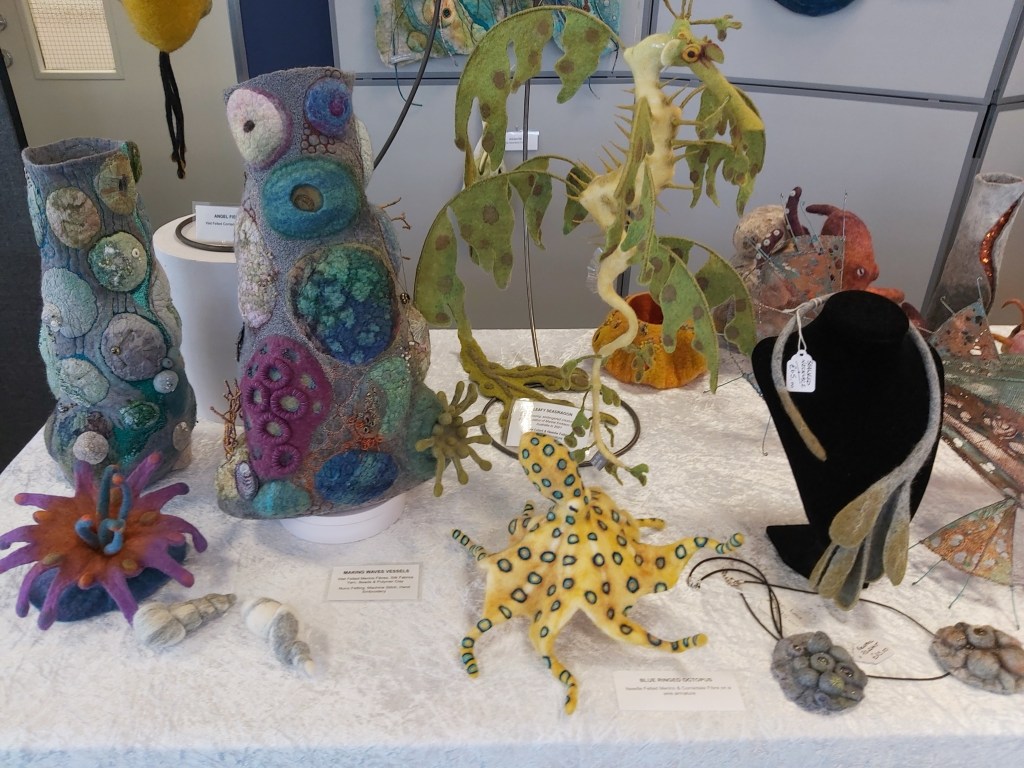
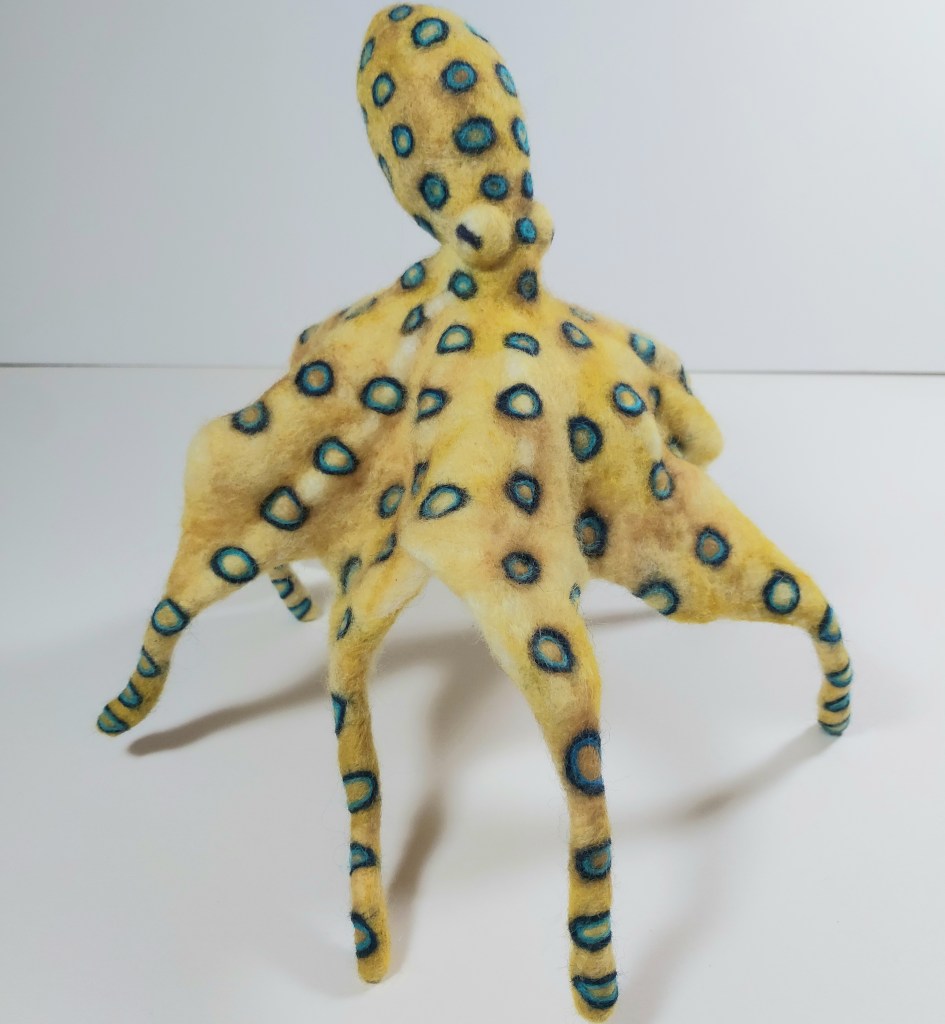
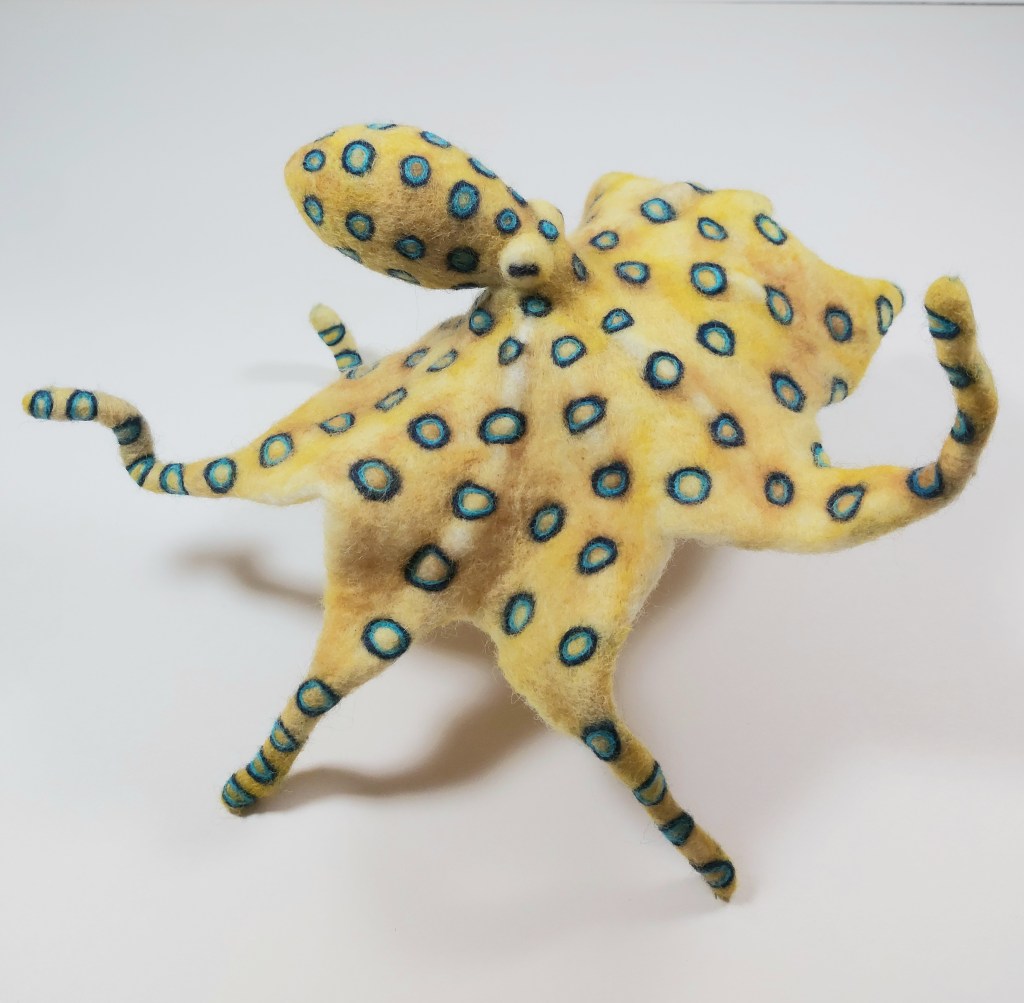
I mentioned in my last post that Waltham Textiles Exhibition will feature an Octopuses Garden. Well, after many hours of needle felting Olivia, or Oli to her friends, was born. At approx 36cm in diameter she’s a blue ringed octopus, fully articulated and created from carded Corriedale with Merino markings. The only thing left to do now is create and attach her suckers but that will be a fiddly time consuming job and one that will be fitted around less repetitive projects!

In real life the blue ringed octopus is much smaller than Oli. Size differs between species, but they range from around two to six centimetres long, with arms reaching lengths of seven to 10 centimetres. They usually appear as pale-brown in colour, and are only identifiable by their iridescent blue markings when they are agitated or hunting. Native to the Pacific Ocean, they can be found in the soft, sandy bottom of shallow tide pools and coral reefs. Although small and pretty they carry an extremely toxic venom which they use to paralyse their prey! Like other octopuses the blue-ringed octopus has a short lifespan of about two years. During the mating season the female will lay anywhere from 50-100 eggs, which she will guard for a long incubation period lasting almost two months. The male blue-ringed octopus dies after mating.
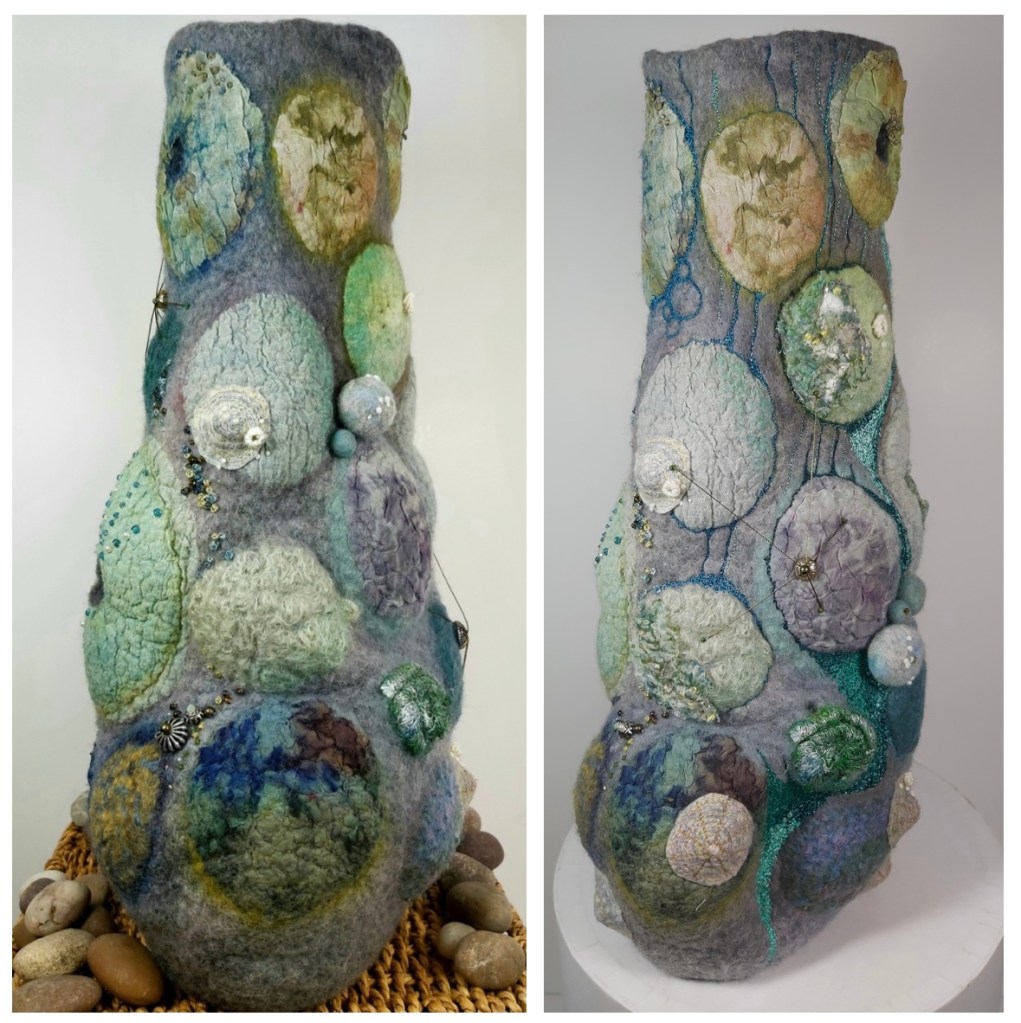
I’ve also recently given a makeover to a 3D wet felted piece, this was the first of two coral inspired vessels I made in 2023. The second one was heavily FM stitched, and far more interesting for it! I’ve been looking at this first vessel for a while and thinking “should I”? Over Christmas I finally bit the bullet and added FM stitch. The images on the left show before and on the right show after.

I absolutely love stitching into felt, whether by hand or machine, and I’m really pleased with the outcome and the added depth the machine stitching has created in this project.

The two coral inspired vessels

Uttoxeter Catch Up…..

I’ve done it again…..it’s over six months since my last post and I’m now sitting here wondering how it happened and whether it’s possible to “seamlessly” slip in half a dozen catch ups without it looking clunky!

As this blog originated as an online journal to keep track of the things I’m doing, seeing and experiencing creative wise, I really do want to fill in the yawning gap that was Spring & Summer 2022 but I’d be kidding myself to think I can make it look seamless. Some of what I’m going to post has already appeared on the Felting and Fibre Studio. I would normally write it for myself first and then copy it across but, for whatever reason, it didn’t happen! Anyway, here goes with my Uttoxeter catch up which takes us back to April and the Quilt & Stitch Village, an annual 3 day textile show held at Uttoxeter Racecourse in Staffordshire.

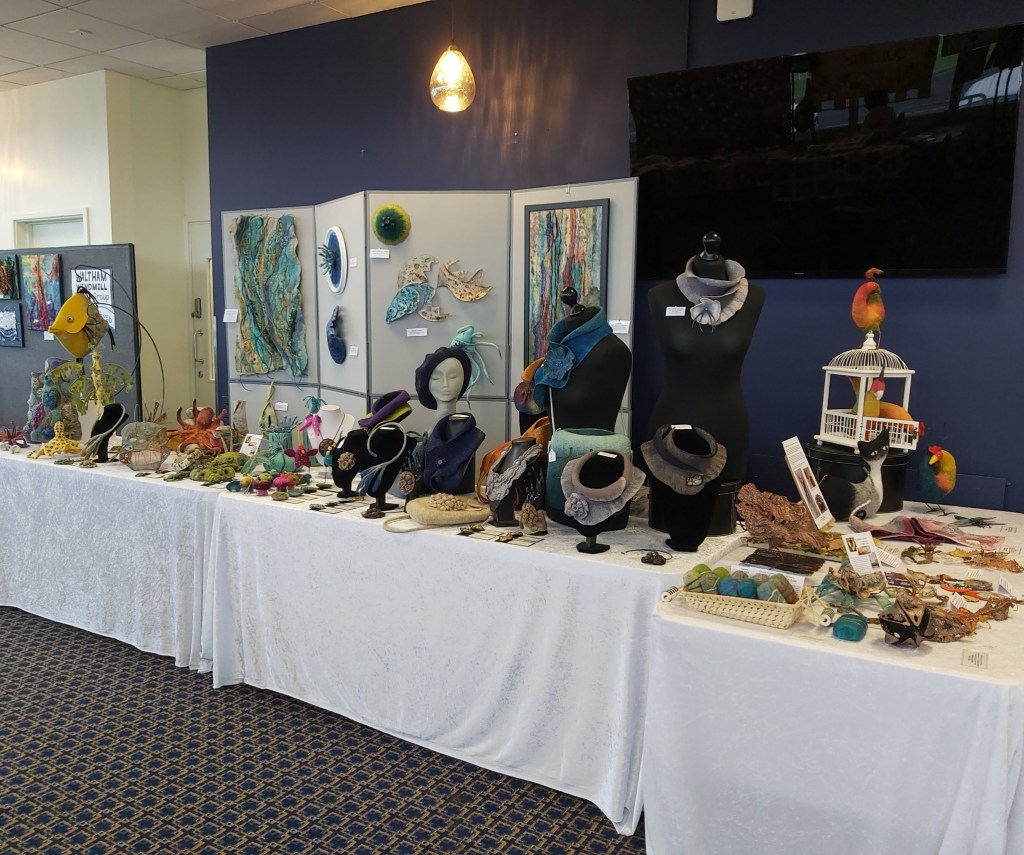
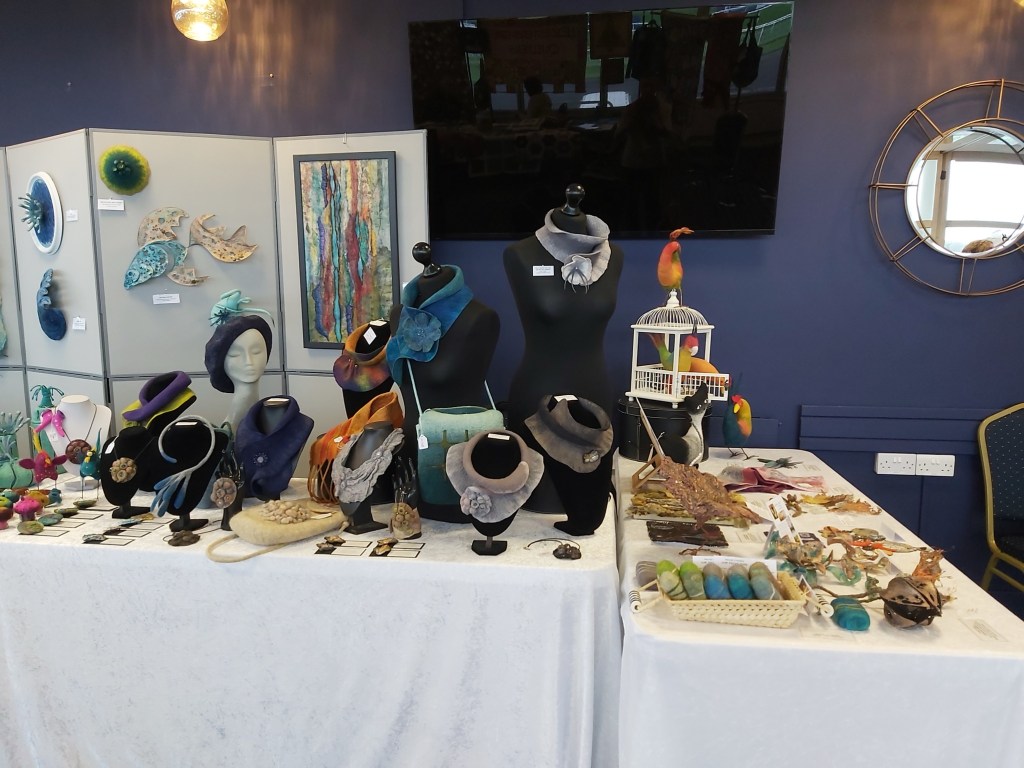
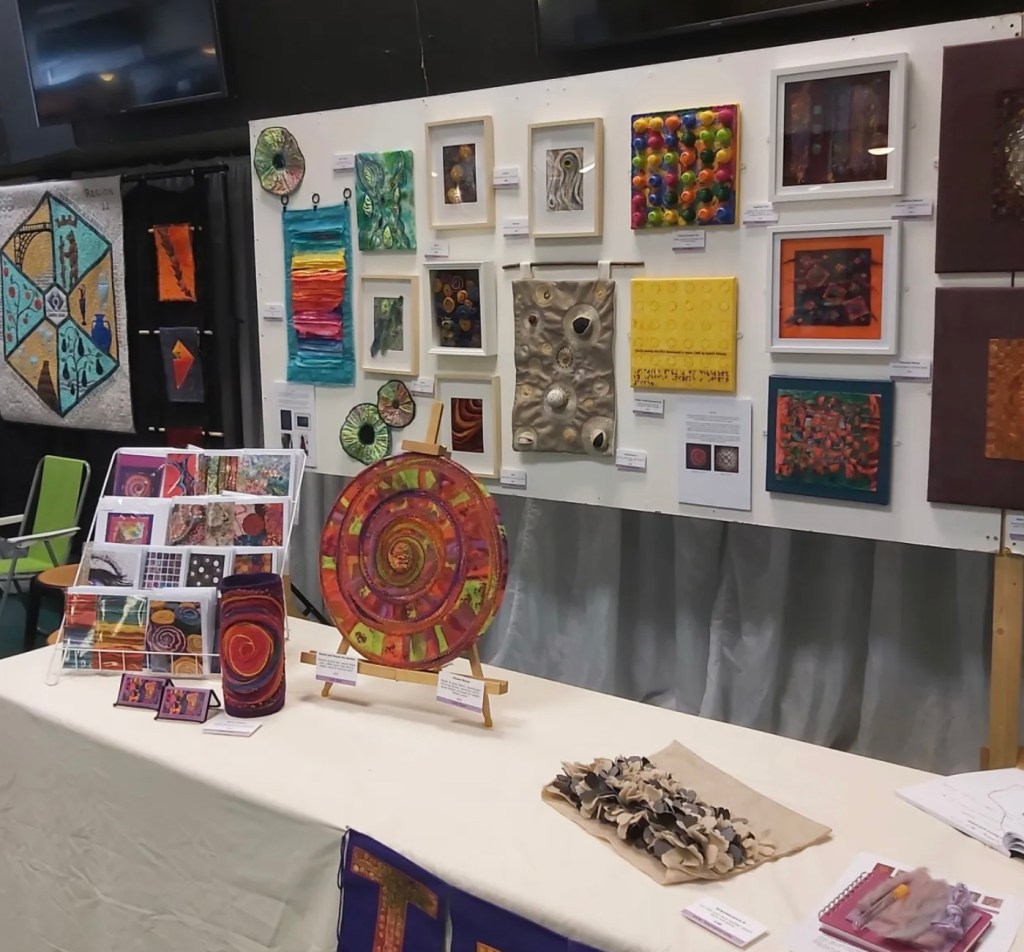
It was my first time exhibiting at Uttoxeter and I wasn’t sure what to expect. Would visitor numbers be low? Most ladies attending shows like this are of a certain age (me included!) and I know some still have concerns about mixing in large groups. This is predominantly a quilt show, would there be enough interest in feltmaking or would the majority walk straight passed? I was manning my stall alone…. would the neighbouring stall holders be too busy to relieve me when I needed a loo break? I needn’t have worried, when the doors opened at 10am the visitors flooded in and it turned out to be three very “full on” days! These are a few of the items I had on show……

Just prior to the show I’d felted myself a couple of sculptural, roll edge collars which I wore over that weekend. They attracted a lot of interest which has led to me making them as commissions as well as running one day workshops for ladies wanting to make their own.

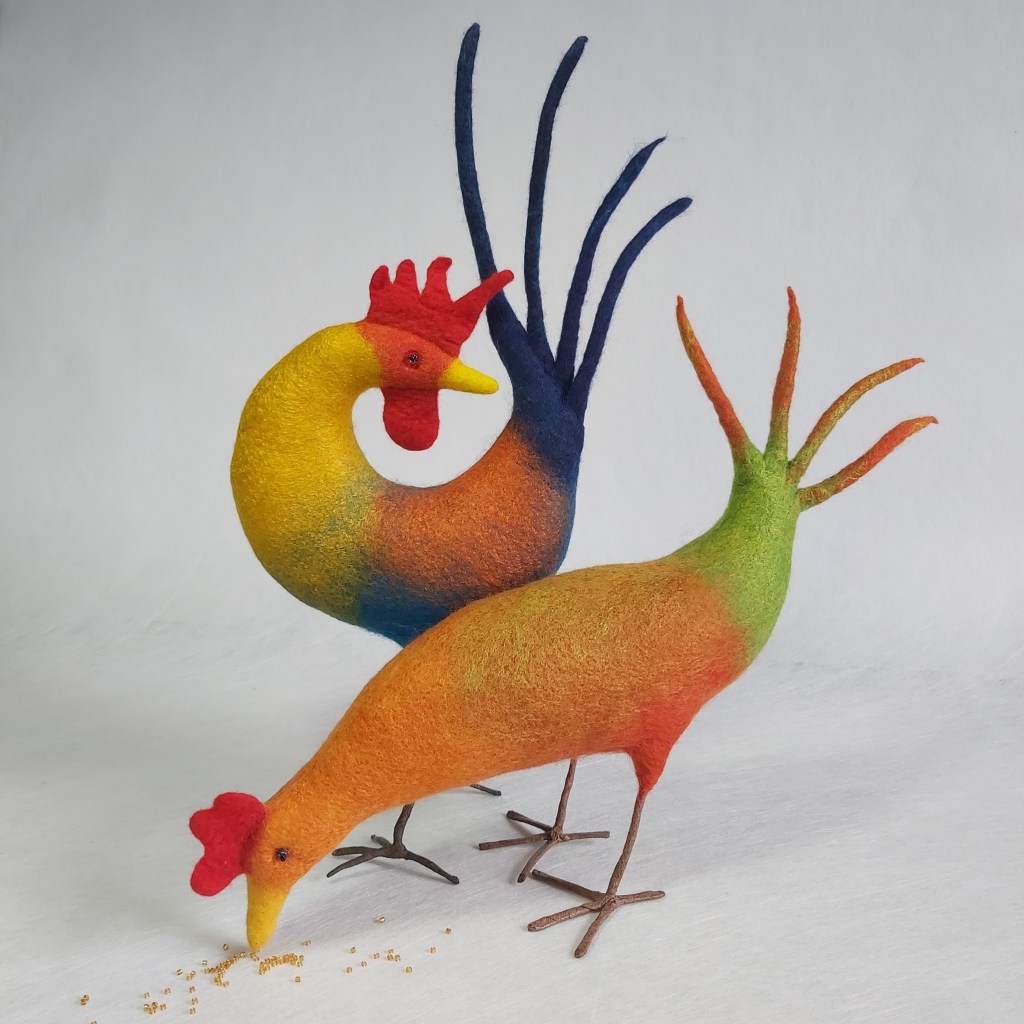
The cockerel and hen also proved popular with visitors. I had originally read a free tutorial on how to make a wet felted parrot in an issue of the Australian “Felt” magazine. It had been written by a wonderful Feltmaker called Sue Smorthwaite who creates fabulous birds native to her home in Australia. Keen to try the technique, but not wanting to use Sue’s design, I had the idea to make a pair of chickens. By making two I could kill two birds with one stone (sorry!) as I also needed to create a pair of “something” for a Noah’s Ark Project…..but that’s for another post!

My pitch was next to Project Linus, a charitable organisation that provides quilts and blankets for children in need. Their aims are to “Provide love, a sense of security, warmth and comfort to children who are seriously ill, traumatized, or otherwise in need through the gifts of new handmade blankets and afghans, lovingly created by volunteer “blanketeers.” And to “provide a rewarding and fun service opportunity for interested individuals and groups in local communities, for the benefit of children.”

Project Linus always attracts a lot of interest and the two lovely ladies on that stand were swamped with visitors for the three days! Somehow they still managed to cover for me when I needed a comfort break which was really appreciated!

I didn’t get much chance to visit other stands but when Jane (Wylde Oak Artistry) came over to say hello and told me she was working with Spun-bond fabrics I had to go see her work. I loved her masks and corsets, made on the theme of body dysmorphia, and came away feeling that there is so much more I could be doing with Lutradur!

Another stand I particularly enjoyed was “Traverse”, a group of exhibiting textile and mixed media artists. Apologies for not getting close ups of their work…….it’s worth following the link and taking a look at their website.

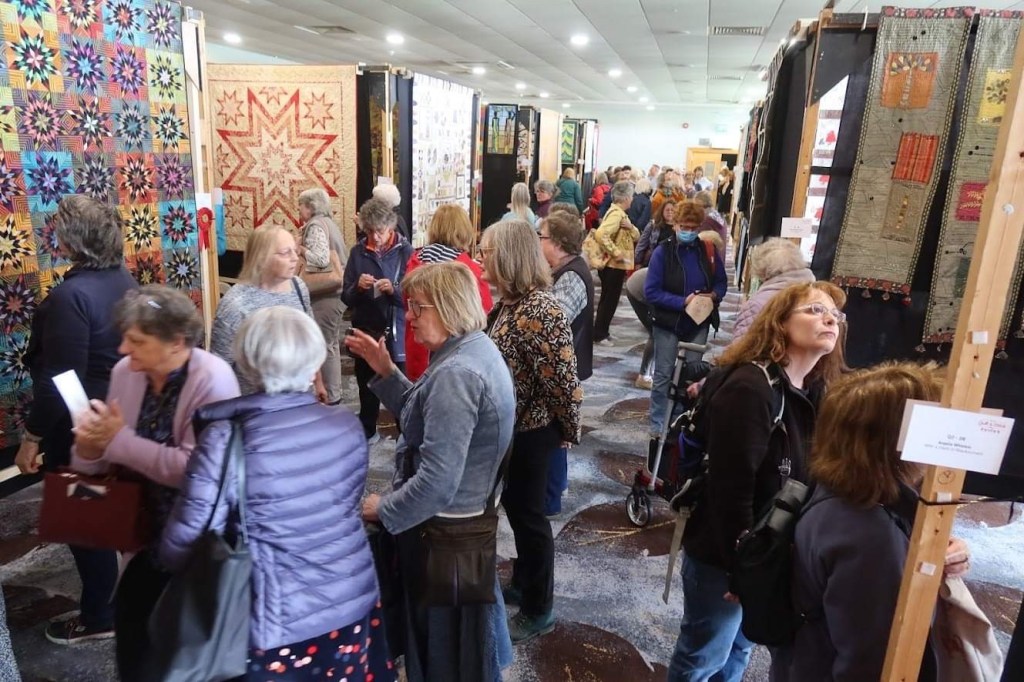
It was a good show, spread over three large halls as well as various other smaller buildings. Most of the photos I took were prior to opening but as you will see from the last three, we really did get visitors!