In a previous post I showed a wire work Angler Fish made using galvanised wire, aluminium wire, beading wire and sinamay, for Waltham Textiles forthcoming exhibition. My original plan had been to cover the wire frame with painted Tyvek fabric before distressing with a heat tool….somehow I got carried away with making the framework and didn’t get to add the Tyvek fabric at the point I’d intended and the fish was put to one side looking like this…..
Feeling this project wasn’t really finished, last week I decided to bite the bullet and go back to my original idea of adding the Tyvek fabric, although at this stage it was going to be particularly fiddly! Now I can call it done and I’m really glad I took the time to do it, the result is far closer to how I originally envisaged my fish looking.
Wire work, Tyvek fabric and Sinnemay
Painted with Dylon fabric paint and acrylic ink she stands approx 31cm tall x 62cm long x 36cm wide.
There are over 300 species of anglerfish living at various ocean depths. All anglerfish are carnivorous and therefore adapted for the capture of prey. Deep-sea species have large heads that bear enormous, crescent-shaped mouths full of long, fang-like teeth angled inward for efficient prey-grabbing. Most adult females of the suborder Ceratioidei have a luminescent organ called the esca at the tip of a modified dorsal ray (the illicium or fishing rod). This organ serves the purpose of luring prey in dark, deep-sea environments, but also serves to call males’ attention to the females to facilitate mating. Who knows what this girls gone fishing for!
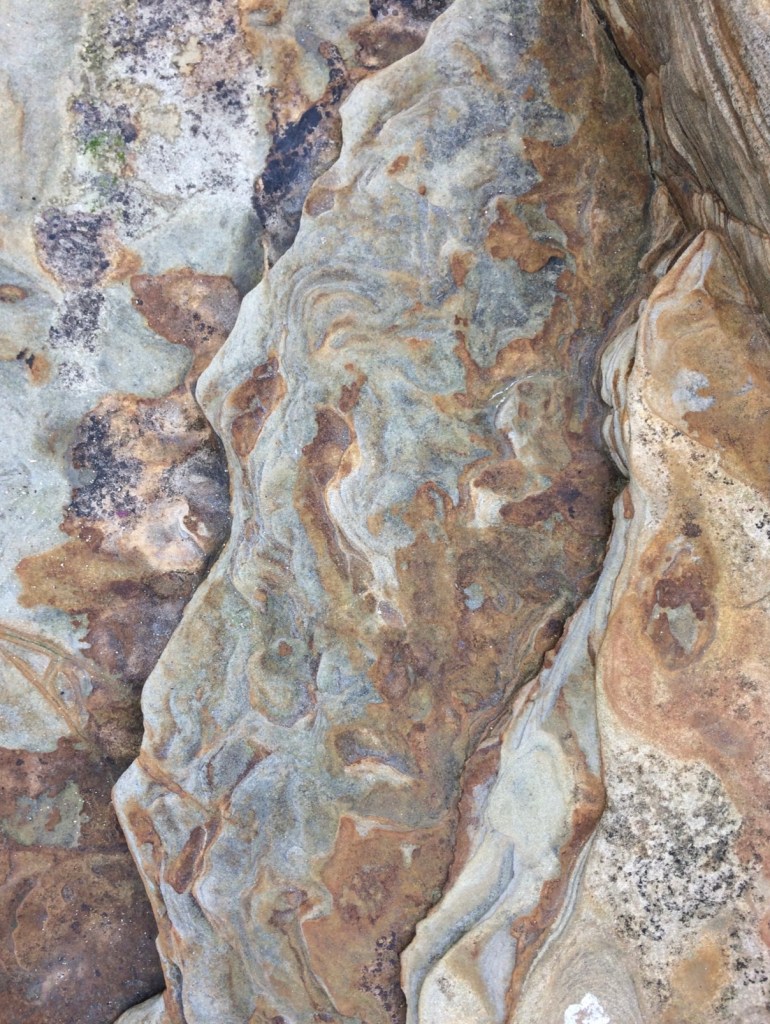
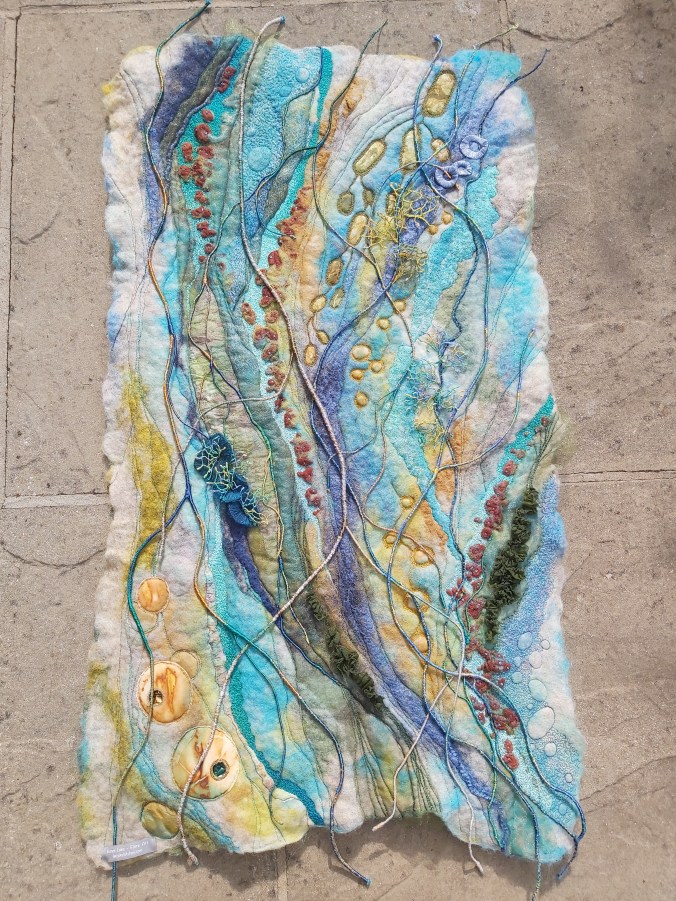
As part of the Waltham Windmill “Making Waves” challenge all members will have a metre wide wall space at next years exhibition to use as they wish. It’s too early to know for sure what I’m going to be putting up in my space (no shortage of ideas though!) but one possible piece could be this wet felted wallhanging I’ve called “Going with the Flow”. The inspiration for this came from the wonderful, wavy markings on the large stone slabs on Seahouses beach in Northumberland. This is one of my favourite spots in the UK and I took these photos a couple of years ago knowing that one day they would inspire a piece of work.
For the background I pulled out my box of oddments, short lengths of fibre left over from various projects, not enough to put back in their pack but too much to throw away…..not that I ever throw any fibre away! I recently bought myself a drum carder from Richard Britton and had fun carding all those oddments before laying them out.
This is how it looked after felting with silk fabrics, silk fibres, knitting yarn and nepps. I liked the silk circles bottom left but wanted them more 3D so they were removed and replaced with hand dyed fabric discs, recycled from another project.
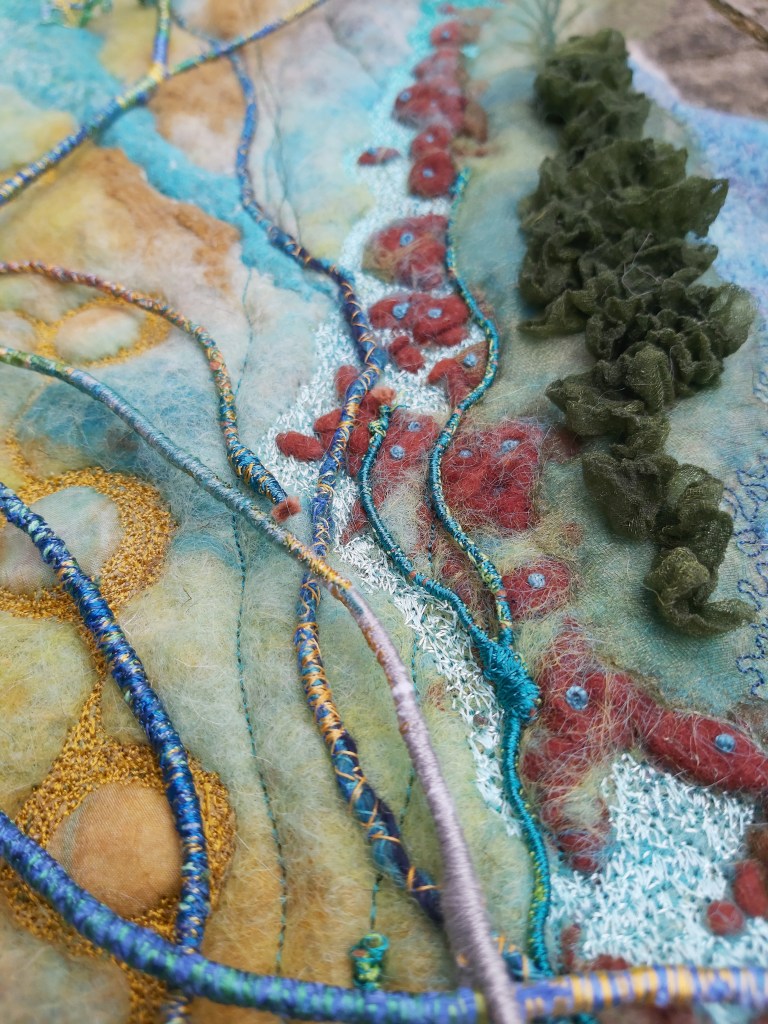
So now I had my base fabric it was time to start embellishing. I made a start with a few lines of free motion stitch, mimicking the curving marks on the stone slabs. I didn’t have a sketch, or a plan, for where I was going but I like to work this way, making a start and then seeing where it takes me. I have to admit it would sometimes be far quicker to have a plan as it would avoid all of the attaching and removing and repositioning until it looks right, but I really do enjoy that part of the process!
Its been several months in the making but I’ve thoroughly enjoyed working on it using a combination of free motion stitch, hand embroidery, recycled fabrics and coffee capsules, sheer fabrics, hand painted silk fabrics and machine wrapped cords. The more I embellished the further it shifted from being about single slab of rock to becoming more about the ocean in general with its abstract rivulets of water, seaweed, coral and the obligatory rock pools. Approx 90cm x 50cm.
Another of the specific items we’ve been challenged with for the Making Waves exhibition is a fish. I immediately decided I was going to wet felt mine which lead to us having a in-house felted fish workshop and the creation of TroutPout! She’s made from carded Corriedale and is approximately 33cm x 36cm excluding the fins.
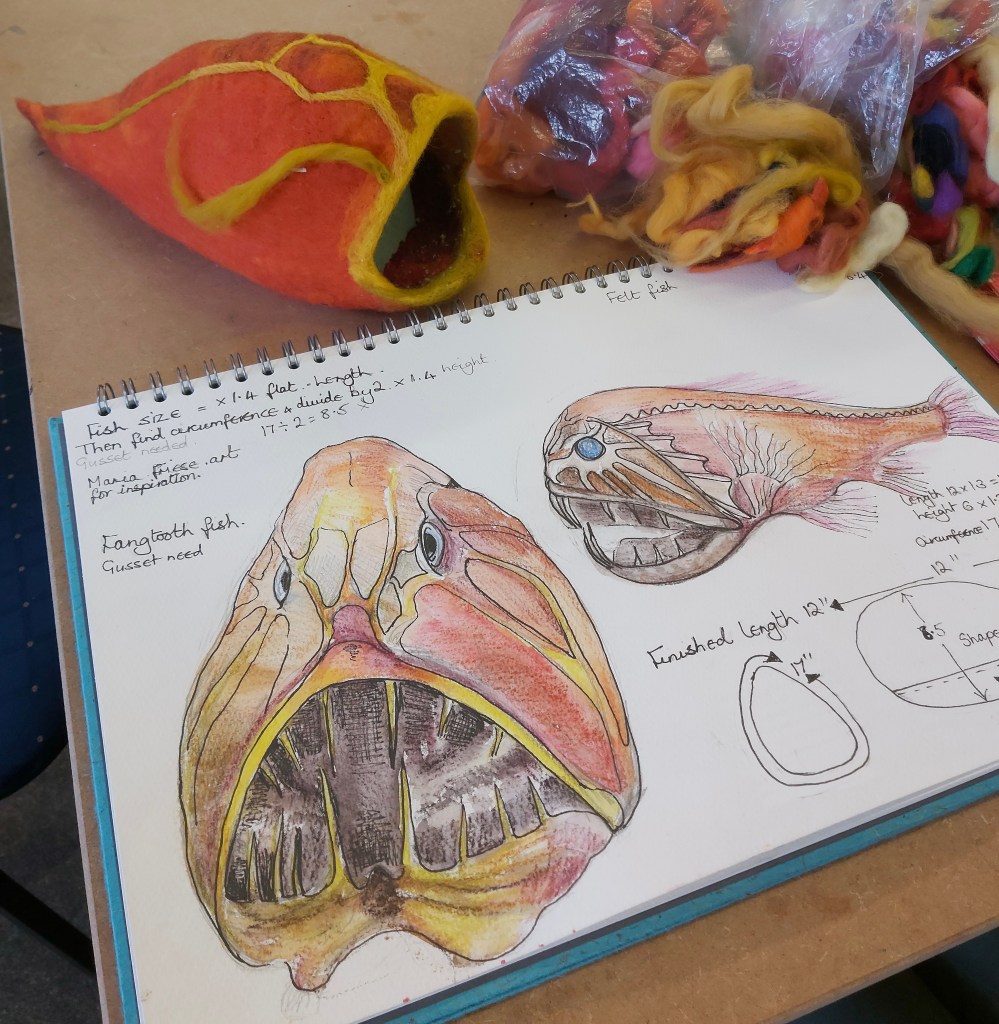
These are some of the other fabulous fish that members have made so far, this one is Barbara’s scary Fangtooth…..
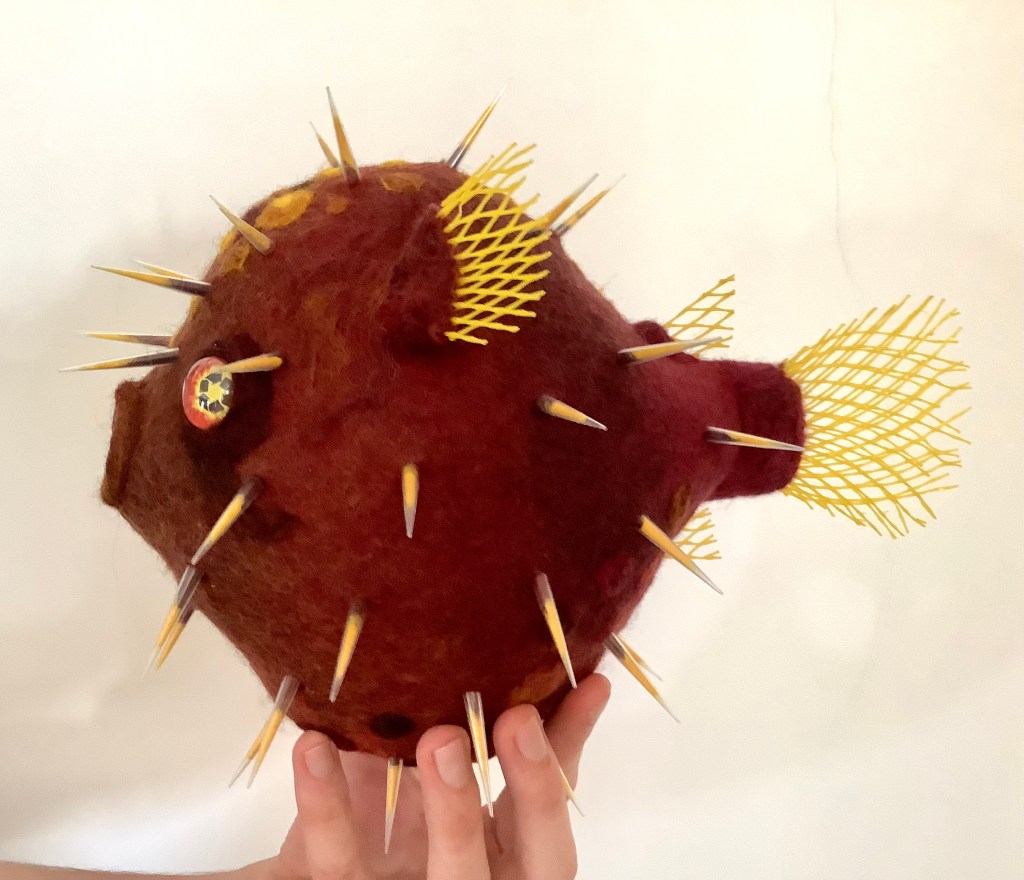
Lucy made a wonderful wet felted Puffer Fish adding recycled plastics, including pipette tips, wine bottle netting and glass beads with recycling symbols underneath, to highlight the plight of our oceans.
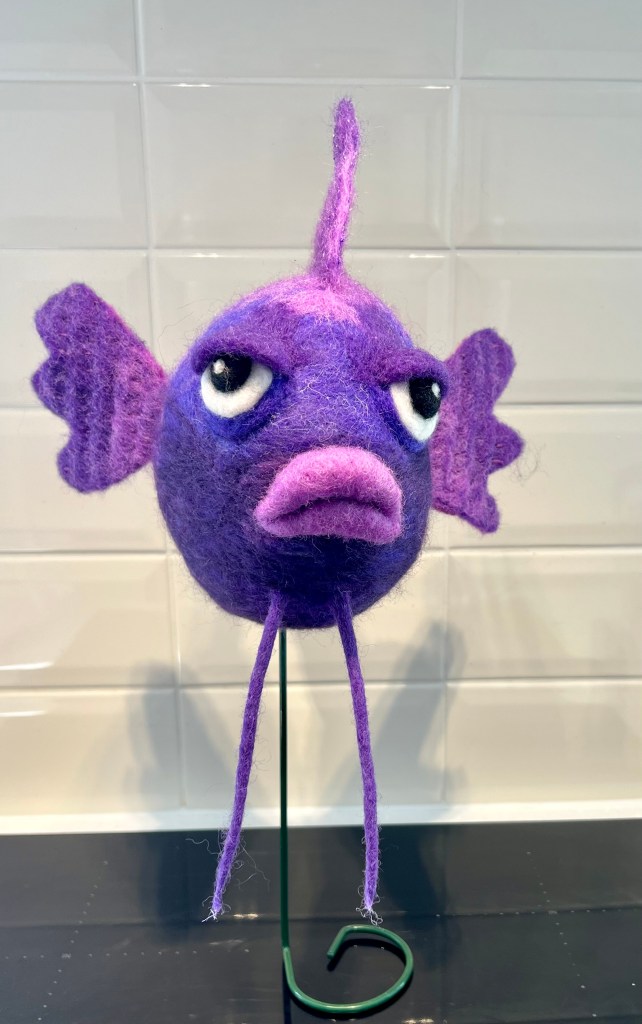
Sue is new to wet felting but she’s taken to it like a fish to water (couldn’t resist!) and has made “Angry Fish”. I think he looks more sulky than angry but he’s terrific!
And there are several others that are work in progress….
I’ve been teaching 3D Seed Pod workshops recently using wire wrapped with Tyvek fabric and decided I’d also like to make an Anglerfish from wire rather than fibre. It was only when I’d got the 60cm x 33cm framework made that I sat back and realised I’d gone past the stage where I had meant to start adding my fabric! Time for plan B…..maybe I could use wire mesh to give it “body”?
I looked for some online but hesitated as I wasn’t sure how flexible or suitable the mesh would be. Having put the fish to one side, a few days later I joined the Lincolnshire Textile group and at my first meeting I was offered a piece of silver coloured Sinamay. Sinamay is one of the most popular hat-making foundations. It’s woven from the processed stalks of the abaca tree, a type of banana native to the Philippines. I couldn’t believe my luck……..being silver coloured this off cut looked like wire mesh but wasn’t and if I sprayed it lightly with water I could shape it to fit and stitch it with aluminium wire to my framework. So this is Wanda, also known as “Gone Fishing!” made with a combination of galvanised, aluminium and beading wire and Sinamay. She wasn’t easy to photograph as I didn’t have large enough sheets of black card but hopefully enough detail is showing.
Another feature of our exhibition will be the Octopus’s Garden so we will be needing a few Octopus and a variety of coral decorate it…..my collection is steadily growing!
I mentioned having joined the Lincolnshire Textile Group and, as luck would have it, their current theme, and next years exhibition, is “Water” so sits nicely with the Waltham theme. It’s good to know I can carry on creating ocean inspired work for at least the next 12 months!
The Waltham Windmill textile group, of which I’m a member, have a theme which runs for two years culminating in an exhibition of work. The current theme is Making Waves and the exhibition for this one will be held sometime in the first half of 2024.
Within the groups theme we have free rein to make whatever we want plus we’ve agreed a number of specific items we will each make. One of the items is a jelly fish. Having done a bit of research into the many and varied species of jelly fish I came across the spotted Blue Jellyfish which is native to UK waters. My first thought was to create a “wet look” using Merino fibre covered with lots of viscose which would create a sheen and then I would free motion stitch the spots. That was quickly replaced with the idea of making my jellyfish from sheer fabrics…..I seem to have accumulated lots of sheers and only ever use tiny amounts so this would be a perfect opportunity to use up some of my stash. After rummaging through a huge sack of fabrics, almost losing hope of ever finding the colour I needed, I came across a small piece of blue and another of turquoise, just enough to do the job…..so much for stash busting!!
Blue Jellyfish (Cyanea lamarkii), feeding on small plankton, England – source www.wildlifetrusts.org
The remnants of fabric, and the size of my embroidery hoop, determined the size of my jelly fish. I’d got some of the wash away stabiliser left over from a project I did a few years ago so that would be useful for stiffening and shaping the jelly fish.
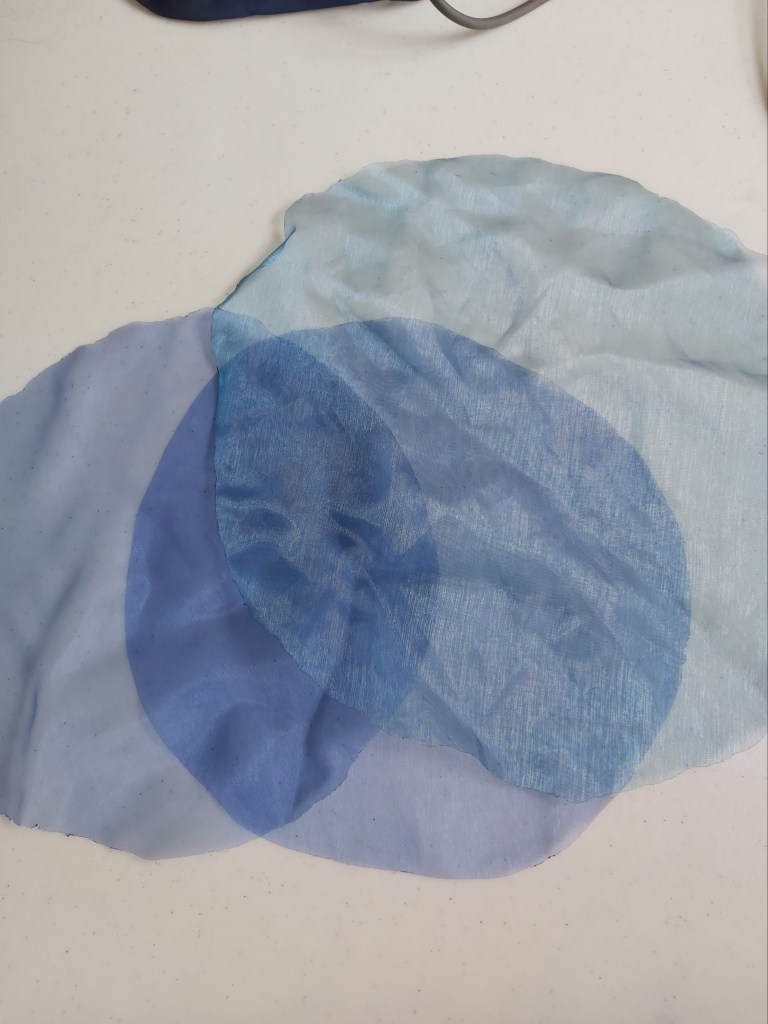
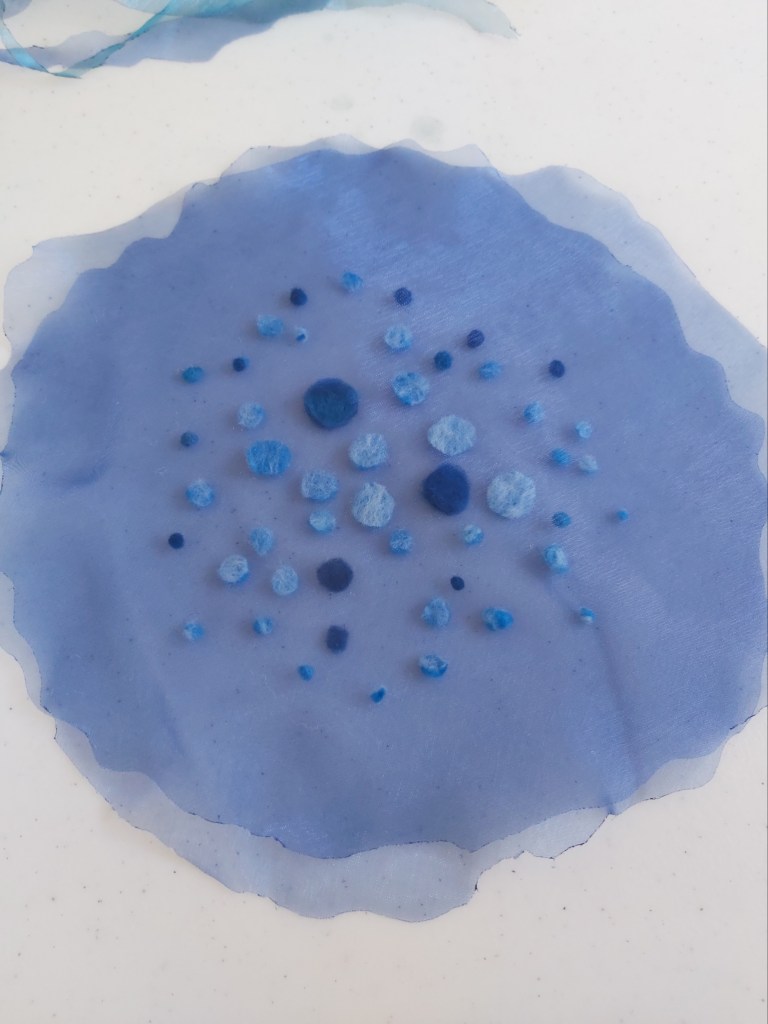
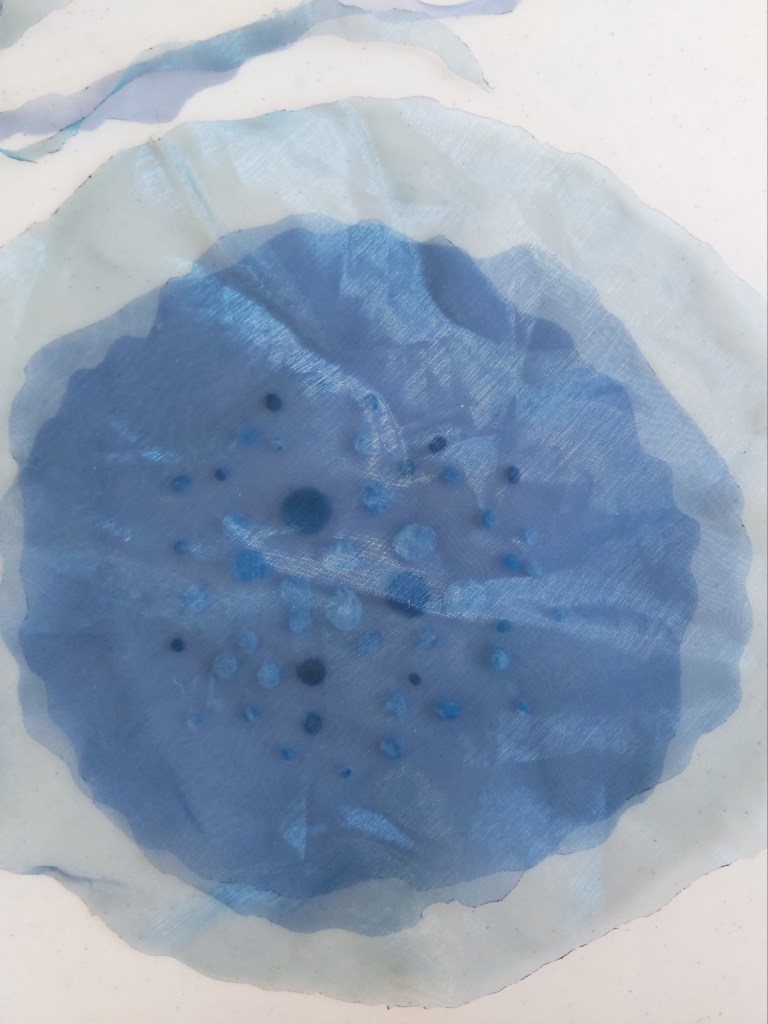
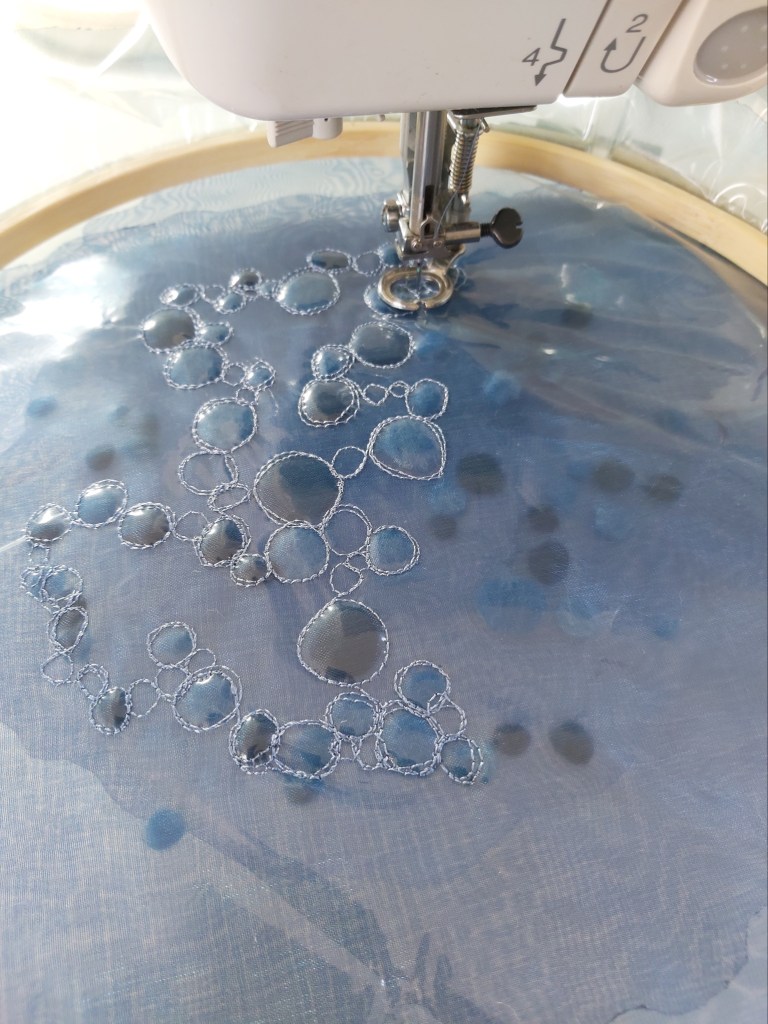
I had enough blue fabric to cut out two circles plus one slightly larger from the turquoise. I also added a small white circle of fabric underneath thinking it would highlight the spotty area. Next I cut up some scraps of felt for the spots and arranged them on the blue discs before covering with the turquoise sheer. This sandwich was then put in the hoop and I machine stitched around the spots…..or at least that was my intention! Unfortunately I struggled to see where some of the felt was so it’s a bit hit and miss but it was near enough!
After removing it from the hoop I washed out some of the stabiliser retaining a good bit of the glue on the fabric to enable me to shape it over a plastic bowl. I didn’t think to photograph the drying stage so the next image shows it dry with the unattached tentacles cut from tulle and sheers.
The final step was to wet felt a blue “inner”, with additional thin felt tentacles, sew the fabric tentacles inside it and insert into its casing.
The finished spotted blue jelly fish.
I’m quite pleased with the finished result and this particular area of the exhibition should be interesting as we’ve used lots of different styles and techniques between us.
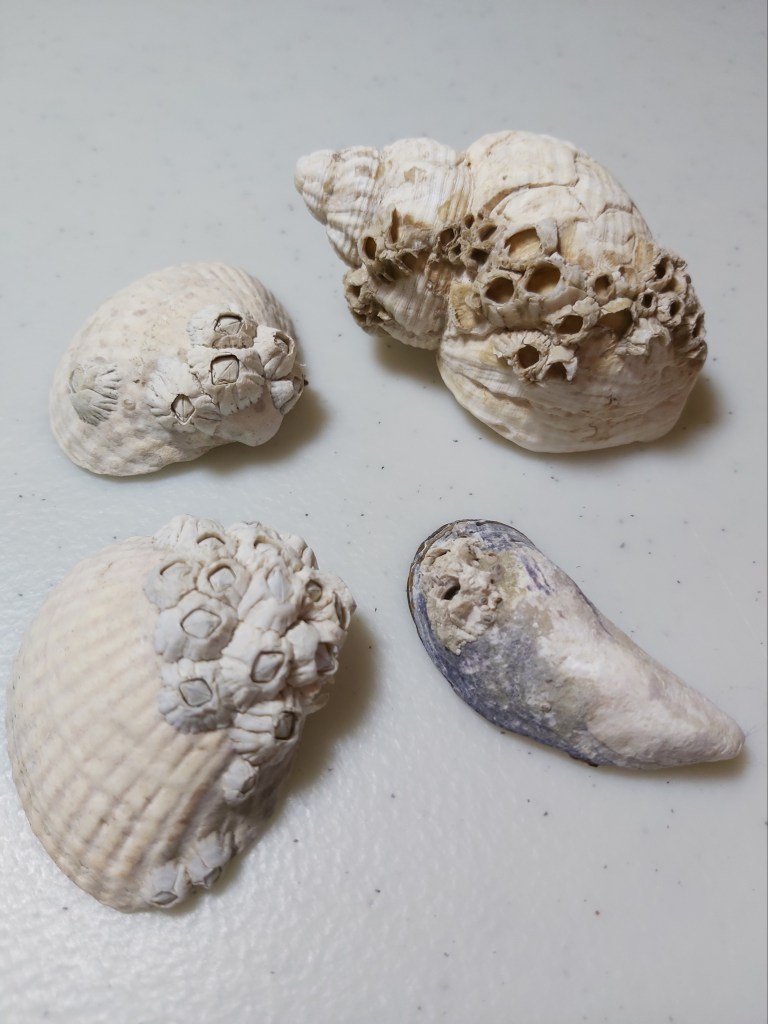
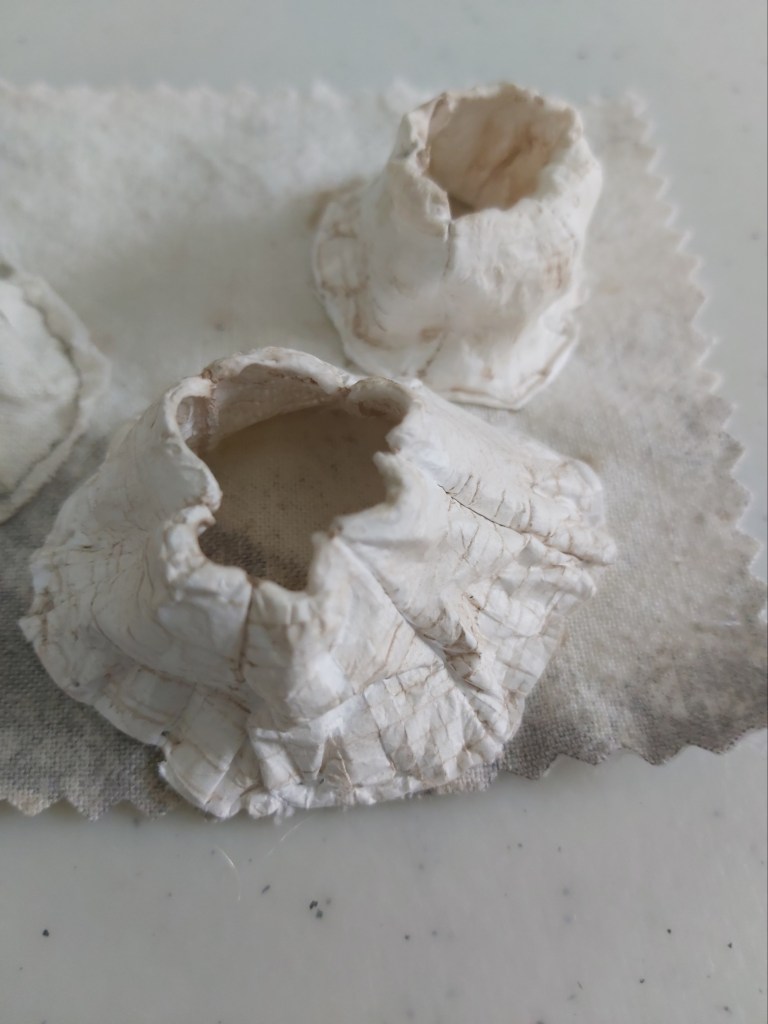
Another idea I’ve been playing with is barnacles. I’ve always had a fascination for barnacles and can’t resist collecting them when I find them on stones and shells. These marine crustaceans are related to the crab and lobster and tend to live in shallow and tidal waters, typically in erosive settings.
There are around 1,000 different species and, as adults, typical barnacles are covered with calcareous plates and are cemented, head down, to rocks, shells, pilings, ships’ hulls, driftwood, or seaweed, or to the bodies of larger sea creatures, from clams to whales.
They feed by reaching into the water column with eight pairs of thoracic limbs called cirri which are long and feathery. The cirri extend to filter food, such as plankton, from the water and move it towards the mouth as you can see in this video. (Follow the link and scroll down to Ecology)
Barnacles on rusty metal
I’ve always liked this photo of barnacles on a rusty piece of metal which was taken on a visit to Ullapool harbour so I’m experimenting with different fabrics, including cotton and Tyvek, to make a barnacle inspired wall hanging. So far I’m leaning towards the Tyvek fabric.
Cotton fabric barnaclesTyvek fabric barnacles
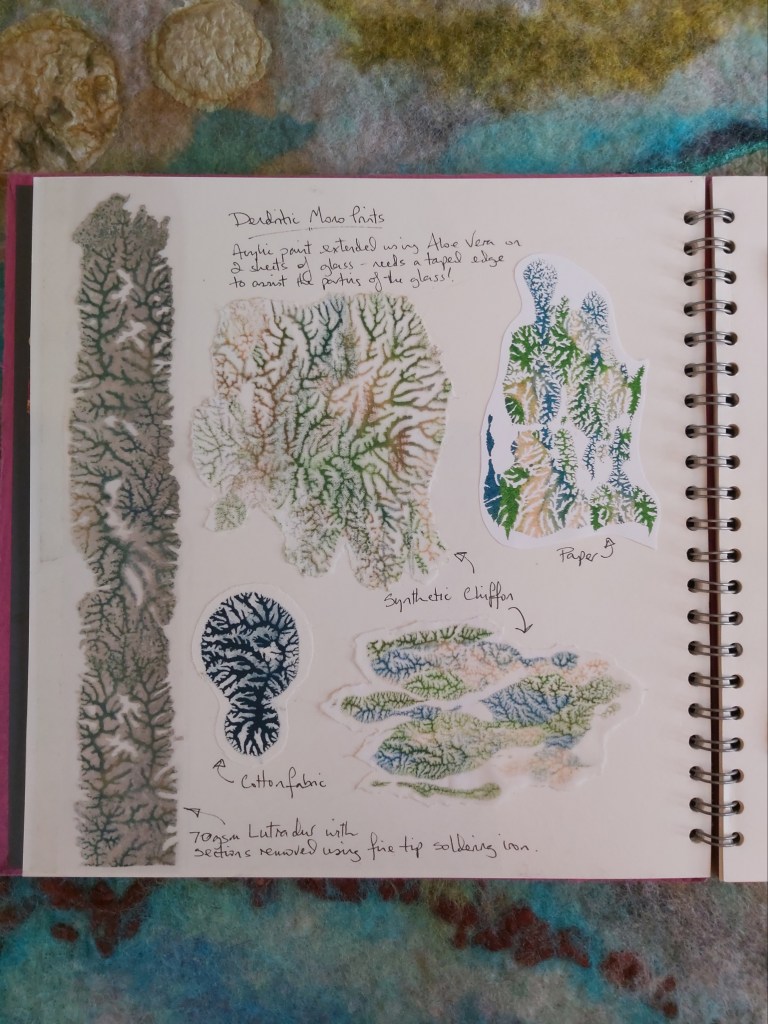
Something else I think will lend itself to the theme is dendritic printing. I love the vein like patterns, very reminiscent of coral, which can be created by pressing acrylic paint between two sheets of glass or plastic and then printing with it. I’ve been trying this out on different surfaces including paper, Lutradur, chiffon and cotton.
The most surprising result was a the print on felt, I was amazed at the clarity of it and I can see this being developed further with added stitching.
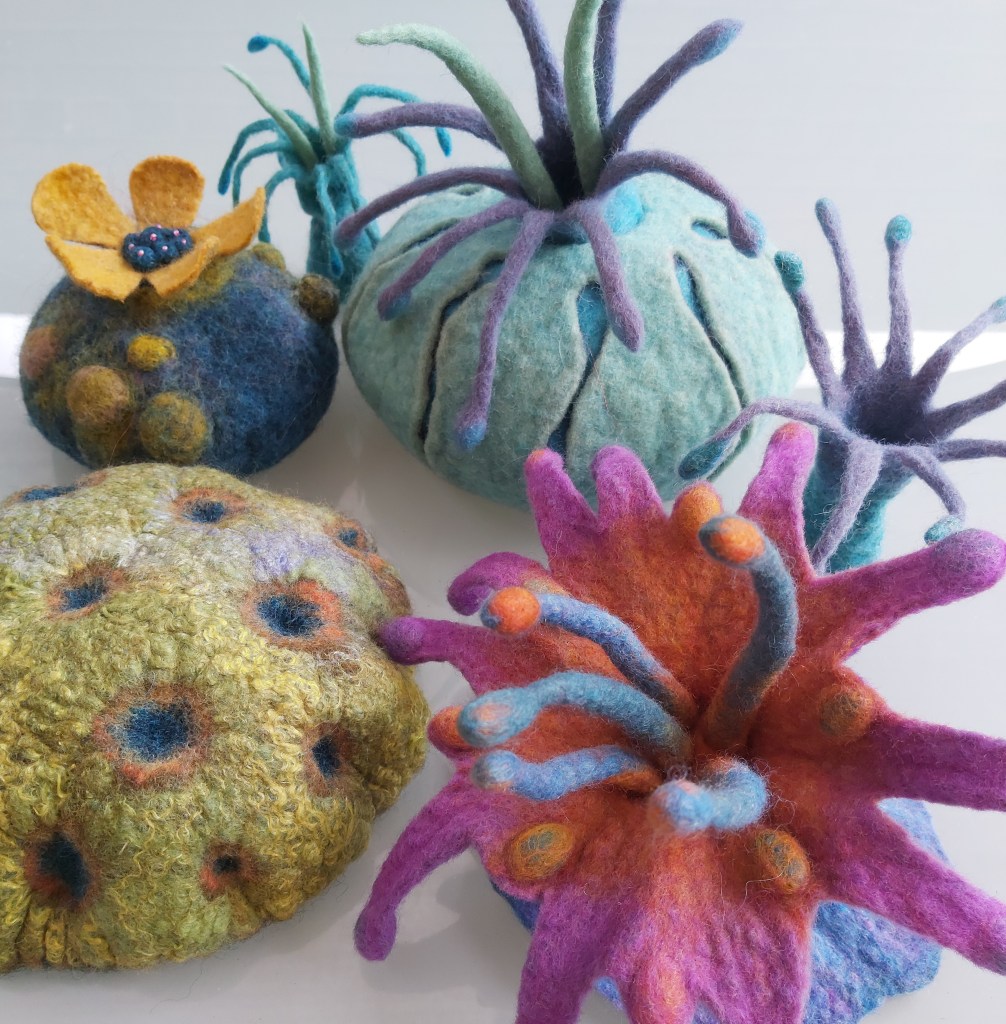
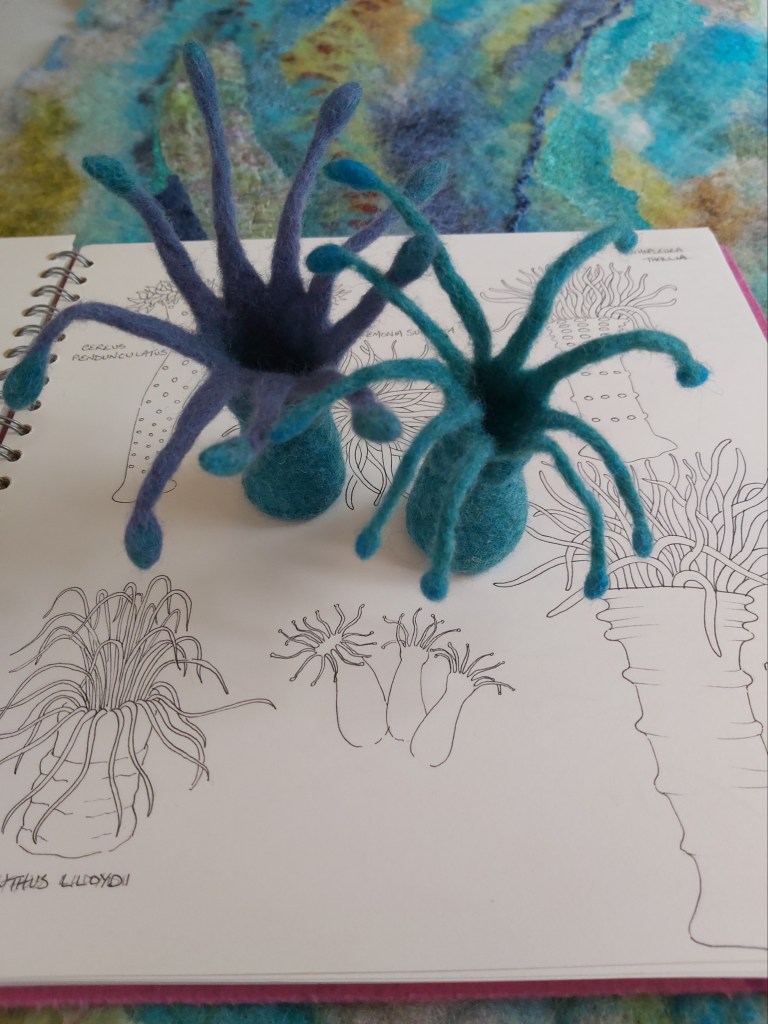
Working on ideas for felted sea anemones
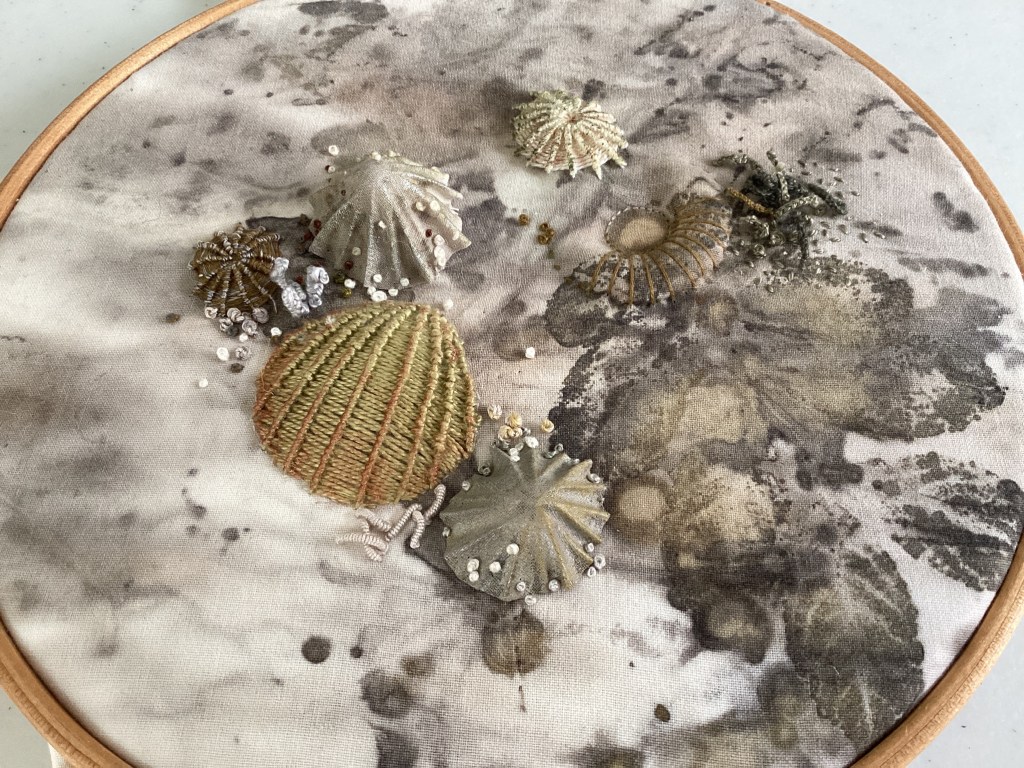
There are so many possibilities within this theme that my mind is working overtime and I’ve a few other projects on the go right now. One of them is this small 20cm dia embroidery being worked on an eco print cotton fabric.
Another is a wallhanging approximately 95cm x 45cm. It started out as a wet felted background made from various remnants of fibre which I ran through the drum carder. It’s had a lot of embellishment since this picture was taken, incorporating machine stitch, hand stitch, cord making, recycled coffee capsules, burnt sheer fabrics and hand painted silk fabrics. It’s almost finished now so I will feature that in my next post.


















 Lincs In Stitches