David Hockney gets a scarf…..

A felted scarf and he's nearly done!

A felted scarf and my David Hockney mixed media quilt is nearly ready for quilting!

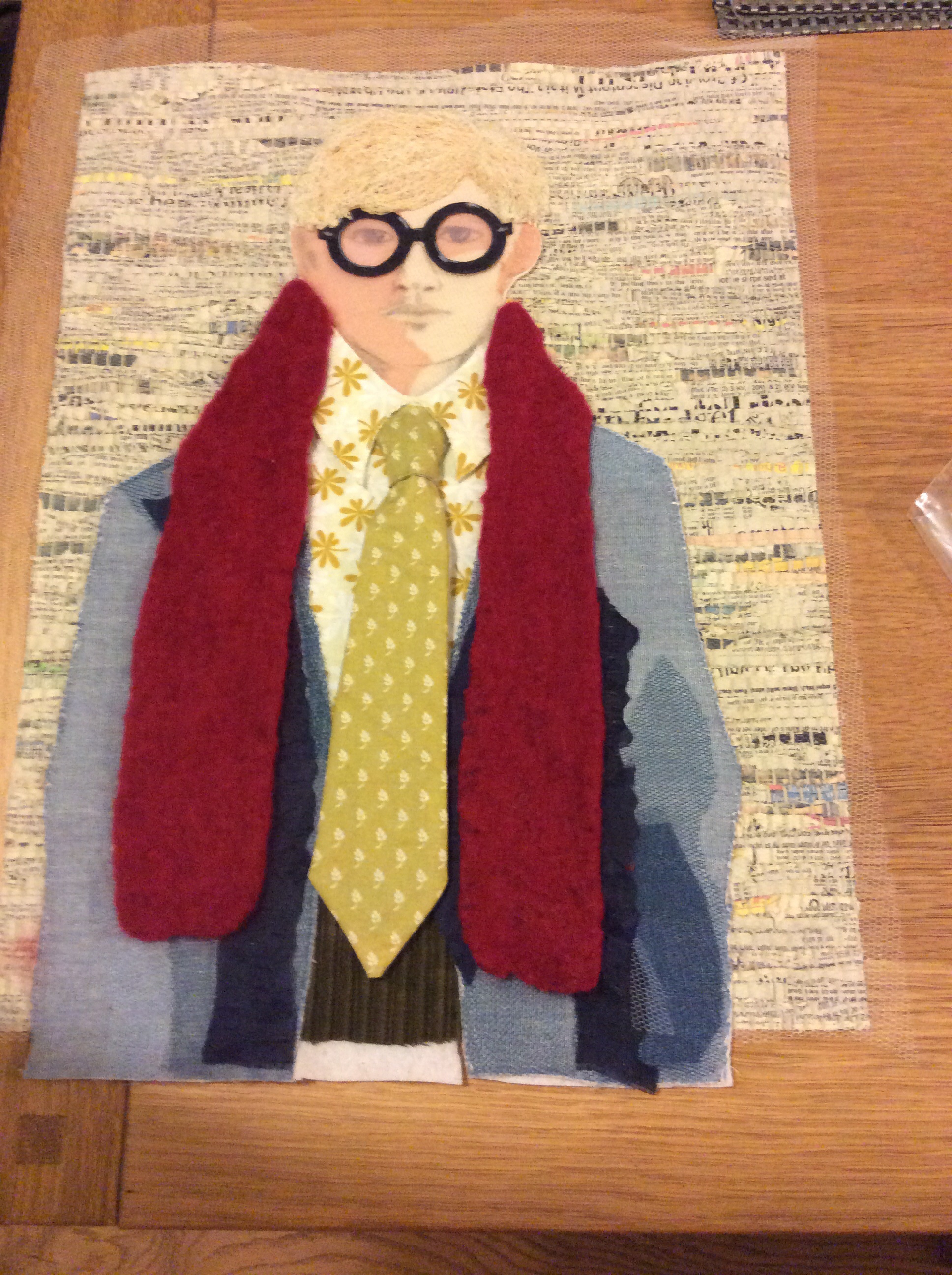
This evening David Hockney got himself a dark red Merino wet felted scarf so now he’s nearly ready to be put together and quilted.

To finish off I’v machined four rows of stitching at the back of the figure to represent the newsprint columns, quilted around the edge of the figure and added a black border.

My David Hockney self portrait

My finished quilted version of David Hockney’s self portrait


Hockney gets a shirt…..

Work in progress

Work in progress

The mixed media Hockney quilt has been shelved for a couple of weeks but today I made a start on his clothing. Based on his 1954 self portrait, I am bringing him into the next decade.  Along with his iconic dyed blond hair and round specs I decided to swap his check shirt for something a little more flamboyant!

Patchwork Bag by Annette Cooke…..


Denim patchwork and appliqué bag

Denim patchwork and appliqué bag

Yesterday I saw this fabulous ‘recycled denim jeans’ quilted patchwork bag at the Wednesday ‘Sit & Stitch’ Session at Stitchcraft in Grantham.  It was made by Annette Cooke, one of the local crafters, and is covered in all sorts of beautiful, vintage style applique and embellishments.

Detail showing contrasting lining.

Detail showing the contrasting lining.

My friend Molly and I spent the day sewing with Annette and her friends and soon discovered we had chosen the ‘lively’ table to sit at!  Thanks for making the two of us so welcome.   We are looking forward to seeing you all again very soon and hopefully I will get to include more of your work on here.

Side detail

Side detail


Delft Quilt….


Hand embroidered Delph Quilt designed and made by Liz Hands

Delft Quilt by Liz Hands

I first saw a version of this Delft quilt a few months ago at a show in Woodhall Spa.  There were lots of quilts on display but this one really caught my eye as it was so dramatic and fresh and the hand embroidered detailing was fabulous.  I immediately fell in love with it and, after talking to its owner, I discovered that she had made it during a series of workshops run by Liz Hands at Stitchcraft in Grantham.  The next day I called Stitchcraft and booked straight onto the next “Delft Quilt” course which is being held one day a month and started this Wednesday.

Although I love the traditional blue Delft shades I chose to make my quilt using these gorgeous, fresh teals with matching embroidery threads.  For the background fabric I am using a delicate ivory patterned cotton.

First of 25 blocks

First of 25 blocks

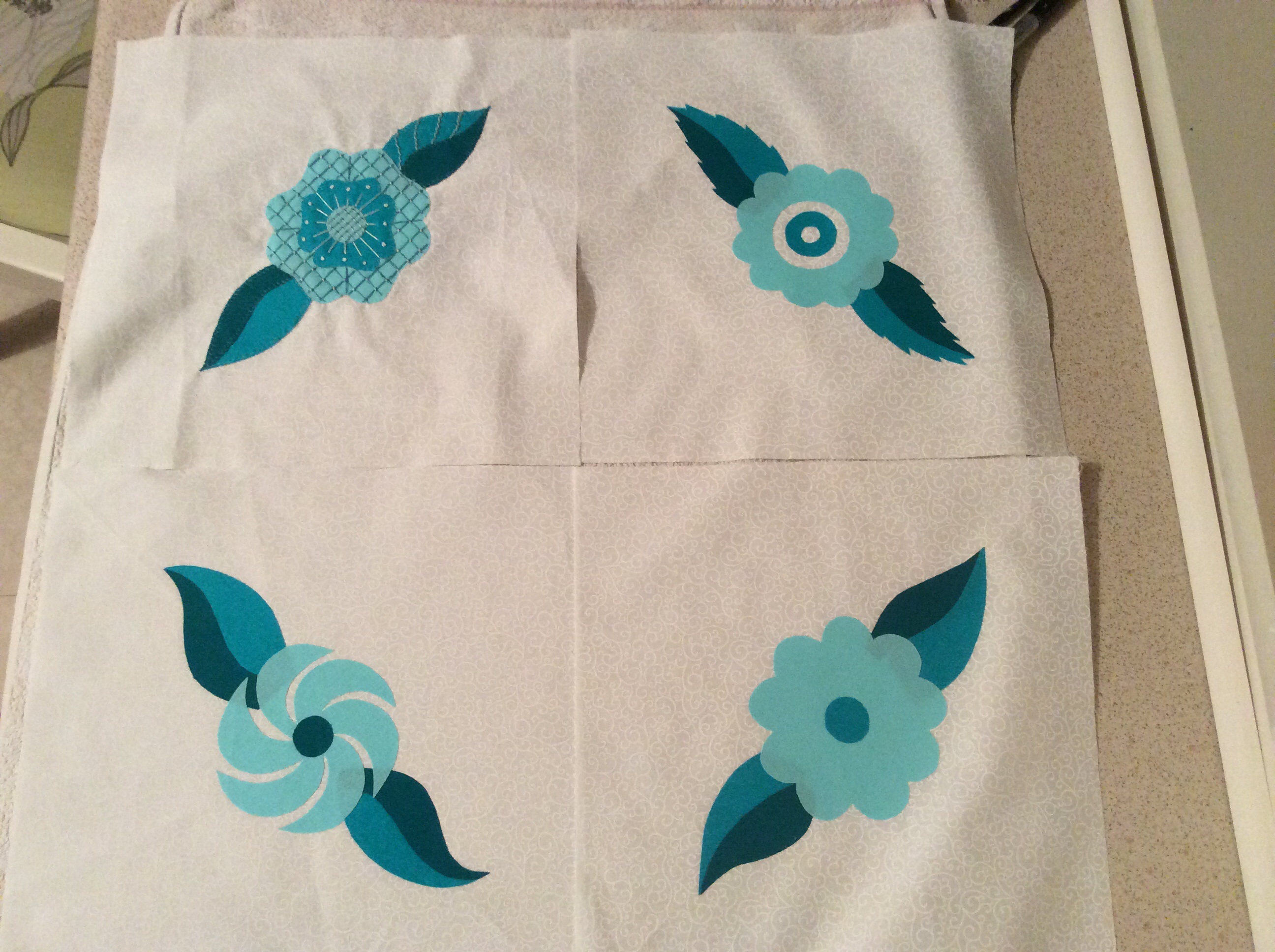
There are ten of us on the course and it’s a very friendly bunch.  Liz has a relaxed style of teaching and is very approachable, which is great for someone like me who hasn’t made a quilt before.  This week I almost completed my first block during the class (just got to finish the 2nd leaf) and I now have the next three blocks cut out and bonded to the background fabric ready to embroider at home.   All I need now is time……..

Four quilt blocks.

The first four blocks cut out and bonded to the background fabric.


Hockney Challenge…..adding the hair.


I want my version of Hockney’s collage ‘Self Portrait‘ to be a fun piece constructed from a mixture of materials and methods.  The face is being built up with layers of synthetic fabrics, bonded together using an 18w Antex soldering iron.  My first attempt was with a 30w iron and a fine point bit….it was awful!  The fabric burnt and I couldn’t control the cutting edge as the iron was too hot and the point too thick.  I took advice from Margaret Beal on her website and bought a lower wattage iron with an extra fine bit…..it’s a lot easier when you use the right tools!

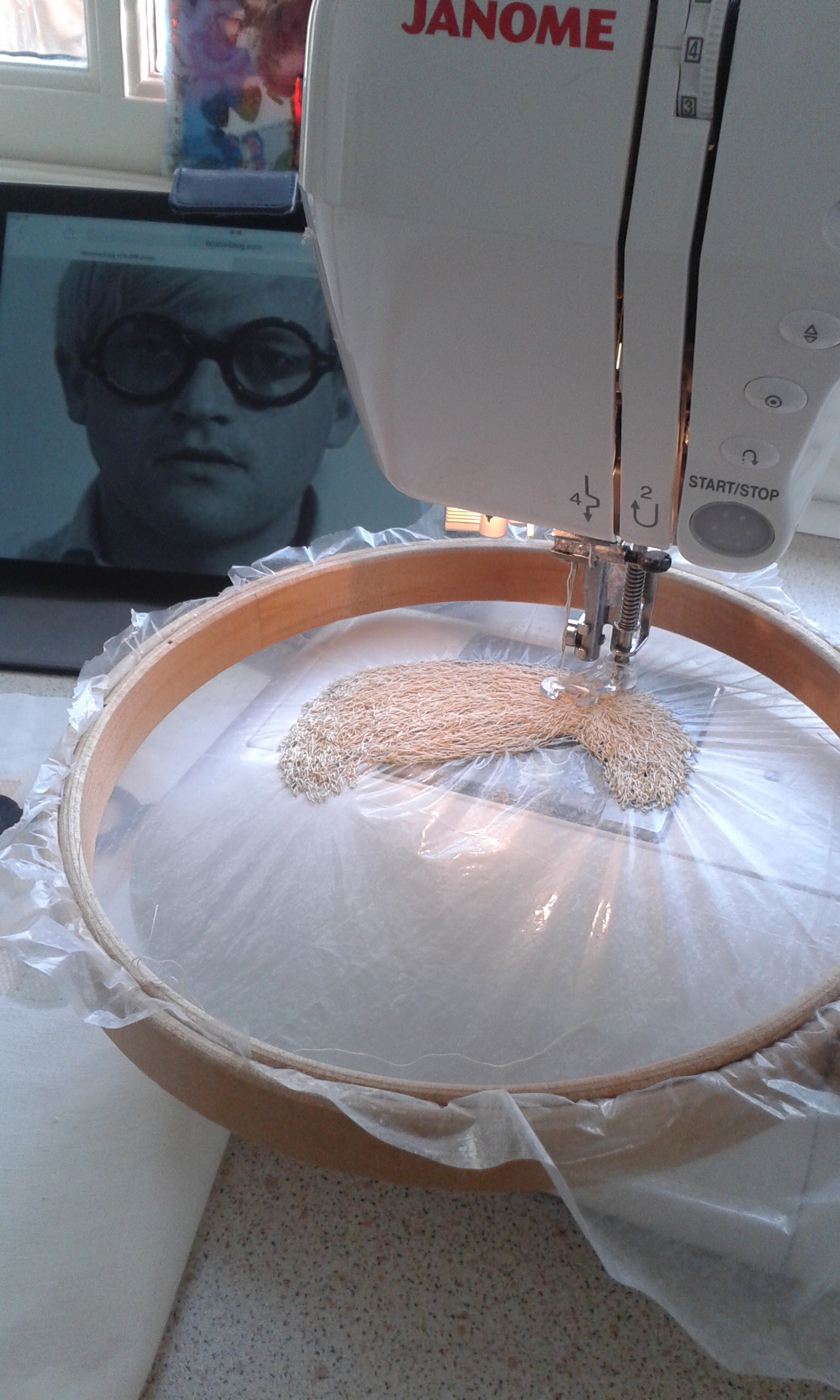
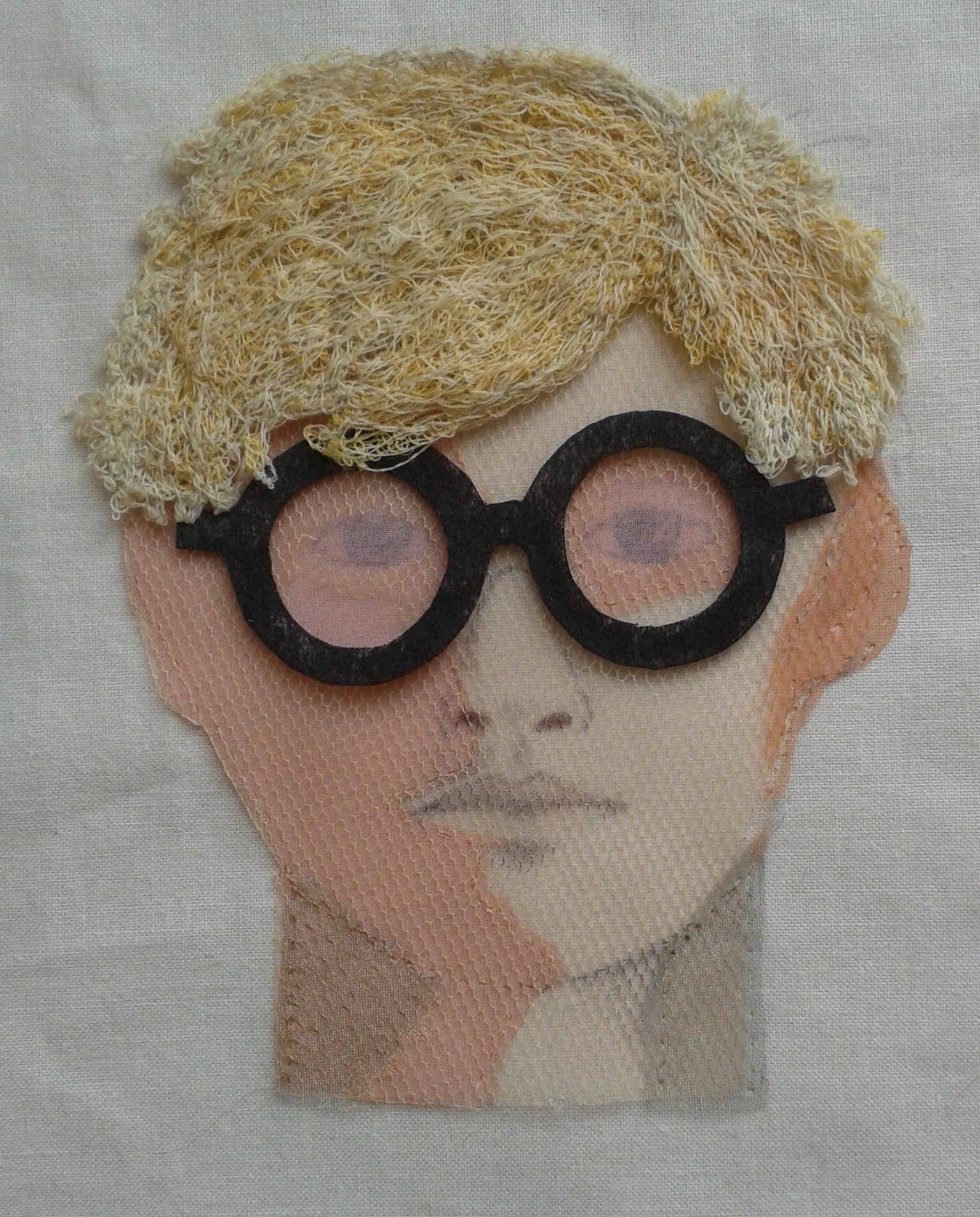
For the mop of blond hair I chose to use a technique which I originally saw demonstrated by Jan Tillett on Youtube.  This involved free machine sewing onto water soluble stabiliser which was held in an embroidery hoop.  I traced the outline of the hair onto the stabiliser before sewing back and forth with yellow and cream thread, overlapping the stitches so that they held together once the background fabric was washed away.  The hair took shape very quickly and I am really pleased with the texture.   The next job will be to select fabrics for the clothes.

Hope Hockney doesn't sue!

Creating the hair using soluble stabiliser.

Portrait of Hockney made from fabric and thread.

The mop of blond hair plonked in place!


LINQS David Hockney Challenge…..


Are you living in Lincolnshire? Do you enjoy quilting and fancy a challenge? If you can answer yes to both these questions you might like to join the ladies in LINQS (Lincolnshire Quilters) and create a quilt inspired by any work of David Hockney’s, past or present. Quilts can be made by an individual or a group and the work can feature any technique or style, including traditional.
The criteria we have to adhere to is…..

1. To be a quilt it must have 3 layers

2. The size must be either 30″x40″ or 30cm x 40cm portrait or landscape. If you want to make a larger size quilt you can hang several smaller ones together.

3. No matter what style we use we must be able to link the finished piece back to DH’s work.

For more information or to register your interest click here.

I didn’t really know Hockney’s work before signing up for the challenge but, after talking to one of the members of LINQS, I took a ride up to Salts Mill to see it for myself. Salts Mill is in Saltaire, West Yorkshire, a few miles from Bradford and it houses a permanent display of Hockney’s work. It also has a terrific book shop and a restaurant serving delicious food on the top floor.
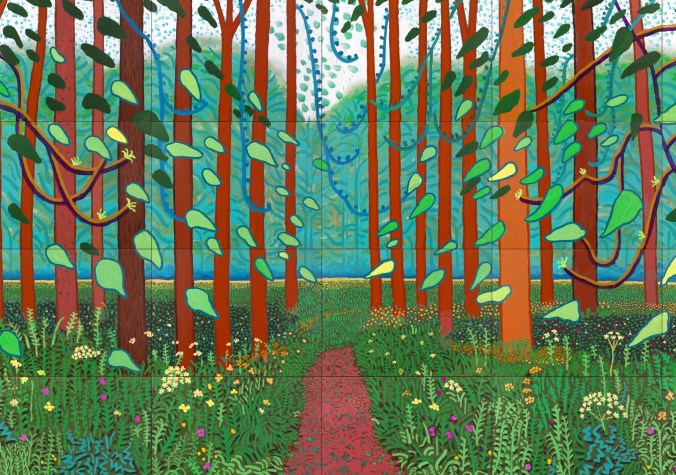
The Arrival of Spring in Woldgate

The Arrival of Spring in Woldgate


Background of my monotone quilt.

Background of my monotone quilt.

Trees are added to stand away from the background.
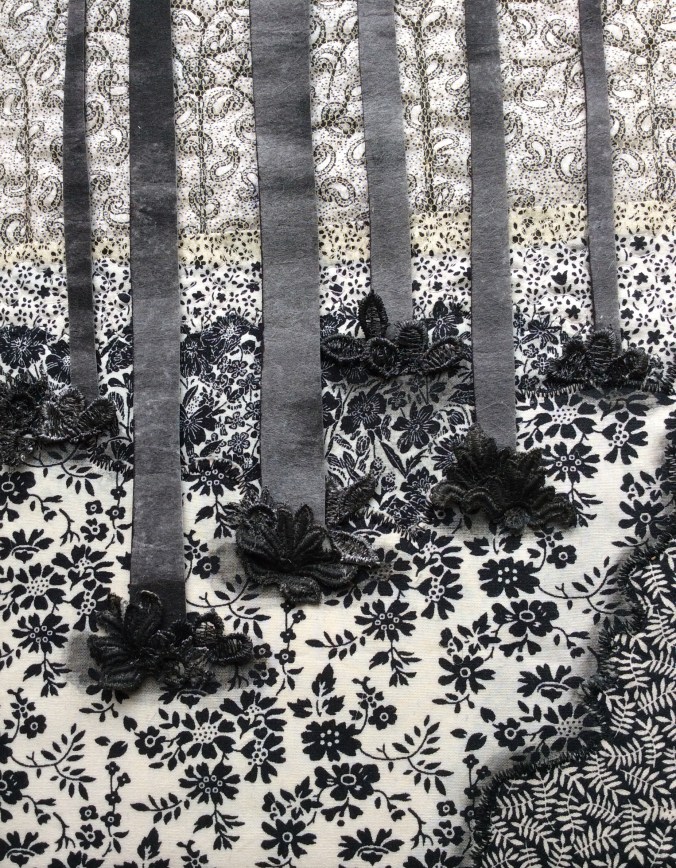
Trees are added to stand away from the background.

Detail of foliage at base of trees.

Detail of foliage at base of trees.

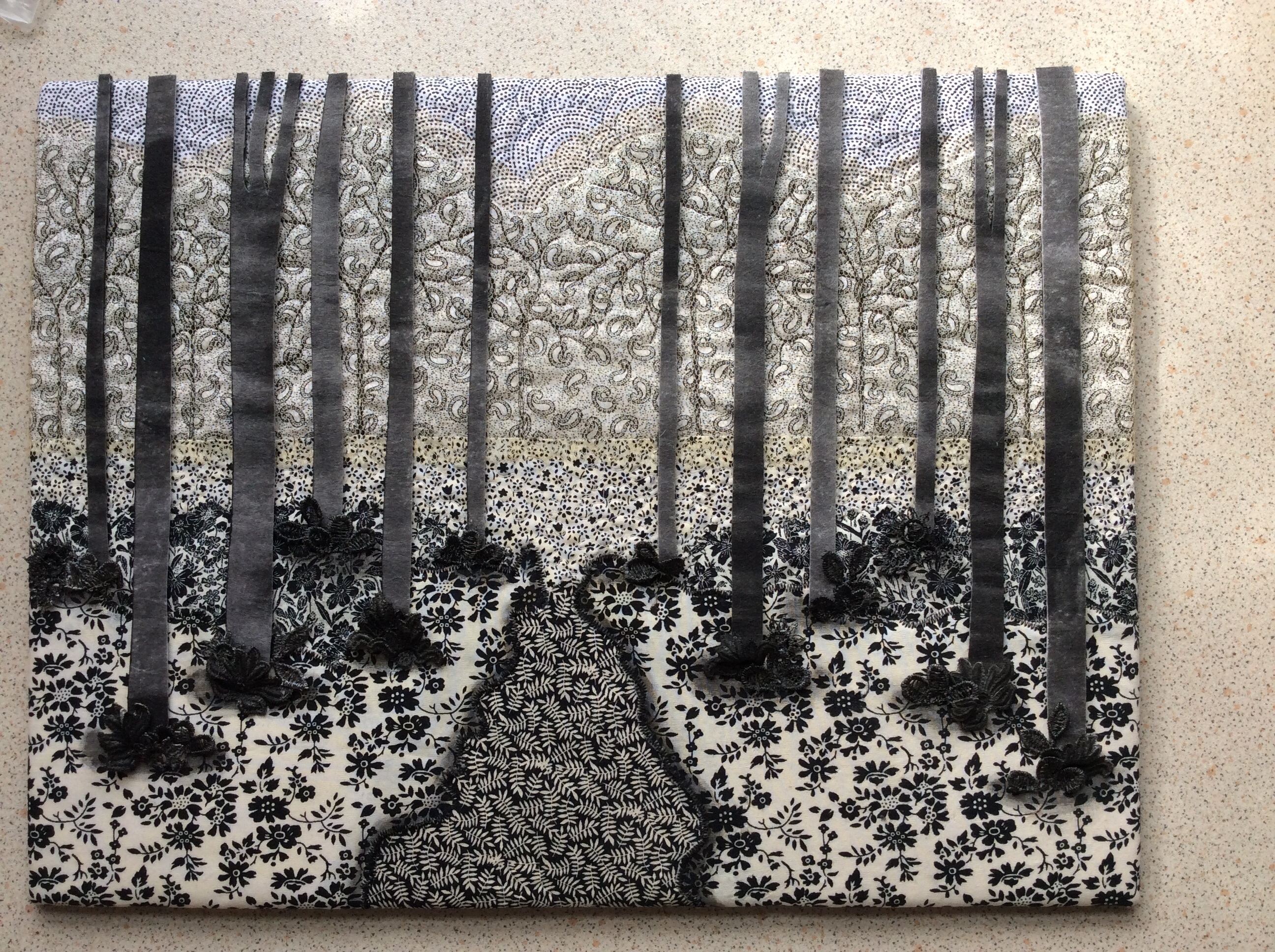
I’ve started work on two ‘mini size, quilts, the first is based on The Arrival of Spring in Woldgate. I decided to strip it back to a monotone colour scheme and started off in a fairly traditional way using machine and hand stitching on the background. I wanted the trees to stand out so I used black acrylic paint on vilene, backed with black felt and attached them with my glue gun. The foliage at the base of the trees was cut from a piece of lace which has also been painted with acrylic. I’m not sure how I am going to finish this one…..do I add the large leaves and the vines? I’ll sleep on it a bit longer before deciding my next step.

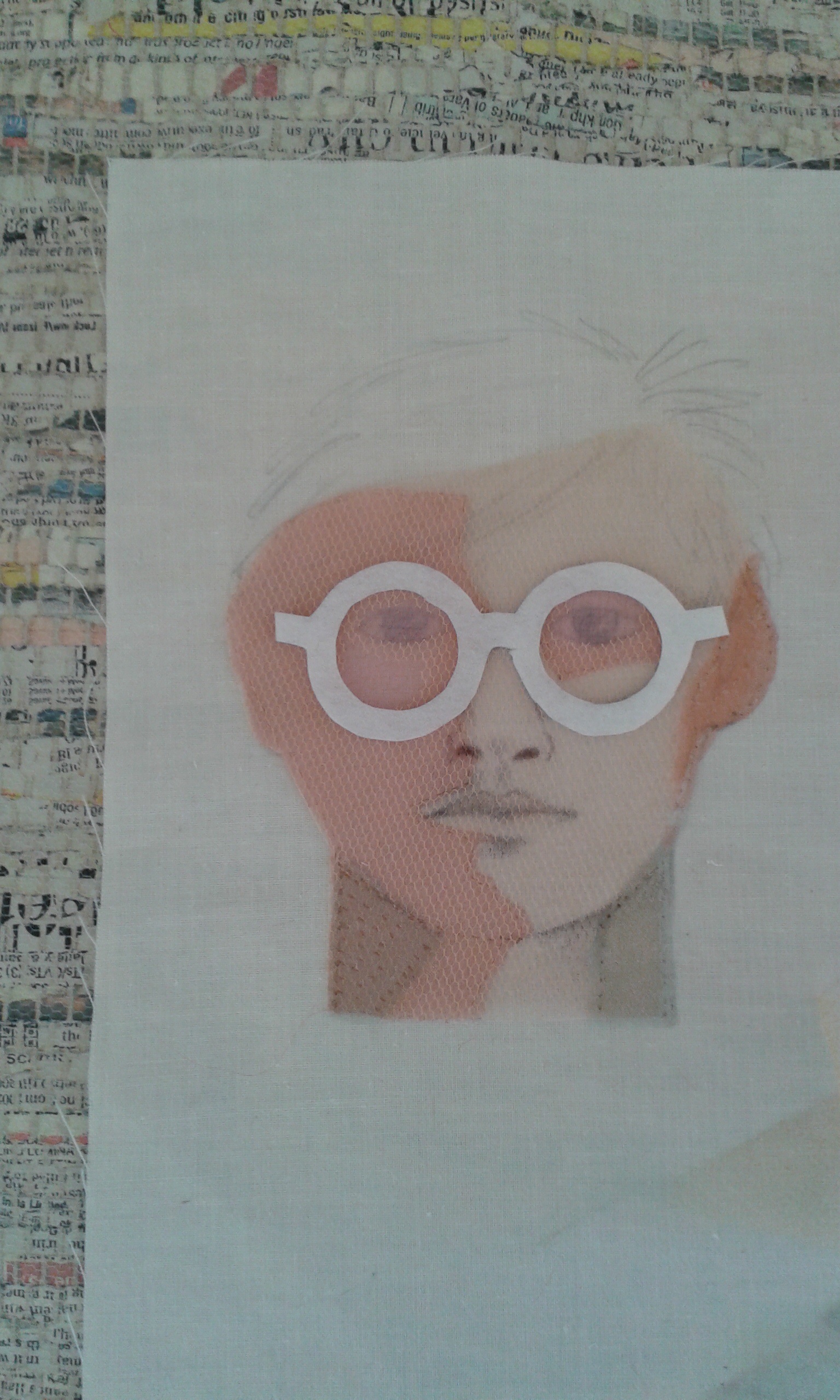
The second piece I’m doing is based on Hockney’s early self portrait collage. This is going to be a mixed media quilt using paper, paint and fabric. The background is the ‘Newsprint’ wallpaper from my last post. I have stuck it onto cream netting using PVA. Once it was dry I turned it over, soaked it with water and gently rubbed the backing paper off until the image was showing through. This has created a nice thin layer which I can quilt at a later stage.
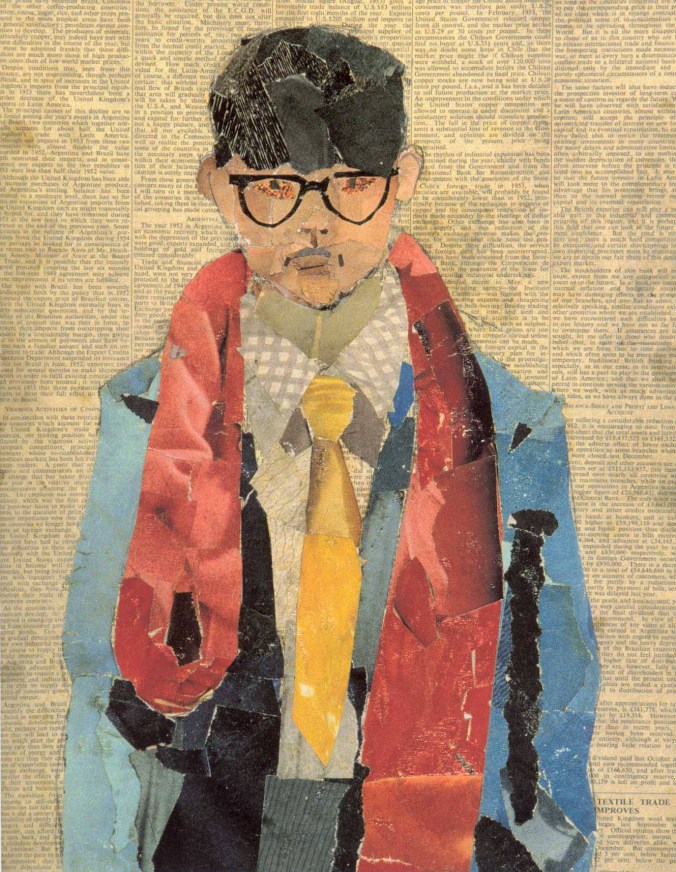
Hockney 1954 Self Portrait
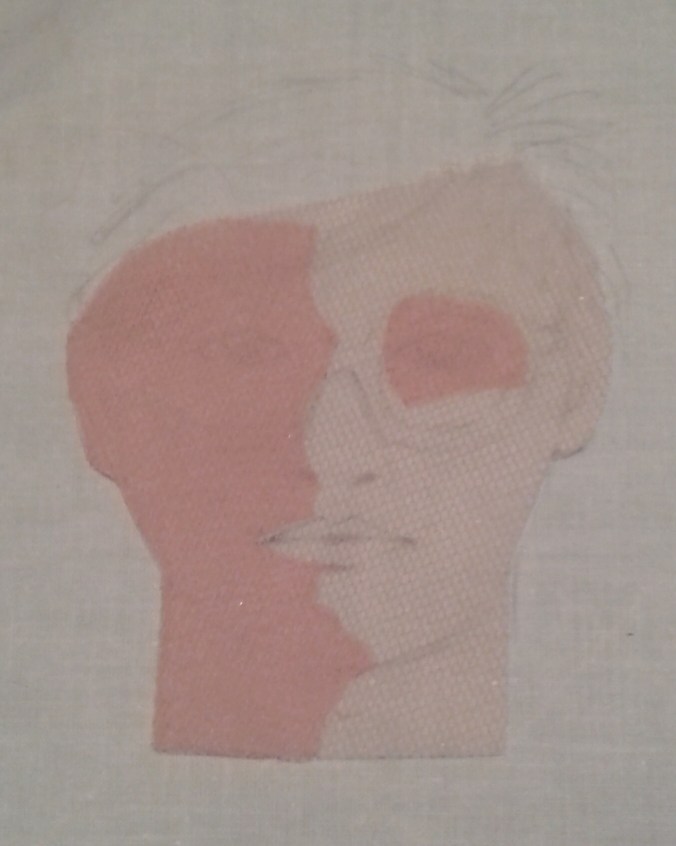
Hockney 1954 Self Portrait

Starting work on DH's face.

Starting work on Hockney’s face.

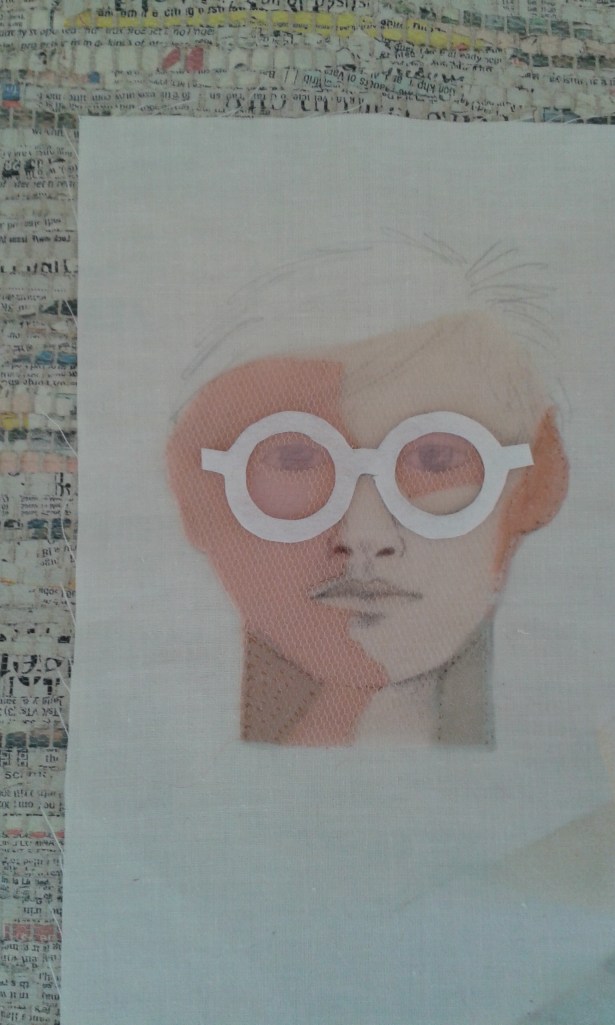
More shading added to the face....the glasses are tried on for positioning.

More shading added to the face….the glasses are tried on for positioning.

Rather than copying Hockney’s 1954 self portrait I have chosen to show him as he styled himself in the 60’s with his trademark dyed blond hair and thick black round specs. After drawing the features onto cotton fabric I am trying a new (to me) technique for colouring the face, using a soldering iron to fuse layers of organza. I got the idea after buying the Margaret Beal book New Ideas in Fusing Fabric. The work in this book is so inspirational I had to buy the iron and have a go! I’m hoping to get some more of this quilt done this week so will post an update when I do.
Shibori….colouring & manipulating fabric to great effect!

Following on from my little experiment with Shibori felting I thought I would share a few of the wonderful items I have found which feature this technique, both felted and otherwise.

Martha Stuart chiffon scarf.

Martha Stuart chiffon scarf.

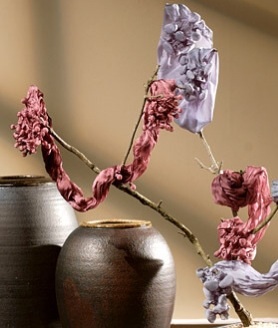
Martha Stuart has instructions here for making this delicate scarf using small stones tied into chiffon.

Mrs Polly Rogers Bubble Scarf

Mrs Polly Rogers Bubble Scarf

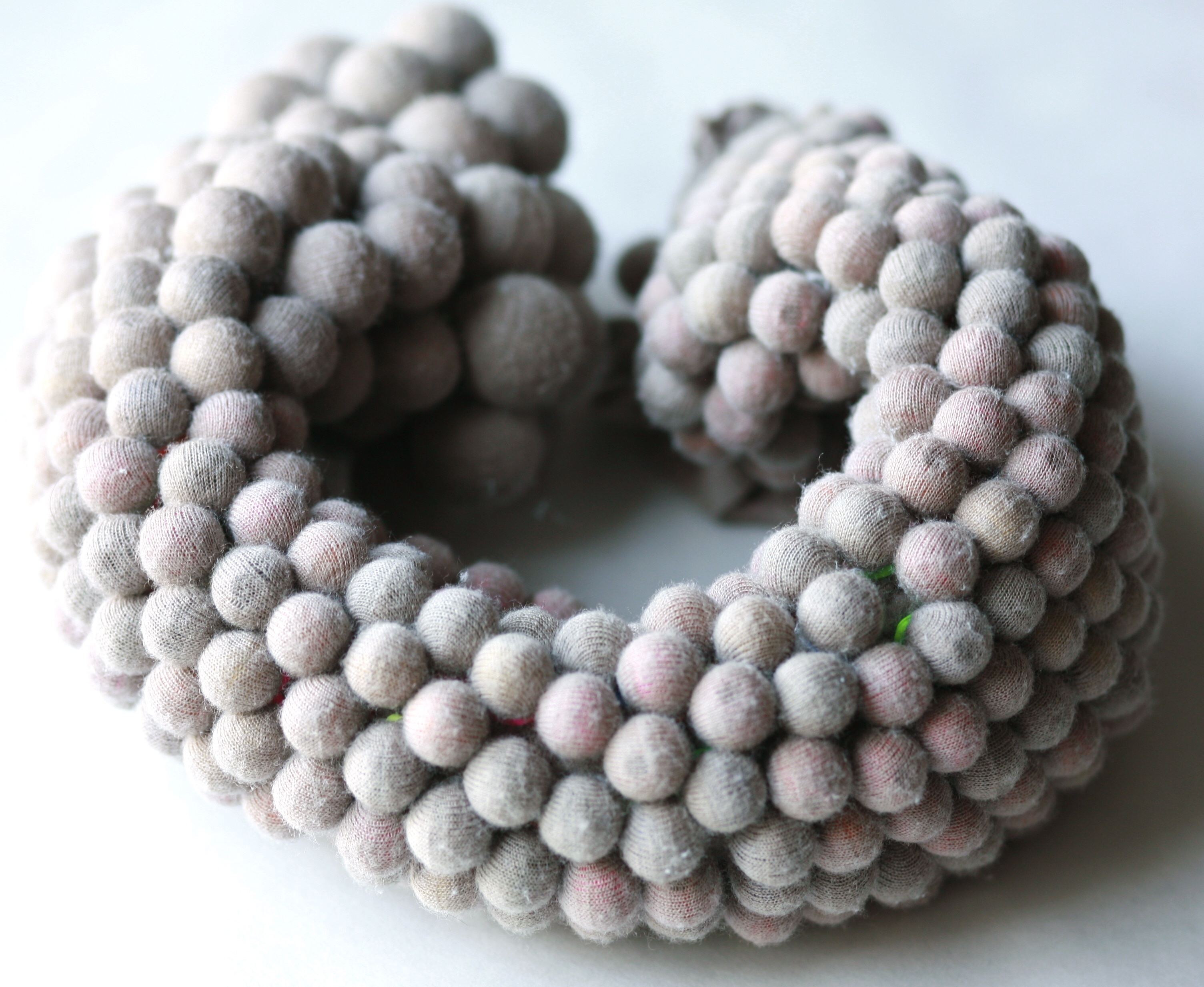
Mrs Polly Rogers has instructions here for making this very chunky, felted bubble Scarf.

The World Shibori Network is a great place to visit to find out more about the techniques used in this ancient craft.  Michelle Griffiths is a professional artist/teacher, living and working in South Wales. She is the World Shibori Network representative for UK/Ireland. Her work is on permanent exhibition in her gallery/studio at Model House Craft & Design Centre, Llantrisant, where she continues to develop the shibori study centre with its shibori workshop programme, textile collection, and reference library.

AntiGravity Necklaces by Michelle Griffiths.

AntiGravity Necklaces by Michelle Griffiths.


Michelle Griffiths Bubble Wrap Fabric.

Michelle Griffiths Bubble Wrap Fabric.

I particularly like the ‘AntiGravity Necklaces’ and ‘Bubble Wrap Fabric’ while ‘Relief 1’ is absolutely stunning!

Relief 1

Relief 1

I also love the detail in the scarf below but unfortunately cannot remember where I found it!

Blue Shibori Scarf

Blue Shibori Scarf

Tyvek leaf…

Tyvek leaf

Tyvek leaf

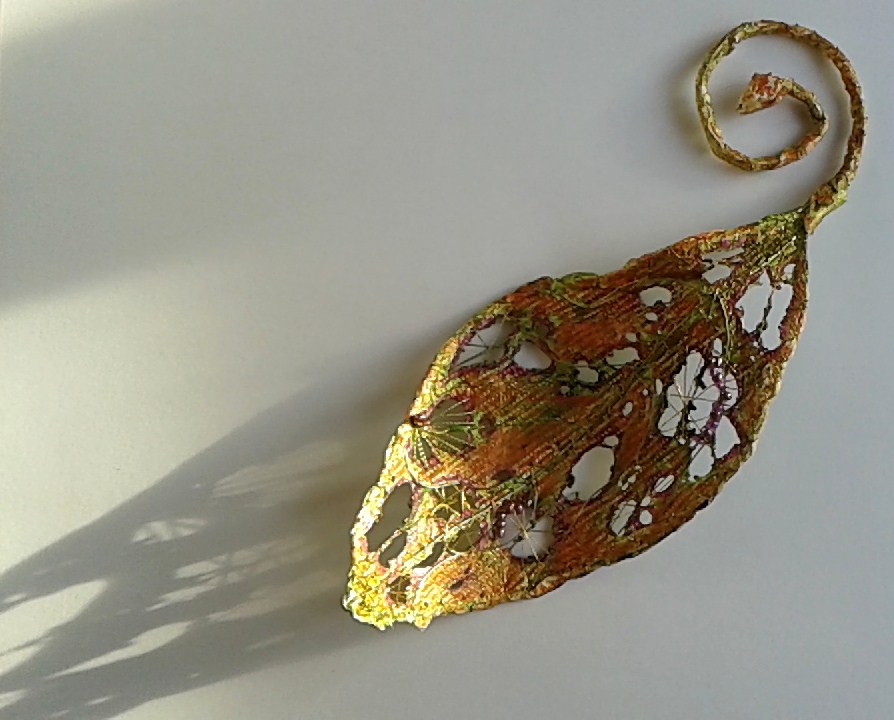
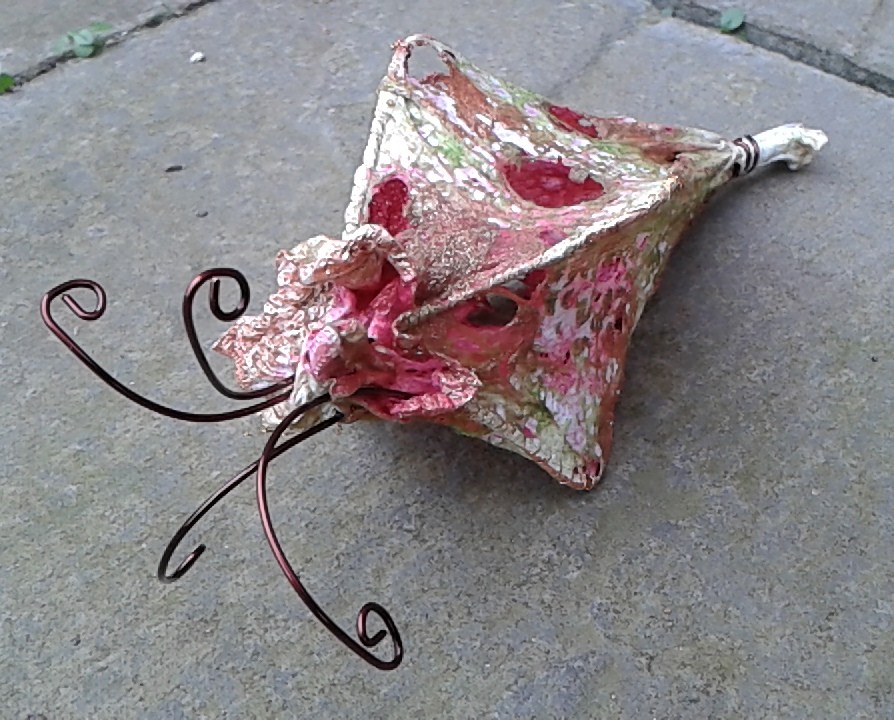
I’ve been playing with the Tyvek again and this time I had a go at machine stitching the fabric, using the embroidery foot and a metallic thread, onto a metal framework which I made in the shape of a leaf.  I tried colouring it with different mediums and discovered that acrylic paint and felt pens seem to work just as well as the fabric paints.  I love the lacy effect that can be achieved when heat is applied and, having seen the way the shadow is cast on this photo, I am thinking that using this technique I could make some beautiful votive’s.

3D Tyvek Leaf

3D Tyvek Leaf

Getting Creative With Tyvek…

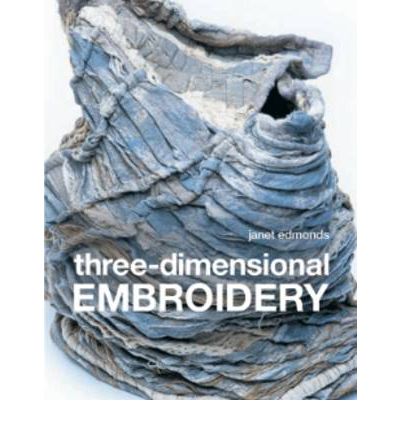
Last week I discovered an exciting new (to me at least!) ‘crafting’ product and, having tried it out yesterday, I thought it worth a mention here.  book cover

My discovery came about as a result of buying a book from The Book Depository called ‘Three Dimensional Embroidery‘ by Janet Edmonds.

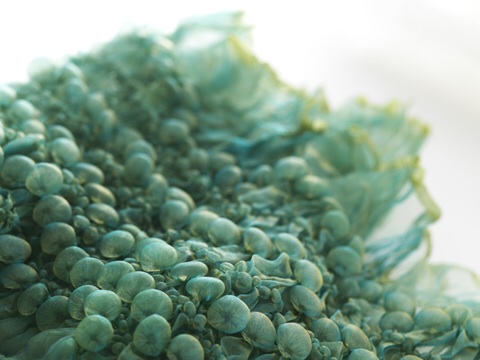
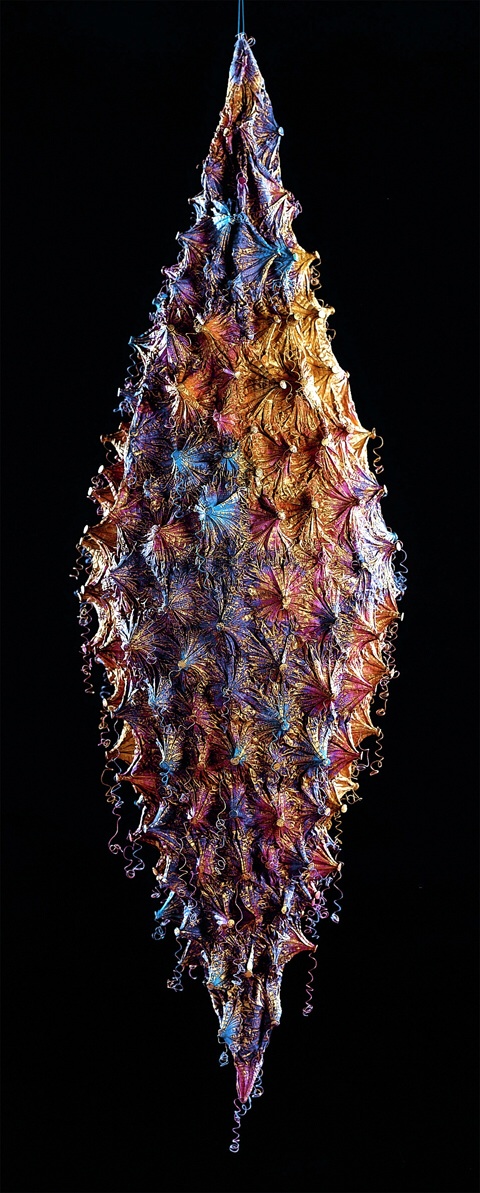
It’s a fabulous book packed with the most inspiring illustrations imaginable and great ideas for creating all manner of things with different types of fabrics.  Chapter 5 is all about using ‘manipulated methods’, distorting fabric to create form and texture, and includes a beautiful photograph of what looks like decaying seed pods.   The caption says they were made from fine-weight Tyvek but, although I loved what I was seeing, it didn’t mean a thing to me!  This changed a couple of days later when I was visiting Illustration from bookCrafty Notions in Newark and, lo and behold, there on a shelf near the felting supplies, I spotted a bag of Tyvek…fate or what?  It seems I was meant to try this stuff out!

So, for the uninitiated, what is Tyvek?  Manufactured by DuPont, it’s an extremely durable, man-made fabric, available in different weights.  Being light-weight but very tough, breathable and water-resistant, one of its most popular applications is in the construction industry.  Other uses include industrial packaging, signage and protective workwear.  Its characteristics make it an ideal choice for crafting as it can be coloured using fabric paints, acrylic paint or felt pens.  It can also be die-cut, laminated, embossed, printed onto and stitched, but the real fun begins when you apply heat to it.  This will cause the fabric to shrink and bubble and, if you apply sufficient concentrated heat,  holes will appear creating a beautiful, lacy effect.  I found you can produce some fabulous distressed effects using a heat gun, clothes iron or soldering iron (I didn’t have the latter so I simply held a piece of wire in my pliers and heated it over a gas ring!).

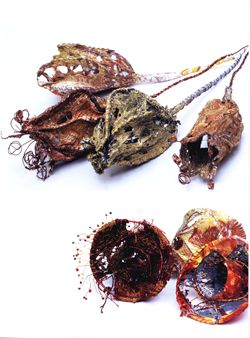
Anyway the result is shown below…my take on the Tyvek seed pods.  The first image was taken after holding the pod over a gas ring, supported on a spatter guard.  The second photo shows the pods after I used the ‘Papermania’ heat tool on them and then added more holes with my home-made soldering iron (hot wire) and added gold metallic thread across some of the larger openings.  My mind is racing with ideas for more ‘manipulated’ projects and I am wondering if I can find a way of combining Tyvek with felting….watch this space!

Tyvek seed pod

My version of the Tyvek seed pod

Stage two saw more holes and the addition of gold metallic thread across some of the larger openings on the green pod.

Stage two saw more holes and the addition of gold metallic thread across some of the larger openings on the green pod.

Something from nothing…

Something from nothing...

Something from nothing…

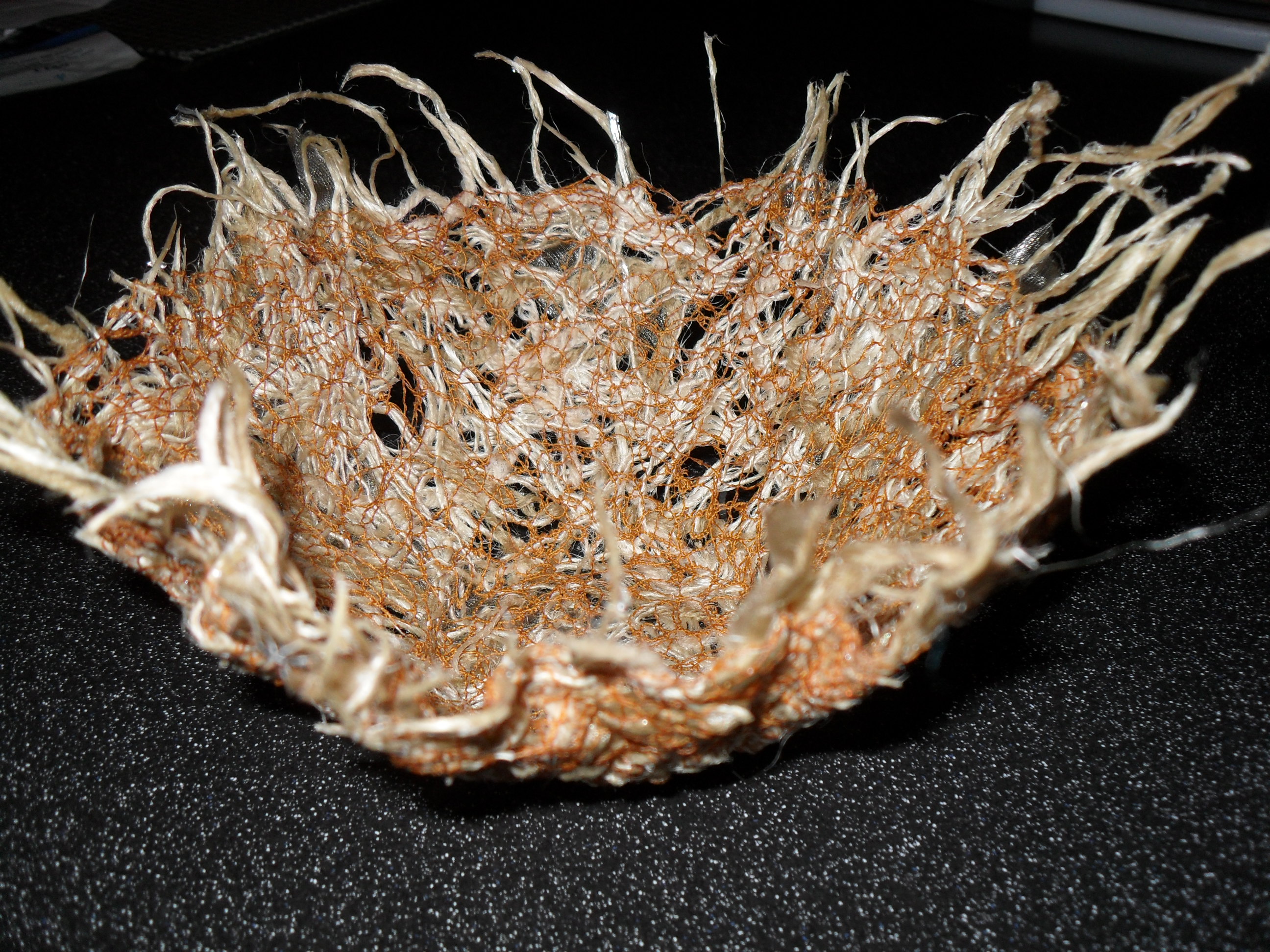
Today I just had to share my latest ‘crafting’ discovery …. water-soluble fabric stabilizer.  You may already be aware of it and have probably used it, but I only stumbled across this product last weekend while browsing youtube.   I was looking for fresh ideas to use up scraps of fabric and during my search I came across a lady called Jan Tillet making bowls from left over snippets of fabric and threads.  Jan’s work is very beautiful and this struck me as a really exciting way to recycle odd scraps and a great way of making something from nothing!  The scraps are sandwiched between two layers of water-soluble fabric stabilizer and then machine sewn all over using a free motion embroidery foot, being sure to cross the stitching over and over again to link it all together.  Once the piece has been covered in stitching the stabilizer is all but rinsed away in cold water and the newly created fabric is draped over a bowl and left to dry.  The aim is to leave a little residue of stabilizer your work so it will stiffen and retain its shape when dry.

I gathered up various scraps and had a go, experimenting with different textures and colours.  Some peices have been put to one side to be worked into future projects while others went on to become bowls.   When making the bowls I found my work needed much more stiffening (maybe I didn’t leave enough residue) so I experimented with spray starch and the far cheaper option of PVA .  I am a big fan of PVA and always have loads to hand, I found that soaking my work in it, before drying on the lowest heat setting in the oven for 20 mins, gave it a much firmer finish which I was happy with.

One of the experimental pieces.

One of the experimental pieces.

Colourful lacy bowl made from fabric scraps.

Colourful lacy bowl made from fabric scraps.

So far I have made three bowls, the first was a colourful one using snippets of organza, chiffon and ribbon which looks really pretty and lacy.  I put a tea light in it for the photo (above) but I wouldn’t recommend using it this way as it could pose a fire hazard!  The other two bowls were both made from hessian, one in its natural state and the other bleached with Milton’s and mixed with strands of tapestry wool.  I particularly like the bleached effect and, as this is the largest bowl, it has made a great bread basket.

There are endless possibilities for using this technique and the great thing is that every piece will be unique.

Bread Basket

Bread Basket