The Codification of Stitch….

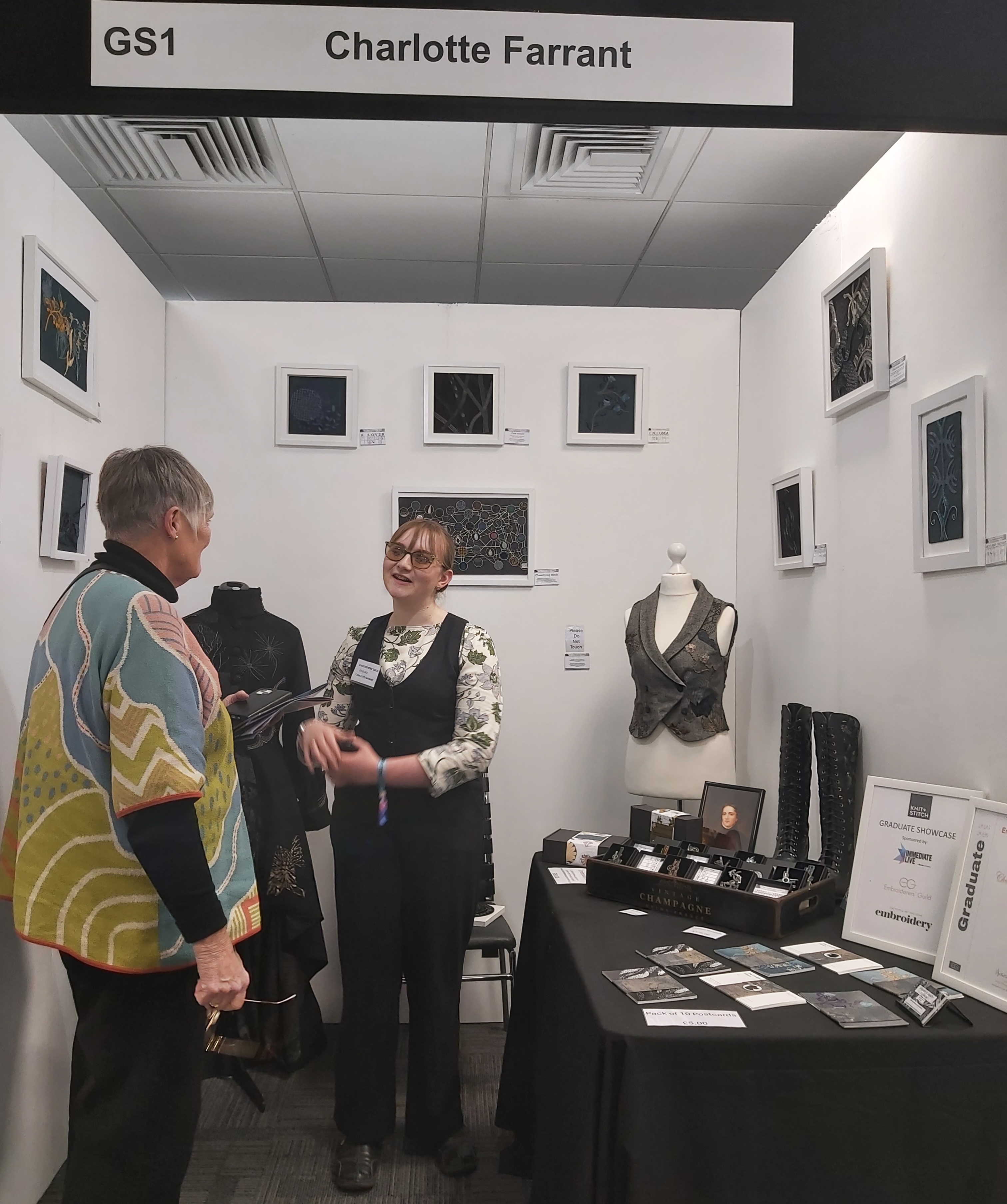
One of the UK’s major textile events, the Knitting and Stitching Show, is held annually in November in the Harrogate Convention Centre. It’s packed with “must have” products and showcases inspiring work by a wide variety of textile artists. Within the show there is a dedicated exhibition area called the Graduate Showcase which highlights outstanding textile art from recent UK BA undergraduate courses. This initiative, run in partnership with the Embroiderers’ Guild, provides a platform for emerging talent in the textile art world and it was here last November that I first saw the work of Charlotte Farrant.
Charlotte hadn’t originally planned a career in textile design, in fact growing up she had formed a fascination for mechanics and saw herself becoming a mechanical engineer. At some point Charlotte discovered she also had a love of embroidery and enrolled in the Royal School of Needlework, graduating with a first class degree. 

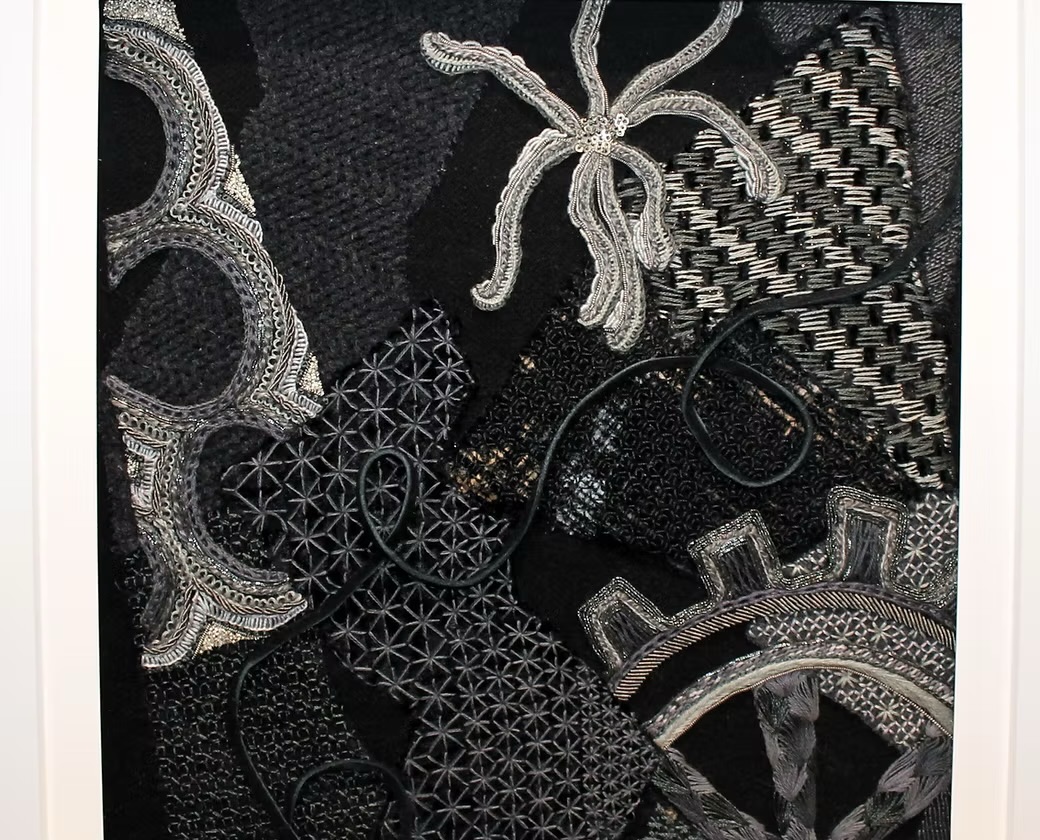
Charlottes “Codification of Stitch” is an innovative coded embroidery system developed by the textile artist herself and it is used to form hidden messages within the garments she designs, transforming textiles into wearable narratives. Specific embroidery stitches represent letters, forming hidden messages amongst the exquisite, decorative Goldwork, Blackwork, Whitework and Raised Work.
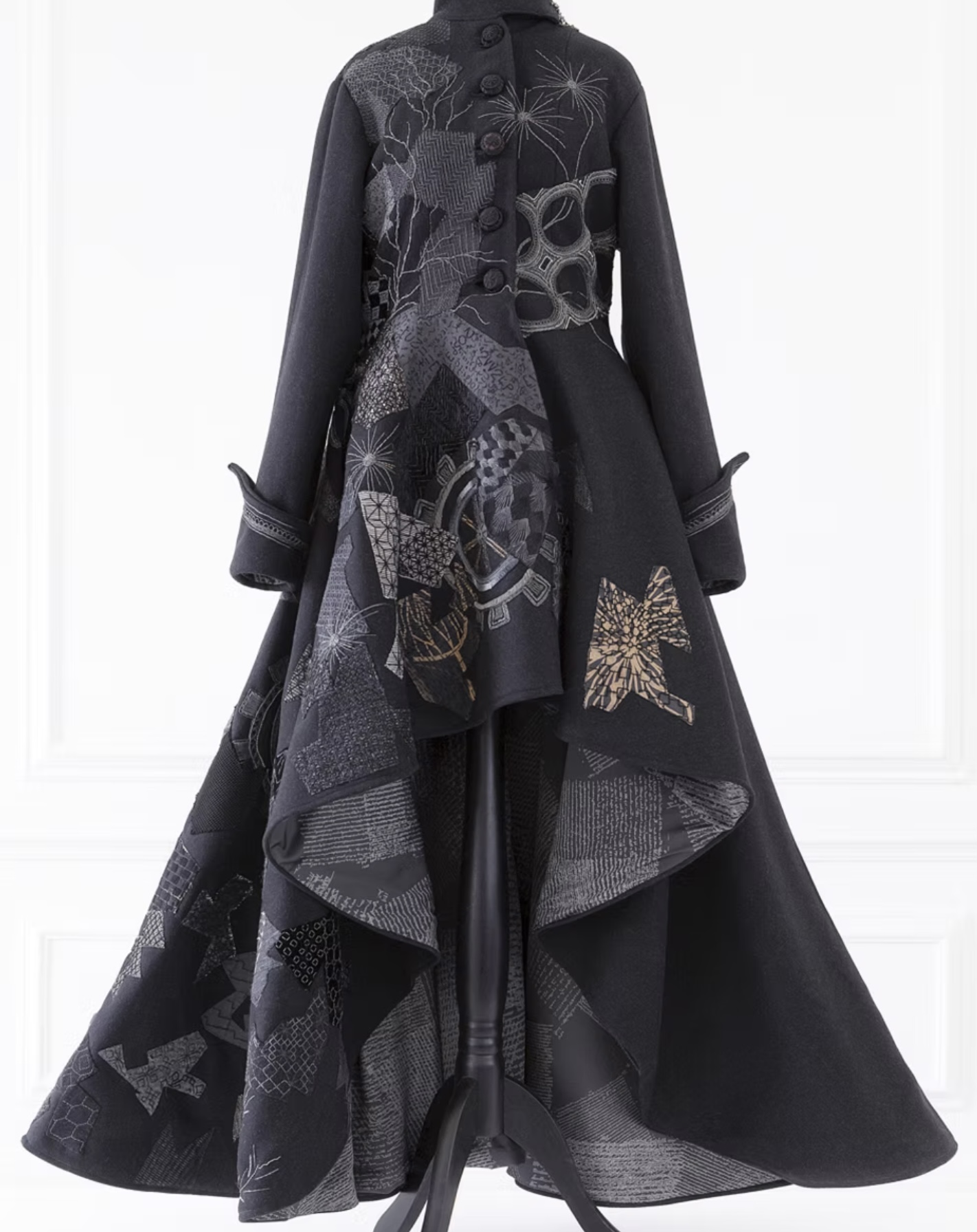
 
It was her fabulous “coded” Ann Lister black coat that first caught my attention on her stand at the show. In 2025, in collaboration with the Anne Lister project, Charlotte designed a range of costumes re-imagining the BBC cast of Gentleman Jack and bringing them in to the 21st century.
 
I hadn’t heard of Ann Lister but I’m guessing plenty of you will have, especially if you’ve seen her life story as portrayed by Suranne Jones in the BBCs series Gentleman Jack. This woman was an ardent diarist and from 1896 to 1840 she wrote a five million word diary, approximately one sixth of which was written in code. She combined the Greek alphabet, zodiac, punctuation, and mathematical symbols allowing her to document, but also conceal, the most private aspects of her life. It’s fitting that this beautiful coat should also conceal its message which is a quote from Ann in August 1823. It reads “I am not made like any other I have seen, I dare believe myself to be different from any other who exist.”

Ann Lister Coat


Sampler for coat

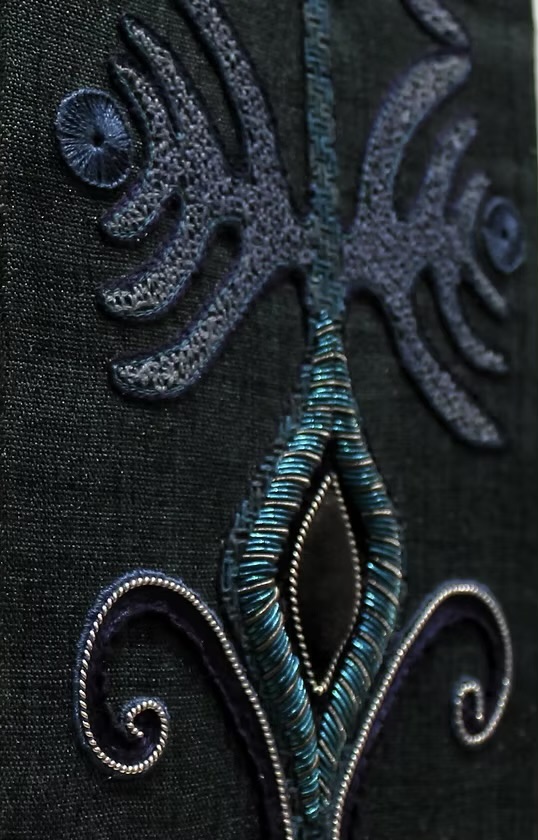
Another “Ann Lister” inspired piece on Charlottes stand was a waistcoat inspired by the diarists love of nature and the coded message on this garment reads “We are not alive if we’re not taking the odd risk now and again.” 

Ann Lister Waistcoat
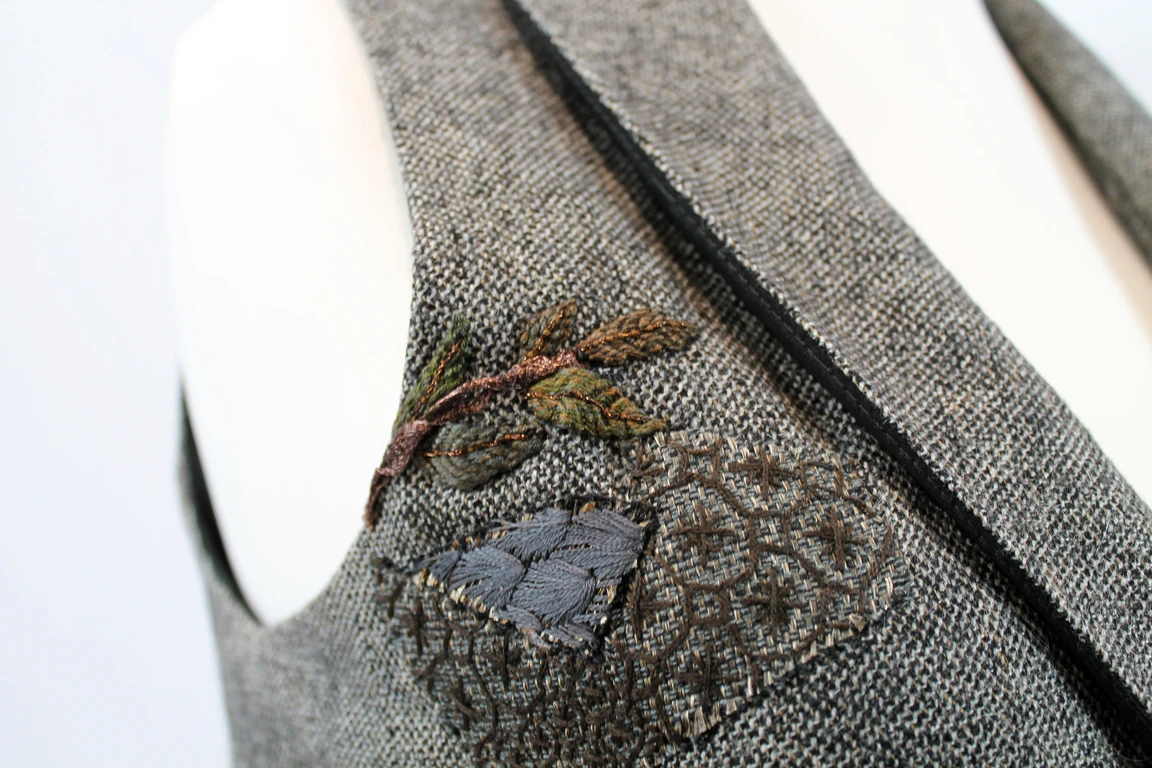
Detail of waistcoat

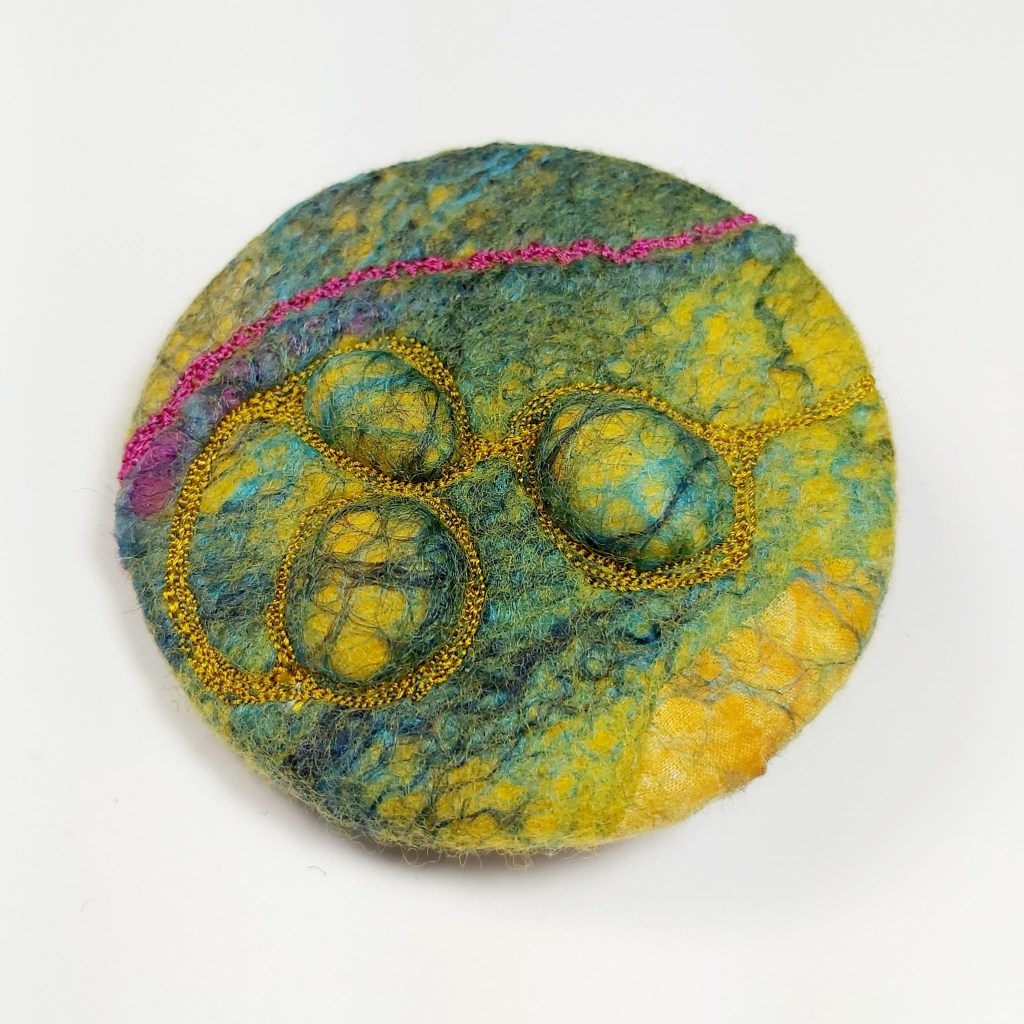
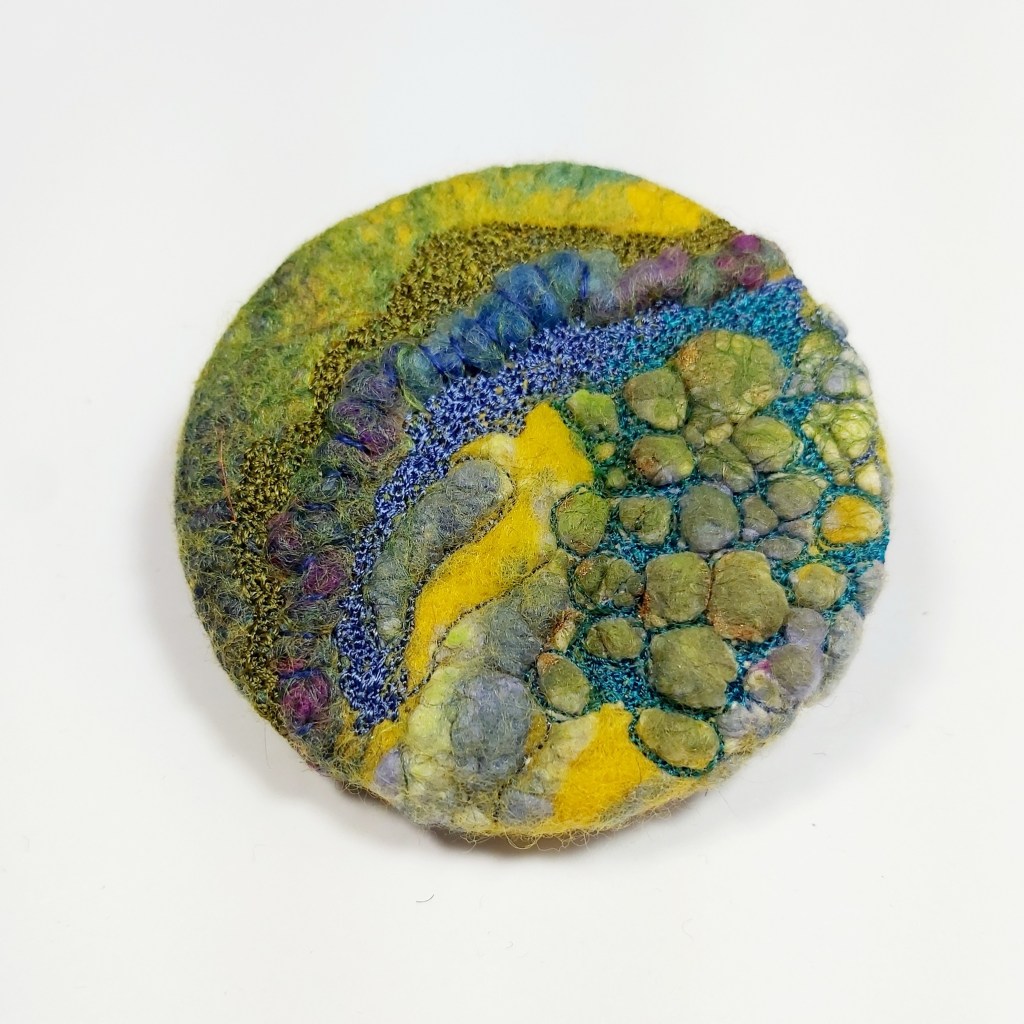
There was also a selection of beautiful intricately stitched, coded brooches on display, each with a printed label providing its deciphered message.

Check out Charlottes website charlottefarrantembroidery.com where you can see her portfolio of designs as well as her shop selling Coded embroidery kits, brooches and many other embroidered coded art works.

Throughout history textiles have been used not only for protection and comfort but also to communicate our personal values and identity. Long before the written word came in to use Ancient civilisations would use specific colours and symbols to convey their environment, spiritual believes and culture. In this way meaning could be woven, felted or stitched into rugs, blankets, clothing, etc. delivering visual messages that could be easily read by the people around them. Examples include the felted rugs created by ancient nomadic tribes which would embody powerful symbols across different cultures signifying the wish for good health, long life, prosperity, etc.

Examples of just a few of the Symbols used in Middle Eastern rug making.

On the other hand, hidden “coded” messages in textiles have been used for a very different, but very important role in history. While imprisoned Mary Queen of Scots embedded complex and personal symbols within her embroideries to express her frustrations, assert her claim to the English throne, and comment on her unjust captivity. This panel depicts a grapevine and a hand holding a pruning knife. It references Mary’s claim to the throne, suggesting the need to cut away the fruitless branch of the Tudor tree represented by the childless and ‘illegitimate’ Elizabeth. The point is driven home by the Latin motto ‘Virescit Vulnere Virtus’ (virtue flourishes by wounding). (source:vam.ac.uk)
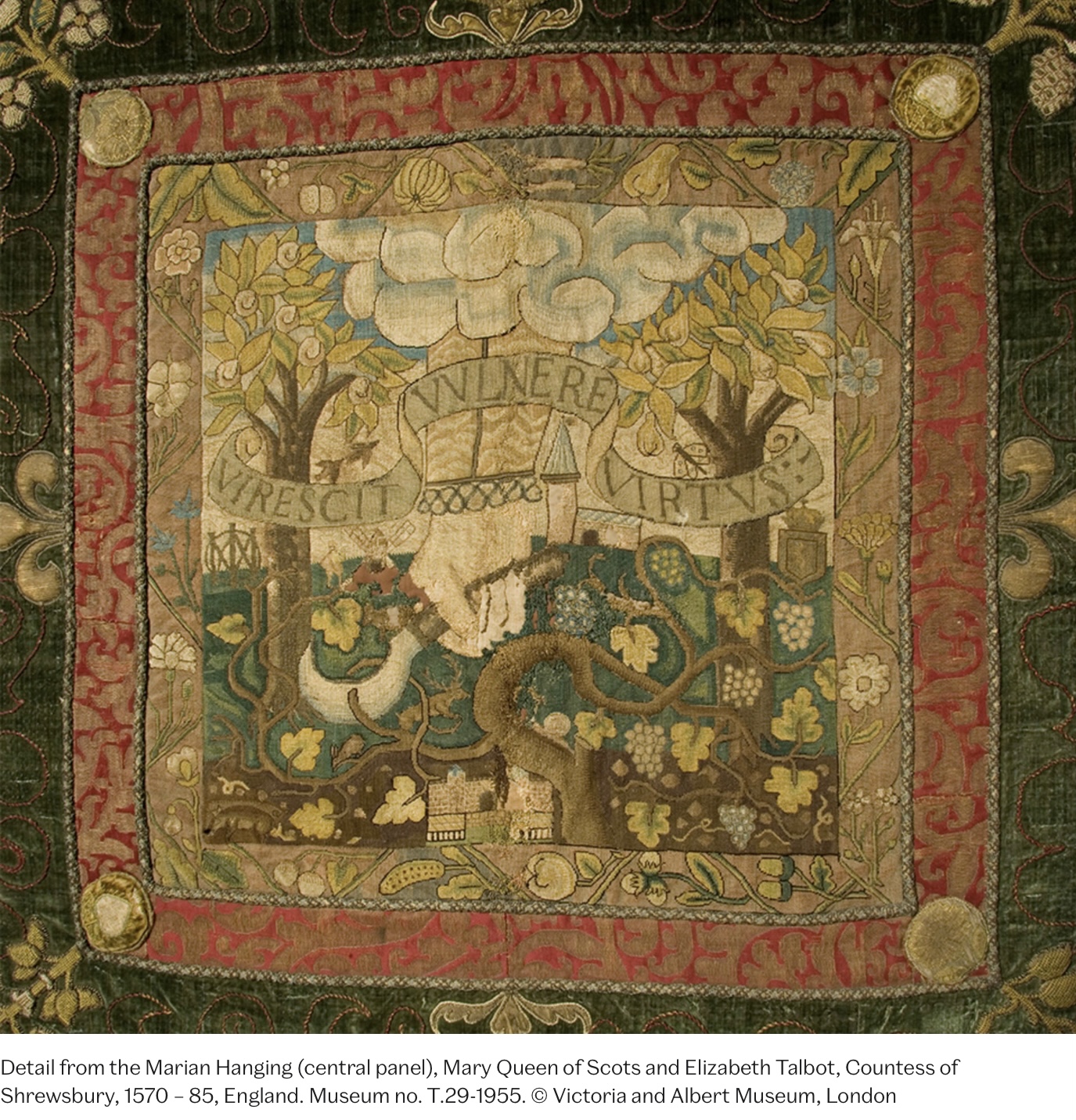
Embroidery also enabled Mary to communicate with her supporters by sending coded messages hidden in her needlework. 

In the realm of espionage, traditional handicraft skills were to take on an even more covert dimension during the World Wars when prisoners, spies and resistance members used embroidery to pass on information under the noses of their enemies. After all, who would suspect that something as innocent as an embroidery or tapestry could offer any threat from the enemy? Morse code and binary code were easily represented using a combination of long and short stitches, or French knots and seed stitches, and these would go undetected when hidden amongst other decorative stitches. Other methods required the person receiving the work to “undo” the embroidery as messages were hidden in the padding of trapunto or concealed beneath a second layer of embroidery. 

Knitting was another innocent looking but very useful craft when it came to espionage. Morse Code knitters employed single purl stitches for dots and sequences of three purl stitches for dashes. Their sequences translated into short and long coded signals. Some knitters used knots to conceal Morse code by tying specific configurations to represent dots and dashes, or varying the distances between their knots. These encoded messages could then be discreetly passed across enemy lines or integrated into knitted items such as hats and scarves to be decoded by the recipient. Written messages were also known to have been passed on, hidden in balls of wool!
This practise wasn’t exclusive to the allies. Using a system similar to Morse, German agents based in the UK also passed encoded messages using knotted yarn which was then knitted in to garments. 

Although an extremely dangerous occupation it’s said that the practise of covert knitting became so prevalent during WWII, some countries actually banned the posting of knitting patterns aboard, fearing they may carry coded information to the enemy. 
During times of war, a knitter was often more than just a creator of warm garments; they were also keen observers and messengers, their needles clicking away as they kept watch. (Source: Timoneillstudios.com)

Image Source: ww2wrecks.com

I will leave you with an embroidery created by one Major Alexis Casdagli. Alexis was captured and spent four years in a German POW camp where he passed the time in the innocent pursuit of cross stitch. He also set up a stitch school, teaching other POWs to embroider. Of the many embroideries he made this piece was so admired by his captors that they proudly hung it in the castle where he was being held and subsequently had it displayed in three other camps.

The prisoners must have found it very amusing that the guards had no idea of the defiant message hiding in the Morse dots and dashes stitched around the borders which read “God Save The King” and “Fxxx Hitler”. Fortunately it was never deciphered during those four years and so the embroidery, and the Major survived the war. He told his son on his return that the Red Cross saved his life but embroidery saved his sanity! 


Stylized Iris: Floral Fabric Art with Recycled Materials

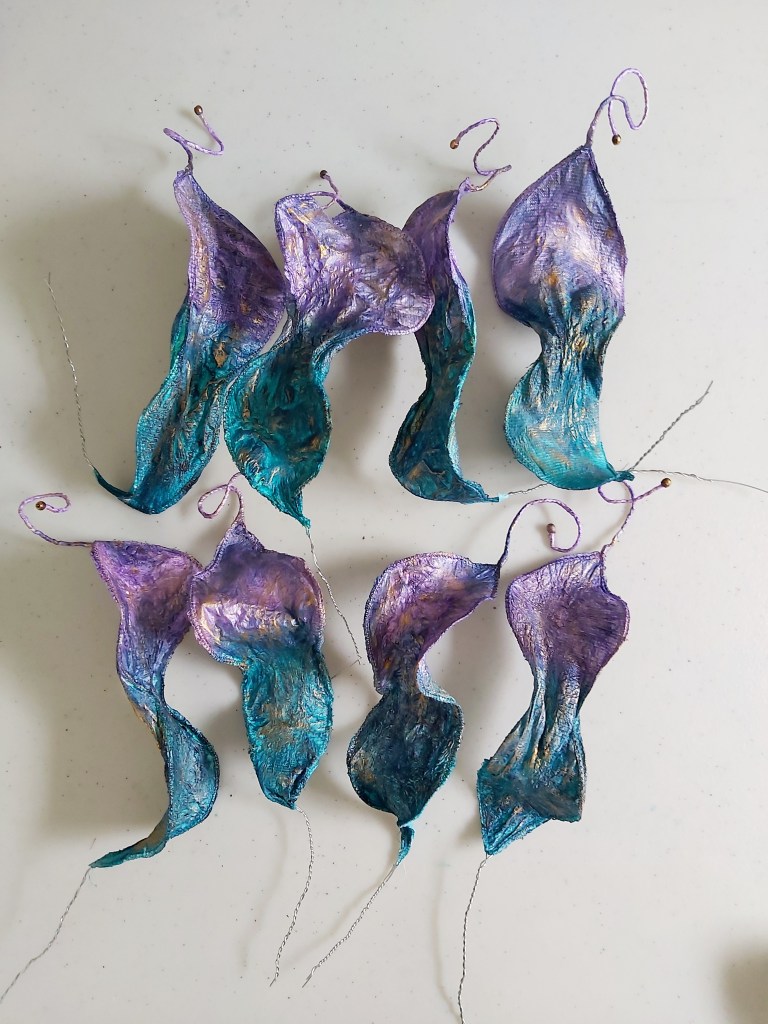
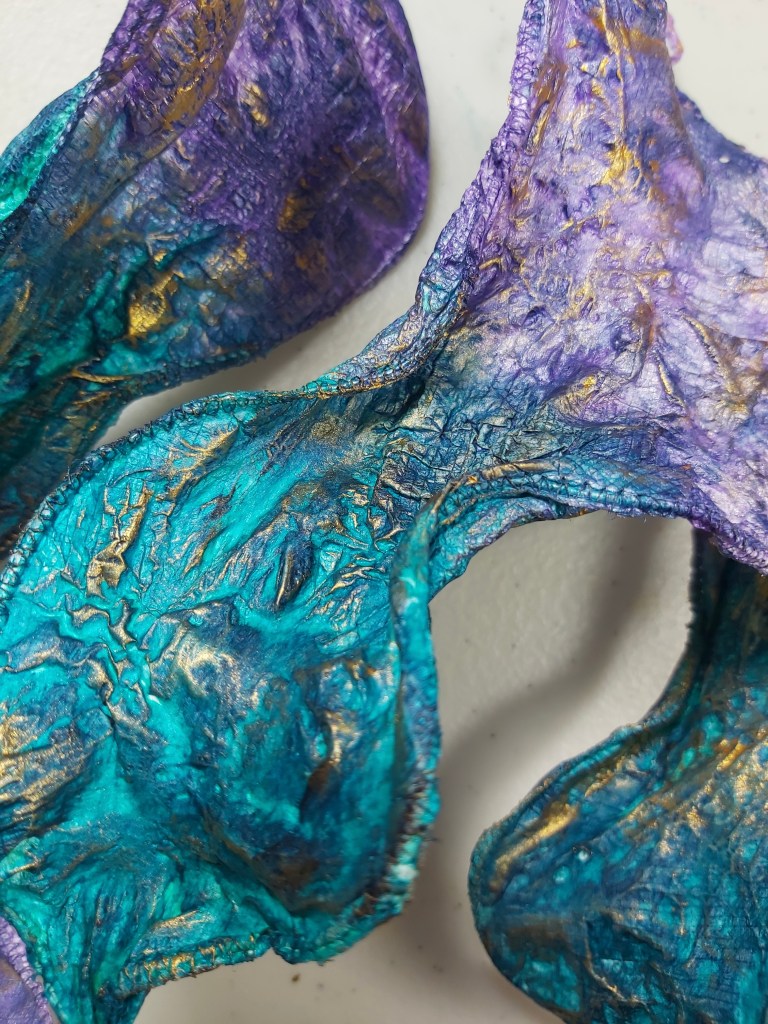
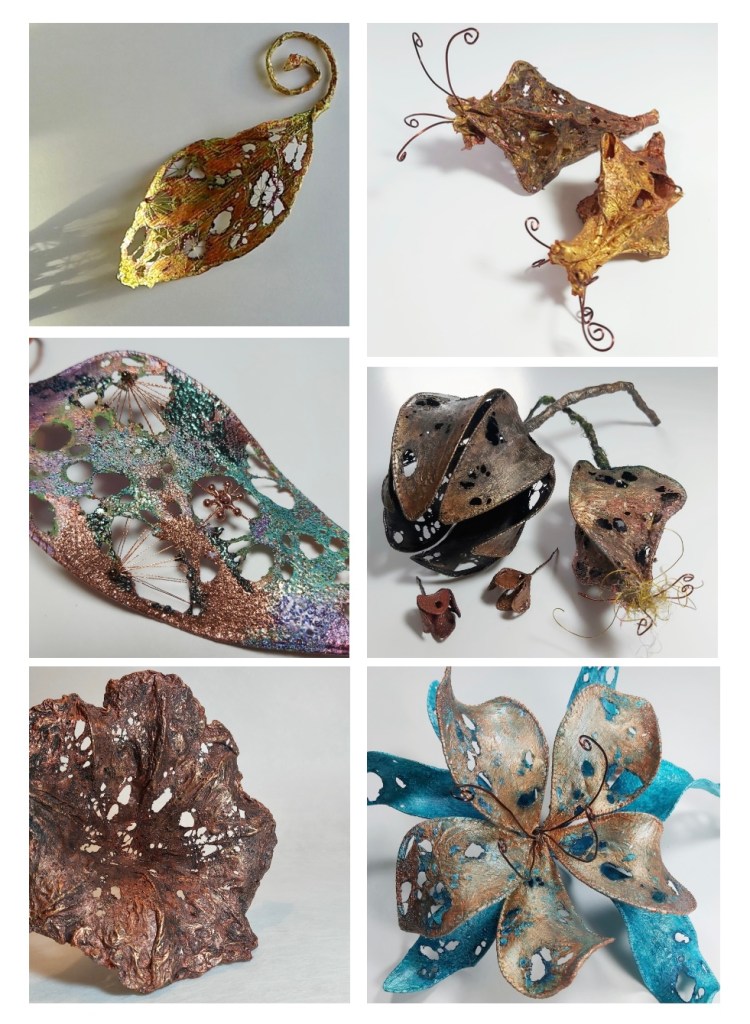
In my last post I mentioned the Iris that I’ve been working on for the Lincolnshire Textile Group exhibition Bountiful Botanicals which will be held in August 2026 in Lincoln Cathedral. Having made numerous leaves, seed pods and flowers in the past using Tyvek I knew this fabric from DuPont would be perfect for the flower project. I think most readers will know of Tyvek fabric but if you don’t it’s made of 100% high density polyethylene (HDPE) fibres. These are randomly laid and compressed through a unique flash-spinning process to form a strong, non woven material that has the properties of paper, film, and fabric. It can be painted, stitched and heat distressed to create wonderful textures and exciting structures.

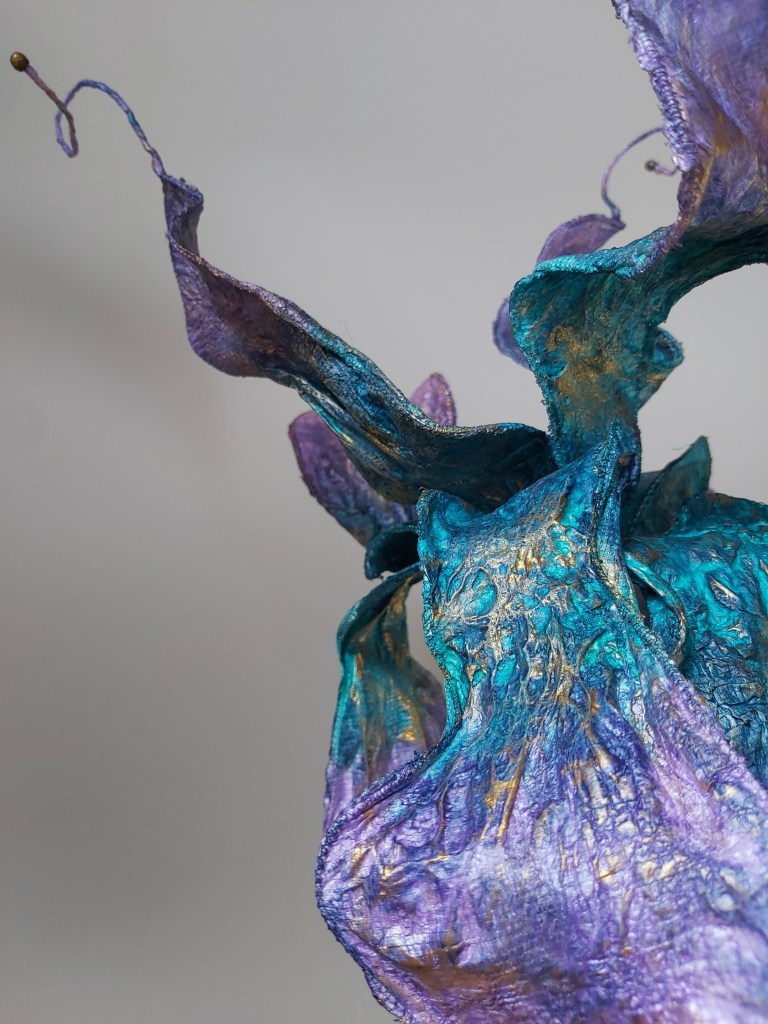
The idea was to create a single, tall slim flower with four leaves. I began by creating the individual petals, four larger ones to hand down and four slightly smaller ones to stand upright. I decided to make this a stylised Iris and added a twirly flourish at the end of each petal, finished off with a gold painted wooden bead.

Apart from the B&Q wire for the armatures all the other materials used in this project have been recycled or repurposed including the recycled Tyvek which I now buy in preference to the new, non recycled version. It isn’t as substantial as the original but perfectly good enough for creating petals, leaves, etc. and I love the effects I can get when it’s distressed and painted with metallic acrylics. Although it isn’t yet widely recycled there are specialist centres that are doing this which is good to know.

The stem of the flower is a repurposed garden cane and for the base I found the perfect shaped glass vase in my local charity shop. Originally I was going to felt a “bulb” as a base but I’m glad I went with the vase as it not only provides the stability needed for the display but it also gave me the ideal form around which I could wrap the string, plus it emphasise the verticality of the flower making it appear even taller. I was intending to dye the string but after offering up a few different coloured papers to audition the colours I came to the conclusion that it works better left natural as it gives more focus to the flower itself.

The photo of my flower in situ shows where the choice of colour came from. It stands 112cm tall and the flower head is approx 26cm wide.

Photo shows a hand made, single stem Iris created from Tyvek fabric and wire. The flower is painted in turquoise, purple and gold metallic acrylic with four turquoise leaves. It stands in a vase on a coffee table next to a large Monstera plant.


If you use Tyvek fabric in your projects and want to try the recycled version it’s available on eBay UK from Spenic-recycling.

Summer Textile Projects…..

As I sit down to begin this post the sky has darkened and the rain (fingers crossed) is about to fall, heaven knows we need it, but what a fabulous summer it’s been so far here in sunny Lincolnshire! I tend to not do too much in the way of creative stuff through July and August as there are too many distractions and this year the intense heat has made me feel very lazy so lots of time spent relaxing, reading and watching creative videos. Consequently I’ve now got a table full of projects I need to finish and a head full of others I want to start. 

A couple of projects I did do this summer are two wet felted vessels. The first one, inspired by a shrivelled seed pod, was made at the İFA Region 8’s Summer School in Arnesby near Leicester. Our region encompasses several counties and is so spread out we struggle to get our İFA members to attend. On the other hand we have a regular group of creative ‘non members’ in the locality who are more than welcome to come along to our events, and thankfully they do! It was a busy and fun two days…..

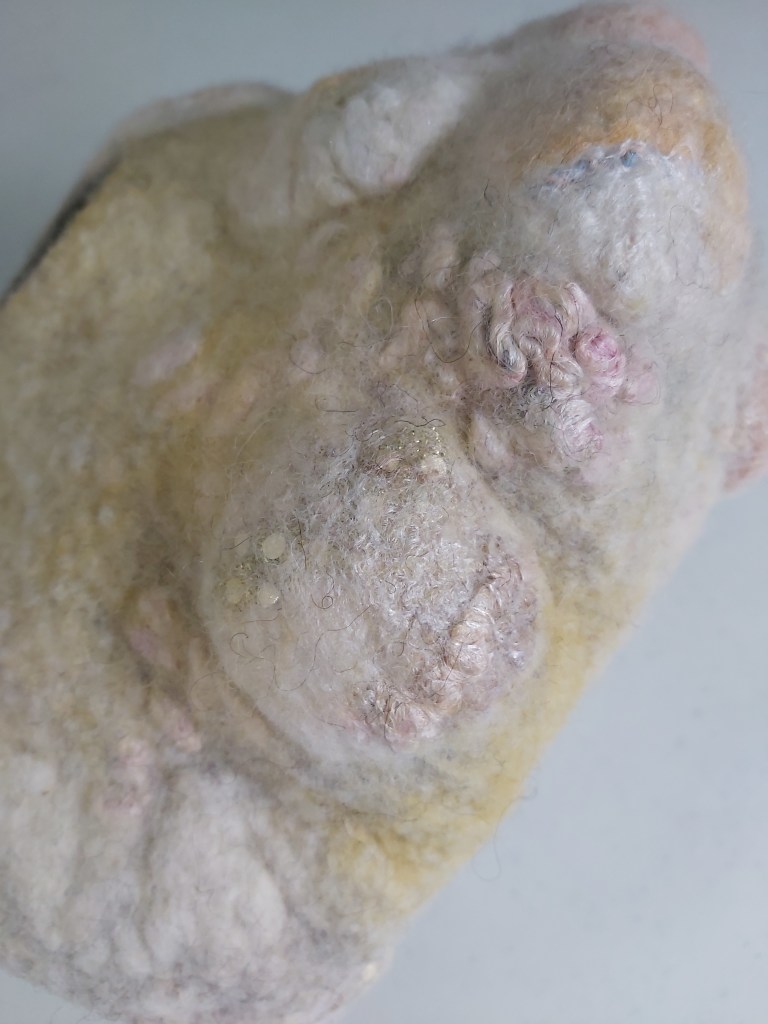
My seed pod began life as five leaf book resist measuring 27cm x 36cm and various colours of Merino and Corriedale fibres. After removing the resist and fulling the felt I pushed and pulled the pod and attached strong clips to create the shape I wanted. I didn’t want a visible hole so the one I cut was so tiny so meant the resist ended up being pulled to pieces in order to get it out! Now it’s finished I feel like it needs a bit of something adding so I’m wondering about embroidering circles in a dull gold thread?


The second vessel was started last Friday when I was working at the Usher Gallery in Lincoln. I’d seen a post somewhere mentioning they were having their second Artist Studio Day and inviting local artists to apply. If successful it meant I would get the use of a table in their ground floor workspace and get to spend the day with four other artists. It sounded like a great opportunity and I’m so glad I applied! Only four artists turned up on the day and unfortunately one of those had to leave early. My other two companions were both painters and it was nice to get to know a bit about them and watch them work. We had a few members of the public come in to see what we were doing but for most of the time it was very quiet which allowed us to focus on our projects.

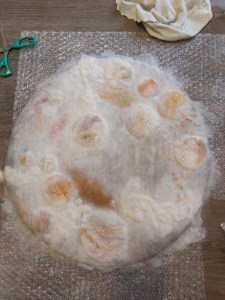
The day before I went I made a textured prefelt using threads, silks, fabrics, etc which I could cut up to create the undulating surface decoration. It was necessary to do this beforehand as I knew my vessel was unlikely to be finished on the day but would need to be at a stable stage in order to be able to fold it to carry back to the car. I got the obvious comments from one or two folk of how my work “looked like a pizza”. The following day after removing the resist and fulling it my 41cm dia pizza had become an 18cm x 24cm 3D vessel weighing 120gms. I’m loving the textures and colours it has!

One of the Summer pieces on my table which I’ve yet to finish is an Iris which I started at the end of July. This is going to be for the Lincolnshire Textile Groups Bountiful Botanicals competition taking place in October. I’m creating it from hand painted Tyvek fabric and wire and the flower will be approximately 30cm dia by 115cm tall. I’ve just got the leaves to do now and then I’ve got the perfect spot for it in my lounge when it’s finished. I don’t want to reveal too much before the competition so this is a sneak preview for now…..

Another work in progress on my table right now is this insect brooch, at approx 14cm long I’ve definitely developed a thing for hand made oversized textile brooches! I’ve just got the legs and antennae to finish, more colour to add and the pin to attach.

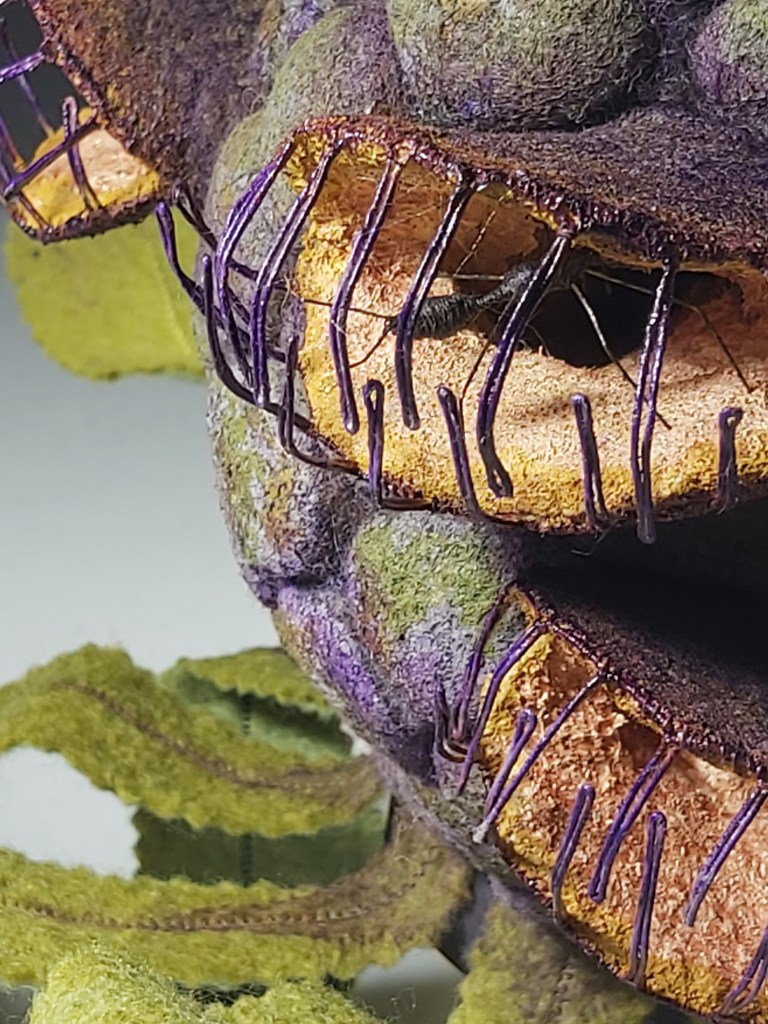
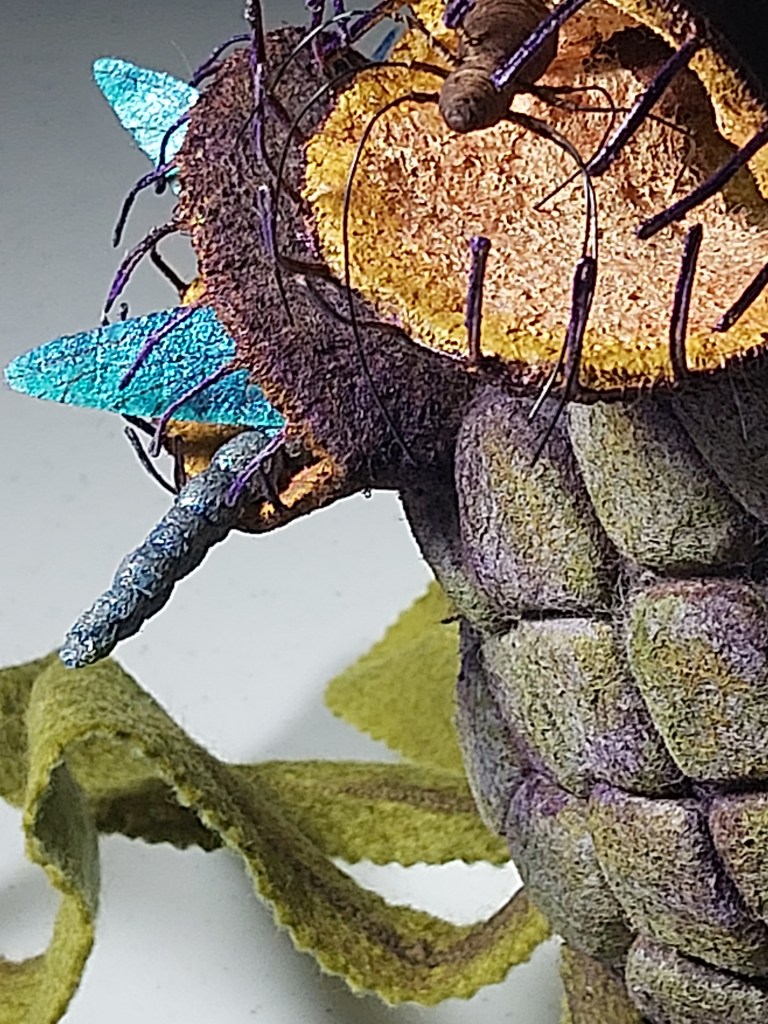
My final work in progress is a mixed media project and something else I’m keeping under wraps until October as it’s also for the Lincolnshire Textile Group. Depending on how it turns out, it might replace the Iris as my competition piece. This started life as an oversized wet felted Banksia Nut which I made last year. I’ve never been happy with it but a few months ago I had the idea of giving it a new lease of life with a new identity. I’ve still got lots to do to it yet. It’s by far the strangest thing I’ve ever made and it won’t be for everyone, let’s just say it’s a hybrid of Banksia meets Venus Fly Trap and yes numerous insects will appear to be harmed in the making of this piece! I can’t wait to reveal it!

Art of the Now…..

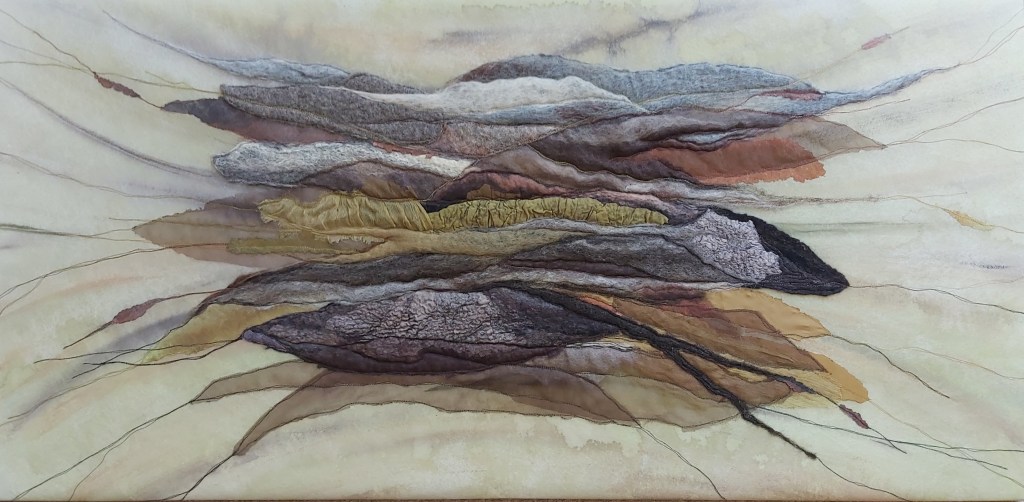
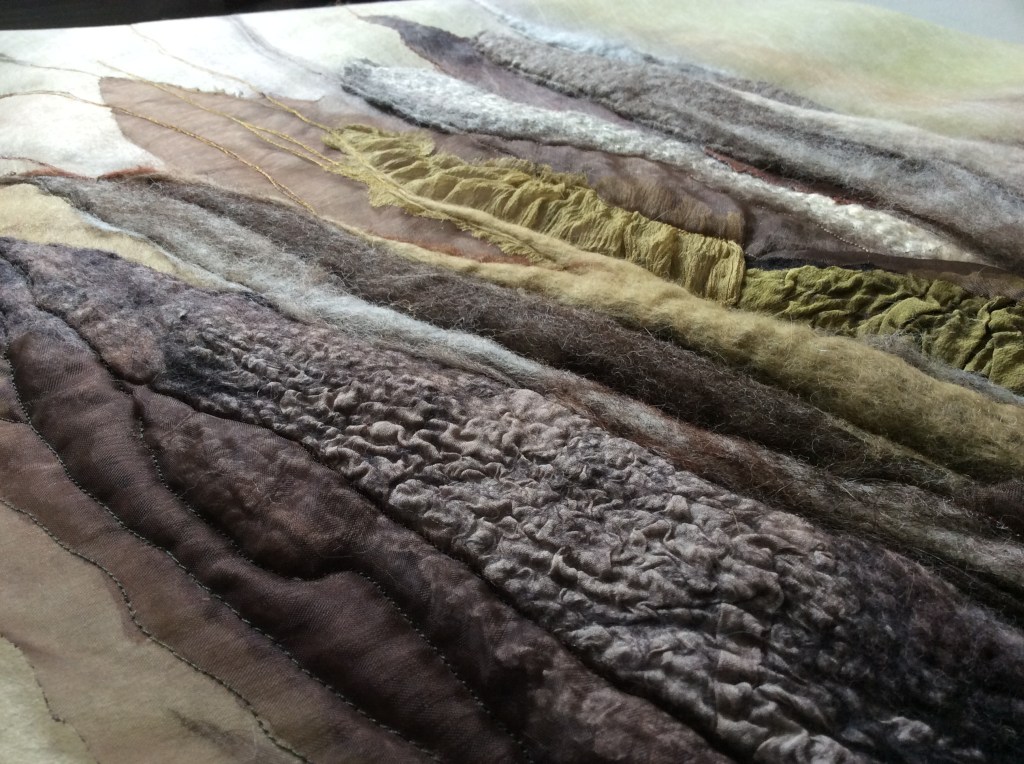
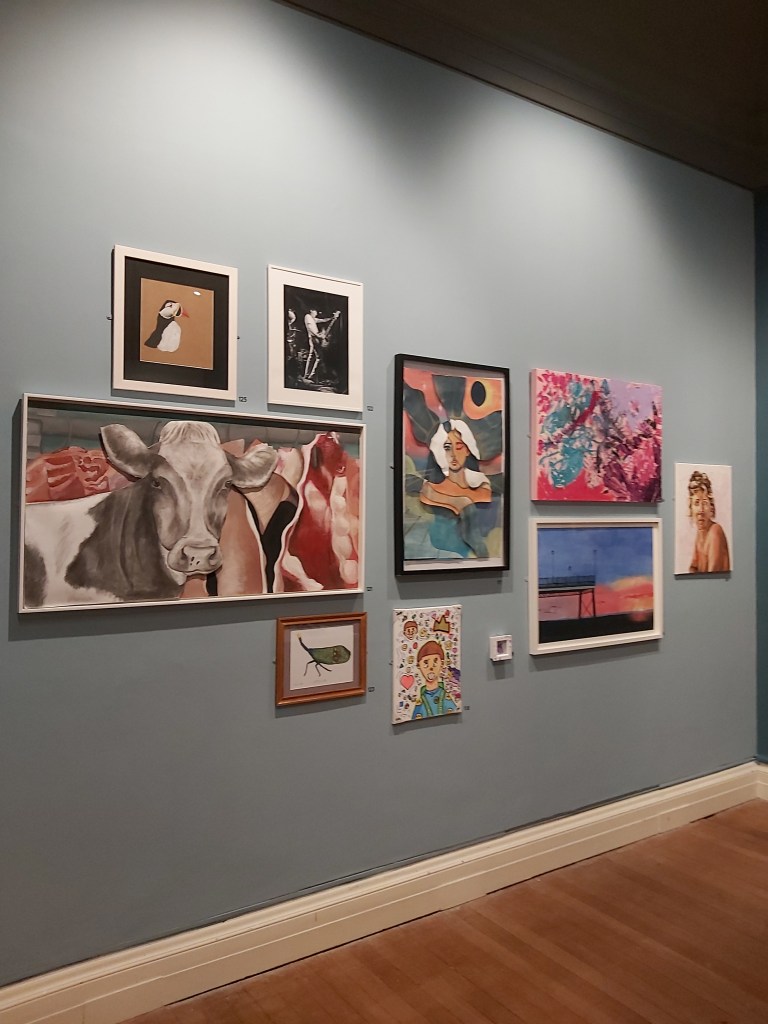
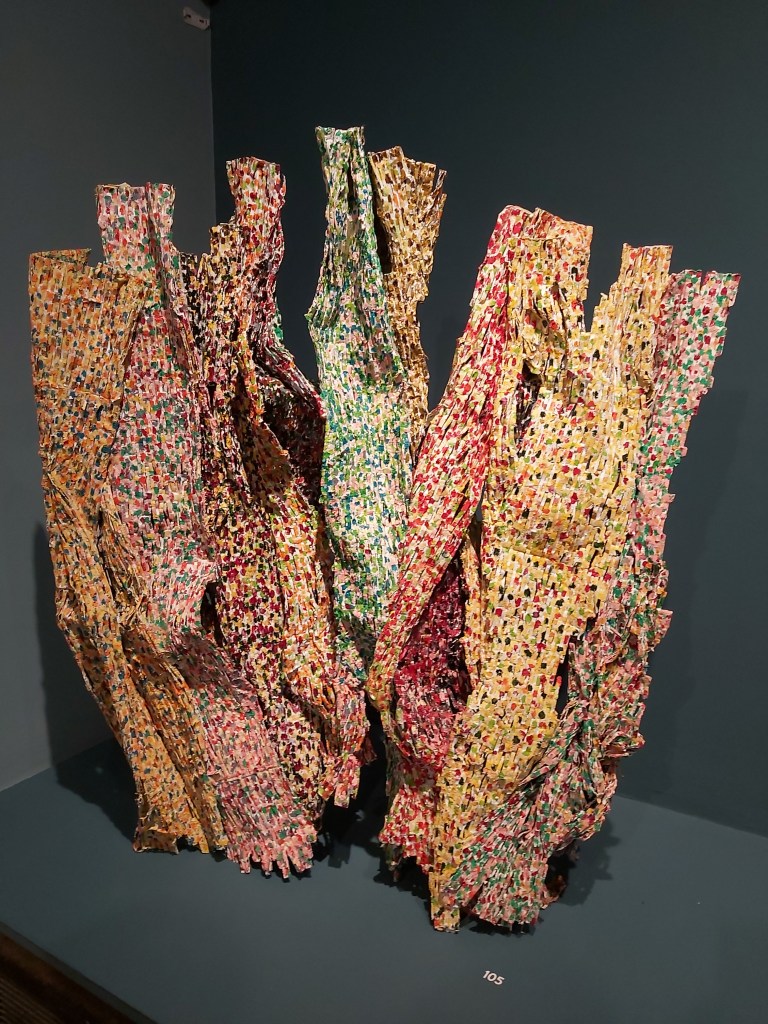
A few months ago I responded to an ad for local artists to apply for the chance to exhibit their art in an Open Call exhibition being held at the Usher Art Gallery in Lincoln. We could submit up to three pieces in any medium. There were around 900 works submitted in total which were then whittled down to just over 100. I was thrilled when I found out that my Nuno felted/mixed media abstract landscape “Northern Soul” had been successful!

Time spent walking in the beautiful Northumberland landscape, particularly around the Coquet Valley and Simonside Hills, provided the inspiration for Northern Soul. It was created using a variety of fibres and fabrics, wet felted and free motion stitched on to a painted background of Lutradur fabric.

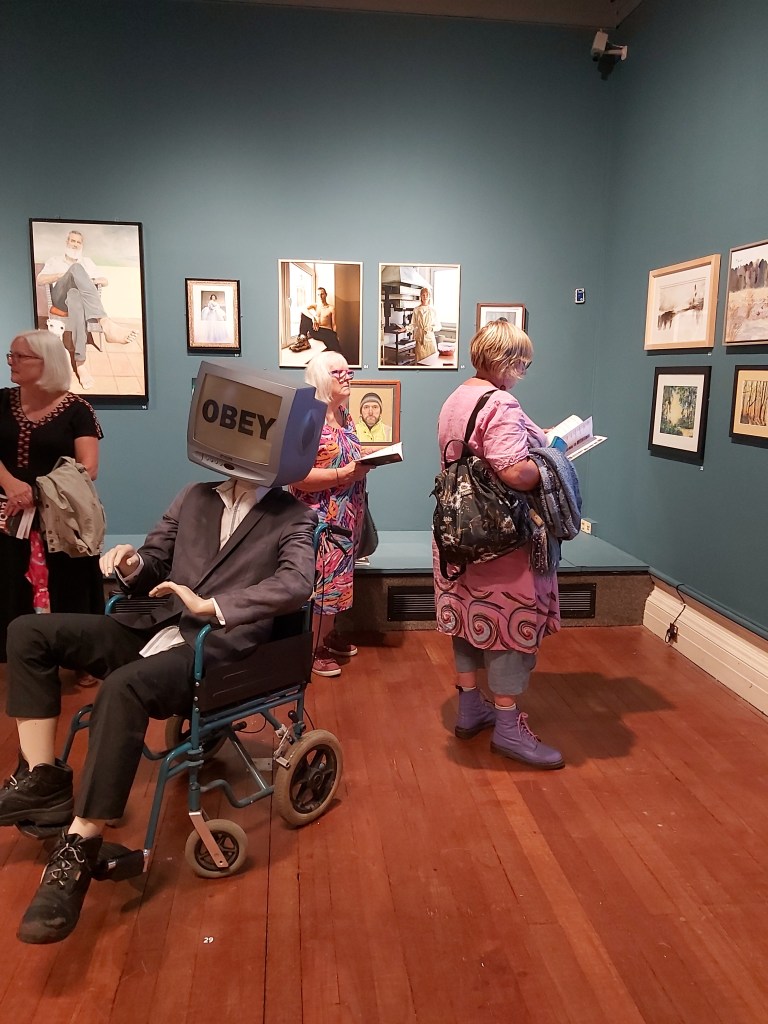
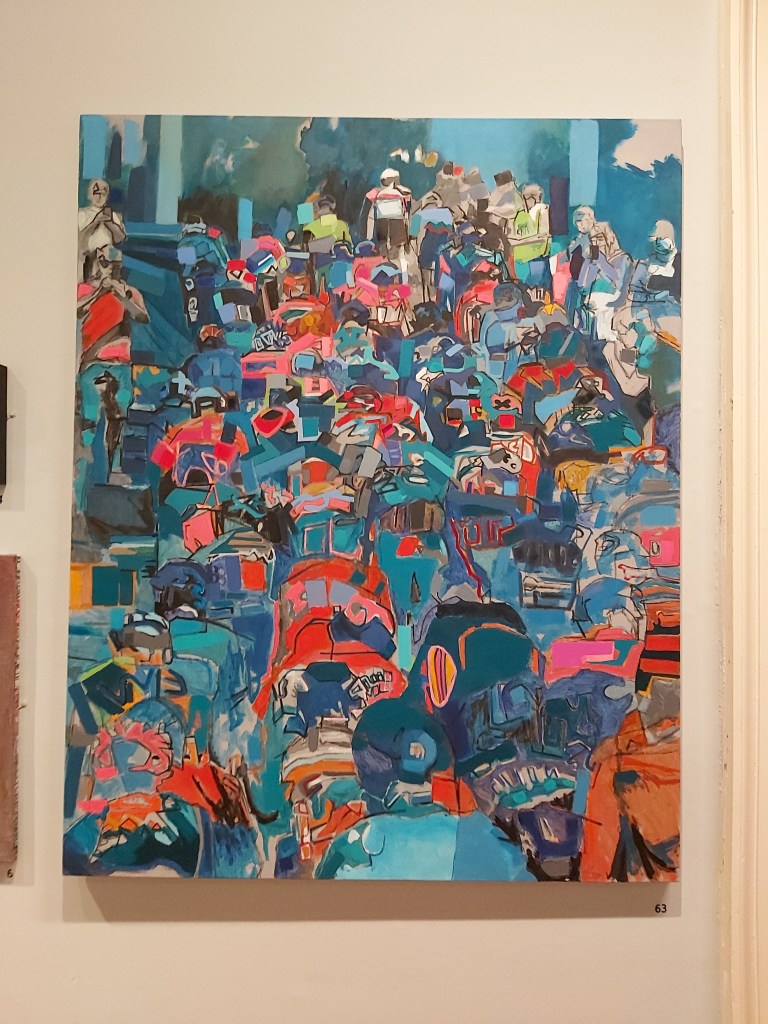
The Art of the Now exhibition runs from now until October 19th, it’s open from Thursday through to Monday from 10am – 4pm. It’s free entry and there is a wide variety of techniques, mediums, subject matter and styles on display, although given the rising interest in textile art it would have been nice to see the gallery representing more of this.
These are a view images from the opening event.

More Insect Brooches…..

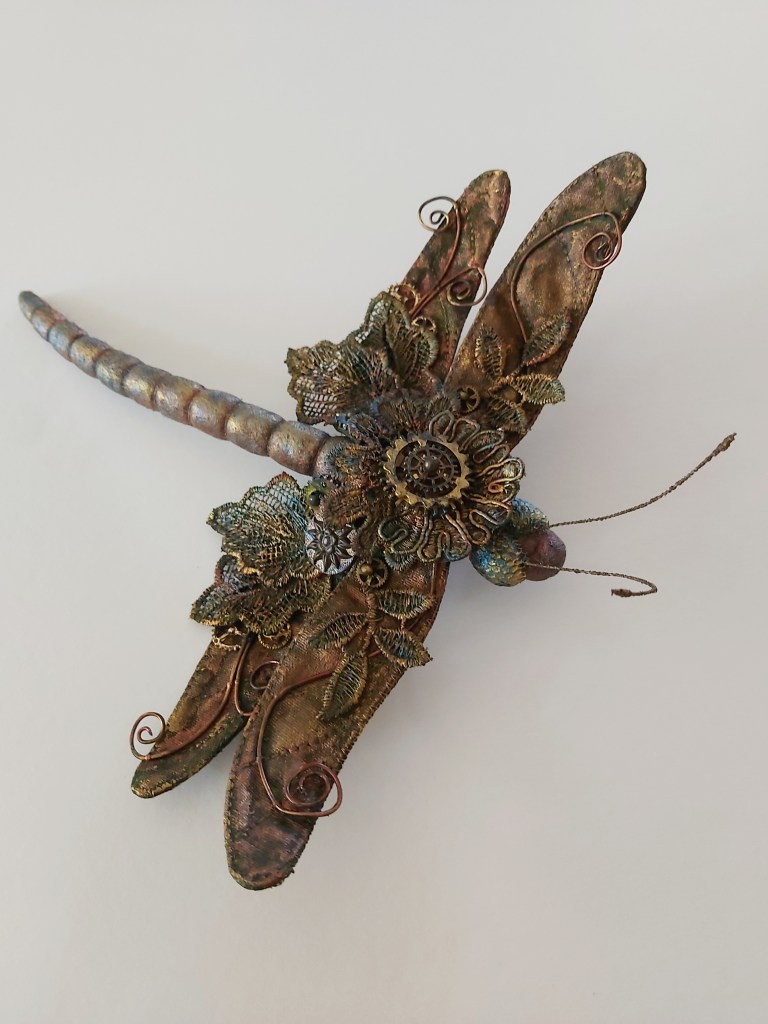
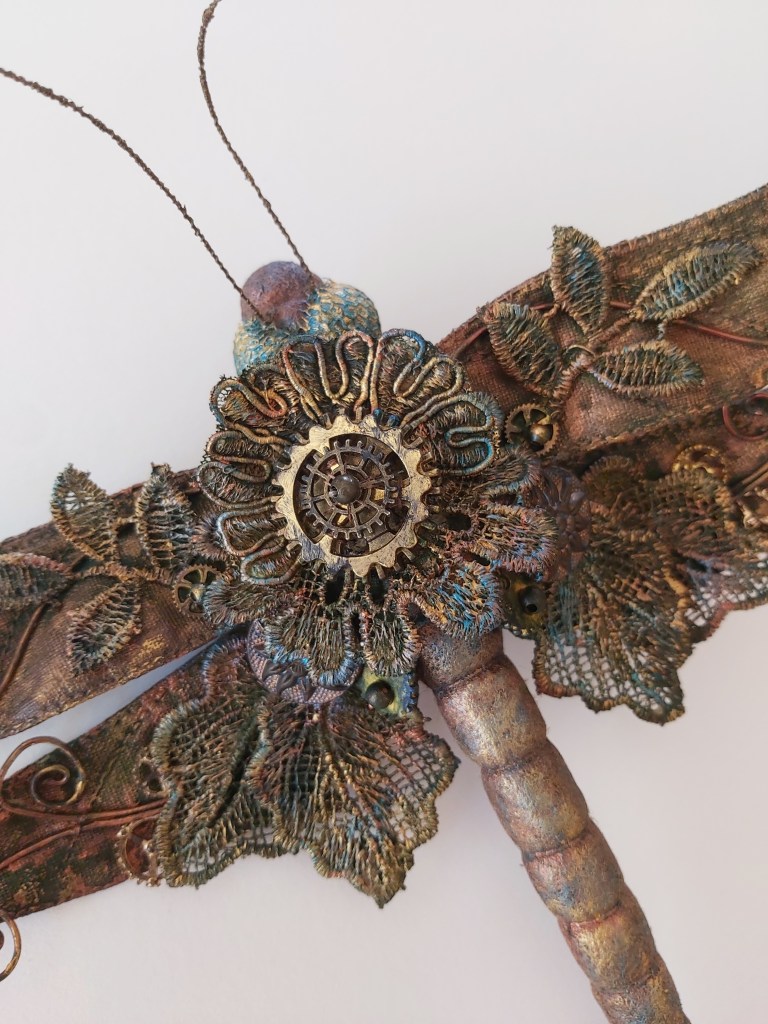
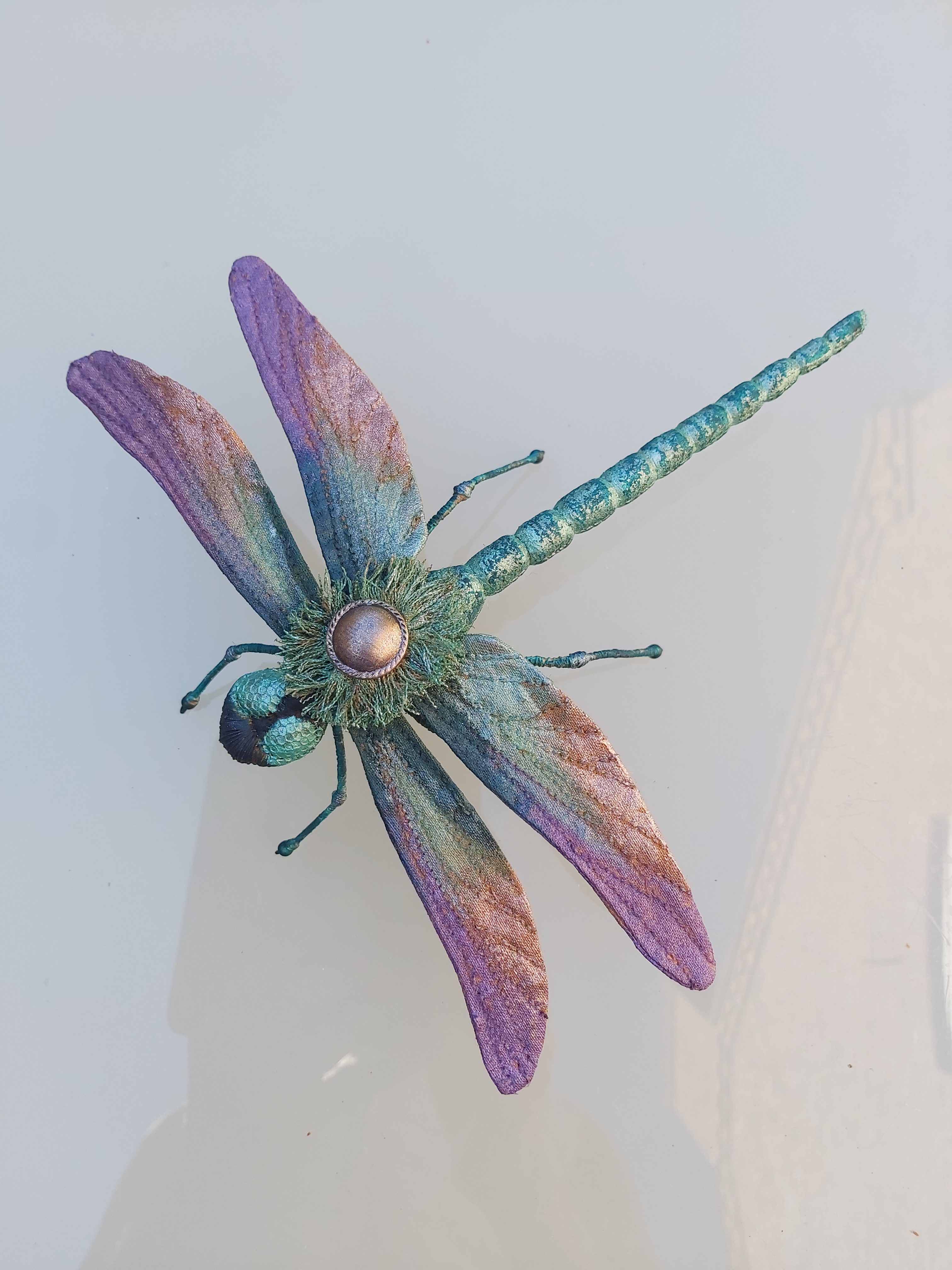
In my last post I showed a dragonfly brooch that worked out too large for me to wear so is now on my wall…..my steampunk dragonfly brooch has worked out even bigger! It’s made with painted cotton fabric and various trims cut from lace with metal beads, wire and cogs. I’m now doubting I will get a full outfit made in time for the Lincoln Asylum festival in August but at least I’ll have this humongous brooch to wear!

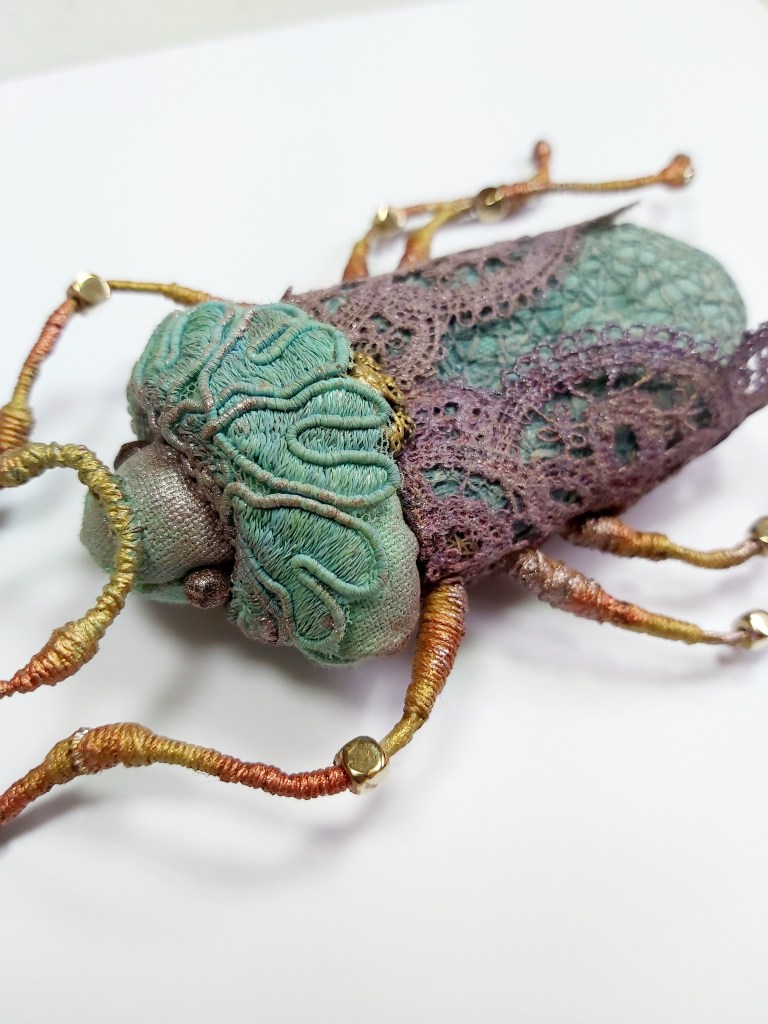
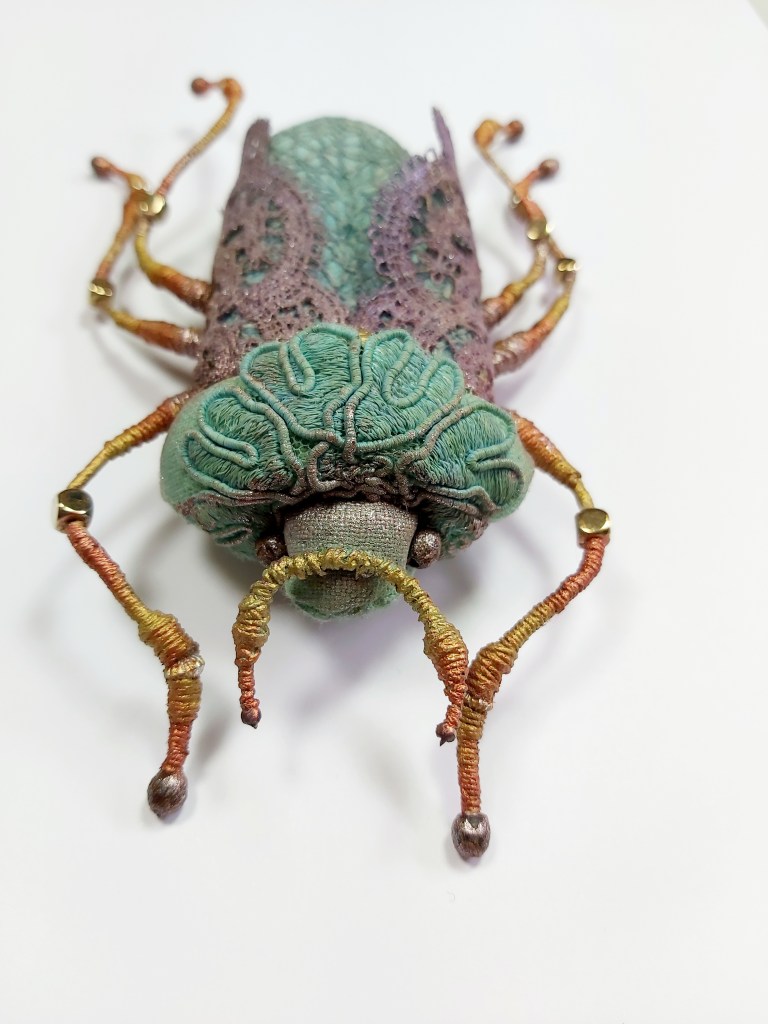
I seem to have developed a bit of a thing for large fabric insect brooches. Billy the beetle is my latest make. No, he’s not a stag beetle, he’s a rare breed, so far only seen in the Lincolnshire Wolds😜 His body started out as a very simple shape cut from cotton fabric which was stuffed and moulded with a few stitched tucks here and there. He’s been decorated lace and hand painted and this time I added legs, wrapping them with threads and adding beads. He has a lot more character than the previous insects, maybe that’s a beetle thing? I can feel an infestation of beetle brooches coming on and it amuses me that when I’m not wearing him I can stand him on my desk as if he’s about to pounce .….sometimes it’s the little things that us smile!

Felted Shells & Fabric Insects…..

In my last post I showed you my wet felted conch shell made from Merino and Corriedale fibres with ribs made from Sari silk yarn. I liked the shape of this and wanted to make another, this time in off white with pale coloured ribs. I found a site on Etsy selling a beautiful subtle coloured variegated sari yarn but unfortunately when it arrived it was so loosely spun I realised it wouldn’t be suitable for this particular project.

Pale neutral coloured Sari yarn layer out in rows


As I was in the mood for felting I didn’t want to have to reorder so decided to search for a pastel “slubby” knitting yarn which I knew was hidden somewhere in the depths of my yarn stash.

A ball of pale grey knitting yarn with slubs in shades of grey and peach.

It turned out to be far easier to work with than sari silk as it was less inclined to move while felting and it had just the right amount of colour and texture for the look I was after. I was intending to leave this shell plain white but now it’s made I think it will benefit from a bit of shading so that’ll get added at some point.

I increased the size of this one to approx 31cm long x 15cm wide x 6cm high. My spinning group has a coastal theme for our 2026 exhibition so there will be lots more shells being made in various fibres, fabrics, techniques, shapes and sizes.

Two wet felted conch shells. A small one in shades of red and blue. A larger one in white with pale grey and peach coloured ribs
A white wet felted conch shell with ribs in pale grey and peach.


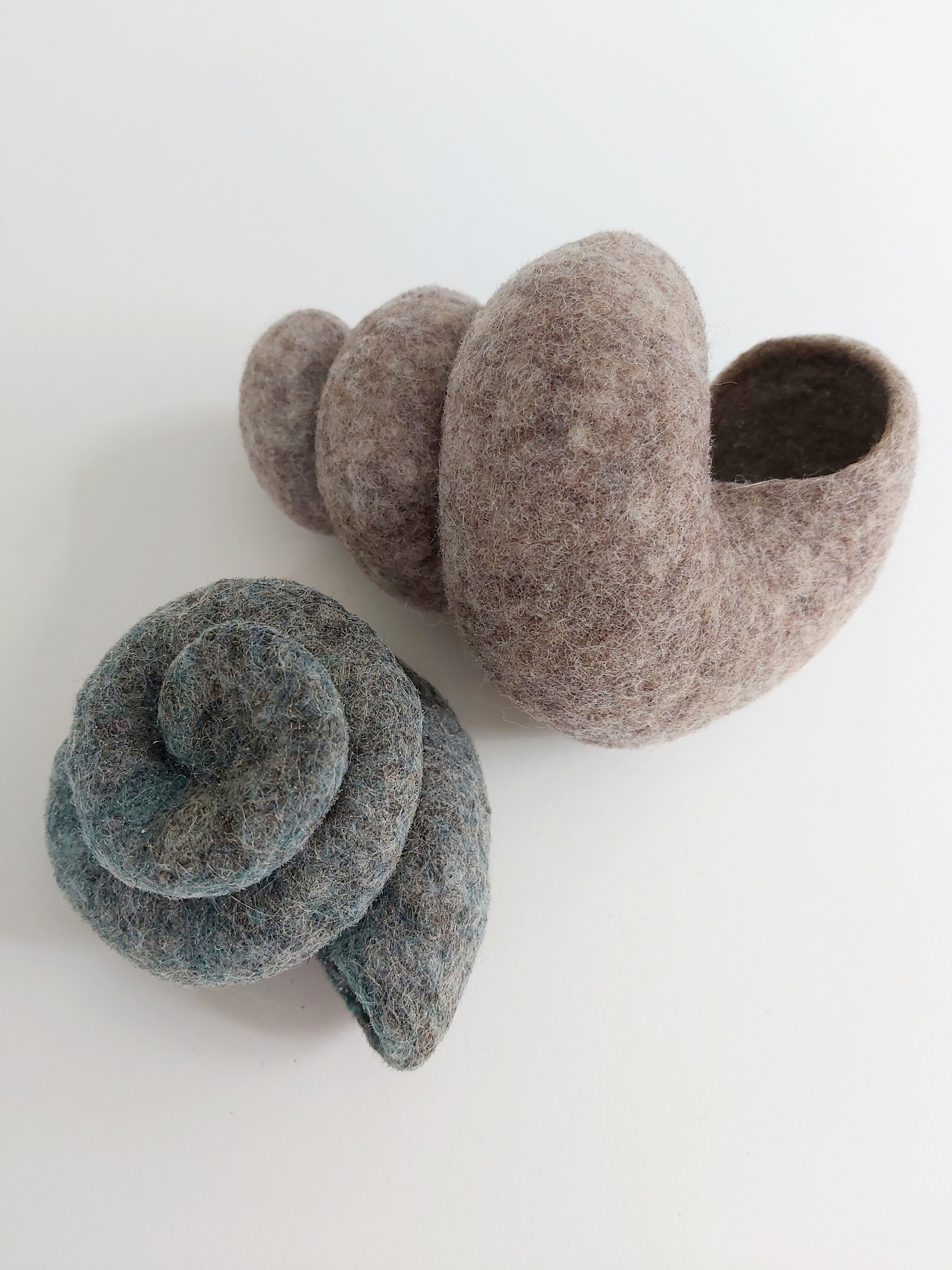
Wet felted spiral shells crop up a lot online and I’d been wracking my brain for ages trying to work out how these are made. I had a light bulb moment back in December when I made this small spiral shell from 10gm of carded Corriedale. Since then I’ve worked out another way of achieving a similar shape and so made this larger version using 20gm of carded Corriedale fibre and measuring approx 13cm x 9cm.

Photo shows two wet felted spiral shells, the larger one is beige, the smaller one is grey.

At one point the shell was sitting next to this bowl and I wondered how the centre piece from the bowl would look inserted in the shell…..

Photo of a wet felted bowl made with blue and turquoise Bergschaf fibres. Felted cords radiate out from the centre of the bowl creating height and interest.

…..I quite liked it so I’m now wondering whether to leave it in there as an abstract hermit crab or make the effort to felt a more realistic looking crab, what do you think?

Beige coloured wet felted spiral shell. Lilac and pale green felt cords protrude from its opening suggesting an abstract life form.
Photo of a beige coloured Wet felted spiral shell with abstract hermit crab poking out of it.

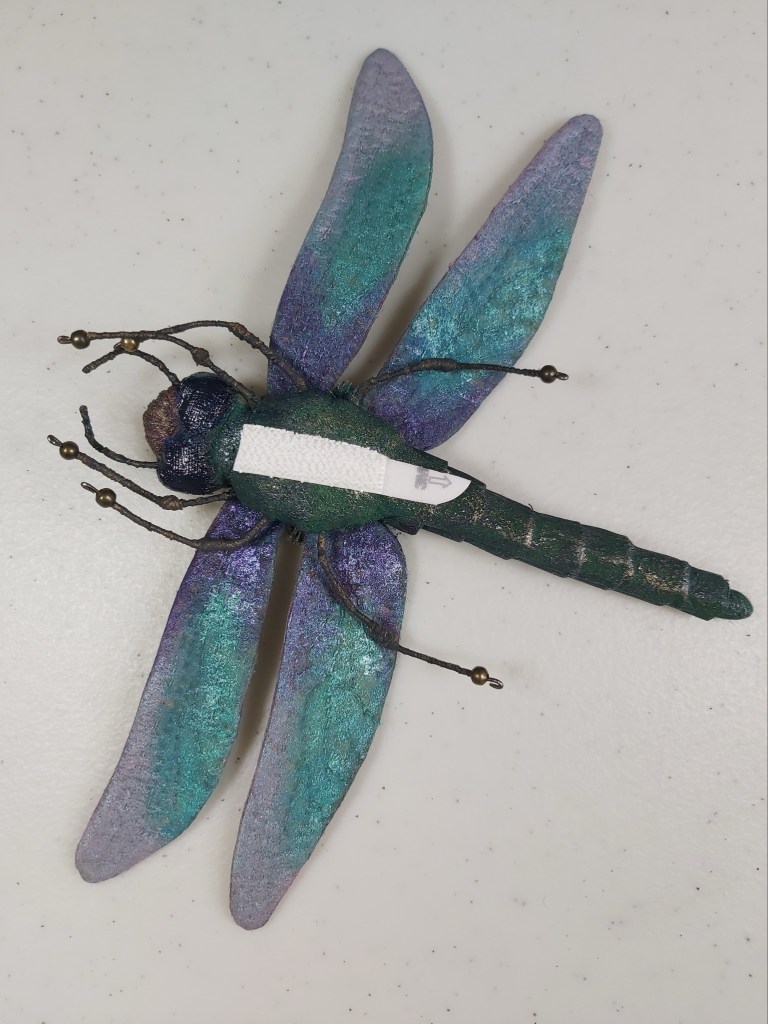
Another theme I’m working on right now is insects, particularly dragonflies and butterflies. It all stemmed from a tutorial by textile artist Anastasiya Goleneva to make this beautiful dragonfly brooch. It’s made from hand and machine stitched and painted calico. At 16cm long x 21cm wide it worked out a bit too big for me to wear as a brooch so instead I’ve put a Command strip on the back and mounted it to the wall.

Having enjoyed making it I decided to do another but using interfacing and my own technique for the body and legs that would allow it to stand and give it a more delicate, longer, slimmer look. One thing I’m not happy with is the “flat” face which suited the brooch but doesn’t look right on the standing dragonfly so version three is underway!
Photo of a 3D dragonfly made from machine stitched fabric and hand painted. It’s standing on an outside table with greenery in the background.
Photo of a 3D dragonfly created from machine stitched fabric. It’s painted in metallic colours of mainly green, pink and blue.

The dragonflies led to my friend Diane asking me to show her how to make a simple butterfly brooch so I made a couple of samples with body and wings made from painted cotton velvet. This fabric takes on a beautiful leather like look and feel when painted with fabric paints or acrylics and remains very soft and flexible. I was thinking of hand embroidering the wings but decided to keep it basic as Diane could add more detail if she wanted to.

Continue reading

Autumn School & the BTS…..

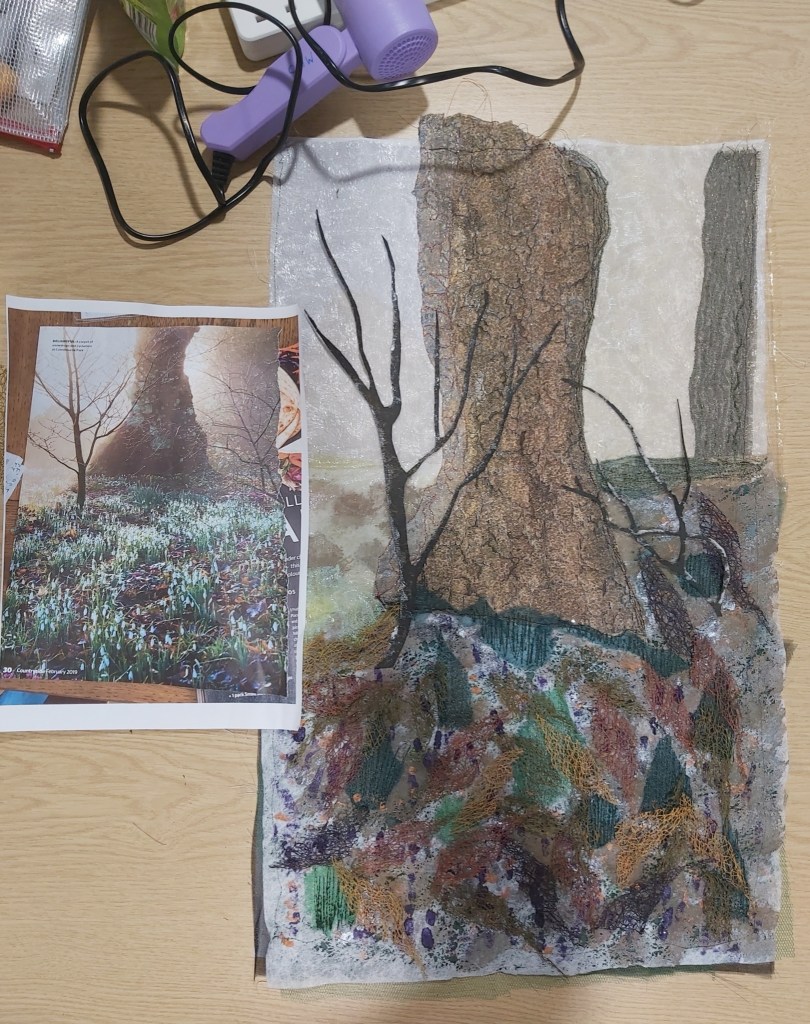
Two weeks ago I was at the Old Barn Hotel, Grantham as guest tutor for the Lincolnshire Textiles Autumn School. The group had invited me to teach my Tall Trees mixed media workshop for fifteen students.

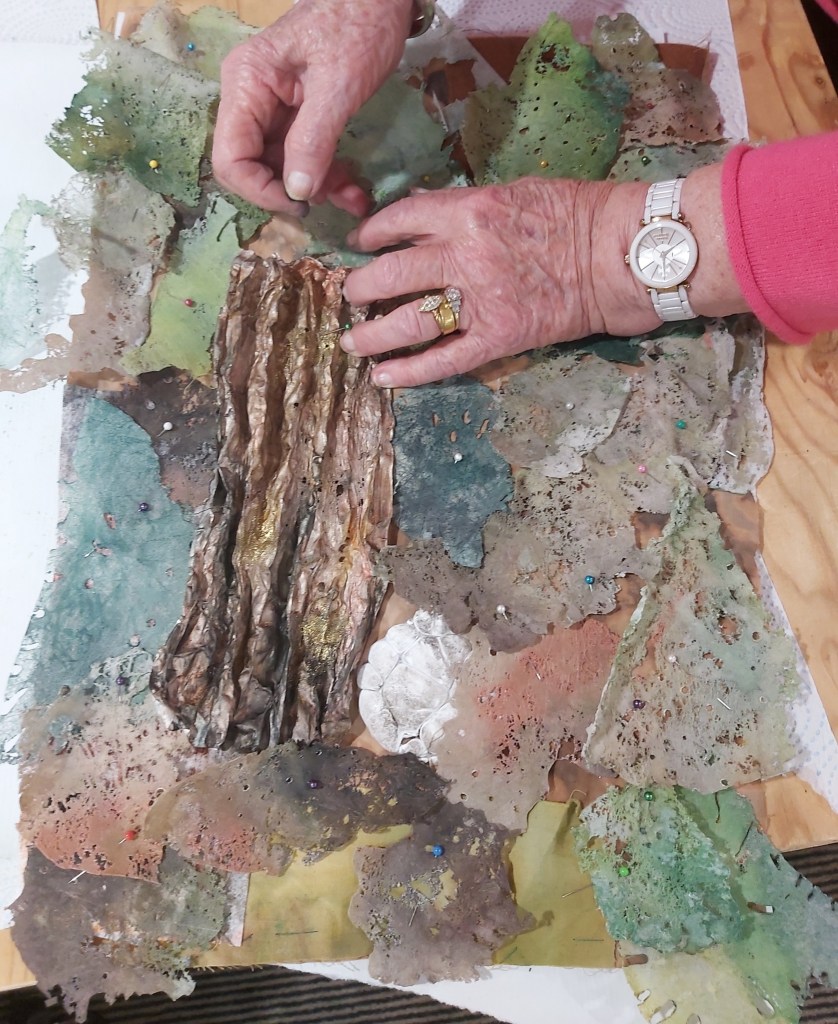
Our class began on the Friday evening after checking in and enjoying a delicious three course meal. The ladies had been asked to bring a photo, sketch or idea for the piece of work they would be making based on a tree/forest theme. I talked through the various materials I like to work with including Lutradur, Tyvek, wallpaper, organza and interfacing. The group were shown examples of how I’ve used these materials in my work and also how previous students have interpreted this workshop.

During the course of the evening ideas were explored, designs drawn up and our base fabrics painted.

The next morning, as soon as breakfast was over, the group were back to work— painting, auditioning different fabrics and papers, machine and hand stitching and burning. I had a terrific group of highly motivated ladies to work with and it was wonderful how they embraced using materials and methods they wouldn’t normally have used. Some of the more traditional members of the group admitted to feeling a little out of their comfort zone at the start but a bit of gentle coaxing and encouragement “to play” seemed to do the job and very soon all appeared to be having fun!

The group coordinator, Janet Taylor, did a great job of organising the weekend and was very kind when she said “Karen did a wonderful job of motivating everyone and worked hard all weekend. We learned so much, and the group was supportive and helpful throughout. It was such a treat to focus entirely on stitching and creativity, without the usual distractions. The weekend was intense but immensely rewarding, made even better by the company of friendly, like- minded people.”

The weekend flew by and although there was still work to done when these photos were taken you can see how good the pieces are looking! The group has its next meeting on Saturday and I’m looking forward to seeing many of these finished.

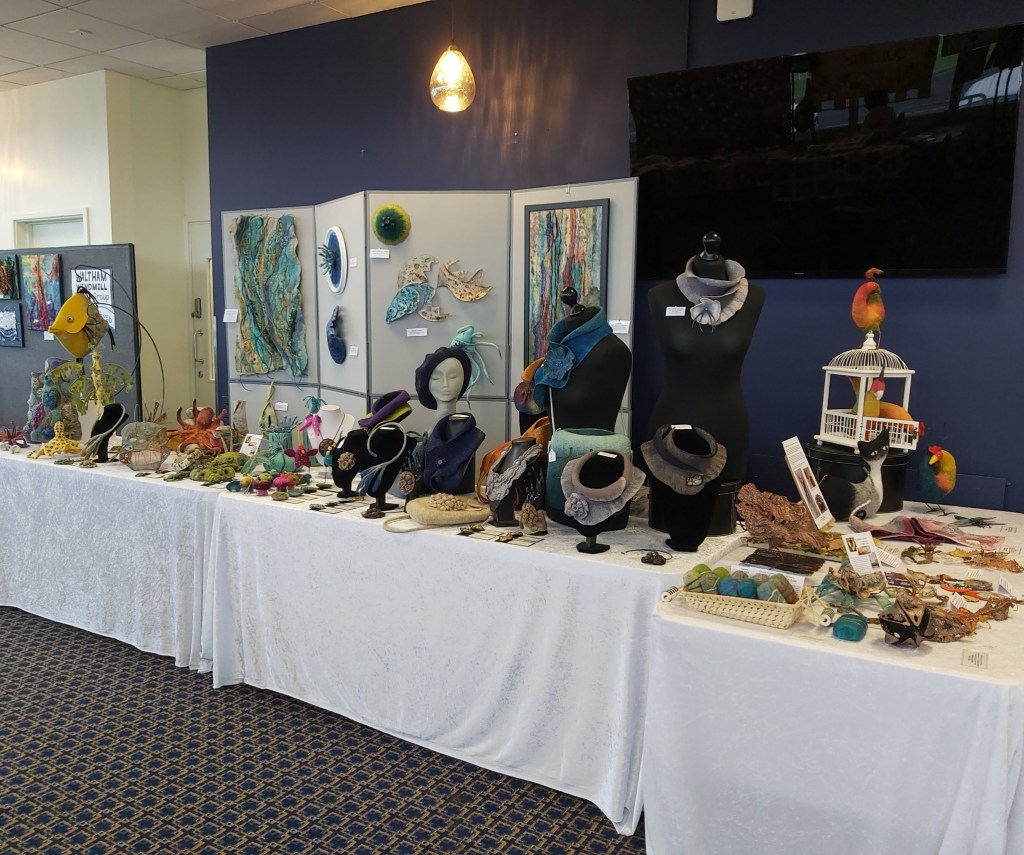
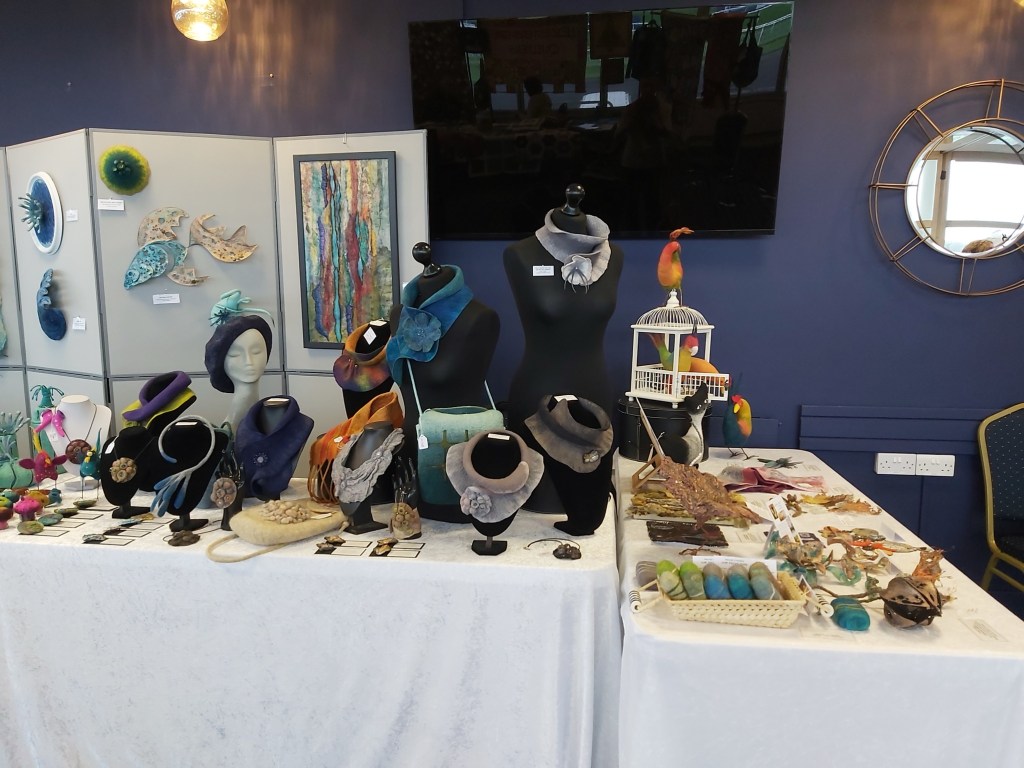
Another recent event was the 2024 Big Textile Show at Leicester Racecourse last weekend. The BTS is always a great show and this year was no exception.

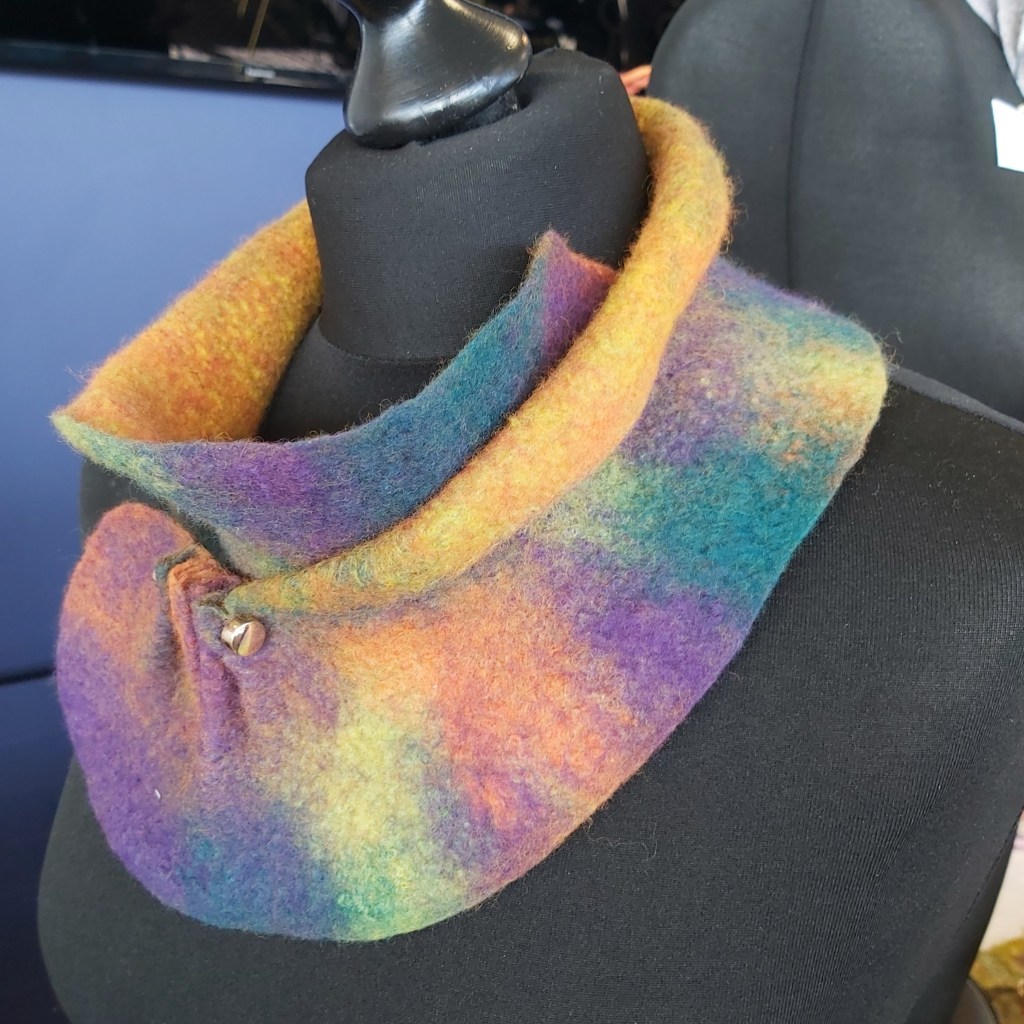
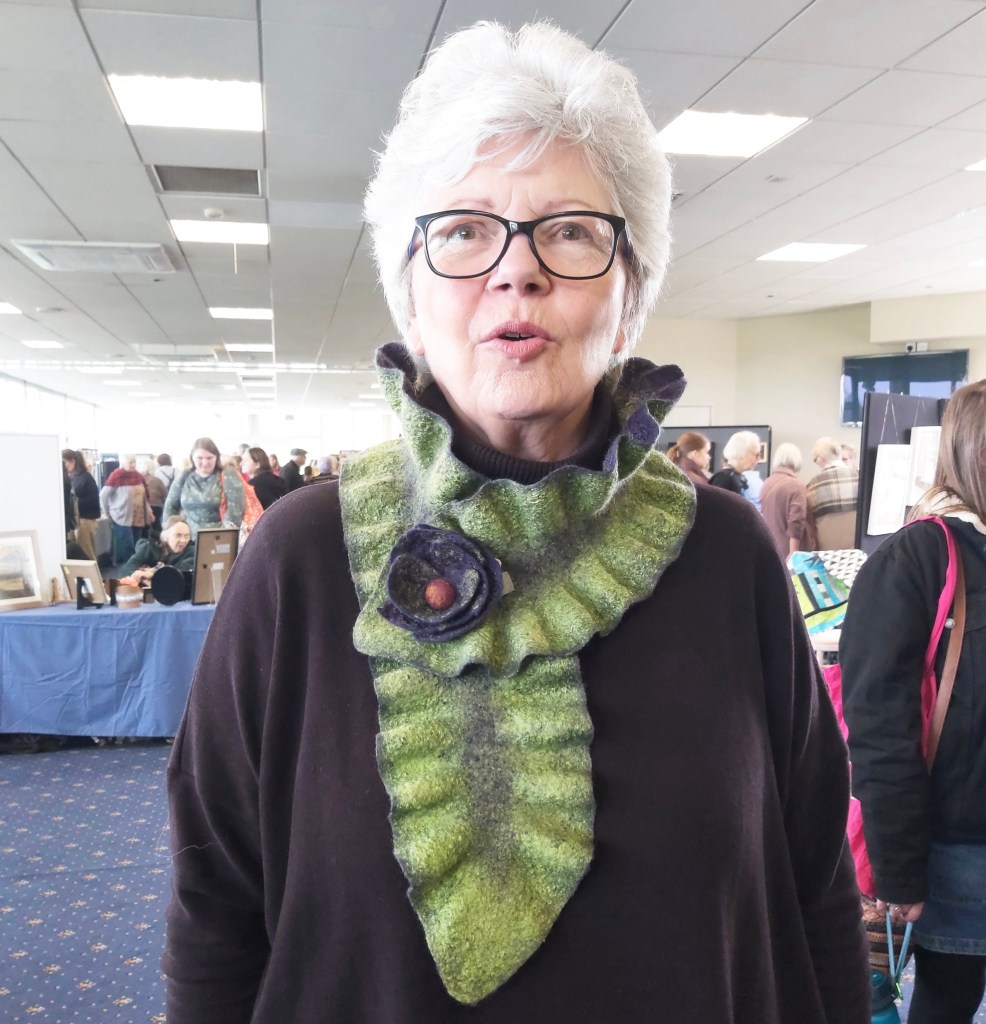
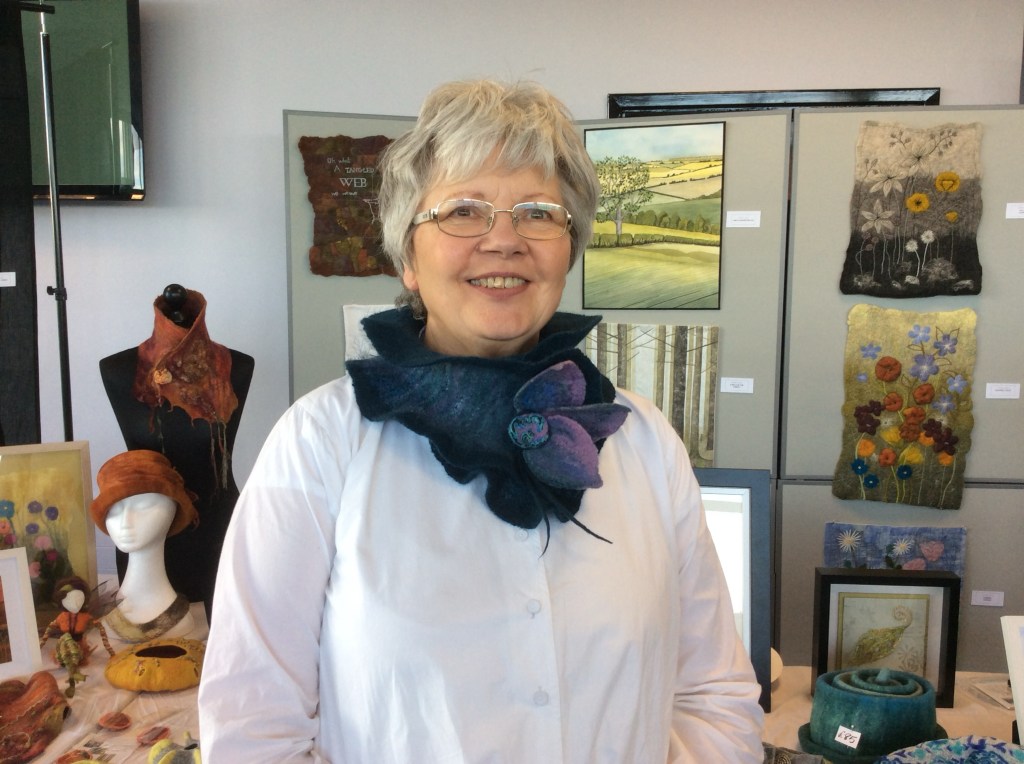
My first customer was the lovely Kate from the Lutterworth Stitchers who purchased my multicoloured Collar. Kates a regular visitor to my stall and looks terrific in whatever she chooses to wear as you can see by these images from previous years!

I took a few other new Collars with me including these two in blue and one in dark grey/neutral tones.

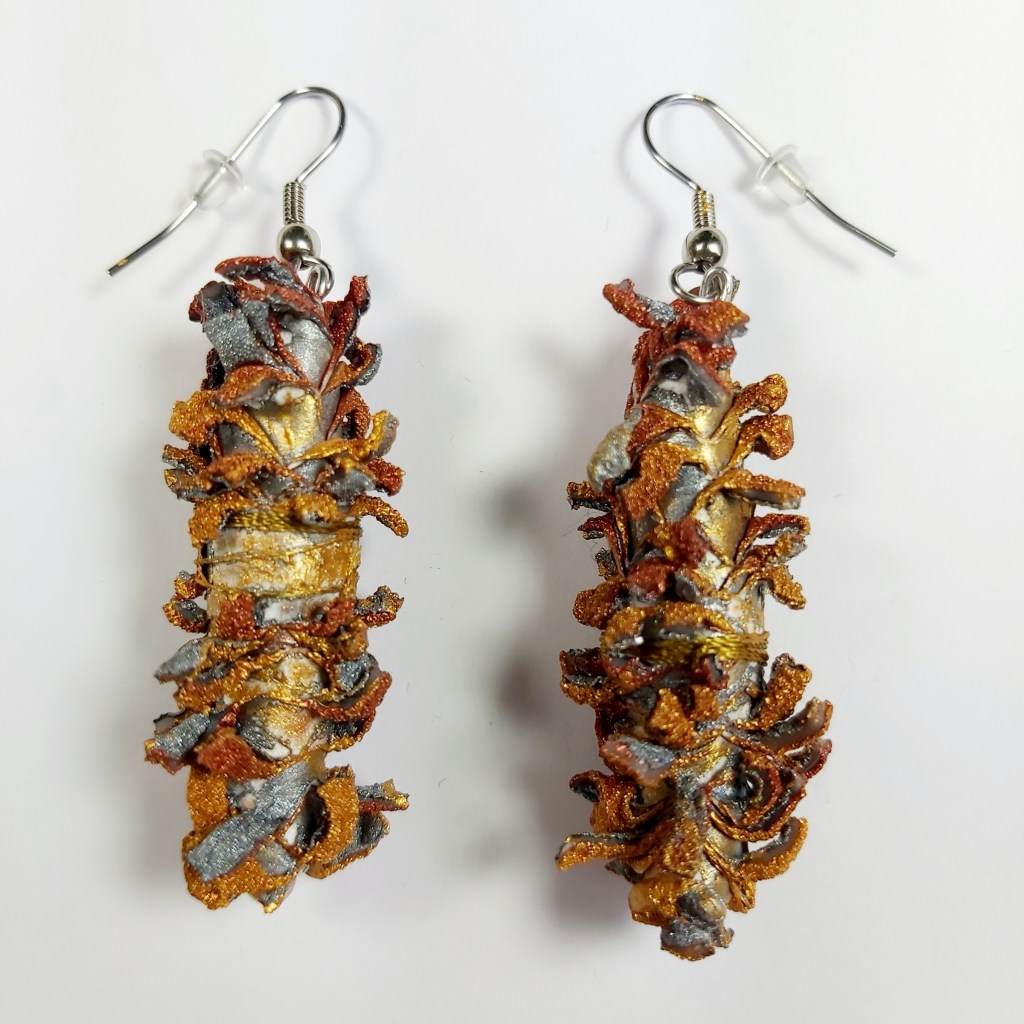
My latest distraction is Tyvek Earrings! A few weeks ago I ran a Tyvek workshop for the Louth Textile group and created a pair of earrings as one of my workshop samples. They proved popular with the group so I made several more pairs for the show. Unfortunately I forgot to photograph them all before the opening but these are what came home with me and are now in my SHOP. I’ve never been a fan of smooth Tyvek beads but I love them with the added textures. It’s quite a challenge making these and absolutely impossible to get an exact match but I quite like that as it adds to their uniqueness!

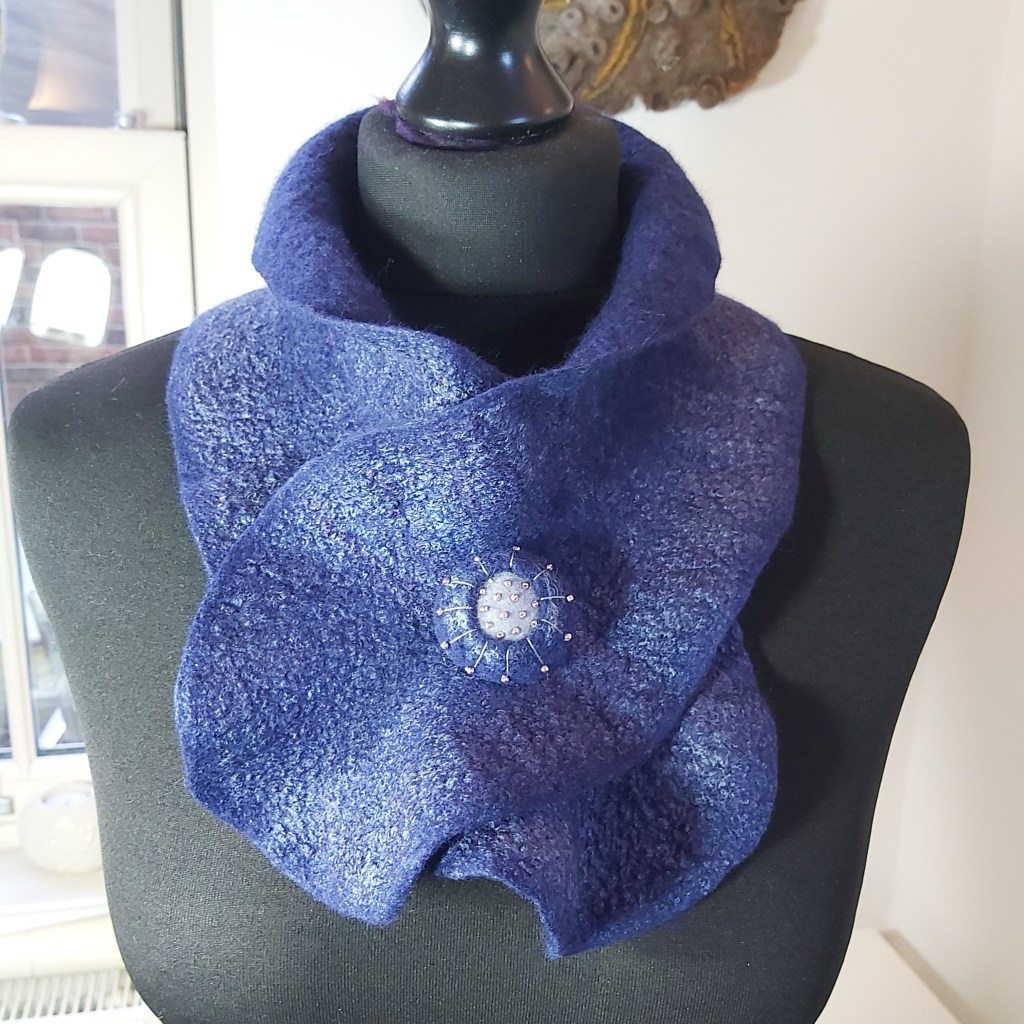
I also made a new batch of gold and silver Tyvek Brooches. I like to mix textures and so these often feature on my felted scarves and collars. These three came home with me so are also in my SHOP along with some new wet felted Brooches.

A few days before the show I started to rework a piece I’ve had hanging in my hallway for several years. It’s been hanging on display behind glass, I don’t know why I originally did that as I’ve always preferred to see textile pieces unglazed. Anyway I recently removed the glass which instantly improved the look but then decided to give it a revamp with added textures, more FM stitch and stronger colours. I’m thinking peeling paint on rusty metal and I’m liking where it’s going but it’s not finished yet so I had it displayed on my stand as “work in progress”!

I’ve detailed a few more events that have happened over the past few months over on the Felting and Fibre Studio which can be found here.

With only three more workshops before Christmas things are starting to quieten down so time to think about new projects and ideas for 2025.

Gone Fishing…..

In a previous post I showed a wire work Angler Fish made using galvanised wire, aluminium wire, beading wire and sinamay, for Waltham Textiles forthcoming exhibition. My original plan had been to cover the wire frame with painted Tyvek fabric before distressing with a heat tool….somehow I got carried away with making the framework and didn’t get to add the Tyvek fabric at the point I’d intended and the fish was put to one side looking like this…..

Feeling this project wasn’t really finished, last week I decided to bite the bullet and go back to my original idea of adding the Tyvek fabric, although at this stage it was going to be particularly fiddly! Now I can call it done and I’m really glad I took the time to do it, the result is far closer to how I originally envisaged my fish looking.
Painted with Dylon fabric paint and acrylic ink she stands approx 31cm tall x 62cm long x 36cm wide.

There are over 300 species of anglerfish living at various ocean depths. All anglerfish are carnivorous and therefore adapted for the capture of prey. Deep-sea species have large heads that bear enormous, crescent-shaped mouths full of long, fang-like teeth angled inward for efficient prey-grabbing. Most adult females of the suborder Ceratioidei have a luminescent organ called the esca at the tip of a modified dorsal ray (the illicium or fishing rod). This organ serves the purpose of luring prey in dark, deep-sea environments, but also serves to call males’ attention to the females to facilitate mating. Who knows what this girls gone fishing for!

Something Fishy

This time last year I became a member of Lincolnshire Textiles, an exhibiting, mixed media group who meet monthly at Cherry Willingham near Lincoln. I became aware of the group after being invited as a guest speaker to talk about my work and this was followed by a visit to their last group exhibition, Sapphire & Steel, which was held in Lincoln Cathedral. As well as members exhibiting their individual pieces, central to the displays is always a group piece and this creates a striking focal point as you enter the Chapter House as you can see from this photo taken of their last exhibition.

This year the main theme of our exhibition is “Water” and the group piece will represent a whirlpool with 30(ish) members having contributed a section each. Along with a template we were each given a colour swatch and asked to work in shades of that colour without going too dark or light either way. This was my template for shape which is approx 60cm x 15cm at its widest parts, and the little colour swatch of thread.

My first thought was to fill the shape with swirls or crashing waves……

But then I remembered seeing some of the pieces that had been submitted at previous meetings and two or three other members had already worked on that type of design, so I decided to rethink.

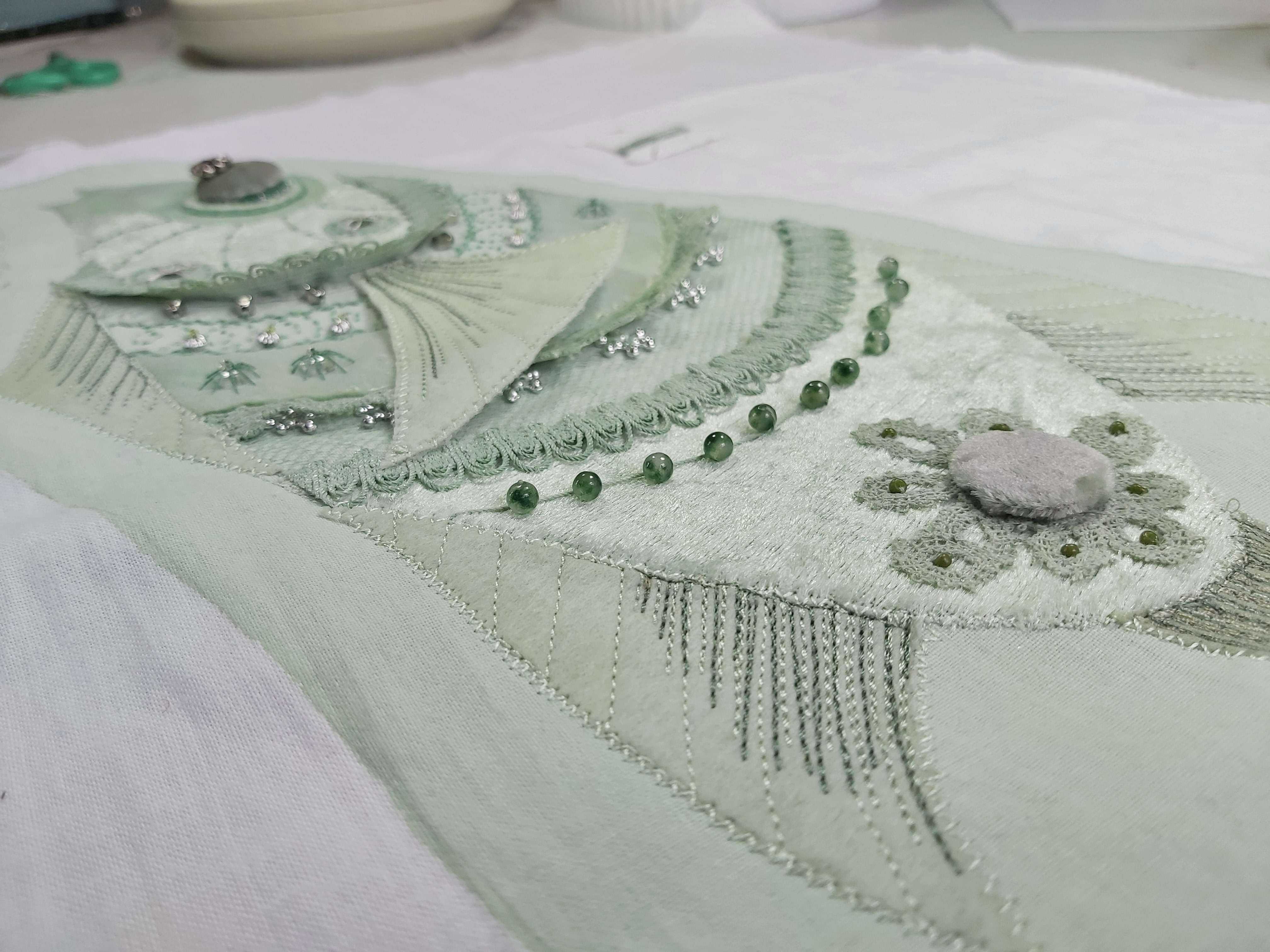
The other thing that came to mind was that my section might lend itself to being the shape of a fish so that’s what I decided on…..

The next step was to gather various threads that looked like they might be suitable and then look for different textured fabrics which I could colour. As we were asked to work in monotone it would be important to use as many textures as possible so I pulled out cotton, velour, interfacing, tulle, Lutradur, Evolon, gauze, elastic and crepe bandage.

I mixed up a shade of green that was as near as possible to the swatch and applied it to the fabrics in varying strengths. This gave me a nice variety of shades and texture to work with.

This is my finished fish with the addition of beads which I’m hoping will catch the light and add interest. I’m looking forward to seeing the finished piece but certainly don’t envy Hilary who now has the job of joining all of our segments together and making them fit!!

Making Waves I…..

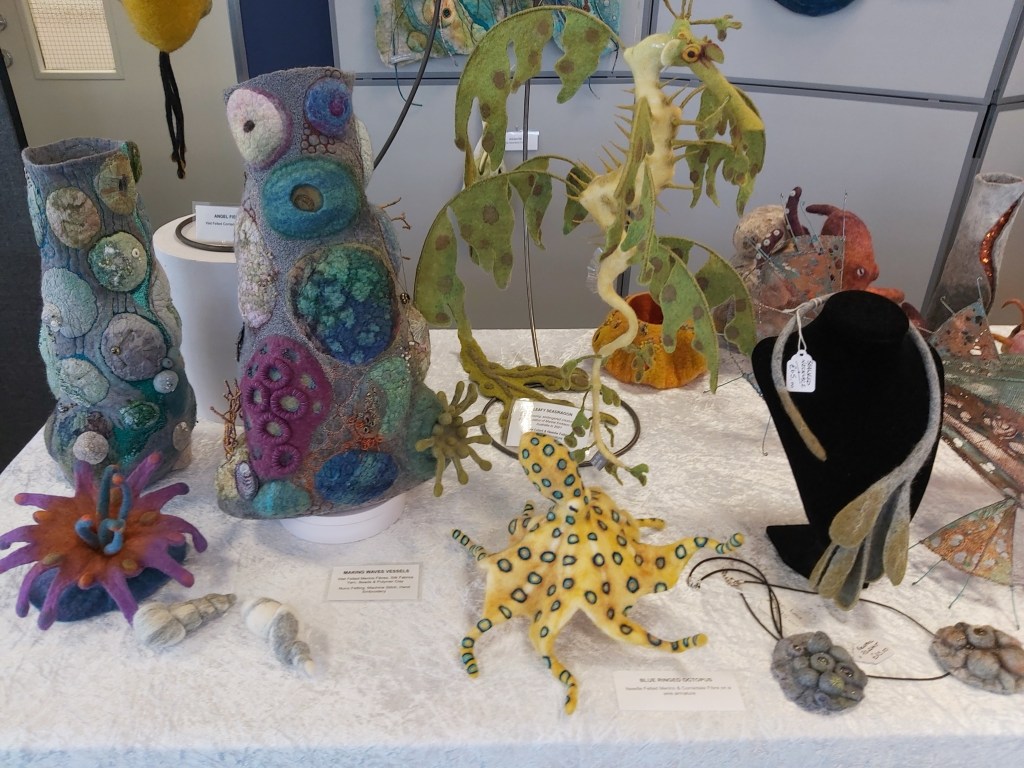
The Waltham Windmill textile group, of which I’m a member, have a theme which runs for two years culminating in an exhibition of work. The current theme is Making Waves and the exhibition for this one will be held sometime in the first half of 2024.

Within the groups theme we have free rein to make whatever we want plus we’ve agreed a number of specific items we will each make. One of the items is a jelly fish. Having done a bit of research into the many and varied species of jelly fish I came across the spotted Blue Jellyfish which is native to UK waters. My first thought was to create a “wet look” using Merino fibre covered with lots of viscose which would create a sheen and then I would free motion stitch the spots. That was quickly replaced with the idea of making my jellyfish from sheer fabrics…..I seem to have accumulated lots of sheers and only ever use tiny amounts so this would be a perfect opportunity to use up some of my stash. After rummaging through a huge sack of fabrics, almost losing hope of ever finding the colour I needed, I came across a small piece of blue and another of turquoise, just enough to do the job…..so much for stash busting!!

Blue Jellyfish (Cyanea lamarkii), feeding on small plankton, England – source www.wildlifetrusts.org

The remnants of fabric, and the size of my embroidery hoop, determined the size of my jelly fish. I’d got some of the wash away stabiliser left over from a project I did a few years ago so that would be useful for stiffening and shaping the jelly fish.

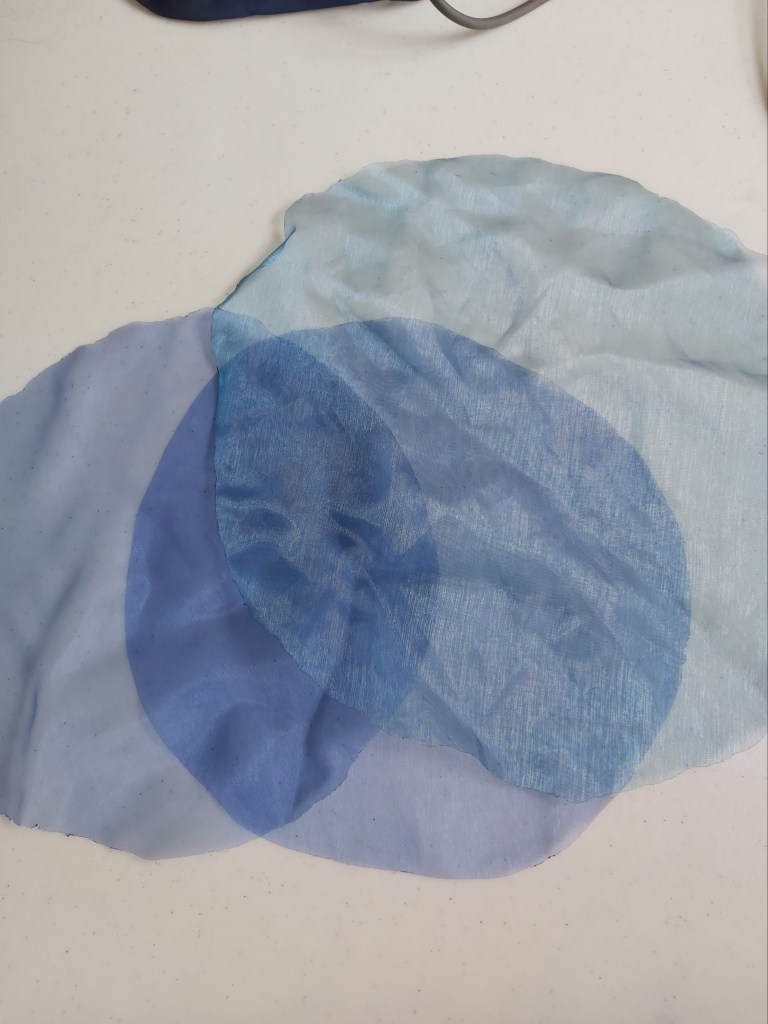
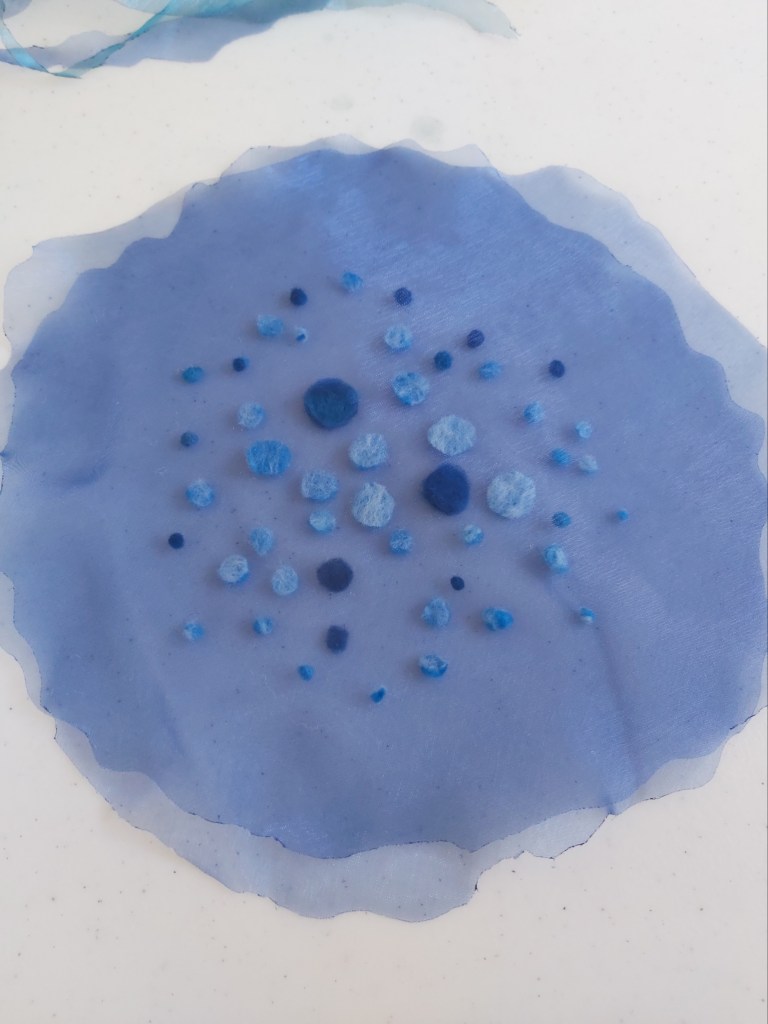
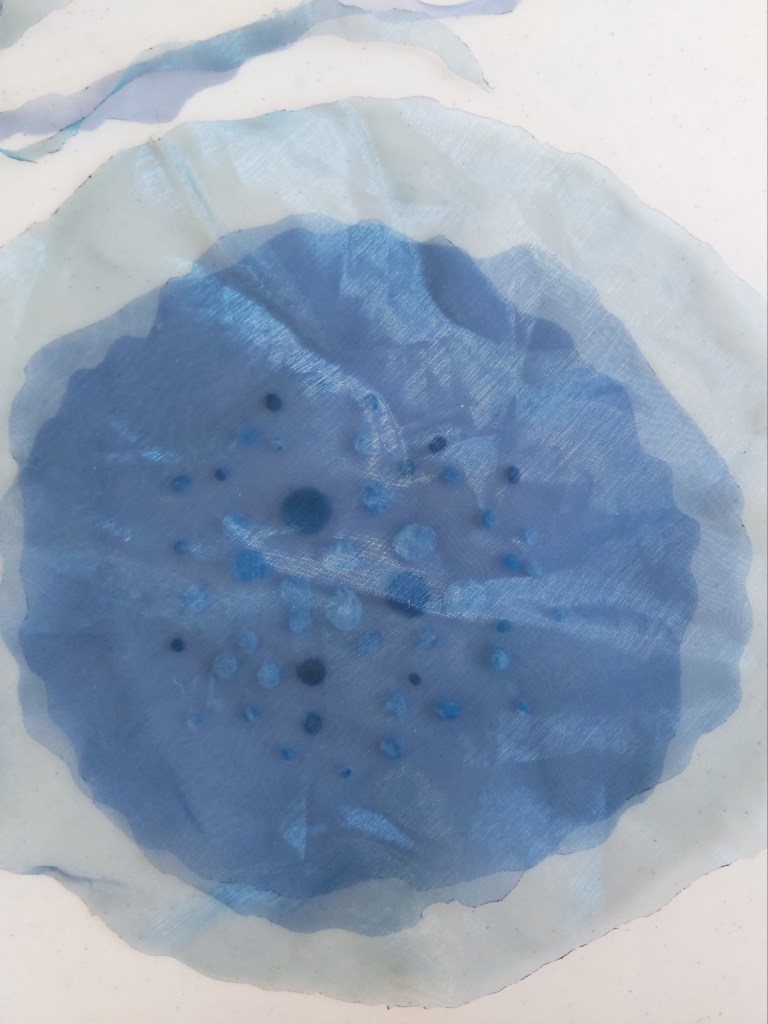
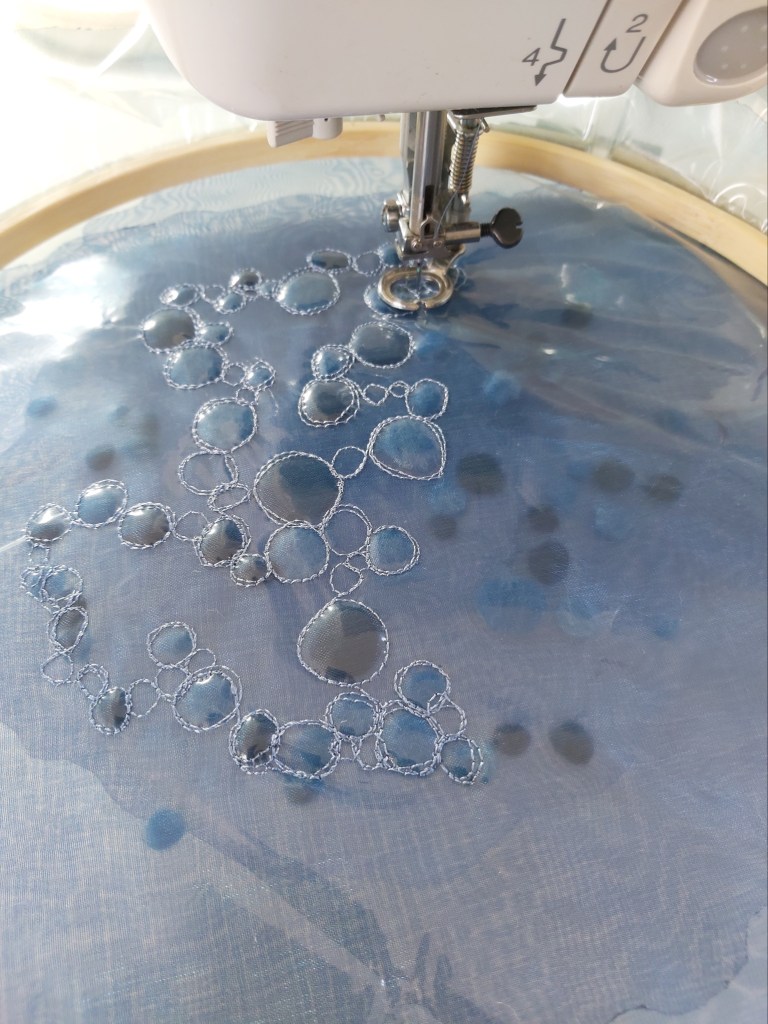
I had enough blue fabric to cut out two circles plus one slightly larger from the turquoise. I also added a small white circle of fabric underneath thinking it would highlight the spotty area. Next I cut up some scraps of felt for the spots and arranged them on the blue discs before covering with the turquoise sheer. This sandwich was then put in the hoop and I machine stitched around the spots…..or at least that was my intention! Unfortunately I struggled to see where some of the felt was so it’s a bit hit and miss but it was near enough!

After removing it from the hoop I washed out some of the stabiliser retaining a good bit of the glue on the fabric to enable me to shape it over a plastic bowl. I didn’t think to photograph the drying stage so the next image shows it dry with the unattached tentacles cut from tulle and sheers.

The final step was to wet felt a blue “inner”, with additional thin felt tentacles, sew the fabric tentacles inside it and insert into its casing.

The finished spotted blue jelly fish.

I’m quite pleased with the finished result and this particular area of the exhibition should be interesting as we’ve used lots of different styles and techniques between us.

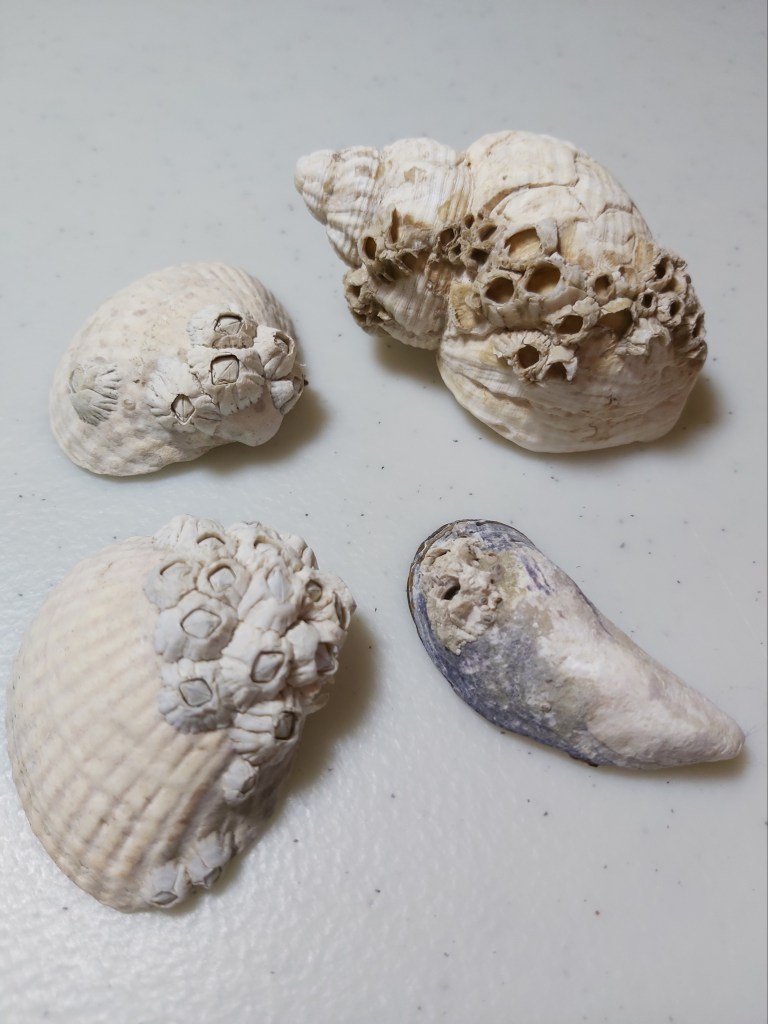
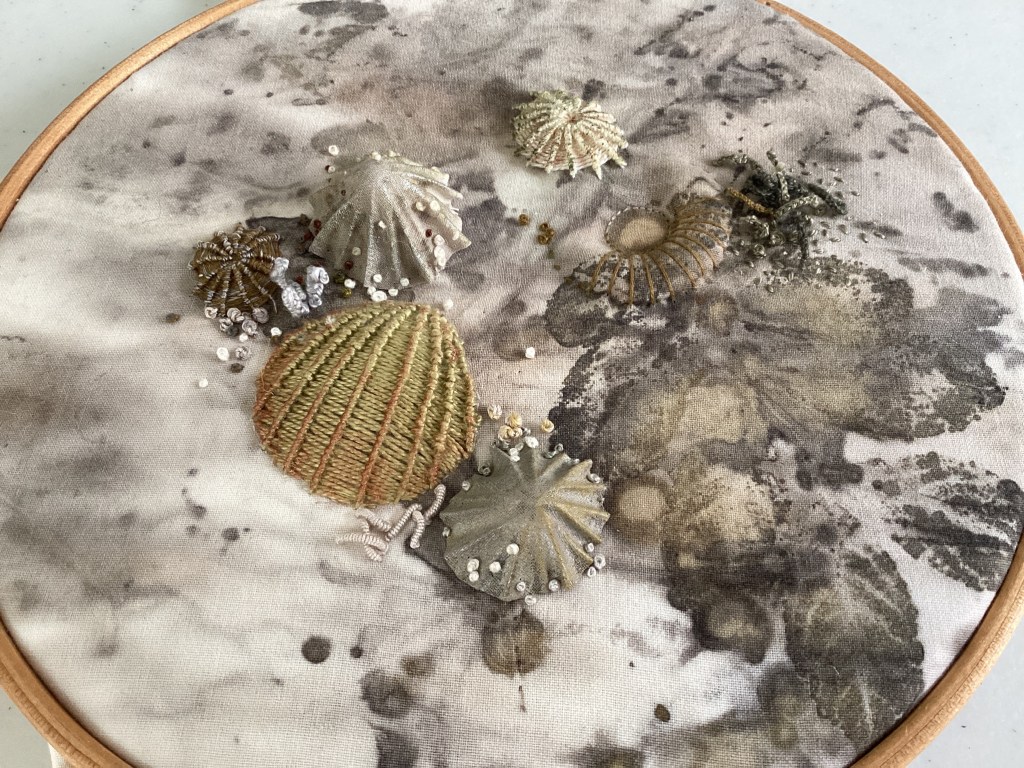
Another idea I’ve been playing with is barnacles. I’ve always had a fascination for barnacles and can’t resist collecting them when I find them on stones and shells. These marine crustaceans are related to the crab and lobster and tend to live in shallow and tidal waters, typically in erosive settings.

There are around 1,000 different species and, as adults, typical barnacles are covered with calcareous plates and are cemented, head down, to rocks, shells, pilings, ships’ hulls, driftwood, or seaweed, or to the bodies of larger sea creatures, from clams to whales.

They feed by reaching into the water column with eight pairs of thoracic limbs called cirri which are long and feathery. The cirri extend to filter food, such as plankton, from the water and move it towards the mouth as you can see in this video. (Follow the link and scroll down to Ecology)

Barnacles on rusty metal

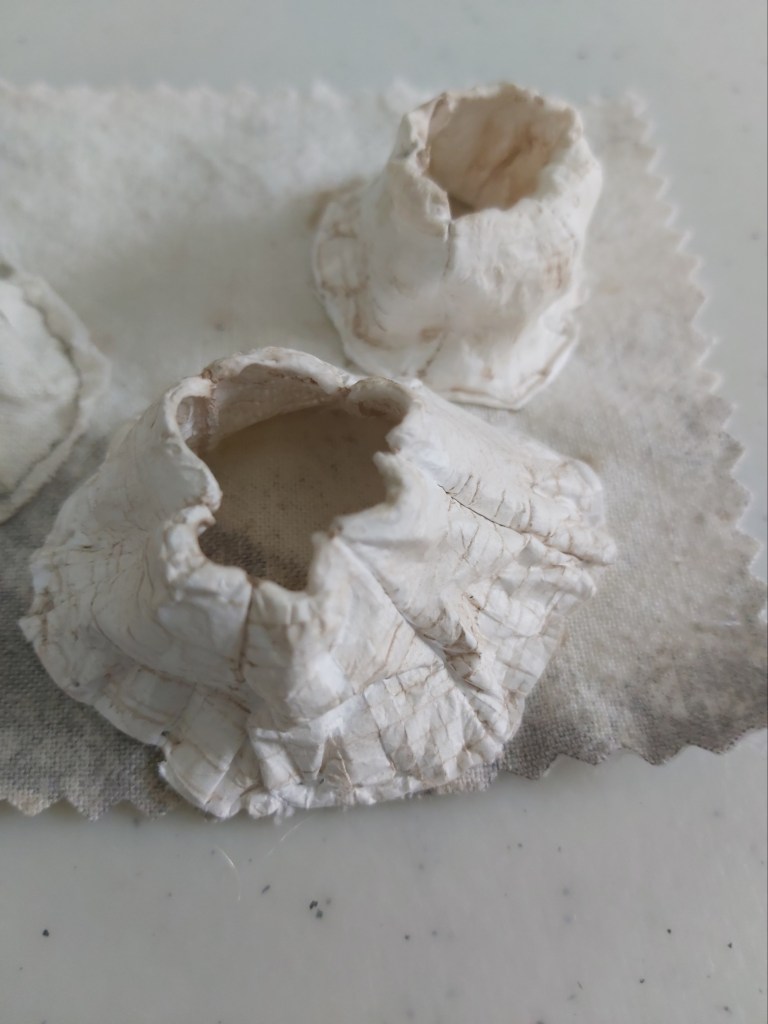
I’ve always liked this photo of barnacles on a rusty piece of metal which was taken on a visit to Ullapool harbour so I’m experimenting with different fabrics, including cotton and Tyvek, to make a barnacle inspired wall hanging. So far I’m leaning towards the Tyvek fabric.

Tyvek fabric barnacles

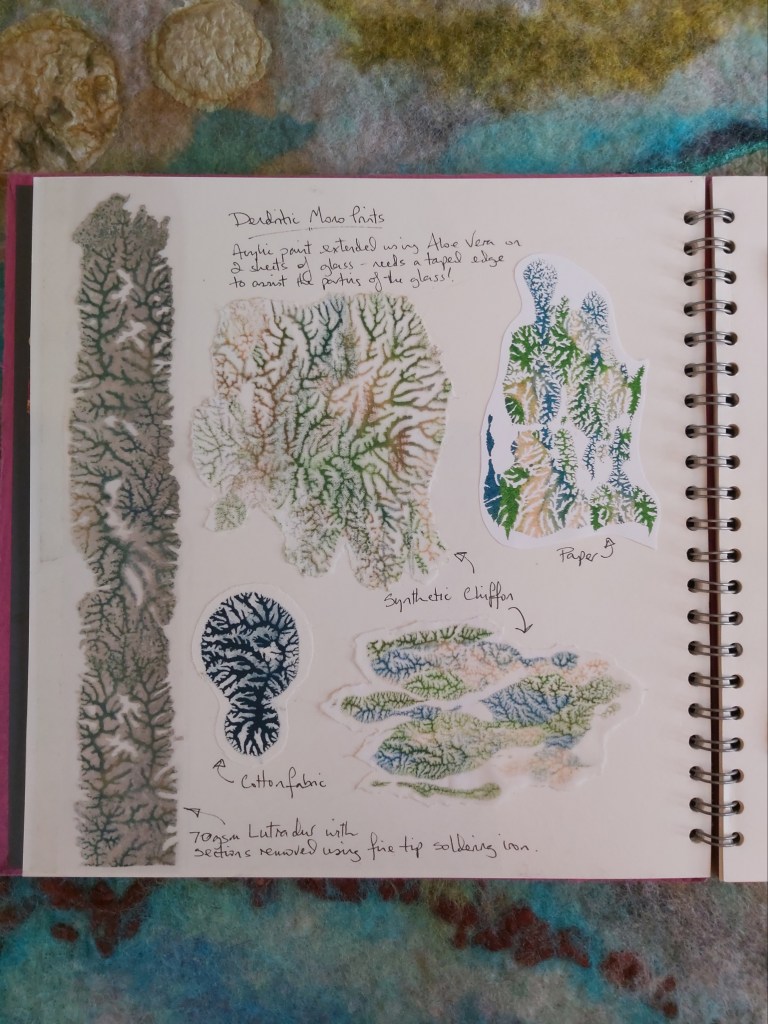
Something else I think will lend itself to the theme is dendritic printing. I love the vein like patterns, very reminiscent of coral, which can be created by pressing acrylic paint between two sheets of glass or plastic and then printing with it. I’ve been trying this out on different surfaces including paper, Lutradur, chiffon and cotton.

The most surprising result was a the print on felt, I was amazed at the clarity of it and I can see this being developed further with added stitching.

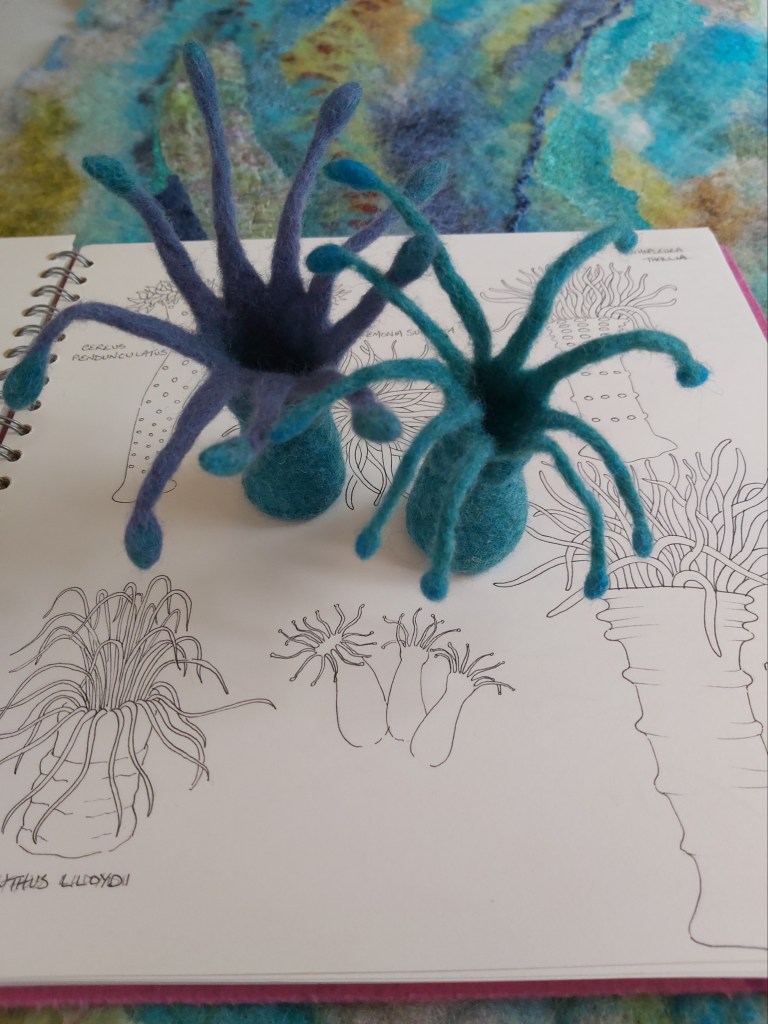
Working on ideas for felted sea anemones

There are so many possibilities within this theme that my mind is working overtime and I’ve a few other projects on the go right now. One of them is this small 20cm dia embroidery being worked on an eco print cotton fabric.


Another is a wallhanging approximately 95cm x 45cm. It started out as a wet felted background made from various remnants of fibre which I ran through the drum carder. It’s had a lot of embellishment since this picture was taken, incorporating machine stitch, hand stitch, cord making, recycled coffee capsules, burnt sheer fabrics and hand painted silk fabrics. It’s almost finished now so I will feature that in my next post.